
What Does AI Video Production ROI Actually Mean?
AI video production ROI means the business value created from video compared with the total cost, time, and effort spent producing it.
The uncomfortable truth is that cheaper video is not automatically better video. A low cost AI video can still have poor ROI if sales never uses it, campaigns do not improve, or buyers do not take the next step.
A strong AI video production ROI can come from lower production cost, faster turnaround, more usable assets, better campaign testing, higher landing page engagement, more demo clicks, stronger onboarding, or reduced support load.
Wyzowl’s 2026 survey reports that 85% of video marketers say video helped them generate leads, 83% say it directly increased sales, and 57% say it helped reduce support queries [Wyzowl, 2026]. This is useful directional evidence, but it is self reported survey data, not audited revenue attribution. (Wyzowl)
Motionvillee is an AI video production company for SaaS, tech, cybersecurity, fintech, and finance brands that need video to support measurable business outcomes, not just content volume. For a deeper results benchmark, read AI video production ROI study
Why AI Video ROI Is Different From Normal Video ROI
AI video ROI has two sides: production efficiency and business performance.
Traditional video ROI often focuses on campaign results. AI video ROI should also measure whether the workflow helped your team create more usable assets, launch faster, test more variations, and reduce manual production effort.
IAB reported that nearly 90% of advertisers were using or planning to use generative AI for video ads in 2025, and buyers projected generative AI creative could reach 40% of all ads by 2026 [IAB, 2025]. This shows why AI is becoming operational in video, but it does not prove every AI video improves ROI. (IAB)
The practical takeaway: AI creates ROI only when faster production leads to useful assets and stronger business movement.What Costs Should Be Included in AI Video ROI?
To measure ROI correctly, include the full cost of production, not only the AI tool subscription.
The full cost can include AI tools, strategy time, scriptwriting, story planning, editing, voiceover, captions, revisions, brand review, product accuracy review, exports, internal review time, and any agency or freelancer fees.
This matters because a video made with AI still has real costs if people spend time reviewing, fixing, and preparing it for business use. For cost planning, AI video production cost should be part of the ROI conversation.
This is a business accounting model, not a public benchmark. Many AI video projects are scoped privately, so exact cost comparisons should be built from your own project data.
What Returns Should Be Counted?
Returns should include direct revenue signals and indirect operating value.
Direct returns may include leads, demo requests, paid ad conversions, landing page conversion lift, sales qualified opportunities, or customer actions.
Indirect returns may include saved production hours, faster campaign launches, more content output, more sales follow up assets, reduced customer support questions, or higher reuse from existing webinars and demos.
Wistia’s 2026 State of Video Report surveyed 900 plus professionals and analyzed over 13 million videos and 79 million viewing hours [Wistia, 2026]. That makes it useful for a broad video performance context, although it does not isolate AI video marketing ROI by itself. (Wistia)
How to Calculate AI Video Production ROI
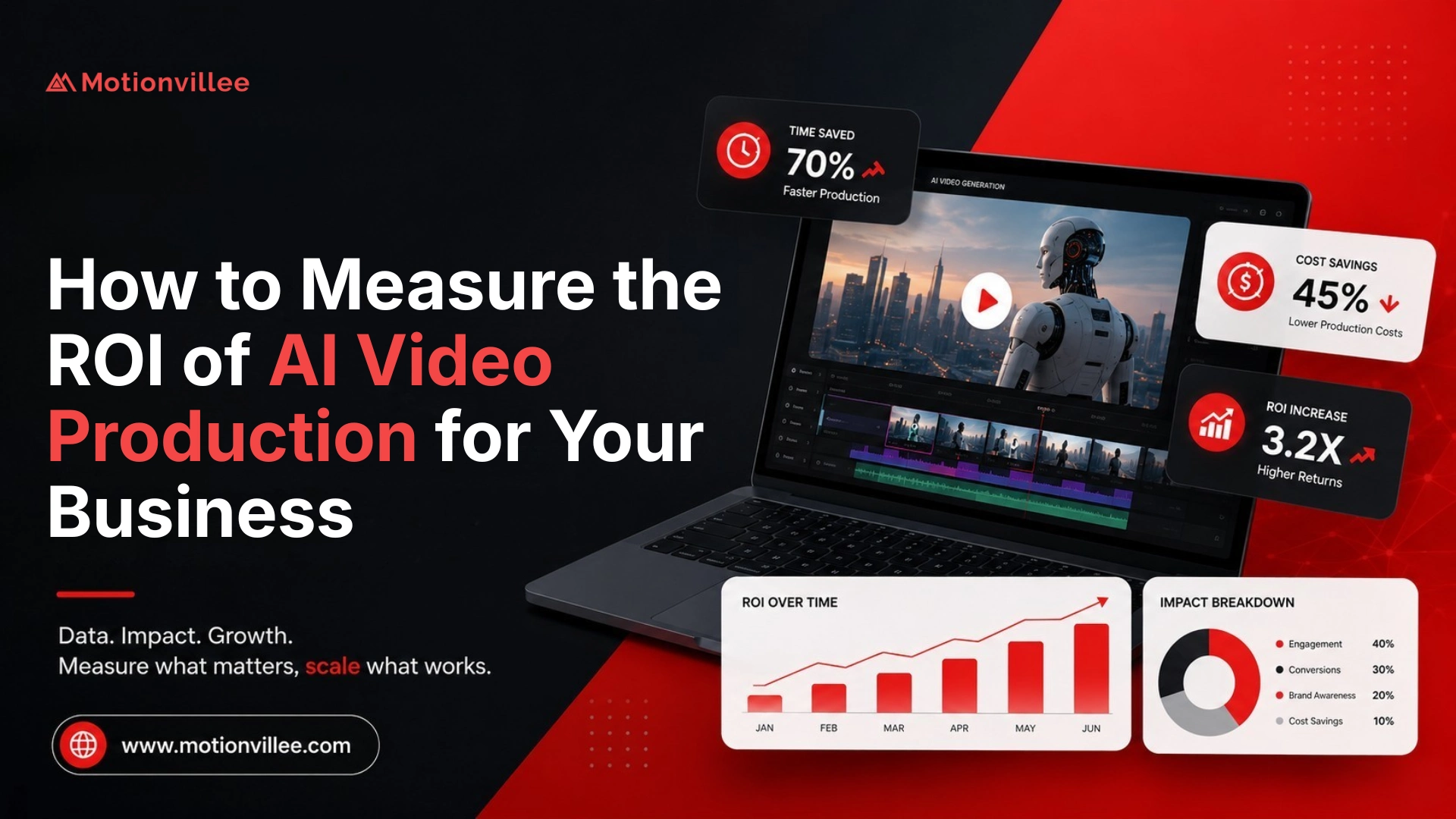
Use this simple model: value created minus total production cost, divided by total production cost.
In plain business terms, first add the real cost. Then estimate time saved, revenue impact, or operational value. Then compare the result with the cost of producing the assets.
| Step | What to do |
| Step 1 | Add the full production cost |
| Step 2 | Estimate time saved or revenue impact |
| Step 3 | Track campaign or funnel results |
| Step 4 | Compare results with production cost |
| Step 5 | Measure cost per usable asset, not only cost per video |
For example, if one AI assisted project creates one main video, five social clips, three ad versions, two sales follow up videos, and one landing page version, the better ROI view is not one video cost. It is cost per usable asset.
Metric 1: Production Time Saved
Production time saved is useful only when it helps the business move faster without lowering quality.
Track brief to first draft time, script development time, editing hours saved, captioning time saved, cutdown creation time, approval to delivery time, and campaign launch speed.
AI can improve speed, but speed alone is not ROI. A faster video that sales will not use or customers do not understand creates weak business value.
Metric 2: Cost Per Usable Asset
Cost per usable asset is usually more useful than cost per video.
A single AI video production project can create one main video, ad cuts, social clips, email versions, sales versions, captioned formats, and landing page edits.
| Project output | Traditional view | Better ROI view |
| One main video | One production cost | Main asset plus reusable versions |
| Five social clips | Extra editing cost | Lower cost per channel asset |
| Ad variations | Separate creative cost | Faster testing value |
| Sales cuts | Extra deliverables | More sales enablement value |
As an AI video production company, Motionvillee uses this asset value lens when helping B2B teams judge whether a project is creating campaign depth, not just a finished file.
Metric 3: Campaign Performance
Campaign performance shows whether AI produced videos are helping marketing outcomes.
Track paid ad CTR, landing page engagement, video completion rate, demo clicks, form fills, cost per lead, cost per demo, retargeting performance, email click rate, and social engagement from target buyers.
HubSpot’s 2026 State of Marketing report says measuring marketing ROI is the top challenge for marketers, cited by 33% of respondents [HubSpot, 2026]. This supports why teams need clearer measurement systems, though the report is not specific to AI video alone. (HubSpot Blog)
The key point: do not judge every AI video by views. A LinkedIn clip, landing page explainer, and sales follow up video should each have different success metrics.
Metric 4: Funnel Movement
A video creates ROI when it helps the buyer take the next step.
| Funnel stage | AI video use case | ROI metric |
| Awareness | Short educational clips | Reach from target audience, watch time |
| Problem aware | Pain point explainers | Engagement, site visits, content clicks |
| Solution aware | Explainers and comparisons | Demo clicks, time on page |
| Product aware | Product videos and sales clips | Sales usage, reply rate, opportunity influence |
| Customer stage | Onboarding and support videos | Activation, completion, fewer tickets |
This is where video marketing ROI becomes more precise. The metric should match the buyer stage.
Metric 5: Sales Team Usage
Sales usage is often missed, but it can be one of the strongest signals of business value.
If sales teams use AI produced videos in outreach, follow ups, demos, proposals, or objection handling, those assets can improve buyer clarity and reduce repeated explanations.
Track how many reps use the video, where they use it, email reply rate, prospect engagement, demo follow up clicks, opportunity influence, and questions reduced after sharing.
Vidyard’s 2025 benchmark report analyzed nearly 1 million B2B videos and frames video as a major part of modern business communication [Vidyard, 2025]. It is not an AI only benchmark, but it supports the role of video beyond top of funnel marketing. (Vidyard)
Metric 6: Customer Education and Support Impact
AI video production can create ROI after the sale too.
Training, onboarding, FAQ, and support videos can reduce repeated manual explanations. Track onboarding completion, feature adoption, training completion, support ticket reduction, customer education engagement, customer success time saved, and time to value.
This is especially relevant for SaaS and tech companies because customer education affects retention and expansion, not only acquisition.
Metric 7: Version Testing and Learning Speed
AI can improve ROI by increasing the speed of learning, not only the speed of production.
Teams can test different hooks, CTAs, audience angles, lengths, proof points, platform formats, and product benefits faster than they could with a single final video.
Track number of variants created, time to launch tests, winning hook, winning CTA, cost per tested variation, and performance improvement after testing.
For quality control, connect this to AI video production quality because more versions only help if the final assets are still accurate, branded, and useful.
What ROI Mistakes Should Businesses Avoid?
The biggest mistake is treating faster production as automatic ROI.
Avoid measuring only production cost, ignoring internal team time, counting every output as useful, measuring all videos by views, ignoring sales usage, missing repurposing value, forgetting onboarding impact, and publishing videos without a CTA.
How to Build a Simple AI Video ROI Dashboard
A useful dashboard should track production efficiency and business performance together.
Include production cost, internal time spent, time saved, number of final assets, cost per usable asset, channels used, campaign metrics, sales usage, customer education metrics, and revenue or opportunity influence.
This dashboard does not need to be complex. It needs to connect cost, usage, and outcomes.
How Should Businesses Measure AI Video Production ROI?
Businesses should measure AI video production ROI by asking two questions: did AI reduce production effort, and did the final videos support a real business outcome?
The best ROI comes when AI helps the business create useful video assets faster, reuse content across channels, test more messages, support sales, and educate customers.
So the better question is not only is AI video production worth it.
It is:
Did this AI video help us save time, improve clarity, and move the business forward?
Motionvillee brings 15+ years of production experience to AI video production, helping B2B brands measure video success by business use, buyer clarity, and pipeline impact.