
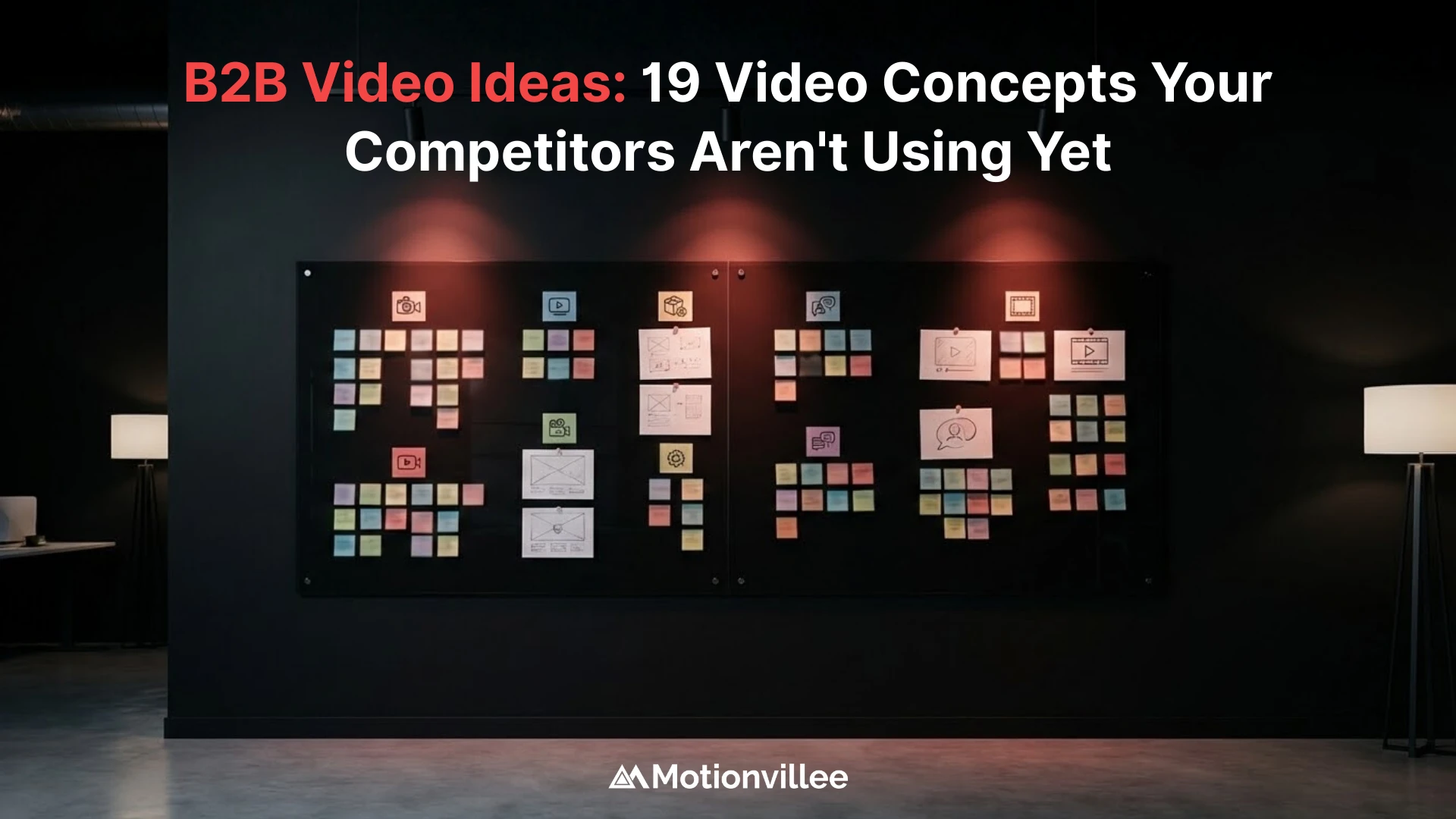
B2B Video Ideas: 19 Video Concepts Your Competitors Aren’t Using Yet
Most B2B companies recycle the same tired video formats: product demos, customer testimonials, and feature explainers. Meanwhile, the companies winning market attention are experimenting with unconventional formats that stand out. This guide reveals 19 original B2B video ideas that differentiate you from competitors still following the playbook.
The B2B Video Conformity Crisis
Most B2B videos fail to capture attention because they follow the same predictable format that every competitor uses, making audiences tune out before your message registers.
Walk through LinkedIn or industry websites and you see the pattern repeated endlessly. A smiling professional explains a problem. A product demo shows features. A customer gives generic praise. The format is so familiar that audiences ignore it.
This conformity creates a competitive disadvantage for everyone following it. Your video must break format expectations to stop the scroll and capture attention. If your video looks like every other B2B video, it gets treated like every other B2B video: dismissed without engagement.
Why Generic B2B Videos Fade Into Obscurity
Generic B2B videos fail because they blend into the endless stream of similar content, offering no reason for viewers to pay attention when they could be doing something else.
Attention is scarce. Your audience is overwhelmed with video content. They’re bombarded with product pitches, expert advice, and promotional messages daily. Your video competes against thousands of others for a few seconds of attention.
Generic videos lose this competition. They don’t surprise viewers. They don’t challenge assumptions. And they don’t offer unexpected insights. They just add to the noise.
The solution isn’t flashier animation or bigger budgets. It’s conceptual originality. When your video format is unexpected, viewers stop scrolling just to understand what they’re watching. That attention is your foundation for engagement and conversion.
The Opportunity in Unexplored Video Territories
B2B companies that experiment with unconventional video formats break through audience indifference and generate 3-5x higher engagement than competitors using standard formats.
Unconventional doesn’t mean risky. It means intentional differentiation. The 19 concepts below are proven formats working for forward-thinking companies. They’re unconventional only because most competitors haven’t adopted them yet.
Early adopters of these formats gain competitive advantage before the format becomes mainstream. Start experimenting now while these concepts still surprise and capture attention.
Video Concept 1: The Reverse Testimonial
Instead of a customer praising your company, show your company praising a customer for how they uniquely used your solution, inverting social proof dynamics.
Traditional testimonials have the customer talking about you. Reverse testimonials have you talking about the customer. You highlight a customer’s achievement and explain how they maximized your solution’s value.
This format shifts focus from “our company is great” to “our customers are innovative.” It positions customers as leaders and positions your company as the enabler. Prospects see themselves in the featured customer and imagine their own potential success.
Video Concept 2: Silent Software Stories
Tell your product story with zero dialogue, relying entirely on visual narrative, text overlays, and music to communicate how software transforms workflows.
Software is invisible. You can’t film it like you film physical products. Silent videos solve this by using animation, screen recordings, and visual metaphors to show transformation without explanation.
The format works because it forces clarity. If you can’t explain your solution in visuals alone, your positioning isn’t clear enough. Silent stories are a discipline that sharpens messaging.
Video Concept 3: Customer Failure Documentaries
Document a customer’s implementation struggles, mistakes, and recovery moments, showing authenticity and building trust through vulnerability instead of pretending everything always works perfectly.
Every customer implementation has challenges. Most B2B videos hide these moments, showing only success. Failure documentaries show the real journey, including mistakes, course corrections, and learnings.
This authenticity builds tremendous trust. Prospects watching failure documentaries think “this company is honest about real-world challenges” instead of “this company’s marketing is unrealistic.” Honesty converts better than false perfection.
Video Concept 4: Competitive Teardown Series
Create transparent video analysis of how your solution compares to specific competitors, addressing directly what prospects are researching without hiding from competitive conversation.
Prospects research your competitors. They want to understand differences but competitors won’t explain their own weaknesses. Competitive teardown videos fill this gap with honest comparison.
Teardowns work best when they’re specific and fair. “Here’s what Competitor X does well: (list strengths). Here’s where we differ: (list differences and advantages).” Fair assessment builds credibility more than attack-based comparison.
Video Concept 5: Behind-the-Roadmap Videos
Show the internal discussions, debates, and decision-making processes behind your product roadmap, humanizing product development and building customer alignment.
Customers wonder: how does the product roadmap get decided? Who’s advocating for which features? What’s the vision behind upcoming changes? Behind-the-roadmap videos answer these questions with transparency.
This format builds customer investment in your future. They see themselves in roadmap decisions. They understand the thinking behind priorities. And they feel like partners in product direction rather than passive users.
Video Concept 6: The Calculated Risk Showcase
Document strategic decisions your company made that could have failed, showing the thinking, preparation, and learning from calculated business risks.
Most companies hide risky decisions until they clearly succeeded. Calculated risk showcases show the vulnerability of making big bets. You document the decision process, the uncertainty, the execution, and the outcome.
This format positions your company as bold and thoughtful. Prospects see you make hard calls, not play it safe. They imagine working with a company that thinks strategically about growth, not one avoiding risk.
Video Concept 7: Employee Debate Format
Show two employees presenting opposing viewpoints on a business or product question, then resolving the debate with data and reasoning, showcasing internal discourse authentically.
Most company videos pretend everyone agrees. Employee debate videos show real disagreement and how your company works through it. Two employees with different perspectives present both sides of an issue.
This format works because it’s realistic. Prospects think “real companies have disagreement and work through it” instead of “this company’s marketing feels scripted.” Authenticity creates connection.
Video Concept 8: Micro-Internship Day-in-Life
Follow a summer intern or new employee through an actual workday, showing company culture, work environment, and team dynamics more honestly than traditional culture videos.
Culture videos are often scripted and polished. Day-in-life videos are real. You follow someone through actual work: attending meetings, collaborating, solving problems, eating lunch, making mistakes.
This format attracts talent and builds employer brand. Job seekers get genuine feel for working at your company. They see culture authentically without marketing spin.
Video Concept 9: Silent Founder Letters
Convert a written founder letter into kinetic typography video, animating the text itself to create visual interest while delivering leadership messaging authentically.
Founder letters are powerful written communication. Converting them to kinetic typography (animated text) adds visual dimension without requiring on-camera performance. Text becomes the visual content.
This format works for introspective, strategic messaging. Founders explain vision, learnings, or direction. The animated text keeps visually simple concepts visually interesting.
Video Concept 10: Customer Profitability Calculators
Create interactive video calculators showing in real-time how your solution impacts customer profitability, translating features into financial outcomes viewers can visualize.
Prospects care about ROI. Interactive calculators show them specifically. “Input your current team size, average salary, and current process. See how our solution impacts your bottom line.” Personalized ROI is compelling.
This format bridges gap between generic claims and personalized benefit. Viewers experience your financial impact directly rather than hearing about it abstractly.
Video Concept 11: Industry Mythology Busting
Challenge widely believed industry assumptions with data, positioning your company as a thought leader willing to question conventional wisdom.
Every industry has myths. “You need a 12-month sales cycle.” “Data integration is always complex.” “Enterprise software is always expensive.” Mythology busting videos challenge these assumptions with evidence.
This format positions you as insightful, not just promotional. You’re providing intellectual leadership alongside your product. Prospects see you think differently about the industry.
Video Concept 12: The Unfinished Product Demo
Show a product demo highlighting what your solution does well, then deliberately show what’s not yet built, creating authenticity and managing expectations strategically.
Most demos show only finished features. Unfinished demos acknowledge what’s still in development. “Here’s what’s live today, what’s coming in Q2, and what we’re still exploring.” Transparency about product maturity builds trust.
This format works for early-stage or evolving products. You’re honest about current state while showing momentum forward. Prospects appreciate clarity over false completeness.
Video Concept 13: Customer Advisory Board Sessions
Film actual customer advisory board meetings, showing customers collaborating with your company on strategic direction and building narrative around customer partnership.
Advisory board sessions show customers as strategic partners, not just users. You document their input on product direction, market strategy, and company vision. Customers see their peers influencing your direction.
This format is powerful for enterprise selling. It shows you have serious customers with skin in the game, not just cheerleaders. It demonstrates customer confidence in your future.
Video Concept 14: Technical Debt Confessionals
Openly acknowledge technical limitations your product has, explain why they exist, and show your roadmap for addressing them, building credibility through authentic limitation acknowledgment.
Every software company has technical debt. Most hide it. Confessionals acknowledge it: “Our integration capabilities are limited by our legacy architecture. Here’s why that exists. Here’s how we’re modernizing.”
Confession builds trust because it’s honest. Prospects respect companies admitting limitations and addressing them systematically. They distrust companies pretending limitations don’t exist.
Video Concept 15: Implementation Failure Autopsies
Document a customer implementation that failed, analyzing what went wrong, what learnings emerged, and how you prevented similar failures for subsequent customers.
Failure stories are powerful because they’re rare in marketing. You show an implementation that didn’t work, analyze root causes, and explain systemic improvements. This builds credibility through accountability.
This format positions your company as serious about customer success. You don’t hide failures. You learn from them publicly and improve based on those learnings.
Video Concept 16: Competitive Win-Loss Analysis
Analyze deals your company won and lost, explaining why prospects chose you or chose competitors, providing transparent deal retrospectives for buyer research.
Prospects wonder why similar companies chose your competitor. Win-loss analysis answers this directly. “We lost this deal because our pricing was higher. We won this deal because our integration was faster.” Transparency about competitive dynamics builds trust.
This format is powerful for sales enablement and competitive research. Prospects get honest assessment of your competitive position and honest account of why deals go different directions.
Video Concept 17: Pricing Philosophy Explainers
Explain your pricing model’s logic, philosophy, and economics, demystifying cost structure and building confidence that pricing reflects actual value delivery.
Prospects are suspicious of pricing models they don’t understand. Pricing philosophy videos explain the thinking: “We charge per user because value scales with team size.” “We charge implementation separately because customization isn’t bundled.” Understanding builds confidence.
This format prevents price objections based on misunderstanding. Prospects still might disagree with pricing, but they understand the reasoning. Understanding shifts negotiation from suspicion to alignment discussion.
Video Concept 18: Vendor Relationship Spotlights
Feature partners and vendors your solution works with, building ecosystem narrative and showing collaborative partnerships that extend your value proposition.
Your solution doesn’t exist in isolation. Vendor spotlights show ecosystem partnerships and integrations. “Here’s how we partner with Salesforce to create seamless CRM integration.” Partnerships extend your story beyond your product.
This format builds confidence in your platform completeness. Prospects see you don’t try to do everything. You focus on your strength and partner strategically with others for complementary capabilities.
Video Concept 19: Customer Graduation Ceremonies
Celebrate customers who’ve outgrown your solution, honoring their success and positioning your company as stepping stone in their growth journey, not permanent captor.
Most companies never acknowledge customers moving on to enterprise solutions or outgrowing them. Graduation videos celebrate this transition: “Congratulations on outgrowing us. You’ve succeeded beyond our platform’s scope. We’re proud we were part of your journey.”
This format builds tremendous brand loyalty. You position yourself as secure enough to celebrate customer success even if it means losing them. Prospects respect this confidence and remember it during buying decisions.
Production Considerations for Unconventional Concepts
Unconventional video concepts often require less polished production and more authentic capturing of real moments, inverting traditional production quality assumptions.
- Authenticity Over Polish: Many of these formats work better when slightly rough or unpolished. Behind-the-roadmap videos should feel like actual meetings, not scripted presentations. Employee debates should feel like real disagreement, not orchestrated. Embrace imperfection as authenticity marker.
- Real Moments Over Staged Scenes: Film actual advisory board meetings, real internship days, genuine product debates. Real footage is more compelling than recreations. The authenticity shines through production quality.
- Quick Turnaround Expectations: These formats often produce faster than traditional videos because less post-production polish is needed. Behind-the-roadmap videos can launch within a week of filming. Failure documentaries don’t need elaborate animation.
- Multi-Format Approach: These concepts often generate multiple assets. One advisory board session produces highlights clips for social, full video for website, interview clips for email. Plan for asset multiplication rather than single-output production.
- Budget Flexibility: Some concepts (silent stories, kinetic typography, calculators) need design and animation investment. Others (day-in-life, employee debates, confession sessions) need camera and editing capability but less design work. Match budget to concept requirements.
Distribution Strategies for Differentiated Content
Unconventional video concepts require targeted distribution to audiences ready for unconventional content, not broadcast distribution assuming universal appeal.
These concepts aren’t for everyone. Competitive teardowns appeal to prospects actively researching alternatives. Failure documentaries appeal to buyers wanting authenticity. Customer graduations appeal to long-term partnership buyers. Match distribution channel to audience mindset.
Distribution tactics for differentiated content: Email sequences targeted to specific buyer stages. LinkedIn posts to niche audiences (product leaders, engineering teams, innovation buyers). Industry communities and forums where unconventional thinking is valued. Sales conversations as conversation starters, not replacements.
Don’t push unconventional videos to audiences expecting traditional formats. Instead, distribute through channels where audiences actively seek differentiated insights. Reddit communities, industry Slack groups, thought leadership platforms, and specialized forums are distribution channels suited to unconventional concepts.
Measuring Impact Beyond Vanity Metrics
Unconventional video concepts often generate lower view counts but higher engagement quality, conversion rates, and relationship depth than traditional videos require different measurement frameworks.
These videos might not go viral. That’s not the goal. Failure documentaries might get 500 views but convert 20% of viewers. Traditional testimonials get 5,000 views and convert 2%. Measure quality of engagement, not quantity of views.
Key metrics for unconventional video: Completion rate (do viewers finish?), share rate (do viewers share with peers?), conversation rate (does it spark discussion?), conversion rate (does it move deals forward?), relationship deepening (does it build trust?).
Track how these videos impact sales cycles. Do prospects who watch employee debates move faster through evaluation? Do prospects watching failure documentaries report higher confidence in your team? Measure business outcomes, not vanity metrics.
Starting Your Experimentation
The 19 concepts above are proven formats, but none are mandatory. The point is to move beyond industry conformity and experiment with unconventional approaches.
Start with one concept aligned to your brand and audience. If you’re B2B SaaS targeting engineers, employee debate format works. If you’re fintech targeting risk-averse CFOs, pricing philosophy videos work. And if you’re HR software targeting progressive companies, customer graduation ceremonies work.
Produce one concept, measure impact, learn from results, and iterate. The process of experimentation matters more than picking the perfect concept. Companies that experiment systematically with video concepts outpace competitors still recycling standard formats.
At Motionvillee, we help B2B companies move beyond standard video formats to differentiated concepts that capture attention and build relationships. We’ve produced competitive teardowns, failure documentaries, employee debates, and other unconventional formats for forward-thinking companies. If you’re ready to experiment with original video concepts, schedule a consultation to discuss which unconventional format aligns with your strategy and audience.