
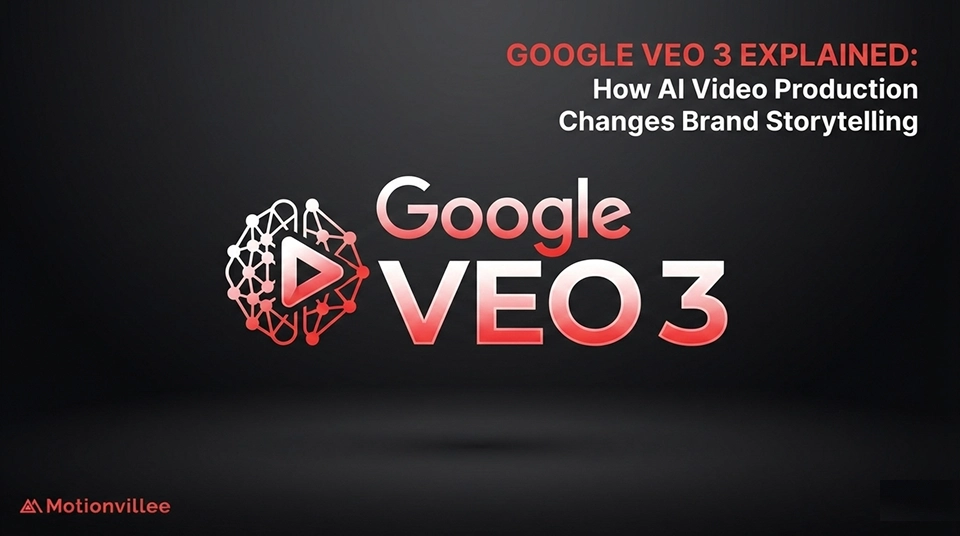
Google Veo 3 Explained: How AI Video Production Changes Brand Storytelling
AI video production with Google Veo 3 isn’t coming.
It’s here.And with Google Veo 3, the conversation shifts from “experimental” to “strategic.”
If you create brand video, product demos, or B2B content at scale, this matters now. Not in five years. Not in theory.
Let’s break it down.
What Is Google Veo 3?
Google Veo 3 is a next-generation text to video AI model developed by Google.
In simple terms?
Veo 3 generates video from a text prompt.
No camera. No crew. No location.
You describe the scene.
The AI builds it.
This is generative video designed for cinematic output realistic motion, dynamic camera angles, detailed environments, and controlled storytelling elements.
It’s part of the new wave of AI video tools 2026 that move beyond short, glitchy clips and into real AI video content suitable for marketing.
So when people ask, “What is Veo 3?” this is the answer:
It’s an advanced AI video generation system built to create cinematic video from written prompts.
How Does Google Veo 3 Work?
You start with a prompt.
Example:
“A cinematic shot of a founder walking through a modern office at sunrise, warm lighting,shallow depth of field.”
Veo 3 interprets:
- Scene composition
- Lighting style
- Camera movement
- Character motion
- Emotional tone
Then it generates a fully rendered video clip.
This is prompt-based video at a cinematic level.
Under the hood, it’s trained on massive datasets of video and visual patterns. But as a brand marketer, you don’t need to understand the neural architecture.
You need to know this:
You control the creative direction through language.
What Can Veo 3 Actually Create?
Here’s where it gets interesting.
Veo 3 AI video can generate:
- Product explainer visuals
- Abstract brand storytelling scenes
- Animated environments
- Cinematic lifestyle footage
- Concept commercials
- Visual metaphors
- AI-generated b-roll
- Background environments for product demos
This makes it a powerful tool for:
- AI video marketing
- SaaS video content automation
- Enterprise AI video tools
- B2B content production at scale
Need five variations of a campaign visual?
- Generate them.
Need visual storytelling for a pitch deck video?
- Prompt it.
Need fast concept testing before production?
- This is where AI content production shines.
Real-World Use Cases for Brands
So, can brands use Veo 3 for marketing?
Yes. But strategically.
- Concept Development
Before hiring a production team, brands can visualize ideas instantly.
Instead of storyboards, you create working video prototypes.
This reduces production bottlenecks.
- AI Video for B2B Marketing
B2B video production tools are traditionally expensive and slow.
With Veo 3 for brands, you can create:
- Product demo environments
- Industry-themed backgrounds
- Scenario-based storytelling
- Visual case study setups
For SaaS brands especially, this unlocks AI video for product demos without renting physical spaces.
- Video Marketing Automation
Need personalized variations for different verticals?
AI video content makes that scalable.
Different industries.
Different visuals.
Same core message.
That’s video content at scale.
Here’s the Catch
Fast? Yes.
Perfect? No.
Let’s be honest about the limitations.
- Creative Strategy Still Matters
Veo 3 doesn’t replace brand storytelling.
It executes prompts. It doesn’t define positioning.
If your message is weak, AI won’t fix it.
- Control Isn’t Absolute
While cinematic AI video is impressive, precision control (especially for specific product shots or exact branding requirements) can still be limited.
Enterprise brands will need oversight.
- Availability & Cost
Many marketers are asking:
Is Veo 3 available for businesses?
How much does Veo 3 cost?
Access is typically phased, often through enterprise partnerships or limited creative
programs. Pricing models for enterprise AI video tools vary depending on usage scale and integration.
Translation: This isn’t a $20/month tool (at least not yet).
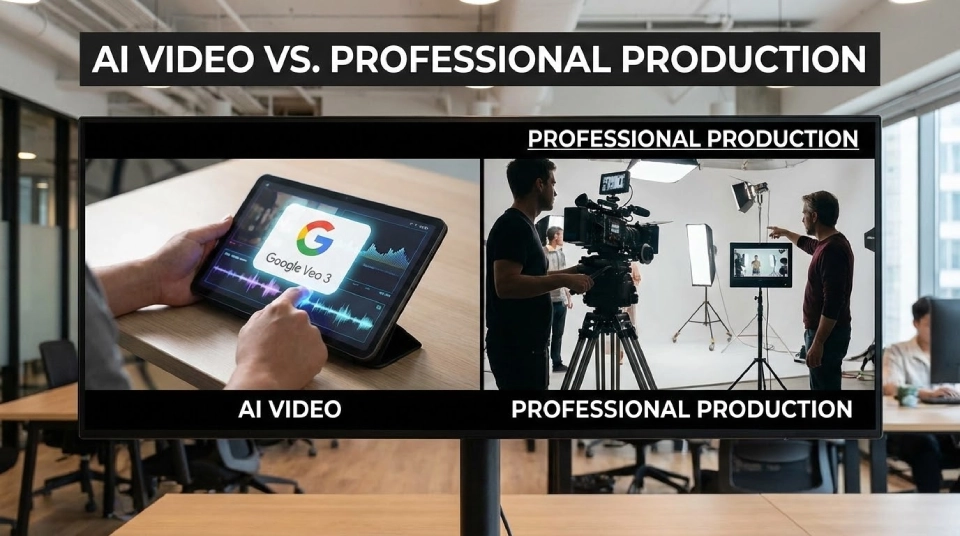
AI Video vs Professional Production
This is the big question.
Is AI video replacing human video production?
Short answer: No.
Long answer: It’s changing the workflow.
Traditional production:
- Weeks of planning
- Crew coordination
- Location costs
- Editing cycles
Veo 3 AI video:
- Prompt
- Generate
- Iterate
- Export
But here’s the nuance.
High-end brand films, emotional storytelling, documentary-style interviews those still
require human direction, performance, and production expertise.
AI handles scale and speed.
Humans handle strategy and emotional truth.
Smart brands will combine both.
Where AI Video Fits in Your Production Workflow
Let’s talk about your video production workflow.
Instead of replacing teams, AI video generation becomes a layer inside the process:
- Ideation → AI concept visuals
- Pitch phase → AI-generated mock videos
- Campaign testing → Rapid visual variants
- Scaled distribution → AI-based localized versions
- Final flagship film → Human-led production
This hybrid approach reduces friction without sacrificing brand quality.
It’s not AI vs humans.
It’s AI plus creative direction.
Decision Framework: Should Your Brand Use Veo 3?
Ask yourself:
- Do we produce high volumes of video content?
- Do we face production bottlenecks?
- Do we need B2B video production at scale?
- Are we exploring AI creative tools already?
- Do we want faster campaign experimentation?
If you answered yes to 3 or more, AI video production deserves testing.
If your brand depends entirely on emotional human storytelling, you may use it more
selectively.
What This Means for 2026?
AI video tools 2026 will not look like AI tools 2023.
The gap between AI-generated content and filmed content is shrinking.
For brands, this means:
- Faster production cycles
- Lower concept costs
- More experimentation
- Greater content output
Final Take-
Google Veo 3 isn’t hype.
It’s infrastructure.
It changes how we think about:
- AI video marketing
- B2B video production tools
- Generative video in enterprise
- AI video content automation
- Brand storytelling at scale
But remember:
Tools don’t build brands.Strategy does.
The brands that win won’t just use AI video production.
They’ll integrate it intentionally into their brand video strategy.