
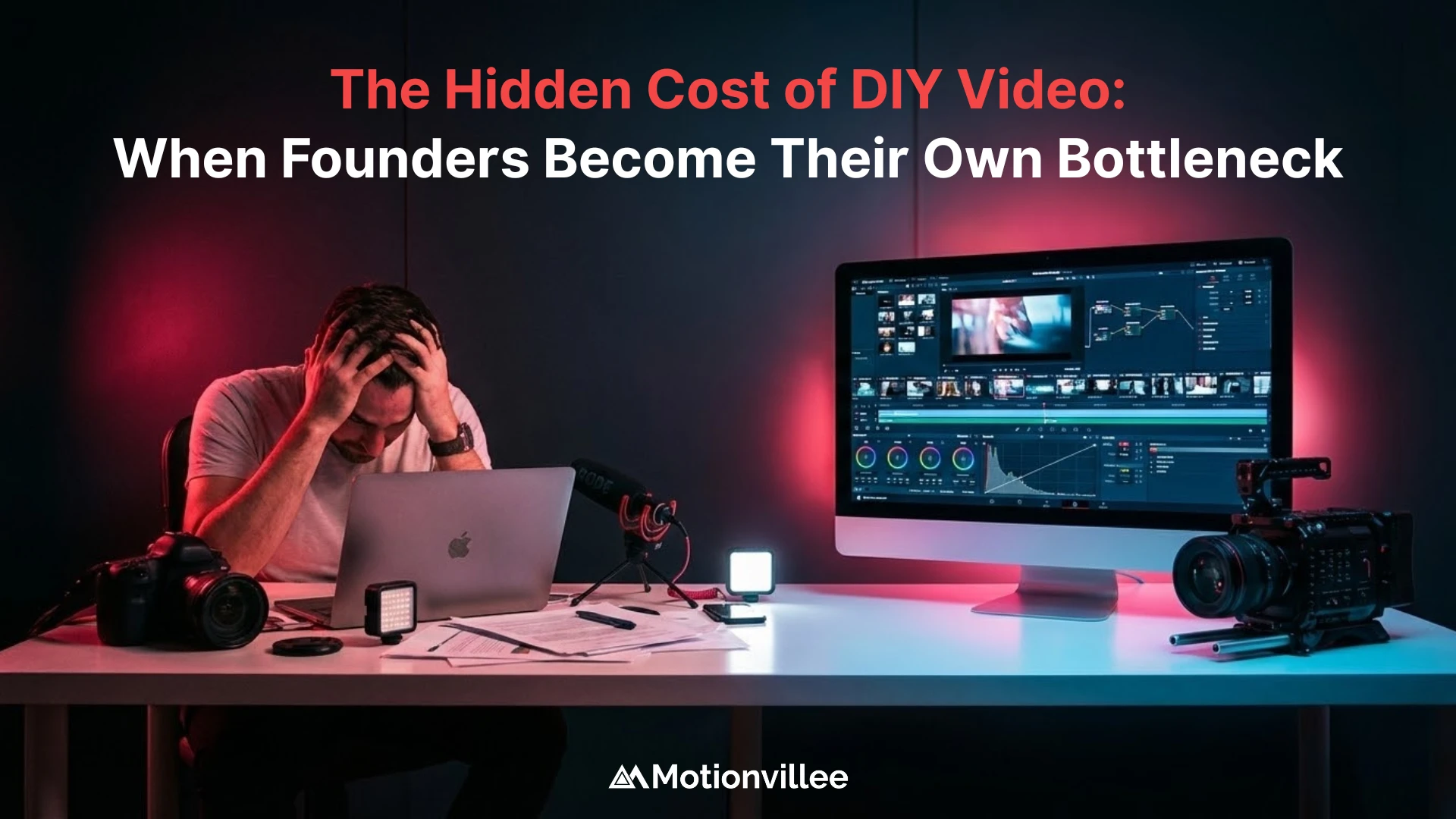
The Hidden Cost of DIY Video: When Founders Become Their Own Bottleneck
Founders creating videos themselves believe they’re saving money. The reality is that DIY video cost extends far beyond software subscriptions and equipment purchases. Hidden costs in founder time, opportunity cost, and delayed revenue often exceed what professional production would have cost.
Why Do Founders Choose DIY Video Production Instead of Outsourcing to Specialists?
Founders believe DIY saves money upfront, gives them complete control, and assume they understand their product better than external vendors can.
The logic seems sound. Video software is affordable. Equipment is accessible. Founders know their product deeply. Why pay thousands to agencies when you can produce videos yourself?
This reasoning misses the hidden DIY video cost equation. Founders underestimate time required, overestimate their positioning expertise, and undervalue their own time. The math looks different when you account for reality instead of assumptions.
Successful founders are busy. They’re closing deals, managing teams, building product, and setting strategy. Adding video production to their plate creates resource constraints that ripple through the entire company.
Professional video production services USA exist precisely because this work shouldn’t fall to founders. But many startups don’t realize the cost of DIY until they’re months into production with nothing to show for the effort.
What Hidden Costs Beyond Software Does DIY Video Production Actually Involve?
DIY video cost includes founder time, opportunity cost, learning curve, revision cycles, and delayed pipeline due to timeline overruns and context switching.
- Founder Time Cost: Video production requires 40-60 hours per video when accounting for research, scripting, recording, editing, and revisions. At a founder’s loaded cost of $200-300 per hour, that’s $8,000-18,000 in labor cost alone. Most founders think it’s free because they’re not billing hours.
- Opportunity Cost: Those 40-60 hours are hours not spent on revenue-generating activities. A founder could be in investor meetings, closing deals, or building product instead of wrestling with editing software. The cost of that lost focus often exceeds the video production cost.
- Learning Curve Tax: Founders learning video production make costly mistakes. They re-shoot scenes, spend hours troubleshooting software, redo editing work. This learning inefficiency adds 30-50% to total production time.
- Revision Cycle Delays: DIY videos often require multiple revision rounds because the founder is also evaluating strategy while producing. This extends timeline by weeks. Each week of delay is lost distribution time and delayed pipeline opportunity.
- Pipeline Impact: Videos that launch late miss market moments. A video launching 4 weeks late costs 4 weeks of demo bookings, lead generation, and pipeline impact. For a SaaS company, 4 weeks of lost pipeline can mean $50K-500K in lost revenue.
- Team Context Switching: When founders become bottlenecks, their team waits. Marketing can’t launch campaigns without approved videos. Sales can’t use videos in outreach. The entire organization is constrained by one person’s video production schedule.
How Much Time Does Video Production Actually Require Versus What Founders Expect?
Professional video takes 3-4 weeks start to finish, but founders underestimate by 50-75%, leading to timeline overruns that delay revenue-impacting initiatives.
- Week 1: Research and Strategy (Underestimated by Founders). Professional teams spend 3-5 days understanding the buyer, positioning gaps, and strategy. Founders think they can skip this because they know their product. This skipping causes poor positioning in the final video.
- Week 1-2: Scripting (Founders Think 2 Hours, Actually Takes 8-12 Hours). Writing a conversion-focused script requires multiple drafts. Founders write a rough draft in 2 hours, then realize it’s feature-focused instead of benefit-focused. Multiple revision rounds extend this to 8-12 hours.
- Week 2: Recording (Founders Expect 4 Hours, Actually Takes 12-16 Hours). Setting up recording equipment, testing audio, recording takes longer than expected. Failed takes, bad audio, and technical issues add hours. Most founders budget 4 hours and spend 12-16.
- Week 2-3: Editing (Founders Think 8 Hours, Actually Takes 16-24 Hours). Learning editing software, fixing audio sync, color correction, adding graphics, and revisions consume far more time than founders expect. First-time editors spend double the time of professionals.
- Week 3-4: Revisions and Optimization (Underestimated by 100%). Stakeholders want changes. Copy needs tweaking. Messaging needs refining. Founders budget zero time for revisions, but revisions consume 8-12 hours minimum.
- Total Time Reality. A founder planning 15 hours total sees the project stretch to 40-60 hours over 3-4 weeks. By then, the launch is delayed, team is waiting, and the founder is frustrated with the process.
When founders underestimate timeline, they also underestimate the DIY video cost. Time overruns create stress, delay marketing launches, and push founders toward finishing incomplete work instead of producing quality output.
Why Does Founder-Produced Video Often Miss Strategic Positioning That Converts Buyers?
Founders are product experts but lack positioning expertise, resulting in feature-focused videos that confuse prospects instead of addressing their actual pain points.
| Dimension | Founder-Produced Video | Professional Strategic Video |
|---|---|---|
| Opening Hook | “We’re a platform that automates workflows” (feature-focused) | “Your team spends 8 hours per week on manual work” (problem-focused) |
| Message Focus | Lists features and benefits generically | Addresses specific buyer’s actual pain point |
| Buyer Psychology | Assumes features sell themselves | Recognizes that clarity and positioning drive conversion |
| Positioning Strategy | No positioning against alternatives | Clear differentiation from competitive alternatives |
| Conversion Result | Viewers understand what product does, not why they need it | Viewers recognize their problem and understand the solution |
| Demo Booking Rate | 3-8% of viewers book demos | 12-20% of viewers book demos |
The core issue is that SaaS explainer videos require positioning expertise, not just production skills. Founders excel at product but often lack positioning strategy. They know features deeply but miss how to translate those features into buyer outcomes.
How Does DIY Video Creation Create Bottlenecks That Prevent Scaling Your Funnel?
Founders become the constraint on video production, creating delays that prevent distributing videos across multiple channels, stages, and buyer segments needed for pipeline acceleration.
The Bottleneck Mechanism
One founder can produce maybe one video per month while managing the business. But effective video marketing requires multiple videos: awareness videos for cold audiences, consideration videos for engaged prospects, decision videos for active evaluators. One founder can’t produce this volume while running the company.
Channel Distribution Delays
Videos sitting in draft form can’t be distributed on LinkedIn, email, landing pages, or paid channels. While the founder finishes editing the first video, marketing can’t launch campaigns. Sales can’t use videos in outreach. The entire organization waits for the founder’s video production schedule.
Funnel Stage Gaps
Because the founder can only produce one video at a time, they can’t cover all funnel stages simultaneously. They start with decision-stage product demos while awareness-stage content sits unproduced. The funnel is incomplete and prospects can’t progress naturally through the buying journey.
Segment-Specific Positioning Gaps
Different buyer segments need different messaging. CFOs care about ROI. CTOs care about integration. Department heads care about workflow. One generic video can’t speak to all segments. But producing segment-specific videos requires volume only professional teams can deliver.
Growth Ceiling
Ultimately, the founder becomes the cap on growth. You can’t scale what one person can produce in their spare time. B2B marketing videos at scale require teams, not founders juggling production alongside their core job.
What’s the Pipeline and Revenue Impact of DIY Video Versus Professional Strategic Video?
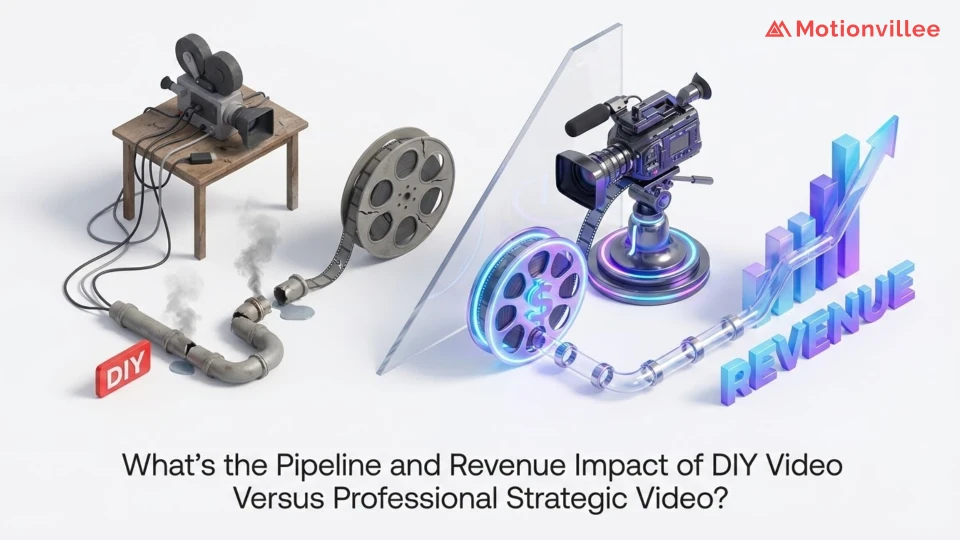
Professional videos drive 3-5x higher demo conversion and 2-3x faster sales cycles compared to DIY videos due to strategic positioning and professional execution.
The DIY video cost shows up in pipeline results. Founder-produced videos with poor positioning generate 3-8% demo booking conversion. Professional strategic videos generate 12-20% demo booking conversion. That’s a 3-5x difference in conversion rate.
Sales cycle velocity also differs. Prospects who watch professional strategic videos move 25-35% faster through the funnel because clarity accelerates decision-making. Prospects watching founder-produced videos stay confused longer, lengthening consideration phases.
Revenue impact compounds. If DIY videos generate half the demos at half the speed, your pipeline growth is quarterbacked by video quality and positioning strategy, not just volume. A founder spending 3 months to produce one underperforming video loses months of growth opportunity.
ROI analysis reveals the true cost. One professional product demo video costing $8,000 generates 40 qualified demos. One founder-produced video taking 60 hours (valued at $12,000 in founder time) generates 10 qualified demos. The professional video delivers 4x better ROI despite higher upfront cost.
What Are the Clearest Signs That DIY Video Is Becoming a Bottleneck on Your Growth?
Warning signs include spending 10+ hours monthly on video, DIY videos not driving demos, founder stress about production, and delayed video launches impacting marketing timelines.
- Sign 1: Founder Time Investment Exceeds 10 Hours Monthly. If you’re spending more than one full day per month on video production, DIY is consuming disproportionate time. This is time you should spend on strategy, fundraising, or product. Recognize this as a signal that outsourcing is needed.
- Sign 2: DIY Videos Not Converting to Demos. If your founder-produced videos get views but drive few demo requests, positioning strategy is the problem. Poor positioning is a signal that professional expertise is missing.
- Sign 3: Marketing Campaigns Delayed Waiting for Video. When marketing can’t launch landing pages or email sequences because the founder hasn’t finished the video, the bottleneck is clear. Your entire growth team is constrained by one person’s production schedule.
- Sign 4: Video Launch Timeline Always Misses Original Target. If every video takes longer than planned, this is a signal that DIY production is harder than expected. Chronic timeline overruns indicate the need for professional production.
- Sign 5: Founder Stress About Video Production. If you dread working on video, this is a sign that DIY isn’t sustainable. Video production should either be fast and easy (it’s not for founders), or it should be outsourced. Ongoing stress signals burnout.
- Sign 6: You Have Video Ideas But Can’t Execute Them. If your team generates video concepts but you can’t produce them because of founder bandwidth, you have a capacity problem. Professional production solves this by scaling your video capacity.
- Sign 7: Competitors’ Videos Are Better Positioned. If you watch competitor videos and realize they’re clearer, more compelling, and better positioned, that’s a signal that your DIY approach is underperforming. Positioning expertise matters.
What’s the Real ROI: DIY Video Approach Versus Outsourcing to Professionals?
Outsourcing costs 2-3x more upfront but generates 5-10x higher ROI through demo conversion, sales cycle reduction, and founder time freed for revenue-generating activities.
| ROI Factor | DIY Video Approach | Professional Outsourced Video |
|---|---|---|
| Production Cost | $0 (hidden as founder time) | $8,000-15,000 per video |
| Founder Time Required | 60 hours per video at $200/hr = $12,000 | 5 hours oversight at $200/hr = $1,000 |
| Total Real Cost | $12,000 (founder time only) | $9,000-16,000 |
| Demo Bookings per Video | 10 qualified demos | 40 qualified demos |
| Cost per Qualified Demo | $1,200 | $225-400 |
| Demo-to-Customer Conversion | 20% (low quality) | 35% (pre-qualified by positioning) |
| Cost per Customer | $6,000 | $650-1,150 |
| Sales Cycle Reduction | Baseline (no improvement) | 25-35% faster |
| Founder Opportunity Cost | $50,000-100,000 (lost focus) | $0 (founder focused on business) |
| Videos Produced Annually | 12 videos (1 per month) | 24-36 videos (2-3 per month) |
The true DIY video cost extends far beyond production. When you add founder time value, opportunity cost of lost focus, poor conversion results, and slow sales cycles, DIY becomes expensive. Professional production appears costly upfront but generates superior ROI through higher conversion, faster sales, and freed founder time.
A founder spending 60 hours per month on video production could instead focus on strategy that moves revenue needle. That 60 hours dedicated to fundraising, partnerships, or product could generate far more than any savings from DIY video production.
At Motionvillee, we help founders escape the DIY video bottleneck. We handle all production so founders can focus on running their business. And we produce strategic, conversion-focused videos that drive qualified demos and accelerate pipeline. We free founder time so they can focus on activities that scale revenue.
If you’re spending more than a few hours monthly on video production, it’s time to outsource. Schedule a consultation with Motionvillee to discuss how professional video production can free your time, improve your pipeline, and generate ROI that far exceeds the investment cost.