
How Do You Convert Video Viewers Into Qualified Demo Bookings?
Most B2B companies measure video success by view counts and completion rates, missing the metric that actually matters: how many viewers book qualified demos. Converting video viewers to demos requires a strategic framework aligned to your buyer’s journey and conversion psychology.
How Are Most B2B Companies Failing to Convert Video Views Into Qualified Demo Bookings?
Most companies measure video success by views and completion rates, missing that the real metric is demo booking conversion, which requires strategic positioning throughout the video funnel.
The disconnect between video metrics and pipeline impact is stunning. A company celebrates that their explainer video got 5,000 views, yet converted zero prospects into demo requests. They’re measuring the wrong thing entirely.
Here’s what’s actually happening. A video gets views because it’s shared on LinkedIn or embedded on a landing page. Views mean people watched. But watching is not conversion. A prospect can watch your entire video and still never book a demo because the video didn’t address their specific concern or create urgency to act.
The gap exists because companies optimize for engagement instead of conversion. They ask: “Is the video holding attention?” They should ask: “Is the video moving prospects toward booking a demo?” These are completely different questions with different answers.
Most videos fail to convert because they lack strategic positioning. They explain features instead of solving buyer problems, use generic CTAs like “Learn More” instead of specific ones like “Book a 15-minute demo.” They treat the video as a standalone piece instead of one element in a conversion funnel.
What Is the Complete Video-to-Demo Conversion Funnel and How Does Each Stage Work?
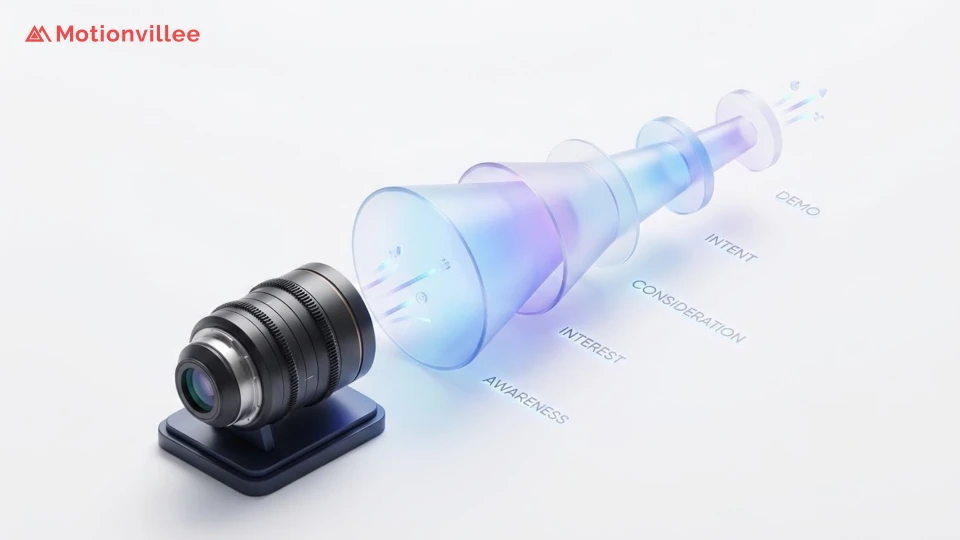
The video-to-demo funnel has five stages: problem awareness, solution education, competitive positioning, trust building, and demo request, each requiring different video types and messaging strategies.
Converting video viewers to demos requires understanding that different prospects are at different buying stages and need different messaging. A single video cannot serve the entire funnel effectively.
Stage 1: Problem Awareness
At this stage, prospects don’t yet recognize they have a problem worth solving. Your video’s job is making them aware that the problem exists and costs them money. Focus on the pain, not your product.
Example: “Manual data entry costs your team 8 hours per week and causes reporting errors that cost $50K annually.” The prospect thinks “That’s us” and now they’re engaged.
Stage 2: Solution Education
Prospects now know they have a problem and want to understand what solutions exist. Your video should explain the solution category, how solutions work, and why this category of solution matters. Don’t mention your product yet.
Example: “Automation eliminates manual entry, improves accuracy, and frees your team for strategic work.” The prospect is learning what’s possible.
Stage 3: Competitive Positioning
Prospects are now evaluating solution options. Your video needs to show how your approach differs from competitors. Emphasize your differentiation, your specific methodology, and why you’re the better choice.
Example: “Unlike traditional automation, we use AI to learn your workflows and adapt continuously without ongoing manual configuration.” You’re positioning against the alternative.
Stage 4: Trust Building
Prospects are close to deciding. Your video should build confidence through customer testimonials, implementation approach, support quality, and proven results. Let customers speak about their experience.
Example: “Companies like Acme Corp implemented our solution in 2 weeks with zero disruption. Here’s how they describe the experience.” Trust is built through proof, not promises.
Stage 5: Demo Request
The final stage is moving the prospect from “interested” to “taking action.” Your CTA must be specific, low-friction, and match their readiness. “Schedule a 15-minute demo to see how we solve your specific workflow” is stronger than generic CTAs.
Each stage requires different video content because buyer psychology changes at each stage. B2B marketing video strategy that accounts for these differences converts 3-5x better than generic approaches.
Why Does Video Positioning Matter More Than Video Quality for Demo Booking Conversion?
Technical buyers evaluate based on how clearly you explain their problem and position your solution, not on animation quality or production value, making strategic messaging more important than creative polish.
The expensive mistake is investing $15,000 in a beautifully animated explainer with poor positioning strategy. The cheaper version with great positioning converts more prospects because positioning matters more than production value for B2B buyers.
- Positioning Clarity Drives Action: When a prospect clearly understands how your solution solves their specific problem, they book demos. When they’re confused about what you do, they leave. Clarity drives conversion.
- Technical Buyers Are Skeptical of Flash: B2B buyers don’t buy on emotion or beautiful animation. They buy on logic, proof, and clear understanding of fit. Fancy production can actually backfire if it feels like you’re trying to hide weak positioning.
- Messaging Alignment Builds Confidence: When your video messaging aligns with their actual buying concern, they feel understood and move forward. When your messaging is generic, they question whether you truly understand their problem.
- Feature Lists Don’t Convert: Listing features like “real-time integration,” “API support,” and “automated workflows” doesn’t motivate demo bookings. Explaining the outcome of those features does convert.
- Specificity Beats Generic Benefits: Saying “improve efficiency” doesn’t land. Saying “reduce manual data entry by 95% and eliminate $50K in annual errors” lands powerfully. Specific positioning converts better than beautiful vagueness.
- Buyer Problem Recognition Drives Urgency: When the prospect hears their exact problem named in your video, urgency increases. They realize you understand their situation and they need to learn more. This psychology drives demo bookings.
The right positioning strategy combined with basic production quality beats poor positioning with premium production every time. Focus on what you say before worrying about how fancy it looks.
How Should You Structure Explainer Videos Specifically to Drive Demo Requests?
Structure videos to open with problem clarity, build urgency around costs, explain your solution approach, differentiate from competitors, and end with a specific, low-friction demo CTA that matches buyer readiness.
The structure of your explainer video determines whether viewers book demos or ignore the CTA.
Follow this five-step framework.
- Open with Problem Recognition (0-10 seconds): Start with “Does this sound familiar?” and name the exact problem your prospect experiences. Make it specific and relatable. Don’t open with your company name or product positioning. Open with their pain.
- Build Urgency by Quantifying Cost (10-20 seconds): Show what the problem costs. “This costs your team 8 hours per week, which adds up to $200K annually in lost productivity plus $50K in reporting errors.” When prospects understand the cost of inaction, they’re motivated to explore solutions.
- Explain Your Solution Approach (20-50 seconds): Show how your solution eliminates the problem. Use animation or visuals to explain what happens after they implement your product. Don’t list features, show outcomes. “Your team spends 15 minutes on data entry instead of 8 hours, eliminating errors entirely and freeing them for strategy work.”
- Differentiate From Competitors (50-70 seconds): Explain why your approach is better than alternatives. Reference how you’re different without naming competitors directly. “Unlike manual automation, our AI learns your workflow and adapts continuously without ongoing configuration.” This positioning moves toward demo conversion.
- End with Specific CTA (70-90 seconds): Close with a clear, specific demo request. “Schedule a 15-minute demo to see how we eliminate your data entry burden without disrupting your workflow.” The CTA must be specific, time-bound, and match their readiness to move forward.
This structure aligns with buyer psychology at each moment. It recognizes the prospect, builds urgency, shows what’s possible, builds confidence, and requests action at the right moment. Explainer video services using this framework drive significantly higher demo booking conversion than those using feature-first or story-first approaches.
What Metrics Should You Track From Video to Demo Booking to Prove Pipeline Impact?
Track completion rate, demo booking conversion, demo quality (not just quantity), sales cycle reduction, and customer acquisition cost per video-sourced customer to measure true ROI.
| Metric Category | Vanity Metrics (Misleading) | Business Metrics (What Matters) |
|---|---|---|
| Video Engagement | Total views (5,000 views sounds impressive) | Completion rate (Do 60%+ finish watching?) |
| Demo Booking | Clicks on CTA (100 people clicked) | Qualified demos booked (15 people actually scheduled) |
| Lead Quality | Number of leads (50 people entered email) | Demo conversion to customers (30% of demos convert) |
| Pipeline Impact | Cost per view ($100 budget / 5,000 views = $0.02) | Cost per customer ($100 budget / 2 customers = $50) |
| Efficiency | Engagement time (viewers spent 2 min average) | Sales cycle reduction (35% shorter pipeline) |
| True ROI | Video metrics isolated | Video contribution to revenue growth |
The mistake most companies make is stopping at view counts and engagement metrics. These feel good but don’t prove the video drove business results. Track what actually matters: how many qualified demos the video generates and how many of those convert to customers.
Setup your analytics to attribute demos to the specific video that drove them. Then track which demos convert to customers. This attribution reveals the true cost per customer and ROI of your video investment. Paid ad video content teams do this rigorously because they need to justify ad spend. Your video should be measured the same way.
How Do You Sequence Multiple Videos Across the Buyer Journey to Maximize Demo Conversions?
Deploy awareness videos early to educate unaware buyers, consideration videos mid-funnel to position your approach, and decision videos late-stage to build confidence in your specific solution versus alternatives.
Converting video viewers to demos improves dramatically when you sequence videos strategically instead of relying on one video to do everything.
Awareness Stage: Problem Education Videos
Deploy videos that make prospects aware the problem exists and costs them money. These videos target cold audiences who don’t yet know a solution is available. Use LinkedIn ads and content marketing to reach them.
Example video: “Why manual data entry is destroying your team’s productivity.” Goal: Get them to recognize they have a problem. Success metric: Problem recognition from cold traffic.
Consideration Stage: Solution Positioning Videos
Deploy videos explaining your solution category and your specific approach. Target prospects who now know they have a problem and are exploring options. Use email nurtures and retargeting to reach them.
Example video: “How automation eliminates manual entry and what you should look for in an automation partner.” Goal: Position your approach as the better option. Success metric: Demo booking requests from consideration-stage prospects.
Decision Stage: Competitive Differentiation Videos
Deploy videos showing why your solution is better than alternatives. Target prospects actively comparing vendors. Use sales presentations and email sequences to reach them.
Example video: “Why AI-based automation outperforms traditional automation.” Goal: Build confidence in your specific solution. Success metric: Sales cycle acceleration and higher close rates.
Product demo video content also belongs in decision stage, showing feature walkthroughs and implementation clarity. Sequencing the right video at the right stage increases overall conversion rates dramatically compared to pushing one video through all stages.
What Are the Most Common Mistakes B2B Companies Make When Trying to Convert Video to Demos?
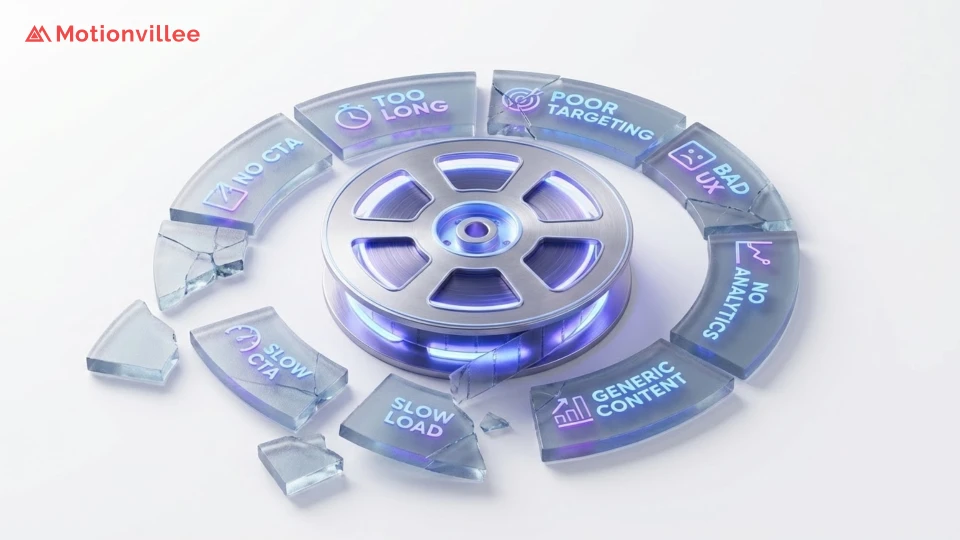
Common mistakes include using one video across all funnel stages, focusing on features instead of buyer outcomes, placing CTAs too late, failing to qualify demo requests, and not measuring conversion impact.
- Mistake 1: Creating One Generic Video for the Entire Funnel. Awareness-stage prospects need problem education. Decision-stage prospects need competitive positioning. One video can’t do both. Segment your videos by buyer stage and awareness level.
- Mistake 2: Opening with Features Instead of Problems. “Our platform offers real-time integration, API support, and automated workflows” puts people to sleep. “This integration eliminates 8 hours of manual data entry per week” makes them lean in. Lead with outcomes, not features.
- Mistake 3: Burying the CTA. If your CTA appears only in the final frame, 30% of viewers have already left. Your CTA needs to appear at 60-75 seconds, not 90 seconds. And it needs to be specific, not generic.
- Mistake 4: Using Weak CTAs. “Learn more” or “Click here” don’t convert. “Schedule a 15-minute demo to see how we eliminate your workflow burden” converts. Your CTA must be specific about the action and the benefit.
- Mistake 5: Not Qualifying Demo Requests. You book 20 demos but only 2 convert to customers. This suggests your video attracts low-quality leads. Improve your positioning to attract more qualified prospects, or add a qualification question before booking demo.
- Mistake 6: Failing to Measure Conversion. You can’t improve what you don’t measure. Track completion rates, CTA click rates, demo booking rates, and demo-to-customer conversion. Use this data to optimize your next video.
- Mistake 7: Treating Video as Standalone. A video exists within a buyer journey. The landing page message should align with the video message. The email that directs them to the video should set expectations. Everything should point toward the demo CTA.
Ready to Convert Your Video Strategy Into Qualified Demos?
The companies seeing highest demo conversion are those using strategic video positioning aligned to funnel stages, measuring pipeline impact rigorously, and optimizing continuously based on data.
Converting video viewers to demos is not about having the most beautiful or most viewed video. It’s about strategic positioning that moves prospects closer to booking demos at each stage of their buyer journey.
Here’s what separates companies that convert video viewers to demos from those that don’t: They treat video as a conversion tool, not a creative exercise. They align messaging to buyer stage, measure what matters: demo bookings and pipeline impact. They optimize based on performance data. And understand that strategy drives conversion more than production quality.
At Motionvillee, we help B2B companies build video strategies that convert viewers into qualified demos. We start with understanding your buyer journey, your positioning gaps, and your demo booking challenges. And create stage-specific videos with strategic positioning designed to move prospects toward booking demos.
We measure completion rates, demo booking conversion, and pipeline attribution. And optimize based on data. We treat your video as part of your sales engine, not just marketing content.
Ready to transform your video strategy from views-focused to demo-focused? Schedule a free consultation with Motionvillee. We’ll analyze your current video performance, identify conversion gaps, and show you how strategic video positioning can accelerate your pipeline and increase demo booking rates by 30-50%. Let’s discuss how to convert your video viewers into qualified prospects ready to demo your solution.