How Explainer Video Pricing Really Works: Transparent Cost Breakdown for 2026

How Explainer Video Pricing Really Works: Transparent Cost Breakdown for 2026

How Explainer Video Pricing Really Works: Transparent Cost Breakdown for 2026

Explainer video pricing quotes vary wildly from $500 to $50,000 for similar projects, leaving buyers confused about what they’re actually paying for. This guide reveals the complete pricing breakdown so you understand costs, evaluate proposals intelligently, and know whether you’re getting value or being overcharged.


The Explainer Video Pricing Mystery Unveiled

Explainer video pricing varies so dramatically because different producers use different pricing models, include different deliverables, employ different talent levels, and serve different markets with completely different cost structures.

You request a quote for a 2-minute explainer video. One vendor quotes $1,500. Another quotes $8,000. A third quotes $25,000. The same video length, similar style, but wildly different prices. How do you know who’s right?

The confusion exists because pricing complexity comes from multiple factors: production approach (template vs custom), animation type (2D vs 3D), talent quality (freelancer vs agency), geographic location, revision policy, and what’s actually included. Understanding these variables eliminates confusion and helps you evaluate proposals fairly.

The Explainer Video Pricing Mystery Unveiled


Why Explainer Video Quotes Vary So Dramatically

Quote variation comes from five factors: production model (template vs custom), geographic labor cost differences, experience level of talent, scope complexity, and what gets included in deliverables.

  • Production Model Difference: Template-based videos using pre-built animations cost $500-$2,000. Custom animations built specifically for your script cost $3,000-$8,000. 3D and premium productions cost $15,000+. Same video length, completely different approaches, completely different prices.
  • Geographic Labor Cost Variation: A US agency pays $75-150/hour for animators. A Philippine freelancer charges $15-25/hour for similar quality. Same skill level, radically different pricing because labor costs differ by country.
  • Talent Experience Level: A freelancer with 2 years experience charges less than an agency with 10-year portfolio of premium work. Both can produce quality videos. Experience and proven results command premium pricing.
  • Scope Complexity: A simple screen recording with voiceover costs less than a fully animated character-driven explainer. A video with advanced visual effects costs more than a video with simple graphics. Complexity drives cost.
  • Deliverables Included: Some quotes include only MP4 file. Others include multiple formats, social media versions, and subtitle files. Some include unlimited revisions. Others limit revisions. Scope of deliverables explains significant price differences.


The Four Fundamental Pricing Models Explained

Explainer video producers use four distinct pricing models: fixed package pricing, custom quotes, hourly billing, and value-based pricing, each with different advantages and disadvantages for buyers.

  1. Fixed Package Pricing: Producer offers defined packages: “Basic Package $2,000 includes 60-second video, one revision, MP4 format.” Clear pricing upfront. No surprises. But limited flexibility if you need something outside the package.
  2. Custom Quote Pricing: Producer quotes individual projects based on scope. You describe what you need. They quote the cost. Flexible but requires negotiation and has no price guarantee until fully scoped.
  3. Hourly Rate Billing: You pay for hours spent on your project. $50/hour to $150/hour depending on talent level. Flexible for evolving scope but creates uncertainty about total cost.
  4. Value-Based Pricing: Cost aligns with business impact. “Since this video will likely generate $500K in pipeline, we’ll quote $15,000.” Rarer model but aligns producer incentive with your business outcome.


What You’re Actually Paying For: The Hidden Components

Explainer video costs break into three phases: pre-production planning and strategic work, production execution and asset creation, and post-production polish and delivery—each phase drives significant cost.

Pre-Production Costs That Set the Foundation

Pre-production includes discovery calls, strategy sessions, competitive analysis, and script development. This phase determines video quality more than production phase does. A well-positioned script with clear messaging produces better videos than poor script with excellent animation.

Discovery and strategy work might be $0 (freelancers skip it) to $2,000+ (agencies invest heavily). Time spent here prevents costly revisions later. Producers charging nothing for pre-production often produce lower-quality positioning.


Production Phase Expenses That Drive Quality

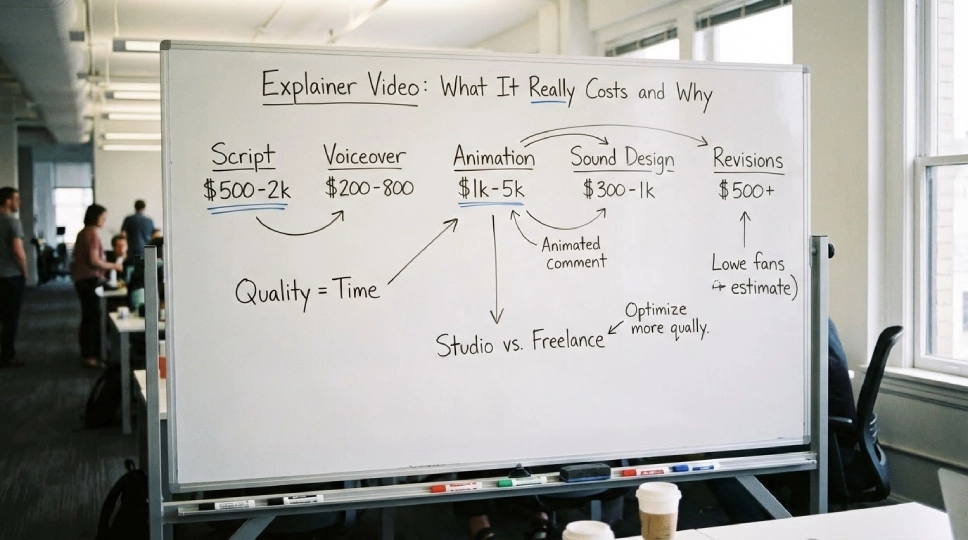
Production includes voiceover talent, animation or video production, sound design, and music licensing. This phase is most expensive because it requires skilled labor. A professional voiceover talent costs $100-$500. Professional animators cost $50-$150/hour. Music licensing for commercial use costs $100-$500.

Production costs vary most dramatically based on animation type. 2D animation from templates costs less than custom 2D animation, which costs less than 3D animation. Choose animation type strategically because it directly impacts production budget.


Post-Production Elements That Polish Your Message

Post-production includes editing, color correction, subtitle creation, multiple format delivery, and revisions. Post-production is where videos transform from rough edit to polished final product. Professional post-production work is worth the investment because it determines whether viewers perceive quality and professionalism.


The Price Spectrum: From Budget to Premium

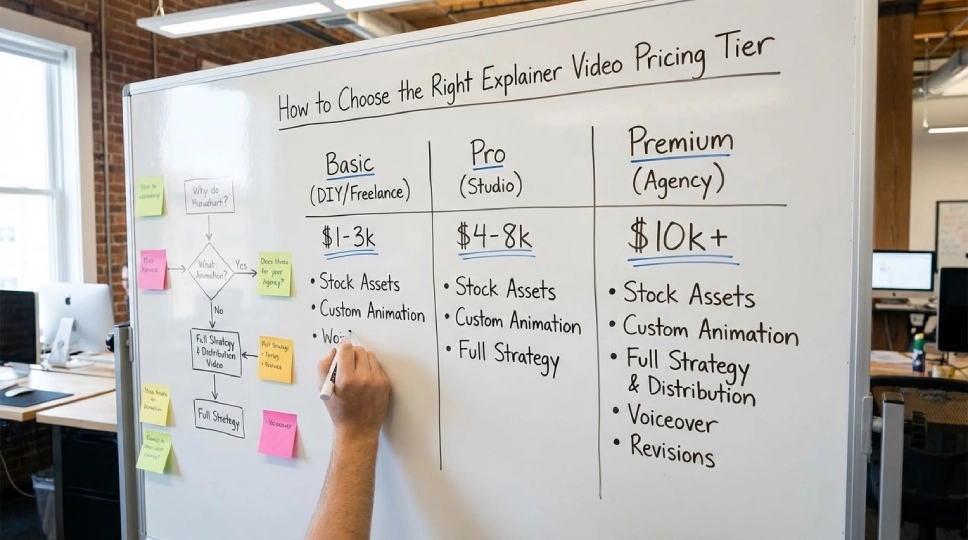
Explainer video market segments into four price tiers from budget template-based videos under $2,000 to premium custom productions over $15,000, each tier serving different business needs and quality expectations.

Price Tier Production Type Timeline Use Case Quality Level
$500-$2,000 Template-based animation using pre-built elements 5-7 days Quick concept videos, internal training, early-stage startup MVPs Basic-adequate, limited customization
$3,000-$8,000 Custom 2D animation built for your script 3-4 weeks Professional SaaS explainers, service demos, mid-market positioning Professional, strategic positioning, standard deliverables
$8,000-$15,000 Premium 2D with custom illustrations and advanced effects 4-6 weeks Brand-defining explainers, competitive positioning, premium brand positioning High polish, custom visuals, comprehensive deliverables
$15,000-$50,000+ 3D animation, live-action hybrid, advanced VFX 6-12 weeks Enterprise positioning, product launch videos, healthcare animation Cinematic quality, complex animations, extensive customization


Breaking Down Each Production Stage Cost

Understanding cost breakdown by production stage helps you evaluate where your budget is going and whether pricing is aligned with the work involved.

Strategy and Discovery Sessions: Why You Pay for Planning

Discovery sessions cost $0 (some freelancers skip them) to $1,000+ (agencies invest heavily). In discovery, you discuss your product, target audience, competitive positioning, and goals. The producer learns your business so they can position your video strategically.

Producers investing time in discovery produce better videos because they truly understand your positioning. Producers skipping discovery often produce generic videos that miss your specific differentiation.


Scriptwriting Fees: The Foundation of Every Dollar

Scriptwriting might cost $0 (you provide script) to $500-$1,000 (professional scriptwriter develops multiple drafts). Script quality determines video quality. A professional scriptwriter crafts positioning strategy into conversational narrative that engages viewers.

Pricing varies based on scriptwriting complexity. Simple product explanation costs less to script. Complex B2B positioning requiring competitive differentiation costs more to script well.


Storyboard and Style Frame Development Costs

Storyboarding and style frames cost $200-$800 and require 2-5 days of design work. Storyboards show every scene visually before animation begins. Style frames establish the visual direction and design aesthetic.

This planning phase prevents costly revisions later. Producers skipping storyboarding often produce videos requiring significant changes. Producers investing in storyboarding produce videos matching client vision first revision.


Voiceover Talent: From Budget to Celebrity Pricing

Voiceover talent costs $50 (budget marketplace talent) to $500+ (professional union talent). Professional voiceover talent is worth the investment because voice quality impacts viewer perception of professionalism dramatically.

Budget voiceover might sound amateurish, damaging video credibility. Professional voiceover talent makes even simple animations sound polished and credible. Voiceover is investment that improves ROI.


Animation and Design Work: Where Hours Translate to Dollars

Animation work consumes 40-80% of production timeline and cost. A senior animator costs $75-150/hour. A junior animator costs $30-50/hour. Animation complexity, video length, and animation type (2D vs 3D) determine animation hours required.

A 2-minute 2D animation with simple graphics might require 40 hours. A 2-minute 3D animation with complex effects might require 80+ hours. Animation hours directly translate to cost.


Sound Design and Music Licensing Expenses

Sound design (audio transitions, effects) costs $100-$300. Music licensing for commercial use costs $100-$500 depending on where music is used (YouTube vs broadcast vs ads). Some producers include music in pricing. Others add as separate line item.

Professional sound design and quality music elevate video polish significantly. Budget on sound if it’s not included in initial quote.


Revision Rounds: Understanding What’s Included vs Extra

Standard package includes 2-3 revision rounds. Additional revisions cost $200-$500 per round. Understanding revision policy prevents surprise costs. Ask upfront: “How many revisions are included? What’s the cost for additional revisions? What counts as a revision vs a new request?”


Geographic Pricing Variations That Impact Your Budget

Producer location significantly impacts pricing because labor costs, operating costs, and market rates vary dramatically by country and region.

  • North American Agency Rates: US and Canadian agencies charge $3,000-$15,000+ per video because labor costs are high and market rates reflect decades of established pricing. US quality is premium but US cost is premium too.
  • European Production Studios: UK, Germany, and Scandinavian studios charge $4,000-$12,000 because labor costs are moderate relative to services offered. European quality is high. European pricing is middle ground between US and Asia-Pacific.
  • Asia-Pacific Alternatives: Philippines, India, and Vietnam producers charge $1,000-$4,000 because labor costs are significantly lower. Quality varies widely but best Asia-Pacific producers deliver quality comparable to North American producers at 50% cost.
  • Remote-First Agencies: Distributed teams spanning multiple countries charge $2,000-$8,000 by combining lower-cost talent in some regions with premium talent in others. This model balances cost and quality effectively.


Video Length and Duration: The Cost Multiplier Effect

Video length directly multiplies cost because longer videos require more animation frames, longer voiceovers, and more production hours, making length one of the most significant cost drivers.

  1. The 60-Second Standard and Its Price Point: A 60-second explainer video is industry standard length and establishes baseline pricing. Most producers quote based on 60-second baseline. Videos under 60 seconds cost slightly less. Videos over 60 seconds cost proportionally more per additional second.
  2. 90-Second Videos: When More Time Means More Money: A 90-second video costs 40-50% more than a 60-second video because production hours increase 40-50%. Time increase is not linear because some production elements (discovery, scripting, setup) are fixed regardless of length.
  3. Long-Form Explainers: Pricing Videos Over Two Minutes: Videos over 2 minutes enter premium pricing territory because production hours increase significantly. A 3-minute video might cost 2-2.5x more than a 60-second video. Most producers quote premium prices for videos over 3 minutes because they’re non-standard.

Video Length and Duration: The Cost Multiplier Effect


Complexity Factors That Increase Your Investment

Beyond length, animation complexity, custom illustrations, special effects, and multiple versions all increase cost significantly because they require additional skilled labor and production time.

Character Animation vs Simple Graphics

Videos with animated characters cost 30-50% more than videos with simple shapes and icons because character animation requires more detailed work and longer production timelines. Characters also require consistent design across all scenes.

Decide early whether you need character animation or can accomplish positioning with simple graphics and motion. Character animation increases budget but can increase engagement and emotional connection.


Custom Illustrations vs Stock Asset Libraries

Custom illustrations specific to your brand cost $500-$1,000+ to create. Stock asset libraries (pre-made illustrations producers own or license) cost nothing additional once licensed. Custom illustration increases cost but improves brand differentiation.

Most mid-range explainers use 80% stock assets with 20% custom elements. This balances cost and customization effectively.


Advanced Visual Effects and Motion Complexity

Advanced effects like particle systems, 3D depth, complex transitions, and sophisticated motion graphics increase production complexity and cost. Simple motion increases cost 20-30%. Advanced effects increase cost 50%+.

Determine whether advanced effects serve your message or distract from it. Often simple, clear motion serves positioning better than complex effects.


Multiple Video Versions and Format Variations

Creating multiple versions (60-second, 90-second, 30-second for social) adds cost because each requires editing and optimization work. Most producers add 20-30% to pricing for each additional version beyond the main version.

Plan your version strategy upfront and negotiate multi-version pricing. Creating all versions during initial production is cheaper than creating versions months later when production team has moved on.


Hidden Costs That Catch Clients Off Guard

Beyond base production cost, several hidden charges surprise clients who don’t specifically ask about them upfront, including rush fees, revisions beyond scope, music licensing, and format variations.

Hidden Cost Category Typical Cost When It Applies How to Avoid
Rush Fee / Expedited Timeline +25-50% of project cost When you need video sooner than standard timeline Plan timeline realistically. Don’t rush unless necessary.
Beyond-Scope Revisions $200-500 per revision round When revisions exceed included revision rounds Clarify revision limits upfront. Define what counts as revision vs change order.
Music Licensing Premium $100-500 additional When commercial use or broadcast use requires premium licensing Specify intended use. Budget for commercial licensing if needed.
Additional Format Deliverables $100-300 per format When you need video in formats beyond MP4 (MOV, WebM, etc) Ask what formats are included. Add additional formats only if needed.
Translation / Localization $500-1500 per language When you need video in multiple languages Plan language strategy upfront. Budget for translation if needed.
Subtitles and Captions $100-250 When you need professionally edited subtitles Ask if subtitles are included. Budget separately if needed.
Resizing for Platform Specifications $50-150 per platform When you need video optimized for specific platforms Specify platforms upfront. Ask if optimization is included.


Red Flags in Explainer Video Pricing

Certain pricing red flags indicate corner-cutting, unrealistic promises, or scope misalignment that will lead to poor quality, missed deadlines, or cost overruns.

  • Extremely Low Quotes: Quotes significantly below market ($500 for professional custom 2D animation) indicate either template-based work you could do yourself or quality compromise. Fair pricing usually reflects true cost of quality work.
  • Unrealistic Timelines: Promises of “one-week turnaround for custom 3D animation” signal corner-cutting. Quality 3D production requires 6-8 weeks minimum. Unrealistic timelines suggest rushed work or missed deadlines.
  • Vague Scope Definition: Quotes without clarity on what’s included (revision limits, revision rounds, deliverable formats, asset usage rights) indicate potential for scope disputes and cost overruns.
  • Missing Key Deliverables: Quotes that don’t mention voiceover talent quality, revision policy, or format deliverables suggest important items aren’t included. Ask explicitly about everything you need.
  • No Contract or Terms: Producers unwilling to provide written contract or clear terms suggest unprofessional operation. Professional producers have contracts protecting both parties.
  • Portfolio Quality Doesn’t Match Pricing: If portfolio quality seems mediocre but pricing is premium, producer might be overpriced relative to actual quality delivered.


How to Evaluate Pricing Proposals Intelligently

Intelligent proposal evaluation requires comparing detailed breakdowns across multiple vendors, asking specific questions about deliverables and terms, and assessing portfolio quality relative to pricing.

Comparing Apples to Apples: The Quote Breakdown Checklist

When comparing quotes, ensure all proposals include same elements: production type, video length, revision policy, voiceover quality, music licensing level, number of versions, and delivery formats. Different proposals might have dramatically different scope.

Create a comparison spreadsheet listing every vendor and checking which deliverables each includes. Same deliverables at different prices shows pricing variation. Different deliverables at different prices makes comparison more complex.


Questions Every Buyer Should Ask Before Signing

Question 1: “What’s included in your quote? What’s excluded?” Get explicit list of deliverables, revision rounds, and formats included. Get explicit list of what costs extra.

Question 2: “What happens if I request revisions beyond what’s included? What’s the cost per additional revision?” Understand revision policy before signing.

Question 3: “Do you provide multiple video versions (30-second, 60-second, social versions) or just one version?” Understand whether your version needs are included or additional.

Question 4: “Who owns the video assets and music licensing after delivery? Can I reuse the video indefinitely?” Understand usage rights and ownership.

Question 5: “What if I need to make changes after delivery? How long do you provide support?” Understand post-delivery support and additional change costs.


Portfolio Quality vs Pricing Alignment

Compare portfolio quality to pricing. Does the portfolio suggest the quality you’re paying for? A vendor charging $12,000 should have portfolio demonstrating premium quality. A vendor charging $2,000 might have more basic portfolio, which is appropriate for price point.

Request references from recent clients. Ask specifically: “Did the project come in on budget and timeline? Would you hire this producer again?” Client feedback matters more than portfolio alone.


Understanding What’s Negotiable and What Isn’t

Some pricing elements are negotiable. Production timeline, revision policy, and included deliverables are often negotiable. Creative direction and voiceover talent quality should not be negotiated down because they directly impact final quality.

If you need 3 versions instead of 1, negotiate multi-version pricing instead of paying single-version price and then paying per additional version later. If you need faster timeline, negotiate rush fee upfront instead of discovering it’s expensive after signing.


Strategic Cost-Saving Approaches Without Sacrificing Quality

Smart cost-reduction strategies maintain quality while reducing investment: handling some elements yourself, phasing production over time, reusing assets across videos, and making strategic compromises.

  1. DIY Elements You Can Handle In-House: You might be able to handle scriptwriting, providing product screenshots, or creating style guides, reducing producer workload and cost. Not all elements are suitable for DIY (voiceover, animation require professional skill), but some are.
  2. Phased Production: Spreading Costs Over Time: Instead of paying $8,000 for complete video upfront, produce 2-3 videos over 6 months at $3,000 each. This spreads cash outlay and allows learning from first video to improve second video.
  3. Reusable Assets That Lower Future Video Costs: When producing first video, commission a library of reusable assets (character designs, graphics, motion templates) you can reuse in future videos. Initial investment is higher but future videos cost significantly less.
  4. Smart Compromises That Maintain Impact: Use 80% stock assets with 20% custom elements instead of 100% custom. Use simple graphics with strong positioning instead of complex animation. Focus investment on voiceover and music quality instead of animation complexity.


Industry-Specific Pricing Considerations

Different industries have different pricing norms because production requirements vary: SaaS requires simpler animation, healthcare requires specialized animation expertise, and enterprise requires longer production timelines.

B2B SaaS Explainer Video Cost Expectations

SaaS explainers typically cost $1,000-$8,000 because animation requirements are moderate (workflows, interface changes, conceptual positioning). SaaS market is competitive so many producers specialize in SaaS, increasing supply and stabilizing pricing.

Timeline for SaaS explainers is 3-4 weeks typically. Deliverables usually include main video plus 30-second and 90-second versions.


E-Commerce and Consumer Product Video Budgets

E-commerce videos often use product footage plus animation overlays, costing $1,000-$6,000. Timeline is 2-3 weeks. These videos are shorter and simpler than enterprise videos, so pricing is typically lower.


Healthcare and Medical Animation Premium Pricing

Healthcare animation requires specialized expertise in medical accuracy and regulatory compliance. Healthcare videos cost $1,000-$25,000+ because animation must be medically accurate and approved by compliance teams. Timeline extends to 6-10 weeks.

Healthcare premium pricing reflects specialized expertise and regulatory requirements, not just complexity.


Educational and Training Video Economics

Educational videos focus on clarity and completeness. They cost $1,000-$10,000 depending on length and complexity. Timeline is 3-5 weeks. Educational videos are often longer than other explainers (3-5 minutes) to cover comprehensive topics.


The ROI Equation: When Higher Prices Make Financial Sense

Higher video production investment makes financial sense when higher quality generates sufficient conversion rate improvement to pay for itself through increased pipeline and customer acquisition.

A $2,000 template video might generate 5% demo booking conversion. A $8,000 custom video might generate 15% demo booking conversion. If you drive 1,000 prospects to the video, template generates 50 demos. Custom generates 150 demos. Difference is 100 additional demos per 1,000 viewers.

If 20% of those additional 100 demos convert to customers at $5,000 average contract value, additional revenue is $100,000. Additional cost is $6,000. ROI is 1,567%. This explains why higher pricing makes sense.

The key is that video positioning must convert at higher rates because of quality. A high-cost video with poor positioning won’t generate higher conversion. Pricing should align with positioning quality and strategic approach.


Payment Structures and Terms to Understand

Professional video producers use milestone-based payments protecting both parties: deposits at signing, progress payments at milestones, and final payment upon delivery.

  • Deposit Requirements: Standard deposit is 25-50% of project cost due upon signing contract. Deposit secures producer’s time and resources. Producers requiring deposits are professional and prepared for the project.
  • Milestone Payments: Remaining balance often breaks into milestone payments: 25% upon script approval, 25% upon draft completion, final 25% upon delivery. Milestone structure aligns payment with production progress.
  • Net Payment Terms: Agencies often request Net 30 terms (payment due 30 days after invoice). Agencies might offer Net 15 for faster payment. Discuss payment terms upfront and ensure they fit your cash flow.
  • Rights and Ownership: Clarify whether you own the final video and music permanently or whether you’re licensing use for specific time period. Most producers transfer ownership of final video to client. Music licensing varies depending on music source.


The 2026 Pricing Landscape: Current Market Rates

2026 pricing trends show inflation adjustment from 2024 rates, growing influence of AI tools on production efficiency, and increasing demand for multiple video versions pushing average project costs up.

  • How AI Tools Are Influencing Pricing Models: AI animation tools and script-writing tools reduce production time and cost for some producers. This creates downward pricing pressure on commodity explainers but premium producers using AI tools to enhance (not replace) human work charge premium rates. Professional explainer video services using AI as productivity tool maintain pricing while increasing quality and turnaround.
  • Inflation and Market Adjustment Factors: 2024-2025 saw 8-12% price increases across video production market due to inflation. 2026 pricing reflects this inflation adjustment. Expect 3-5% annual increases as labor costs continue rising.
  • Supply and Demand Dynamics in Video Production: Increased video marketing adoption has increased demand for explainer videos faster than supply of quality producers has grown. This supply-demand imbalance maintains upward pricing pressure. Waiting times for premium producers have extended from 2-3 weeks to 4-6 weeks, justifying premium pricing for faster delivery.


Building Your Explainer Video Budget: Practical Framework

Determine your video budget by working backward from business objectives: define required conversion rate improvement, calculate revenue impact of improved conversion, then allocate production budget ensuring positive ROI.

Aligning Budget With Business Objectives

What’s your goal for the video? Generate trial signups? Drive demo requests? Build brand awareness? Different goals justify different budgets. A video driving mission-critical feature adoption might justify $10,000 investment. A video for internal training might justify $2,000 investment.

Calculate what improved conversion rate justifies in budget. If you drive 1,000 prospects monthly to video currently generating 5% conversion (50 demos), improving to 10% (100 demos) is worth 50 additional demos monthly. If demos are worth $2,000 in pipeline, 50 demos equals $100,000 monthly impact. A $5,000 video investment pays for itself in 2-3 days.


When to Stretch Your Budget vs When to Wait

Stretch your budget when: video is core to upcoming launch, competitive window is closing, or budget is enabling significant business outcomes. Wait when: timing pressure is artificial, budget is already exhausted elsewhere, or you can build gradually with smaller investments.

Sometimes waiting 3 months to allocate sufficient budget for premium production beats rushing with insufficient budget for commodity production.


Getting Maximum Value From Your Investment

Maximize value by: planning multiple versions upfront instead of creating later at additional cost, building reusable asset library for future videos, ensuring clear positioning before production begins, and measuring conversion rate impact to prove ROI and justify future investment.

A well-planned, strategically positioned $5,000 video produces more value than a poorly planned $10,000 video. Strategy and positioning matter more than budget size.

Building Your Explainer Video Budget: Practical Framework


Making Informed Pricing Decisions With Confidence

Explainer video pricing complexity exists because explainer videos themselves are complex products: they combine strategy, creative work, technical production, talent, and distribution planning. Understanding cost drivers helps you evaluate proposals fairly and negotiate confidently.

The lowest price often hides quality compromise. The highest price often reflects brand premium, not proportional quality increase. Fair pricing aligns with deliverables, timeline, talent quality, and strategic approach.

Request detailed quotes from 2-3 vendors. Compare deliverables explicitly. Ask questions about what’s included and excluded. Evaluate portfolio quality relative to pricing. Choose the vendor offering best value, not cheapest price or highest price.

At Motionvillee, we price transparently based on deliverables, timeline, and strategic approach. We include detailed scope documentation so you know exactly what you’re paying for. We can work within various budgets from template-based approaches to premium custom productions. If you’re evaluating explainer video options and want transparent pricing guidance, video production services with detailed cost breakdowns, schedule a consultation to discuss your budget and business objectives.

About the author

Frequently Asked Questions

Why does explainer video pricing vary so much between vendors?
Explainer video pricing varies because each vendor uses different production models, talent levels, and deliverables. A $1,500 quote often relies on templates, limited discovery, basic animation, and fewer revisions. An $8,000 or $15,000 quote usually includes custom 2D or 3D animation, strategy, scriptwriting, storyboards, pro voiceover, licensed music, and multiple versions. Location also matters, since US and European studios pay higher labor costs than Asia based teams. You are not just paying for video length, you are paying for process, expertise, and scope.
A typical explainer video cost covers three phases. Pre production includes discovery, strategy sessions, scriptwriting, and sometimes style frames. Production covers storyboard creation, illustration or design, animation, voiceover talent fees, and music licensing. Post production includes editing, sound design, quality control, revisions, subtitles, and final exports in agreed formats. Some video production services include multiple cut downs for social media and aspect ratios. Others only deliver a single MP4 file. Always ask for a clear line item breakdown of what is included and what is extra.
In 2026, a 60 to 90 second explainer video typically ranges from $3,000 to $8,000 for custom 2D animation with strategy, scripting, and standard revisions. Template based videos can be as low as $500 to $2,000 but offer limited customization and weaker positioning. Premium work with advanced illustration or complex motion can reach $8,000 to $15,000 for the same duration. Prices above $15,000 usually involve 3D, live action hybrids, or heavy compliance in fields like healthcare and enterprise. Duration, complexity, and talent level drive the final explainer video pricing.
You can reduce explainer video cost by keeping the scope focused and handling some elements in house. Provide a clear brief, brand assets, and draft script to cut pre production hours. Choose simple 2D motion graphics instead of complex character animation or 3D. Plan all needed versions upfront so the studio can edit variants in one pass instead of separate projects. Invest in professional voiceover and music while avoiding unnecessary effects. Most savings come from simplifying style and length, not from squeezing animator rates unrealistically.
To compare explainer video pricing fairly, ask every vendor the same structured questions. What is the exact length and style included? How many rounds of revisions are covered and what counts as a change of scope? Is strategy, scriptwriting, storyboarding, and style exploration included in the fee? Who provides voiceover, music licensing, and subtitles? What formats and aspect ratios will you deliver? Who owns final assets and rights? When you place answers side by side, you can see which quote offers the best value rather than just the lowest price.

Share

Motionvillee helps businesses create and distribute stunning, impactful videos that drive real results.

You might also like

Full-Funnel Video System: How to Accelerate Your Sales Cycle by 40% Most B2B companies...

Startup Explainer Video Strategy: How to Launch with $0 Paid Ads Budget Startup budgets...

B2B Video Ideas: 19 Video Concepts Your Competitors Aren’t Using Yet Most B2B companies...

Need a video that works?

Book a quick call with a Motionvillee video strategist. We’ll understand your situation, agree on project outcomes, and then design 2-3 tailored solution options and quotes.