
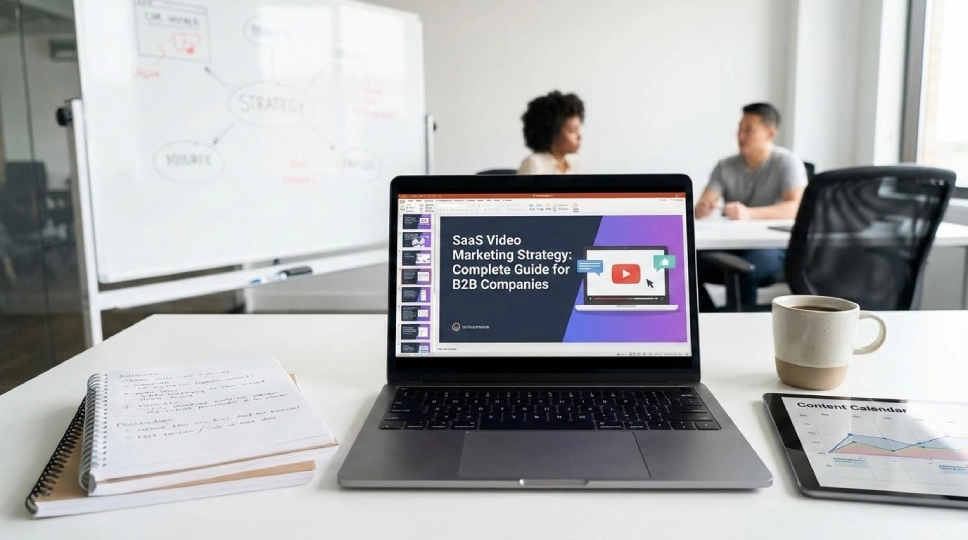
SaaS Video Marketing Strategy: Complete Guide for B2B Companies
Your competitors aren’t winning with better products. They’re winning because prospects understand their value faster. A strategic SaaS video marketing strategy turns complex features into clear stories that drive qualified demos and compress sales cycles.
What Is a SaaS Video Marketing Strategy and Why Does It Matter for B2B Companies?
A SaaS video marketing strategy uses targeted video content across your funnel to help prospects understand your value before they ever speak to sales.
Most B2B SaaS companies struggle with a simple problem. Prospects don’t understand what you do or why you’re different. Your website explains features. Your sales team explains benefits. But by the time someone books a demo, they’re still confused.
Video solves this clarity problem at scale.
When you produce video content for every funnel stage, prospects self-educate. They watch an explainer on LinkedIn. See a product demo on your landing page. And review customer testimonials before the sales call.
The result? Qualified pipeline. Shorter sales cycles. Deals that close faster because buyers already understand your value.
Building a strong SaaS video marketing strategy means mapping specific video types to buyer intent at each funnel stage. Companies using this approach report 30-40% shorter sales cycles and higher close rates on qualified opportunities.
Ready to start producing video at scale? Explore our SaaS video production services.
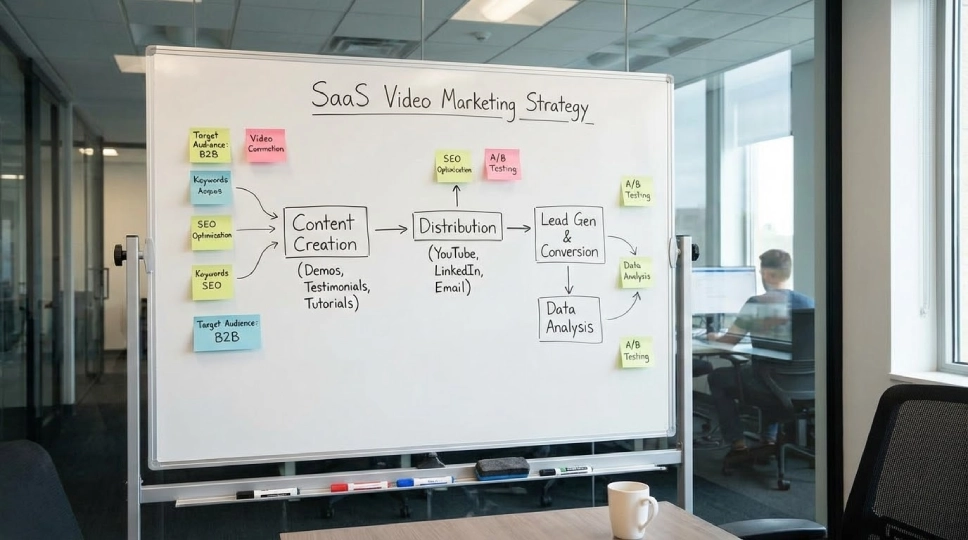
How Does a SaaS Video Marketing Strategy Shorten Your Sales Cycle?
Video compresses education time, moving prospects from awareness to decision faster than any other content format.
Think about your current sales process. First call explains the problem. Second call demos the solution. Third call addresses objections. Fourth call closes.
Each call takes time, requires calendar coordination, and risks losing momentum.
Video changes this equation.
Prospects who watch your explainer video before the first call already understand the problem you solve. Those who see your product demo understand how the solution works. Testimonial viewers trust that it actually delivers results.
Your first sales call becomes your third call. You skip the education phase entirely.
Companies implementing a full-funnel SaaS video marketing strategy report 30-40% shorter sales cycles. Not because video magically speeds up decisions. Because it front-loads education so sales conversations start further down the funnel.
What Types of SaaS Videos Drive the Most Qualified Demos?
Different video formats serve different funnel stages. Explainers for awareness, product demos for consideration, testimonials for decision.
Not all videos do the same job. Trying to use one flagship explainer across your entire funnel is like using a hammer for every construction task.
Here’s how video types map to buyer intent:
Awareness Stage Videos
Explainer videos that introduce the problem and position your category. These run on social media, paid ads, and top-of-funnel content. Goal: make prospects aware they have a problem worth solving.
Consideration Stage Videos
Product demo videos showing exactly how your solution works. These live on landing pages, in email sequences, and sales enablement. Goal: prove your approach solves the problem better than alternatives.
Decision Stage Videos
Customer testimonials and case study videos providing social proof. These support final buying decisions and internal stakeholder alignment. Goal: build trust that you’ll deliver promised results.
The most effective SaaS companies produce multiple video types, not just one. You need content variety to keep prospects engaged as they move through your funnel.
Learn more about which formats work best: 11 SaaS Video Types That Outperform Landing Pages.
How Do You Create a SaaS Video Marketing Strategy That Aligns with Your Funnel?
Map specific video types to awareness, consideration, and decision stages based on where prospects need education most.
Start by auditing your current funnel. Where do prospects drop off? Where do sales calls get stuck explaining basics? Those gaps tell you where video adds the most value.
Step 1: Identify Your Funnel Stages
List every touchpoint from first awareness to closed deal. Website. LinkedIn. Email sequences. Demo calls. Proposal reviews.
Step 2: Map Video Types to Stages
Awareness needs explainers. Consideration needs demos. Decision needs testimonials. Don’t create video randomly. Create it strategically.
Step 3: Plan Production in Batches
Produce multiple videos at once using the same visual style and messaging framework. This keeps your brand consistent while maximizing production efficiency.
Step 4: Set Distribution Rules
Define exactly where each video lives. Homepage hero? LinkedIn ads? Email nurture sequence? Sales enablement deck?
Most SaaS companies fail at video because they skip strategy. They produce one video and hope it works everywhere. It doesn’t.
Discover why strategic planning matters: 13 Reasons to Build a Full-Funnel SaaS Video Strategy in 2025.
What Makes SaaS Video Content Stand Out in Crowded Markets?
Premium visuals combined with strategic storytelling create differentiation competitors can’t match.
Your market is noisy. Every competitor claims they’re better, faster, cheaper. Prospects scroll past generic marketing every day.
Video that actually stands out does three things:
Visual Quality That Signals Premium
Your video represents your product. Low-quality visuals signal low-quality software. Premium animation, thoughtful design, and professional production tell prospects you’re serious.
Strategic Messaging That Speaks to Pain
Generic messaging gets ignored. Specific messaging connects. Show prospects you understand their exact challenges.
Storytelling That Shows Transformation
Features bore prospects. Transformation excites them. Show the before state (pain), the after state (gain), and how you bridge the gap.
Companies like Microsoft and Uber use video as their competitive edge. Not because they spend millions. Because they understand video is how modern B2B buyers evaluate options.
See what great SaaS video looks like: 8 Top SaaS Explainer Video Examples from Leading Tech Brands.
How Should B2B SaaS Companies Distribute Video Content for Maximum ROI?
Multi-channel distribution ensures decision-makers see your message at every touchpoint. LinkedIn, email, landing pages, and paid ads.
Creating great video is half the work. Getting it in front of buyers is the other half.
LinkedIn Distribution
Post video natively to LinkedIn. Add subtitles (most watch without sound). Write a hook that makes people stop scrolling. Use video in LinkedIn ads targeting decision-makers by job title and company size.
Email Integration
Embed video in nurture sequences. Add thumbnail images that link to video landing pages. Use video in sales follow-up emails to reinforce demo conversations.
Landing Page Placement
Homepage hero (explainer). Product pages (demos). Pricing page (testimonials). Each page serves different buyer intent, so video should match.
Paid Advertising
Run video ads on LinkedIn and YouTube targeting your ideal customer profile. Retarget website visitors with video ads showing specific product benefits.
Distribution isn’t guesswork. It’s a system. Map video types to channels based on where your buyers actually spend time.
Understand the complete process: The Complete Video Production Workflow: 5 Stages for B2B & SaaS.

How Do You Measure SaaS Video Marketing Success Beyond View Counts?
Track qualified demos booked, sales cycle length, and pipeline velocity. Not vanity metrics like views or engagement.
Most SaaS companies measure video the wrong way. They count views, track watch time, and celebrate engagement rates.
None of that matters if video isn’t driving revenue.
Metrics That Actually Matter
- Demo Booking Rate: How many people who watch video book a demo versus those who don’t? If video viewers book at 3x the rate of non-viewers, your video works.
- Sales Cycle Length: Compare time-to-close for deals where prospects watched video versus those who didn’t. Shorter cycles mean video is doing its education job.
- Pipeline Velocity: Track how fast deals move through stages. Video-educated prospects should progress faster because they understand your value earlier.
- Cost Per Qualified Lead: Calculate total video production and distribution cost divided by qualified leads generated. Compare to other channels like paid search or events.
Revenue metrics beat vanity metrics. Always.
Dive deeper into measurement: 5 Key Metrics to Measure LinkedIn Video ROI for SaaS.
How Does Motionvillee Help B2B SaaS Companies Scale Video Production?
We become your video department, producing content at scale without vendor chaos or Hollywood budgets.
Most SaaS companies face the same video problem. You need multiple videos. And you need quality that signals premium positioning.
But you don’t want to manage shoots, edits, and vendor chaos.
Motionvillee operates differently. We don’t sell you one video. We become your video partner.
You gain:
- Multiple video formats from single productions (explainers, demos, social clips, testimonials)
- Strategic guidance on which videos serve which funnel stages
- Consistent visual quality that builds brand recognition
- Production at scale without Hollywood pricing
Within weeks, you have fresh video content. Within 90 days, you produce more video than competitors while spending less time managing vendors.
Companies like Microsoft and Uber trust us because we understand B2B SaaS. We know your buyers, your funnel, and what drives qualified demos versus vanity metrics.
Work with a team that understands your market: USA Video Production Services.
Master the fundamentals: What Are the 31 Video Best Practices Every SaaS Company Needs for 2026?.
Ready to Build Your SaaS Video Marketing Strategy?
Your competitors are already using video to win deals. Every day you wait is another day prospects choose better-marketed products over better actual products.
Schedule a strategy call with Motionvillee. We’ll map your funnel, identify video opportunities, and show you exactly how to produce content that drives qualified pipeline in 90 days.