

The Video Marketing Audit: 7 Questions to Answer Before Planning Your 2026 Strategy
Most B2B companies invest in video production without understanding which videos drive pipeline and which waste budget. A video marketing audit before 2026 planning reveals these gaps and prevents costly strategic mistakes.
Why Conduct a Video Marketing Audit Before Planning Your 2026 Strategy?
A video marketing audit reveals which videos drive pipeline impact, which waste budget, and what gaps exist in your funnel, essential foundation before investing in 2026 video production.
Companies enter 2026 planning knowing they need video strategy but lacking data on current performance. They guess about which videos work, then repeat past mistakes. An audit changes this equation.
Here’s what an audit accomplishes. It quantifies ROI per video, identifies funnel gaps, reveals positioning weaknesses, and shows which videos deserve expansion versus replacement. This data transforms 2026 planning from guesswork to strategy.
Without audit clarity, companies overfund underperforming videos and underfund high-performers. They miss funnel stages prospects need to move through. They position generically when competitors position specifically. An audit prevents these expensive mistakes.
The companies scaling fastest in 2026 are those starting with a honest video marketing audit. They understand current performance, identify gaps, and plan strategically. Companies skipping the audit repeat 2025 problems and waste 2026 budget.
Conducting an audit before planning requires asking seven critical questions about your existing video portfolio. These questions form the foundation for strategic 2026 planning with professional video production services USA.
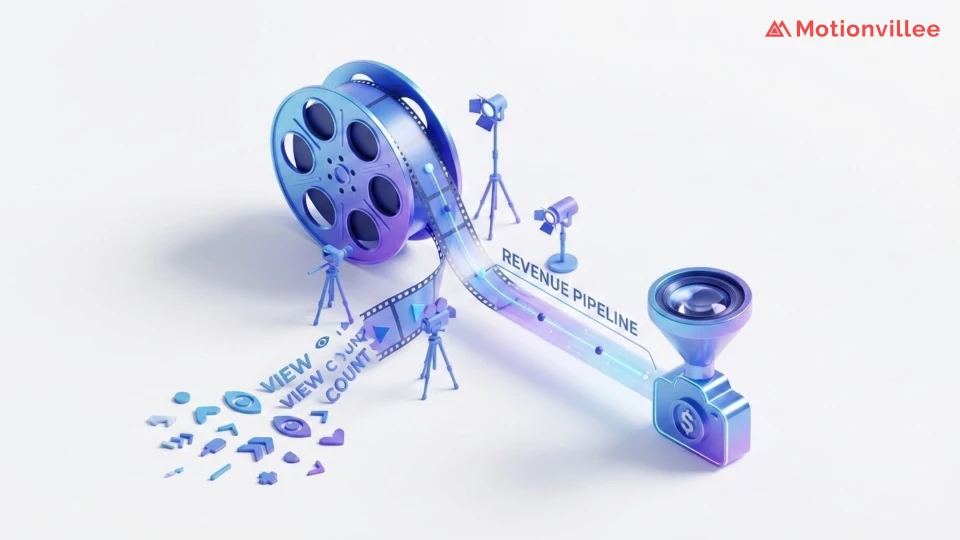
Question 1: Are Your Current Videos Actually Driving Pipeline and Revenue, or Just Views?
Audit completion rates, demo booking conversion, and revenue attribution to distinguish high-ROI videos from underperformers measured only by vanity metrics.
- Pipeline Metrics That Matter: Completion rate (60%+ means the video holds attention), demo booking conversion (15%+ means positioning works), sales cycle reduction (faster progression means messaging resonates), customer acquisition cost (lower means video is efficient). These metrics prove business impact.
- Vanity Metrics That Mislead: View count (5,000 views means nothing if zero demos result), engagement rate (likes don’t equal conversions), click-through rate on generic CTAs (clicks don’t mean qualified interest), time spent watching (viewer attention doesn’t prove positioning effectiveness). These metrics feel good but hide poor performance.
- ROI Calculation Framework: Calculate cost per demo by dividing video production cost by qualified demos generated. Calculate cost per customer by dividing cost per demo by your demo-to-customer conversion rate. Compare this to your customer acquisition cost from other channels. This reveals true ROI and priorities for 2026.
Question 2: Does Your Video Portfolio Cover All Critical Funnel Stages or Are Strategic Gaps Limiting Growth?
Map existing videos to awareness, consideration, and decision stages to identify missing content blocking prospect progression through the buyer journey.
- Awareness Stage Audit: Do you have videos that make problem-unaware prospects recognize they have a problem worth solving? These videos should focus on the pain, not your product. If missing, prospects never enter your funnel. Identify which awareness-stage videos exist and which gaps remain.
- Consideration Stage Audit: Do you have videos explaining your solution category and approach? These target prospects who know they have a problem and want to understand options. Missing consideration videos mean prospects move to competitors without learning your positioning. Map which consideration content exists.
- Decision Stage Audit: Do you have videos showing why your solution is better than alternatives? These target prospects actively comparing vendors. Missing differentiation videos cause prospects to choose competitors. Identify which product demo video and positioning content you have for decision stage.
Question 3: Is Your Video Messaging Speaking Directly to Your Target Buyer’s Actual Pain Points?
Audit whether video positioning addresses your specific buyer’s core problems or if messaging is generic enough to fail resonating with qualified prospects.
| Messaging Dimension | Generic Positioning (Underperforms) | Targeted Positioning (Converts) |
|---|---|---|
| Problem Statement | “Companies struggle with efficiency” (applies to everyone) | “Manual data entry costs your team $200K annually” (specific to buyer) |
| Solution Focus | “Our platform automates workflows” (feature-focused) | “You reclaim 8 hours per week and eliminate reporting errors” (outcome-focused) |
| Buyer Recognition | “Ideal for businesses looking to improve” (vague audience) | “CFOs in mid-market SaaS facing scaling challenges” (specific segment) |
| Competitive Position | “Best-in-class solution” (generic claim) | “Unlike traditional tools, we adapt without manual configuration” (specific differentiation) |
| Conversion Result | Viewer thinks “maybe this applies to us?” (uncertain) | Viewer thinks “this is exactly our situation” (certain to act) |
Question 4: How Effectively Are Your Videos Being Distributed to Reach B2B Buyers at the Right Journey Stage?
Analyze whether videos reach prospects on correct channels at correct times, revealing missed opportunities in email, LinkedIn, landing pages, and paid advertising.
Email Distribution Audit
Review which videos appear in nurture sequences and at what stage. Are awareness videos going to cold prospects? And consideration videos going to engaged prospects? Are decision videos reserved for late-stage evaluators? Misaligned email distribution reduces conversion significantly.
LinkedIn Distribution Strategy
Assess whether videos appear in organic posts, ads, and messaging. Are awareness videos targeting broad audiences? And consideration videos targeting company size and industry? Are decision videos retargeting engaged prospects? LinkedIn offers targeting precision that most companies underutilize.
Landing Page Placement Audit
Examine which videos appear above the fold versus buried. Do awareness landing pages have problem-focused videos? and do consideration pages have solution positioning videos? Video placement relative to copy impacts completion rates and conversion significantly.
Paid Channel Distribution Analysis
Review paid ad video content performance across channels. Are awareness videos in cold prospecting campaigns? And consideration videos in retargeting? Are decision videos in remarketing to engaged prospects? Paid distribution strategy directly impacts ROI and should align with awareness stage.
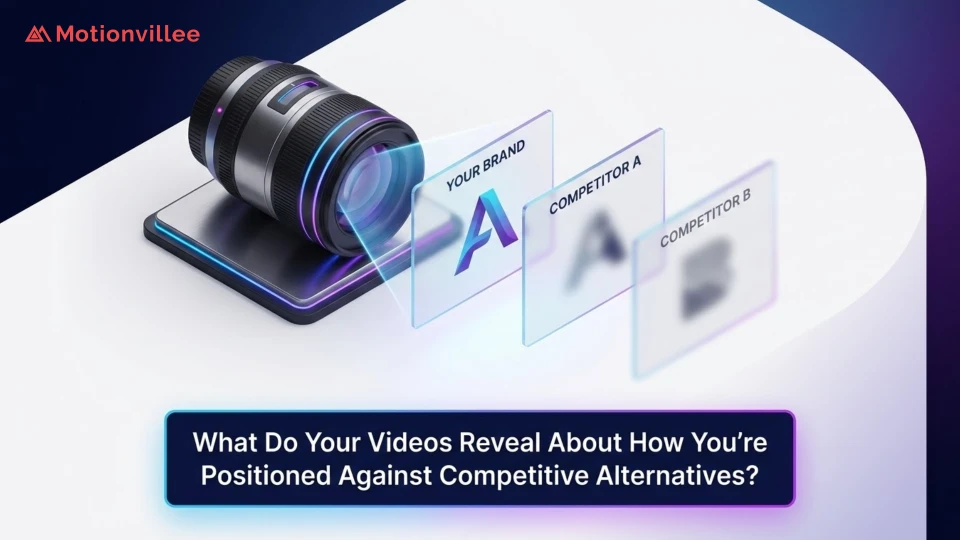
Question 5: What Do Your Videos Reveal About How You’re Positioned Against Competitive Alternatives?
Benchmark your video positioning against competitors to identify whether your differentiation is clear and compelling or if you’re blending into generic messaging.
Watch your competitors’ videos with the question: “How is their positioning different from ours?” If you can’t articulate clear differences, your buyers can’t either. Competitive positioning audit reveals whether your differentiation stands out or blends in.
Here’s the audit framework. First, identify five direct competitors and watch their awareness, consideration, and decision videos. Note how they open videos, what problems they emphasize, which solutions they highlight, and how they differentiate. Then watch your videos with the same questions.
Compare the results. If competitor videos and your videos look interchangeable, you’re missing positioning clarity. If your videos clearly articulate what makes you different, you’re winning. Use this comparison to identify positioning gaps for 2026 strategy.
Competitive positioning audit often reveals that companies are positioning generically when opportunity exists for specific differentiation. Explainer video services help companies move from generic to specific positioning in 2026 planning.
Question 6: Which Videos Should You Keep, Optimize, or Replace Based on Performance Data?
Use completion rates, conversion data, and pipeline attribution to prioritize which underperformers to optimize and which high-performers to expand or replicate.
- Keep Criteria (High-Performers): Videos with 70%+ completion rates, 15%+ demo booking conversion, and clear pipeline attribution. These videos work. Protect them, use them widely, and replicate their messaging approach for similar buyer segments or funnel stages. They’re your conversion engines.
- Optimize Criteria (Medium-Performers): Videos with 50-70% completion rates, 5-15% demo booking conversion, or unclear attribution. These videos have potential but miss something. Test different CTAs, refine openings, improve positioning clarity. Small changes often convert medium-performers to high-performers.
- Replace Criteria (Underperformers): Videos with below 50% completion rates, below 5% demo booking conversion, or negative pipeline attribution. These videos waste distribution resources. Replace them rather than optimize. Continuing to distribute underperformers drains budget from opportunities.
Question 7: What Should Your 2026 Video Strategy Prioritize Based on Audit Findings?
Translate audit insights into strategic priorities: which funnel gaps to fill, which messaging to refine, and which new videos will drive highest pipeline impact.
- Priority 1: Fill Critical Funnel Gaps. If audit reveals missing awareness videos, these become priority one because awareness feeds the entire funnel. If consideration videos are missing, that becomes priority because prospects can’t evaluate solutions. Identify which funnel stage has biggest gap and address it first.
- Priority 2: Expand High-Performing Videos. Create variations of top-converting videos targeting different buyer segments, industries, or use cases. If one awareness video drives 30 demos, three awareness videos could drive 90. Replicating success scales faster than creating new approaches.
- Priority 3: Optimize or Replace Underperformers. Don’t waste 2026 budget on videos that consistently underperform. Either optimize them dramatically based on competitive positioning or replace them entirely. Continuing underperformers while planning new content is inefficient.
Ready to Audit Your Video Strategy and Plan for 2026?
Companies conducting video audits before planning identify $100K+ in wasted video spend and $500K+ in missed pipeline opportunity, critical insights for 2026 success.
These seven questions form a complete video marketing audit framework. Working through them reveals performance reality, identifies gaps, and shows opportunities. This clarity transforms 2026 planning from guesswork to strategy.
At Motionvillee, we conduct video marketing audits for companies planning 2026 strategy. We analyze your entire video portfolio, measure pipeline impact, identify positioning gaps, and show which videos deserve expansion versus replacement. We then build 2026 strategy based on data rather than assumptions.
Start your audit with these seven questions. Quantify what’s working, identify what’s missing, and benchmark against competitors. Then build 2026 strategy with clarity about opportunities and gaps. Schedule a free audit consultation with Motionvillee to discuss your current video performance and 2026 strategic priorities.