
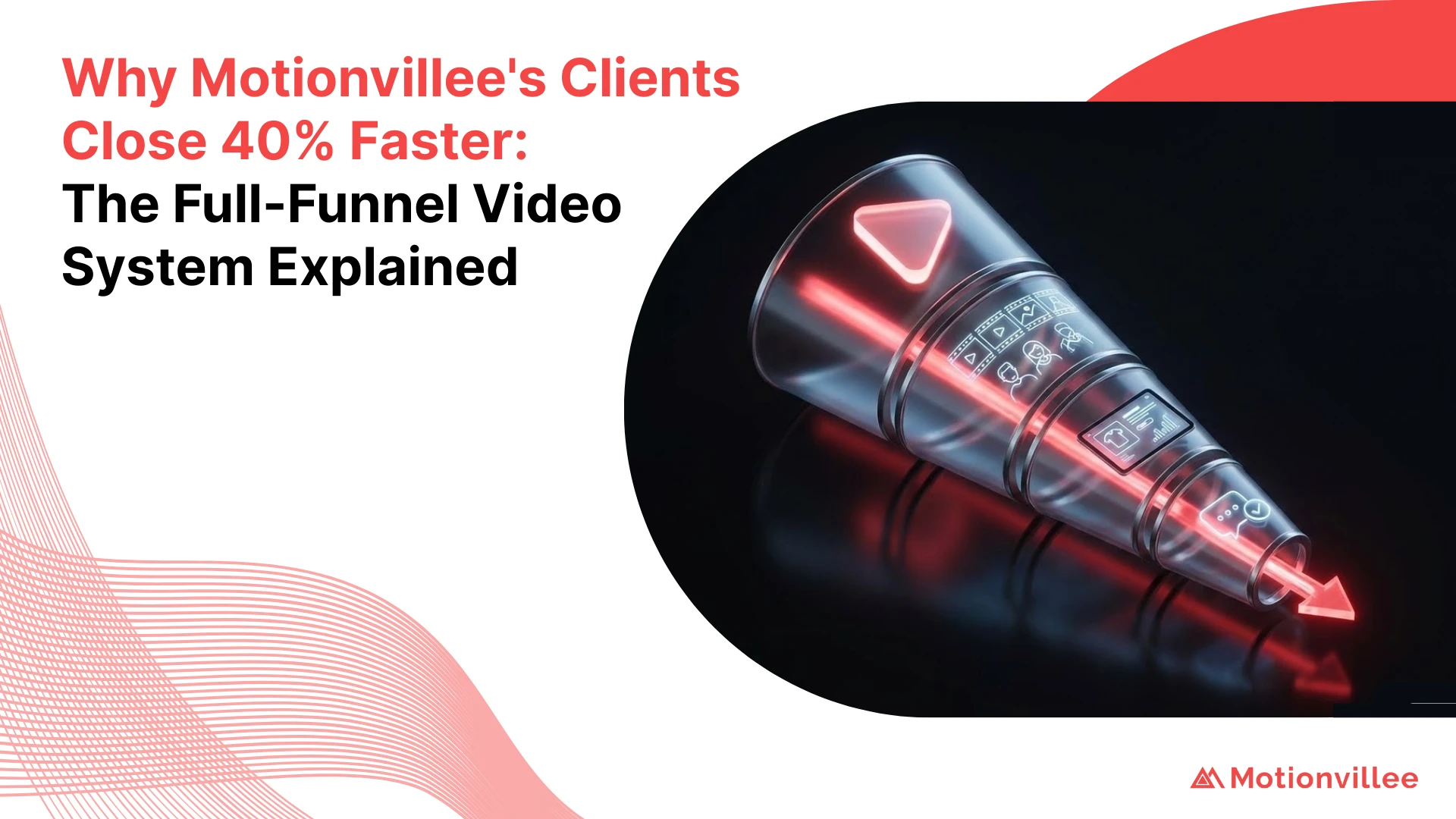
Full-Funnel Video System: How to Accelerate Your Sales Cycle by 40%
Most B2B companies use video as a one-time asset, not as a systematic tool that guides prospects through every stage of the buying journey. A full-funnel video system changes this by creating strategic videos for awareness, consideration, and decision stages, reducing sales cycle length by 40% and increasing close rates dramatically.
The Sales Cycle Problem Costing You Revenue
Most B2B companies waste months on sales cycles that could be compressed through strategic video deployment at specific funnel stages, costing them revenue velocity and competitive advantage.
Your average sales cycle is 60-90 days. Competitors are closing similar deals in 45 days. The difference isn’t product quality or sales team skill. It’s how effectively they educate prospects before salespeople engage.
Long sales cycles exist because prospects need education. They need to understand problems, explore solutions, and build confidence. Without strategic video education, salespeople spend months explaining what video could communicate in minutes.
Why Traditional Video Strategies Leave Money on the Table
Traditional approaches create one generic video and hope it works across all funnel stages, failing to address the specific information needs and buying psychology at each stage.
The One-Video-Fits-All Mistake
You create one product demo video, post it on your website, and hope prospects watch and book demos. This approach fails because different funnel stages have completely different information needs.
A top-of-funnel prospect doesn’t need a detailed product walkthrough. They need to understand if your solution addresses their specific problem. A bottom-of-funnel prospect ready to evaluate needs precisely the detailed walkthrough you created.
One video can’t serve both needs. Using your product demo at the top of funnel wastes it on unqualified prospects. Skipping video at the top of funnel means unqualified prospects reach salespeople unprepared, wasting sales team time.
Where Most Companies Deploy Video and Why It Fails
Most companies deploy video in three ways, all suboptimal. First, they put video on the homepage hoping all visitors watch. Second, they send product demo videos in cold outreach expecting engagement from completely unaware prospects. Third, they embed videos in sales presentations as last-minute proof.
These deployments fail because they’re not funnel-aligned. Video at each stage should match prospect readiness and information need at that moment. Misaligned video either gets ignored (unaware prospect ignores product demo) or wastes time (aware prospect watches unnecessary awareness-stage content).
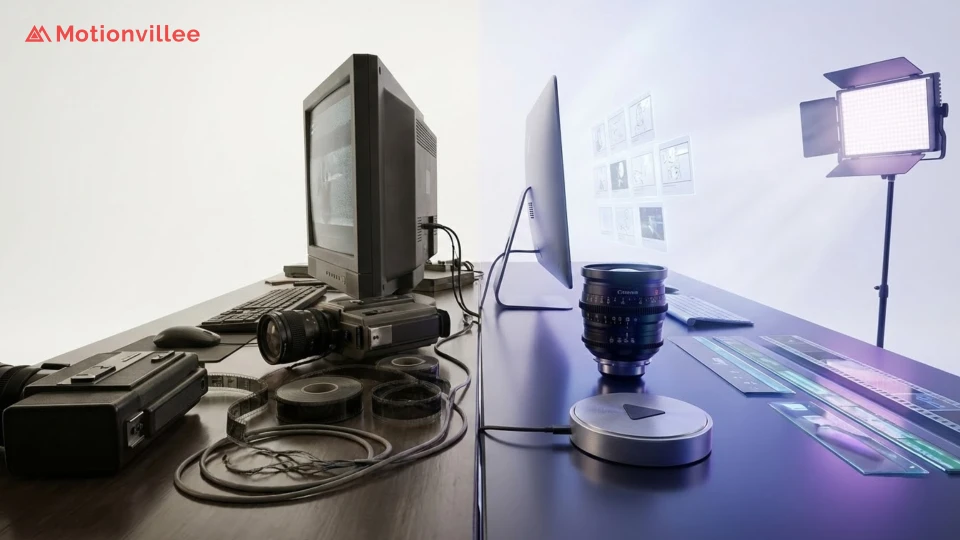
The Full-Funnel Video System: Architecture That Accelerates Deals
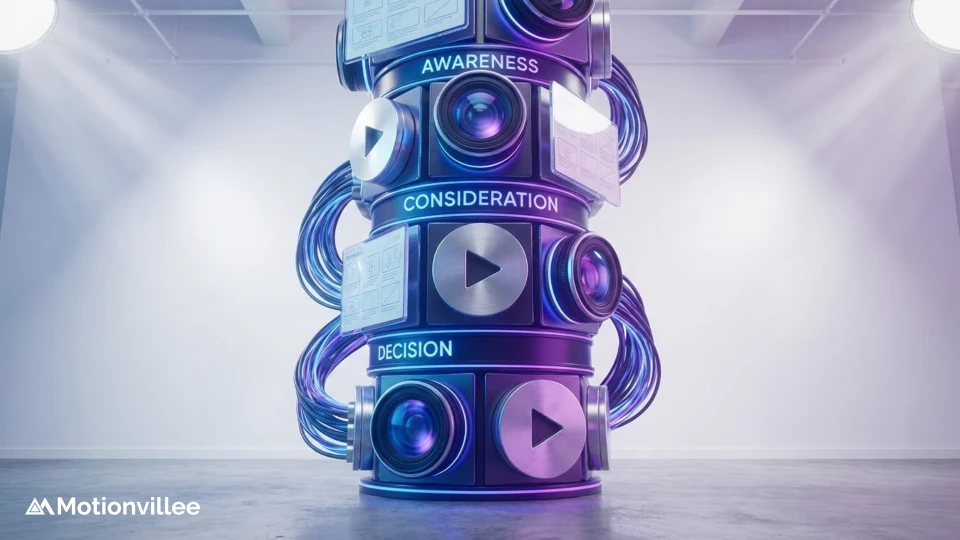
A full-funnel video system creates distinct videos for awareness, consideration, and decision stages, each addressing the specific psychological and informational needs of prospects at that stage.
Understanding the Three Critical Funnel Stages
Top of Funnel (Awareness): Prospect recognizes they have a problem but doesn’t know solutions exist. Video should validate the problem and introduce that solutions exist. Positioning about you or your product is premature.
Middle of Funnel (Consideration): Prospect knows problems and solutions exist. They’re exploring options. Video should explain your specific approach, positioning you against alternatives. This is where differentiation matters.
Bottom of Funnel (Decision): Prospect is evaluating you specifically against 2-3 alternatives. Video should remove final objections, establish trust, and give confidence to commit. This is where proof and specificity matter most.
Top of Funnel: Capturing Attention Without Wasting Budget
Top-of-funnel video captures attention by validating prospect pain and introducing solutions. “Your team spends 40 hours monthly on manual tasks that could be automated.” This opening creates recognition without mentioning your product.
Awareness videos work for all audiences because they address universal problems, not product-specific benefits. They work on social media because they don’t feel promotional. They work in cold outreach because they’re genuinely useful.
Middle of Funnel: Nurturing Prospects Who Aren’t Ready to Buy
Middle-of-funnel video nurtures prospects by explaining your specific approach and differentiating against alternatives. “Unlike manual approaches, our solution uses AI to eliminate errors while your team focuses on strategy.”
Consideration videos position your unique value. They’re ideal for email nurture sequences where prospects are actively researching. They’re ideal for landing pages where prospects have shown buying interest but aren’t ready to commit.
Bottom of Funnel: Removing Final Objections Before the Close
Bottom-of-funnel video removes final objections by showing implementation details, proving success, and establishing confidence. Product demo video showing exactly how your solution works is ideal for bottom-of-funnel deployment.
Decision videos address specific concerns: “Implementation takes one day, not weeks.” “Integration with Salesforce is native and requires zero customization.” These specific answers remove hesitation and accelerate closing.
How Multiple Video Versions Multiply Your Conversion Power
Different versions of your core message adapted for different audiences, platforms, and funnel stages create multiple conversion pathways and increase total conversion rates substantially.
- Awareness to Consideration Pipeline: Prospect watches awareness video about manual process pain. Impressed, they click to learn more. They encounter consideration video explaining your approach. Conversion increases because they’re guided through journey, not dropped at single decision point.
- Platform-Specific Engagement: Same core message adapted for LinkedIn (2-minute professional version), email (90-second version), and website (3-minute comprehensive version) increases reach. Prospects on different platforms encounter the format optimized for that platform.
- Audience Segment Adaptation: Same funnel stages created for different personas (CMO version, CTO version, VP Finance version) speak directly to each decision-maker’s concerns. Segmented messaging converts higher than generic messaging.
- Sales Enablement Variations: Awareness videos for cold outreach. Consideration videos for email sequences. Decision videos for demo follow-ups. Each version serves specific sales process step, reducing sales team burden.
- Mobile vs Desktop Optimization: Same message optimized for mobile viewing (shorter, larger text, vertical format) and desktop viewing (longer, detailed, horizontal format) ensures quality experience across devices. Optimal viewing experience increases completion rates and conversion.
- Retargeting Asset Library: Different versions allow retargeting across channels. Prospects who saw awareness video see consideration video in email. Prospects who watched consideration video see decision video in ads. Sequential exposure increases conversion through familiarity and progression.
The Awareness Stage Video: Building Recognition Fast
Awareness stage video builds recognition by naming the specific problem your target audience faces, validating that the problem is real and costly, and positioning that solutions exist without mentioning your product.
- Open With Problem Recognition: “Your team manually enters data 10,000 times monthly, creating errors and wasting 50 hours.” Problem statement creates immediate relevance. Prospects think “this is about me.”
- Establish Problem Cost: “Those errors cost $200K annually in compliance fines and rework. Those 50 hours represent $50K in team productivity lost monthly.” Cost establishment creates urgency without being pushy.
- Introduce Solution Class: “There’s a better way. Solutions exist that eliminate manual entry entirely.” This introduces possibility without claiming your product is the only answer.
- Position for Consideration: “Explore whether automation could transform your workflow.” Soft CTA moves interested prospects to consideration stage. No pressure for immediate action.
- Keep It Short: Awareness videos work best at 60-90 seconds. Longer engagement from awareness audiences is rare. Short, punchy messaging gets highest completion and shares.
The Consideration Stage Video: Proving You Understand Their Pain
Consideration stage video proves you understand prospect pain deeply by addressing specific pain points, explaining your unique approach, and differentiating against typical solutions they’re already considering.
- Acknowledge Awareness: “You know manual data entry is costing you. You’re exploring solutions.” This acknowledgment shows you understand their stage in the journey.
- Explain Your Approach: “We use AI trained on your industry data to capture entries automatically while a human expert validates accuracy.” Specific approach explains what makes you different.
- Compare to Alternatives: “Traditional RPA automates at 80% accuracy requiring 20% manual review. Our approach achieves 99% accuracy in first capture, eliminating review.” Direct comparison shows why your approach is superior.
- Show Proof: “Enterprise clients see error reduction of 95% and cost savings of $100K+ annually.” Proof with numbers is more credible than testimonials.
- Invite Deeper Exploration: “Ready to see exactly how this would work for your workflow? Schedule a 15-minute walkthrough.” Specific CTA moves qualified prospects to decision stage.
- Optimal Length: Consideration videos work at 2-2.5 minutes. Enough time for detailed explanation without overwhelming. Completion rates stay high at this length when positioning is strong.
The Decision Stage Video: Giving Buyers Confidence to Commit
Decision stage video gives buyers confidence to commit by showing implementation specifics, removing implementation concerns, and establishing clear path to success and value realization.
- Answer Implementation Questions: “Implementation takes one week. We handle all setup and training. You’re live and productive in day 8.” Specific implementation timeline removes uncertainty.
- Show The Solution In Action: Walk through your actual interface showing how the solution works for their specific use case. Real product walkthrough builds confidence that you have a real solution.
- Address Integration Concerns: “We integrate natively with Salesforce, HubSpot, and your existing systems. Zero custom development required.” Native integration removes technical barriers.
- Show Customer Success: “Customer like you implemented in week one, saw 60% error reduction within 30 days, and achieved full ROI in month four.” Specific success timeline from similar customer builds confidence.
- Make the Commitment Easy: “Next step is a 30-minute implementation planning call. We’ll show you your exact timeline and answer any remaining questions. No commitment required.” Friction-free next step removes final hesitation.
- Optimal Length: Decision videos work at 3-4 minutes. Buyers ready to decide will watch detailed content because they’re motivated to make informed decision. Completion rates at this length are highest because urgency to understand is highest.
Why One Production Creates Six Strategic Assets
Strategic video production creates six distinct assets from one core production: full-length version, short social version, email version, mobile version, and platform-optimized variations, multiplying reach and impact.
| Asset Type | Length | Platform Use | Purpose | Format Optimization |
|---|---|---|---|---|
| Full-Length Version | 3-4 minutes | Website, landing page, sales presentation | Comprehensive explanation | Horizontal, high-quality audio, detailed |
| Social Short Version | 30-60 seconds | LinkedIn, Twitter, Facebook ads | Hook attention, drive to full version | Vertical and horizontal, attention-grabbing opening |
| Email Version | 90-120 seconds | Email nurture sequences | Education without overwhelming | Hosted on CDN, fast loading, mobile-optimized |
| Mobile-Optimized | 60-90 seconds | Mobile website, social feeds | Viewing on smartphones | Vertical, large text, no tiny details |
| Audiogram/Quote Card | 15-30 seconds | Social media, Stories, Reels | Teaser to full video | Audio clip with visual design, shareable |
| Subtitled Version | Varies | All platforms, accessibility | Reach viewers who mute video or are deaf | Burned-in or soft subtitles, professional |
Repurposing Smart: Maximum ROI From Single Investment
Strategic repurposing extracts maximum value from video production by creating multiple versions with minimal additional production cost, multiplying reach and conversion pathways exponentially.
One core video production (3-4 minutes) costs $5,000. Creating six versions through editing and optimization costs additional $1,000-$1,500. Total investment: $6,500 for six distinct assets instead of $30,000 if producing each separately.
Six assets deployed across different channels, platforms, and funnel stages reach more prospects, create more touchpoints, and generate multiple conversion opportunities. One video gets ignored by some audiences. Six versions adapted for different channels and stages reach and convert multiple audience segments.
Platform-Specific Optimization That Actually Converts
Different platforms have different algorithms, audience expectations, and viewing contexts requiring optimization specific to each platform to maximize visibility and engagement.
LinkedIn Native Video: Upload videos natively (not YouTube links). Add compelling caption above video. LinkedIn algorithm prioritizes native videos. Optimal length 2-2.5 minutes. Add CTAs directly in video.
YouTube Optimization: Title includes target keyword. Detailed description includes transcript and links. Custom thumbnail increases click-through 30%. Add chapters to long videos. Include cards and end screens directing viewers to next video.
Email Video Placement: Embed thumbnail image with play button (not autoplay video). Video hosting on CDN for fast loading. 90-120 second versions work best. Include fallback CTA for email clients that don’t support video.
Website Homepage: Full-length version above fold. Autoplay muted so it runs without user action. Include clear CTA below video for viewers who complete. Ensure video loads quickly on mobile.
The Data Behind the 40% Faster Close Rate
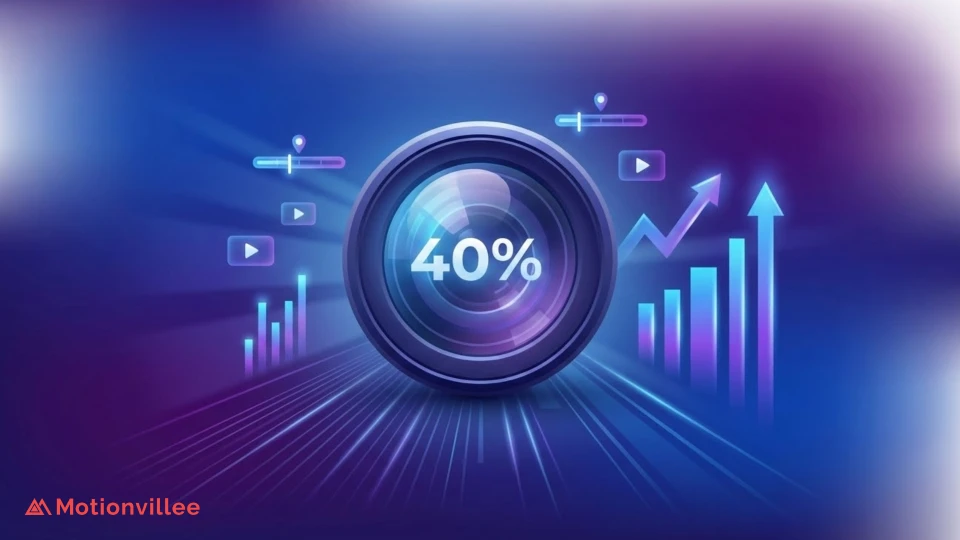
Companies implementing full-funnel video systems see sales cycle compression from 90 days to 54 days average, driven by faster prospect education and reduced sales team friction throughout the process.
Baseline: Without strategic video, a prospect moves through sales funnel in predictable timeline. 1-2 Week: awareness call with sales rep. 3-4 Week: first conversation with specialist. 5-8 Week: demo and evaluation. 9-13 Week: negotiation and close.
With full-funnel video: 1-2 Week: prospect watches awareness video independently and schedules consideration meeting already educated. 2-3 Week: consideration conversation is faster because prospect already understands problem and your approach. 3-4 Week: prospect watches decision video and has specific implementation questions instead of basic questions. 4-6 Week: negotiation and close, compressed because uncertainty is eliminated.
Pipeline Velocity Metrics That Matter
Track these specific metrics to measure full-funnel video impact: days from first touchpoint to demo booking, days from demo to contract signature, percentage of prospects moving from awareness to consideration without sales conversation, and demo-to-close conversion rate.
Companies see 30-40% reduction in days at each stage when video handles stage-appropriate education. Top performers see 40%+ reduction in total cycle time because video acceleration compounds across all stages.
How Video Shortens the Education Phase
Education traditionally happens in conversations with sales reps over weeks. Sales rep must explain problem, explore prospect situation, position solution, address objections, and build confidence. Each step requires a conversation. Process takes 6-8 weeks.
With strategic video, education happens in advance of conversations. Prospect watches awareness video independently. They watch consideration video when interested. They watch decision video when evaluating. Conversations become confirmation of what they already understand, not education. Conversations compress from 6-8 weeks to 2-3 weeks.
Reducing Sales Team Friction Through Visual Proof
Sales reps face two friction points: unqualified prospects consuming time and knowledgeable prospects questioning reps’ credibility. Strategic video addresses both.
Unqualified prospects self-select out by not watching videos. Qualified prospects educate themselves through videos. Reps spend time on qualified prospects, not unqualified ones. Knowledgeable prospects see professional videos demonstrating credibility before talking to reps. Reps start conversations with credibility established instead of needing to prove themselves.
What Sets Motionvillee’s Approach Apart From Generic Video Agencies
Motionvillee builds full-funnel video systems aligned with your specific sales process, not generic videos hoping to work everywhere.
SaaS-Specific Expertise That Speaks Your Language
We specialize in B2B SaaS, not general corporate video. We understand your sales cycle, your buying committee, your typical objections, and your competitive landscape. Our videos speak SaaS language because we’ve built 100+ videos for SaaS companies.
We know what positioning works for SaaS buyers, which messaging converts faster, and where objections typically emerge. This expertise translates to videos that work harder and convert better than generic agency approach.
Strategic Placement: Putting Videos Where Decisions Happen
We don’t just create videos and hope you deploy them correctly. We specify exactly where each video deploys and why: awareness videos in cold outreach because they start education. Consideration videos in email sequences because they nurture already-interested prospects. Decision videos in sales presentations because they close deals.
We provide deployment guides for your sales and marketing teams. Specific guidance ensures videos are actually used where they’re most effective, not left unused because teams don’t know how to deploy them.
Funnel-Aligned Messaging Instead of Creative Experiments
We don’t approach video as creative opportunity where we experiment with new formats and hope something works. We approach video as strategic tool aligned to your sales process and buyer psychology.
Every video serves specific purpose at specific funnel stage. Every message aligns with what prospects need to know at that moment. This alignment makes videos work harder and convert better than creative-first approach.
The Production Process That Protects Your Timeline
Our production process maps your sales process first, then creates videos aligned to that process, ensuring videos are strategically sound before production begins.
Discovery Phase: Mapping Videos to Your Actual Sales Process
We start by understanding your sales process intimately. Where do prospects enter? What questions emerge at each stage? What objections do salespeople hear repeatedly? And what information would shorten cycles if available earlier?
We map specific videos to specific process steps. First Video A goes in cold outreach. Video B goes in email sequence after first call. Video C goes in sales presentation before objection handling. And video D goes in contract review conversation. This mapping ensures videos address real process needs, not imagined ones.
Execution Phase: Creating Assets That Work Together
Once videos are mapped to process, we create them strategically. We script awareness videos with specific opening hooks that work in cold outreach. And we script consideration videos with positioning language that resonates with your actual competitive landscape.
We coordinate messaging across all videos so viewers encounter consistent positioning whether they watch one video or
six. And we plan for asset variations during initial production so creating versions costs minimally.
Deployment Phase: Integration That Sales Teams Actually Use
We don’t deliver videos and disappear. We work with your teams to integrate videos into actual workflows. And we provide training on when and how to deploy each video. We create templates for email sequences, sales decks, and outreach materials showing where videos go.
Sales team adoption determines ROI. We ensure adoption by making deployment as easy as copying a link into an email or clicking a button in your presentation software. Friction-free deployment means adoption.
Real Client Results: Case Studies in Accelerated Closes
Our clients see consistent patterns: 30-40% sales cycle compression, 25-35% improvement in demo-to-close conversion, and 40-50% reduction in sales calls needed to close similar deals.
B2B SaaS Company: From 90-Day to 54-Day Sales Cycles
Enterprise SaaS company with $2M ARR target, 90-day average sales cycle, and 15% demo-to-close conversion. Challenge: long cycles were losing deals to faster competitors and costing too much in sales resources.
We created full-funnel system: awareness videos for cold outreach eliminating unqualified prospects, consideration videos in email sequences positioning their unique approach, decision videos in sales presentations addressing implementation concerns.
Result: 54-day average sales cycle (40% faster), 22% demo-to-close conversion (47% improvement), same sales team closing 35% more deals without headcount addition. ROI: $4,000/month revenue increase from faster cycles, $60K annual savings from reduced sales friction.
Fintech Startup: Doubling Demo-to-Close Conversion
Fintech startup with $500K ARR target, 60-day sales cycle, and 8% demo-to-close conversion struggling to scale sales because conversion was too low to support growth targets. Challenge: complex product required extensive education before prospects felt ready to commit.
We created layered decision-stage videos: one addressing integration concerns, one addressing regulatory concerns, one addressing implementation timeline. Sales team deployed different videos based on which concerns specific prospects expressed.
Result: 16% demo-to-close conversion (100% improvement), 50-day average sales cycle, prospects felt more confident committing because video addressed their specific concerns. ROI: $250K additional ARR from improved conversion, immediate impact on revenue growth.
Common Objections and Why They Don’t Apply Here
Companies hearing about full-funnel video systems often raise three concerns that don’t hold up when examined against data and implementation reality.
“We Already Have a Video”
Having one video is like having one sales collateral for all funnel stages. One demo video addresses awareness prospects poorly and doesn’t educate them properly. One product video doesn’t accelerate already-interested prospects toward closing.
The question isn’t whether you have video. The question is whether you have video for each stage and each audience segment. Most companies have one generic video. Full-funnel system requires three-four strategic videos per audience segment minimum.
“Our Sales Process Is Too Complex for Video”
Complex sales processes with multiple stakeholders, multiple objections, and extended timelines benefit most from video because video handles specialized education more efficiently than sales team.
If your sales process is complex, you have stakeholder-specific concerns. Video can address each stakeholder’s specific concerns without needing salespeople to explain to each stakeholder separately. Video scales complex education better than salespeople.
“We Need to See ROI Before Investing”
Fair concern, but full-funnel system generates ROI quickly through sales cycle compression and demo-to-close improvement. Average client sees positive ROI within 90 days of deployment.
If you’re closing 10 deals monthly at $50K average value, 40% cycle compression worth $200K in accelerated revenue. If conversion improves 30%, that’s worth additional revenue equivalent to 3 additional deals monthly. Both happen from strategic video deployment.
Implementing the Full-Funnel System in Your Organization
Implementation follows three sequential phases: strategy and planning, video production, and deployment and optimization.
Starting Points for Different Company Stages
Early-Stage Startups (under $1M ARR): Start with awareness and decision videos. These are highest-leverage for scaling early sales. Add consideration videos once you have consistent pipeline. Timeline: 8 weeks to full system. Investment: $6,000-$10,000.
Growth-Stage Companies ($1M-$10M ARR): Start with consideration and decision videos. Awareness is handled by paid ads and partnerships. Add persona-specific variations of each stage video. Timeline: 10-12 weeks to full system. Investment: $12,000-$18,000.
Enterprise Companies ($10M+ ARR): Build modular system with 2-3 videos per stage, 3-4 personas per stage, with localization for different markets. Timeline: 16-20 weeks to comprehensive system. Investment: $25,000-$40,000.
Integration With Existing Sales and Marketing Tools
Video deployment requires integration with tools your teams already use: email platform for nurture sequences, CRM for sales process integration, website platform for landing pages, and presentation software for sales decks.
We provide technical guidance on integrating videos into each platform. We create templates showing exactly how to embed videos and where CTAs should go. And we ensure seamless integration so teams use videos naturally within existing workflows.
Getting Started: What to Expect in Your First 90 Days
Week 1-2: Discovery and strategy. We understand your sales process, buyer personas, typical objections, and competitive positioning. We map which videos serve which functions.
Week 3-4: Planning and messaging. We develop key messaging themes and script outlines for each video based on your sales process and positioning.
Week 5-10: Production. We create awareness, consideration, and decision videos with multiple versions planned from the start.
Week 11-12: Deployment training and launch. We train your sales and marketing teams on when and how to deploy each video. We provide templates and implementation guides.
Week 13+: Monitoring and optimization. We track deployment, measure conversion impacts, identify optimization opportunities, and iterate based on early results.
Moving From Generic Video to Strategic Systems
The shift from one-off video to full-funnel system represents a fundamental change in how you approach video marketing. Instead of hoping one video somehow addresses all audiences and all stages, you’re strategically designing video system that guides prospects through your specific sales process.
This approach requires more planning upfront but generates disproportionate returns through faster cycles, higher conversion rates, and reduced sales friction. Companies implementing full-funnel systems consistently see 30-40% sales cycle compression and 25-35% conversion improvement.
At Motionvillee, we specialize in building full-funnel video systems for B2B SaaS companies. We combine SaaS expertise with strategic video approach to create systems that actually accelerate your sales process. We measure success by your sales outcomes, not by creative awards. If you’re ready to move beyond generic videos to strategic systems, schedule a consultation to discuss how full-funnel video system could accelerate your specific sales process.