
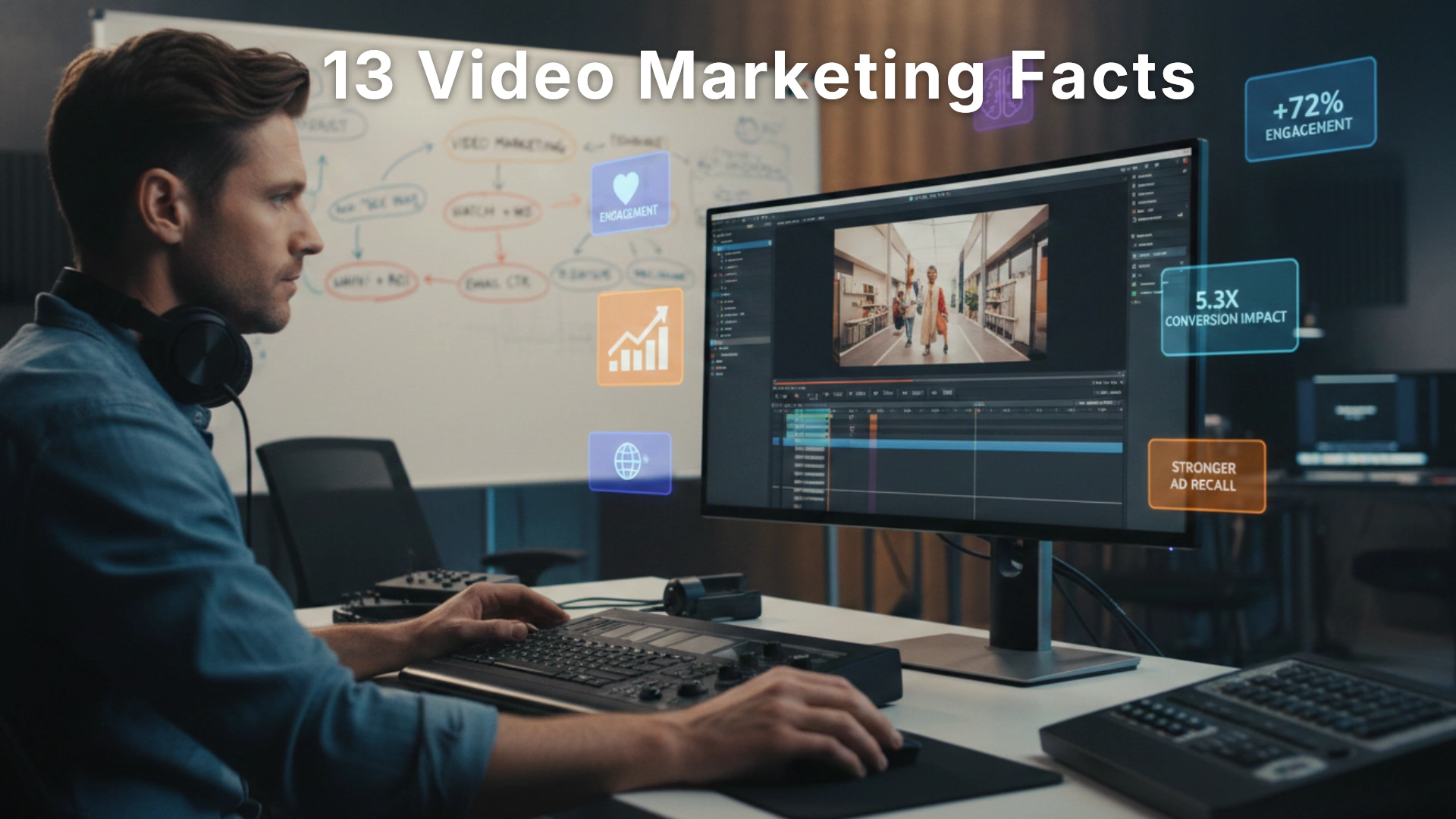
13 Video Marketing Facts
Opinions about video marketing are everywhere. Facts are rarer. This post gives you 13 verified facts pulled from primary research conducted across 2025 and 2026, each one selected because it changes how a B2B marketing team should think about their next video decision.
No filler. No recycled assumptions. Just video marketing facts that matter.
1. 78% of B2B Marketers Currently Use Video, and 56% Plan to Increase Investment Within the Next Year
Video is no longer an emerging tactic. It is the dominant content format across B2B marketing and the fastest-growing area of budget allocation.
MarketingProfs’ analysis of B2B video marketing, citing the 2025 B2B Marketing Benchmark Report from LinkedIn and Ipsos, a market research firm, found that these figures hold true for industries and company sizes alike. The gap between brands that use videos strategically and those that make videos reactively is growing more quickly than the overall adoption gap. For B2B marketing videos, it is no longer enough for you to simply show up. It is how you show up that matters.
2. Marketers With a Video Strategy Are 2.2 Times More Likely to Have a Well-Trusted Brand
Trust is the primary purchase barrier in long B2B sales cycles. Video addresses it faster and more durably than any other content format.
Search Engine Journal’s analysis of B2B marketing trends,Citing LinkedIn’s benchmark data from 1,500 senior B2B marketers, they found that this 2.2x trust advantage held true regardless of industry or business size. This study also confirms that the way to achieve that trust is through personal video from founders or subject-matter experts instead of brand-produced content. This is because people trust people before they trust logos.
3. LinkedIn Video Uploads Grew More Than 20% in 2025, With Comments Up 24% in the Same Period
LinkedIn has become the primary B2B video distribution platform, and its growth rate is still accelerating.
Hootsuite’s 2026 social media trends report found these figures alongside confirmation from LinkedIn’s Director of Product that the platform is currently expanding its video visibility in search results. For social video content targeting B2B decision-makers, LinkedIn is currently where professional buying attention is concentrated most densely, and LinkedIn’s roadmap is doubling down on that fact.
4. 46% of Marketers Now Identify Video as Their Single Most Important Content Type
Video has moved from one format among many to the primary content asset in the majority of marketing strategies.
Social Media Examiner’s 2025 Social Media Marketing Industry Report, The survey was conducted on thousands of survey respondents, all being marketing professionals, and it was discovered that nearly half of all marketers now consider video to be their most important form of content. This is a figure that is almost certain to be higher for B2B marketers in particular, thanks to the dominance of LinkedIn and the trust factor that video provides.
5. B2B Creative Video Campaigns Generate 6-7 Times the ROI of Generic Corporate Video Content
The return on creative ambition in B2B video is now documented. Campaigns that break category conventions outperform those that follow them.
Ad Age’s year-in-review of the most effective B2B campaigns of 2025 found that the strongest B2B creative content consistently used humor, humanity, and brand voice to beat the category average. Buyers watching this content don’t leave their emotions behind when evaluating potential vendors. Paid ad video content that resonates with a buyer’s real-life situation performs better than content that only resonates with their professional persona.
6. Spotify’s Spreadbeats Campaign Won Nine Lions at Cannes 2024, Proving B2B Video Can Compete at the Highest Creative Level
B2B video is no longer defined by low creative ambition. The best B2B video now competes directly with the best consumer advertising on earth.
Campaign Live’s coverage of the most awarded US work at Cannes Lions 2024 This was confirmed by Spreadbeats from FCB New York, which won nine Lions, including a Digital Craft Grand Prix. The campaign is a B2B video made entirely within a Microsoft Excel spreadsheet and targets media planners using a form they use every single day. The campaign is still the most awarded B2B campaign in the world from 2024 to 2025.
7. 84% of B2B Marketers Say LinkedIn Delivers the Best Value of Any Social Media Platform
For B2B brands, the platform debate is over. LinkedIn is where audience quality, buying power, and content performance converge.
Backlinko’s B2B marketing statistics guide,citing Content Marketing Institute data, found that 84% of B2B marketers rate LinkedIn as the best value social media platform for their businesses. The top three video marketing channels for B2B marketers are LinkedIn at 70%, Facebook at 66%, and Instagram at 66%. For every B2B explainer video or thought leadership video, the social media channel of choice is LinkedIn.
8. 87% of People Say They Have Been Convinced to Buy or Download Software After Watching a Video
Video is not just an awareness driver. It is a documented purchase trigger used at the decision stage by the overwhelming majority of buyers.
Ahrefs’ content marketing statistics guide Found this figure and confirmation of the fact that short form video is the highest-performing type of content for B2B and B2C brands in 2024. This one fact alone is enough to end all discussion inside a B2B brand’s organization about whether or not a video for a product demo is worth creating. This is the form of content consumers use the most when making a decision.
9. Video Content Increases Website Dwell Time, Which Search Engines Treat as a Direct Quality Signal
Embedding video on your landing pages and blog posts is not a UX enhancement. It is an SEO decision with measurable ranking impact.
Semrush’s content marketing trends analysis found that engaging video content keeps visitors’ attention and increases the amount of time spent on a page, and search engines see this as a sign of quality and valuable content, thus favoring higher rankings. Video production services for B2B brands mean that hosting finished video content on high-traffic pages boosts the ROI for every video production.
10. 92% of Marketers Plan to Maintain or Increase Their Video Marketing Spend in 2026
Near-universal confidence in video’s commercial returns means budget cuts in this category are now the outlier, not the norm.
Sprout Social’s 2026 Social Media Marketing Statistics report discovered this figure in addition to being able to confirm that short-form social video is seen to provide the best ROI of all video content for B2B marketers at 41%. This is not a confidence in investment based on wishful thinking. This is a confidence in investment based on actual data from several consecutive years.
11. 88% of B2B Buyers Watched Videos to Learn About a Company’s Products in the Previous Three Months
Video is embedded in the B2B buying process itself. Buyers are researching through video before they ever contact sales.
Indeed’s career development guide on demographics and psychographics in marketing It also reiterates the significance of grasping the motivations behind buyer behavior is key to successful targeting. The behavior is also crystal clear: “B2B buyers are doing video-first research on their own.” If you are not creating videos, you are not participating in the research process of the vast majority of your buyers.
12. Video Can Increase a Company’s Customer Base, Improve Engagement, and Improve Search Rankings Simultaneously
No other single content format delivers across awareness, engagement, conversion, and SEO at the same time.
Nutshell’s guide to B2B video marketing documents this multi-outcome advantage for B2B use cases. Videos expand audiences, extend audience engagement, boost visibility on search engines, and can be disseminated on almost every available channel from email and social media to YouTube and product review sites. The compound effect of these benefits means every B2B marketing video created will continue to earn its keep long after the production costs have been recovered.
13. 85% of Videos on Facebook Are Watched With the Sound Off, and 98% of All Video Views Come From Mobile Devices
Mobile-first, sound-off viewing is the default context for most video content. Production teams ignoring this are producing for an audience that no longer exists.
Shopify’s business insights on video and social media It describes a reality of mobile viewing that impacts every production decision: Aspect ratios, caption placement, hook creation, and thumbnail creation must be designed for a user holding a phone and scrolling silently. For social video content within B2B, a video that does not have captions and does not have a strong visual hook within the first three seconds is not underperforming. It is, in effect, invisible to most of its potential audience.
Key Takeaways
- 78% of B2B marketers currently use video, and 56% plan to increase investment within the next year. Being present in video is no longer a differentiator. Strategic execution is.
- Marketers with a video strategy are 2.2x more likely to have a well-trusted brand, the most commercially significant documented advantage in B2B content marketing.
- LinkedIn video uploads grew over 20% in 2025 and LinkedIn is the highest-performing channel for 84-85% of B2B marketers. The platform priority conversation is settled.
- 46% of all marketers now name video their single most important content type, the highest share ever recorded.
- 87% of people have been convinced to buy software after watching a video. A product demo video is not optional for B2B SaaS brands. It is the format buyers use to make final decisions.
- 92% of marketers are maintaining or increasing video spend in 2026. Budget confidence in video has never been higher across the industry.
- 85% of Facebook video and the vast majority of social video is watched with sound off. Captions and visual hooks are not production extras. They are baseline requirements.
- B2B creative video generates 6-7x the ROI of generic corporate video. Creative ambition is a commercial decision, not just a brand preference.