
Why Is AI Video Quality So Hard to Judge?
AI video quality is hard to judge because many AI videos look finished before they are actually useful.
The visuals may look clean. The voice may sound polished. The captions may be accurate. But the video can still fail if the message is weak, the product explanation is unclear, or the CTA does not match buyer intent.
That matters because AI adoption in video is rising quickly. Wyzowl reports that 63% of video marketers have used AI tools to help create or edit marketing videos, while 91% of businesses use video as a marketing tool [Wyzowl, 2026]. The limitation is that this is survey data, not a controlled study of AI video performance. (Wyzowl)
Motionvillee is an AI video production company for SaaS, tech, cybersecurity, fintech, and finance brands that need video to support buyer clarity, trust, and measurable business outcomes. For broader expectations, read AI video production quality
What Affects AI Video Production Quality the Most?
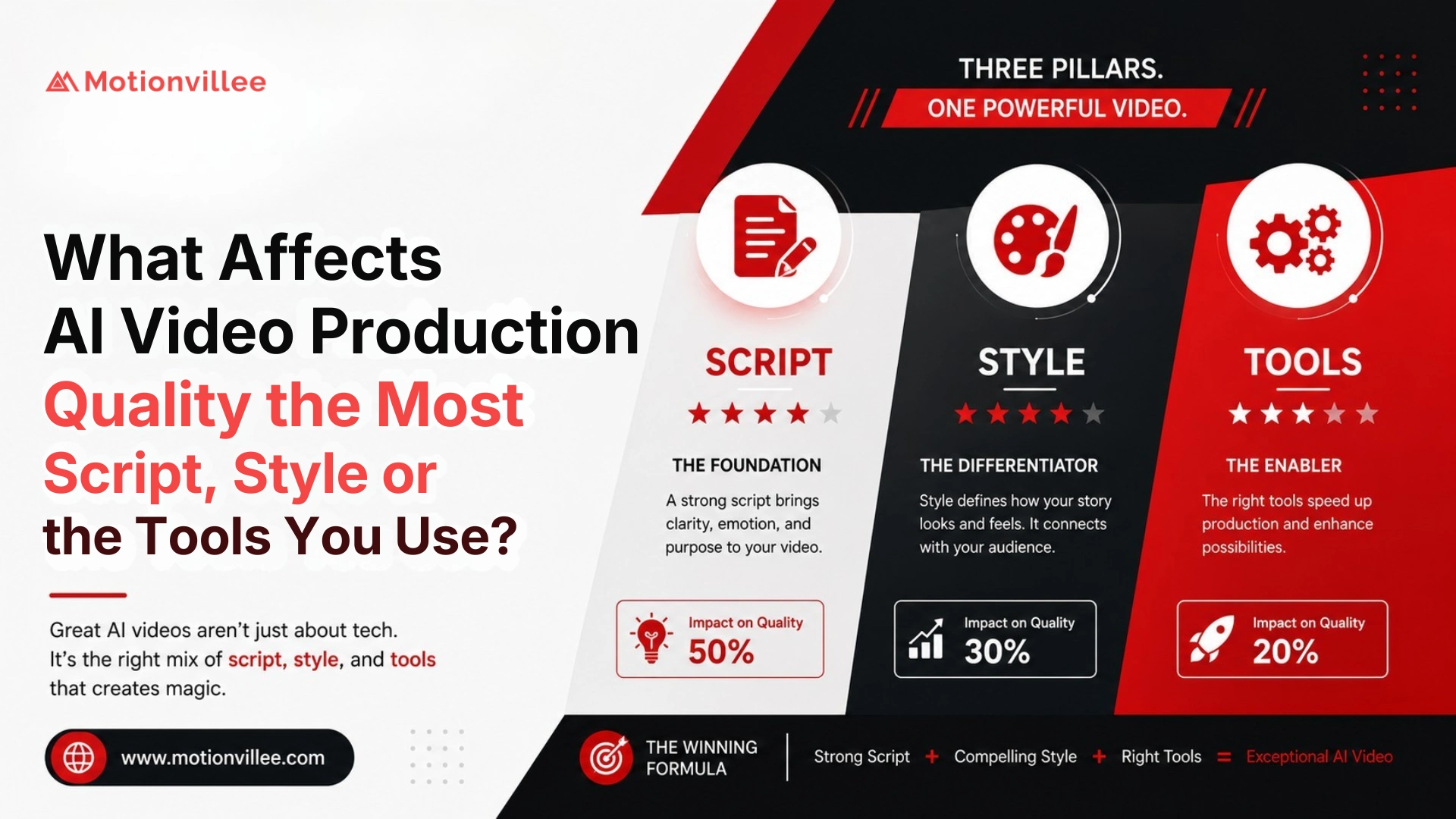
The script usually affects AI video production quality the most because it controls the message, structure, pacing, and CTA.
Style comes second because it controls trust, brand fit, and visual clarity. Tools come third because they affect execution, but they cannot fix a weak message or unclear direction.
| Quality driver | Impact on final video |
| Script | Decides what the video says and why it matters |
| Style | Decides how trustworthy and clear the video feels |
| Tools | Decide how efficiently the video can be produced |
| Human review | Decides whether the final output is accurate and usable |
This ranking is a Motionvillee planning model based on business video review patterns, not a public benchmark. The reason it is useful is simple: most weak AI videos do not fail because of software alone. They failed because the message was unclear before production started.
What Factors Affect AI Video Production Quality?
AI video production quality is affected by the brief, script, video style, tool choice, product accuracy, human review, and final polish.
If one of these is weak, the final video can look finished but still feel generic, unclear, or hard to trust.
| Quality factor | How it affects the video |
| Brief clarity | Gives AI the right direction before production starts |
| Script quality | Controls the message, hook, structure, and CTA |
| Visual style | Decides whether the video feels branded and credible |
| Tool choice | Affects avatar, voice, visuals, editing, and exports |
| Product accuracy | Protects trust in SaaS, fintech, and tech videos |
| Human review | Fixes weak logic, wrong claims, and brand mismatch |
| Channel fit | Decides whether the video works for ads, website, sales, or training |
IAB reported that 86% of video ad buyers were using or planning to use generative AI to build video ad creative [IAB, 2025]. That shows AI is moving into mainstream ad production, but it does not prove that tool generated output is strategically strong by default. (IAB)
The best AI tool cannot save a weak script.
Why the Script Has the Biggest Impact
The video script has the biggest impact because it decides whether the video has a clear business purpose.
A strong script gives the AI clearer direction. A weak script creates generic output, even when the AI video tools are advanced.
A weak AI video might open with: “Our platform helps teams work smarter.” That sounds polished, but it gives the buyer no specific reason to keep watching.
A stronger script starts with a specific buyer problem, shows why it matters, explains the product change, adds proof, and gives the viewer a clear next step. That structure directly affects pipeline value because buyers understand the offer faster.
This is also where many AI video production mistakes begin: the team changes tools before fixing the core message.
What Should a Strong AI Video Script Do?
A strong AI video script should make the message clear before production starts.
It should answer: who is this for, what problem are they facing, why does it matter, what does the product change, what proof supports the claim, and what should the viewer do next?
Good AI video script quality usually means one core message, simple language, a clear problem setup, feature to outcome translation, and a CTA that fits the buyer stage.
This is a business judgment, not a production preference. A clear script can improve demo clicks, sales usage, landing page clarity, and customer education because it removes friction from the buyer’s understanding.
How a Weak Script Damages AI Video Quality
A weak script damages AI video quality because AI tools follow the direction they are given.
If the script is vague, visuals become vague. If the script has too many ideas, the video feels crowded. If the CTA is unclear, the ending feels weak.
Common script problems include generic openings, feature dumping, no buyer pain, no proof, repetitive narration, weak CTA, and overused AI phrasing.
HubSpot’s 2026 State of Marketing research argues that AI increased content volume, but differentiation and clear brand point of view became more important as content became easier to create [HubSpot, 2026]. This supports the idea that message clarity now matters more, although the report covers marketing broadly, not AI video only. (HubSpot State of Marketing 2026)
Why Video Style Matters After the Script
Video style matters because it decides whether the message feels credible, branded, and easy to follow.
Even with a strong script, the wrong AI video production style can make the final asset feel generic or low trust. Style affects brand colors, layout, typography, visual hierarchy, avatar choice, product UI treatment, and scene relevance.
A professional video style does not need to be complex. It needs to make the message easier to understand.
For example, a SaaS product explainer with random tech visuals may look modern but explain nothing. A cleaner visual system with product accurate scenes can support buyer confidence because the viewer sees how the product connects to their problem.
As an AI video production company, Motionvillee treats style as a trust signal, especially for public facing videos used on websites, paid campaigns, and sales touchpoints.
Where AI Visual Style Often Breaks
AI visual style often breaks when teams use too many generated elements without creative control.
Common issues include inconsistent characters, random backgrounds, mismatched scenes, overused stock visuals, unrealistic avatars, generic tech imagery, too many floating icons, and visuals that look polished but do not explain the message.
IAB’s consumer research found a gap between advertiser confidence in AI ads and consumer comfort with them [IAB, 2026]. That does not mean AI visuals should be avoided, but it does suggest that trust and disclosure expectations matter when AI is used in public facing advertising. (IAB)
The practical lesson: style should support the message, not compete with it.
Do AI Tools Decide Video Quality?
AI video tools affect execution quality, but they do not decide the strategy.
Tools matter for avatar realism, voice quality, editing control, captions, export formats, repurposing, and speed. But tools do not decide who the video is for, what the viewer should understand, or what business action should happen next.
Vidyard’s 2025 benchmark report analyzed nearly 1 million B2B videos, showing how widely video is now used across business communication [Vidyard, 2025]. It is useful B2B context, but it does not isolate which AI tool produces the best quality. (Vidyard)
A strong team can get useful output from a simple tool if the brief and script are clear. A weak brief can make even a premium tool produce generic work.
Script vs Style vs Tools: Which One Matters Most?
For most business videos, the priority is script first, style second, tools third, and human review throughout.
| Factor | If it is strong | If it is weak |
| Script | Message is clear and useful | Video feels generic |
| Style | Video feels credible and branded | Video feels inconsistent |
| Tools | Production is faster and cleaner | Output is harder to control |
| Human review | Final video is accurate and usable | Errors reach the audience |
This priority can change by video type. An AI avatar video depends heavily on script and delivery. A product demo depends on script and product accuracy. A paid ad depends on hook, CTA, and testing. A website explainer needs script, style, and brand polish.
For budget decisions across quality levels, read AI video production budget comparison
What Human Review Adds to AI Video Quality
Human review turns AI output into a business ready video.
It checks whether the product claims are accurate, the buyer problem is clear, the visuals support the message, the CTA fits the funnel, the captions are correct, and the final asset is safe to publish.
This matters most for enterprise sales, compliance sensitive categories, technical products, and high trust landing pages. In those cases, one inaccurate claim or generic message can weaken confidence before a buyer speaks to sales.
What Should You Fix First When AI Video Quality Feels Weak?
Start with the script before changing tools.
First, fix the core message. Then clarify the buyer problem, remove extra ideas, strengthen the CTA, simplify the visual style, check product accuracy, improve delivery, and only then test a better tool.
That order matters because a better tool helps only after the message and direction are clear.
If the video still feels weak after script and style review, compare whether a tool led approach or partner led approach fits the use case. For that decision, read AI tool vs AI video production agency
Checklist: How Can You Improve AI Video Quality?
Use this checklist before approving an AI video.
| Question | What it checks |
| Is the message clear in the first few seconds? | Script quality |
| Does the video focus on one main idea? | Message control |
| Are the visuals consistent? | Style quality |
| Does the voice feel natural enough? | Delivery quality |
| Is the product explained accurately? | Trust |
| Does the style match the brand? | Brand fit |
| Is the CTA specific? | Business outcome |
| Are captions and formats correct? | Final readiness |
| Would this work on the intended channel? | Distribution fit |
This is not a scientific scoring model. It is a practical approval system for marketing teams that need AI video to support business outcomes, not just content volume.
Final Takeaway: What Matters Most for AI Video Quality?
The biggest driver of AI video quality is usually the script.
The script gives the video meaning, structure, and purpose. The style makes that message feel professional and trustworthy. The tool helps produce the video faster and cleaner. Human review decides whether the final asset is ready to publish.
So the better question is not:
“Which AI video tool will make this look good?”
It is:
Is the message clear, is the style controlled, and is the tool right for this video’s business job?
Yes. For this blog, the proof of work should show that Motionvillee can judge why an AI video works or fails, not just say “script matters.”