
What Brief Did We Give to Both?
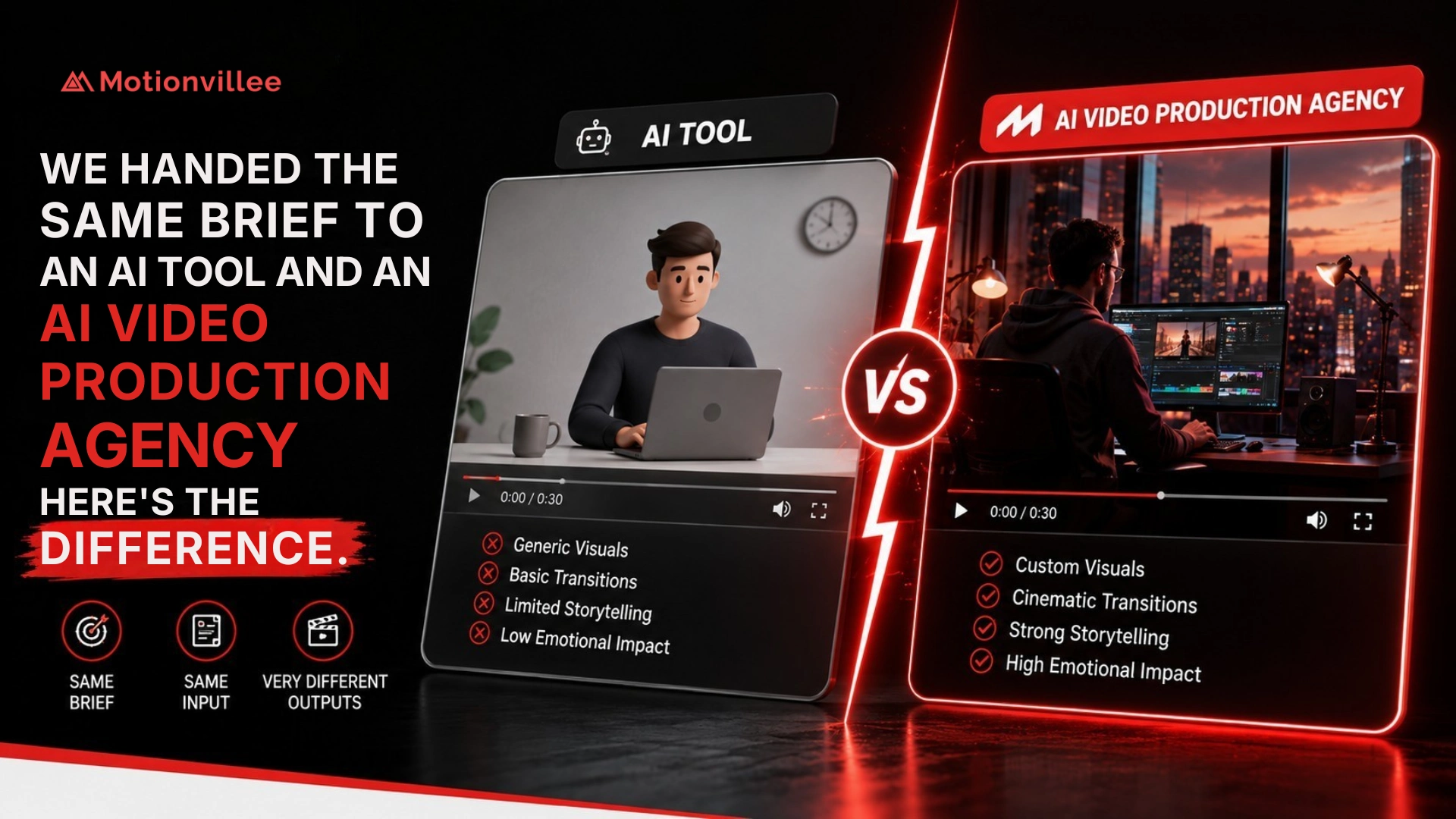
We gave the same brief to an AI tool and an AI video production agency because most businesses compare them only by price. That misses the bigger question: which output is more useful for the business?
Here is the sample brief we used for the comparison.
| Brief element | Details |
| Video type | 60 second B2B product explainer |
| Target audience | Marketing leaders at mid market companies |
| Buyer problem | Teams struggle to explain product value clearly across campaigns and sales conversations |
| Core message | A clear explainer video helps buyers understand the product faster |
| Funnel stage | Solution aware |
| CTA | Book a product demo |
| Brand direction | Clear, professional, simple, and buyer focused |
| Final use | Website, sales follow up, LinkedIn, and email nurture |
This made the comparison fair. The goal, audience, message, CTA, duration, and final use stayed the same.
The timing matters because AI video use is no longer a small experiment. Wyzowl reports that 63% of video marketers used AI video tools to help create or edit videos, while 91% of businesses use video as a marketing tool [Wyzowl, 2026]. This is survey data, so it shows adoption, not guaranteed business value. (Wyzowl)
Motionvillee brings 15+ years of B2B explainer video experience to AI video production, helping teams turn AI supported output into clearer business videos
What We Expected Before the Comparison
We expected the AI video tool to win on speed and the agency to win on strategy. The real difference was how each handled the brief.
The tool moved quickly from input to output. That was expected.
The agency took longer at the start because it reviewed the brief before production.
The difference was not only production quality. It was decision quality.
The tool created a video from the brief. The agency questioned, sharpened, and prioritized the brief before creating the video.
What the AI Tool Did With the Brief
The AI tool was good at creating fast output, but it treated the brief mostly as an instruction.
It produced a first draft quickly, created a basic script structure, suggested template visuals, offered AI voice or avatar options, created a simple scene flow, and prepared exports faster than a manual route.
That is useful when your team already knows the message and needs fast execution.
The limitation was buyer context. The tool used what it was given, but it did not reliably decide which parts of the brief mattered most to a marketing leader, sales team, or high value buyer.
IAB reported that nearly 90% of advertisers were using or planning to use generative AI for video ads, and buyers projected generative AI creative could reach 40% of all ads by 2026 [IAB, 2025]. This supports AI adoption in video ads, but it does not show that AI output is always strategically ready. (IAB)
What the AI Video Production Agency Did With the Brief
The agency treated the brief as a starting point, not the final direction.
The agency clarified the buyer problem, challenged vague sections, tightened the message, reworked the hook, planned the storyboard around buyer understanding, checked product accuracy, aligned the CTA to the funnel stage, and planned final formats.
This made the final output more useful for marketing and sales because the video had a clearer business role.
The core difference was simple: the tool created output, while the agency made decisions before output.
Difference 1: Brief Interpretation
The AI tool followed the brief. The agency improved the brief.
| Area | AI tool | AI video production agency |
| Brief handling | Follows input directly | Reviews and improves direction |
| Missing context | Often guesses | Identifies gaps |
| Buyer pain | Uses what is given | Sharpens the problem |
| Message priority | May include everything | Chooses what matters most |
| CTA | Adds a generic next step | Matches CTA to funnel stage |
This is the first answer to what happens when the same brief goes to AI and an agency: the tool responds, while the agency reframes.
Difference 2: Script Quality
The AI tool helped with speed. The agency helped with clarity.
The AI tool created a script quickly, but parts of it felt broad. The agency script was more specific because it focused on buyer pain, message order, product relevance, proof, CTA, and pacing.
This matters because script clarity influences whether buyers understand the product and whether sales can use the asset confidently.
For a deeper breakdown of script, style, and tool quality, read what affects AI video production quality
Difference 3: Storyboard Logic
The AI tool created scenes that looked logical. The agency created scenes that had a communication job.
| Scene type | AI tool output | Agency output |
| Problem scene | Generic pain point | Specific buyer situation |
| Product scene | Shows tool or dashboard | Shows product solving the problem |
| Feature scene | Lists capability | Connects feature to outcome |
| Outcome scene | Broad benefit | Clear business result |
| CTA scene | Standard ending | Natural next step |
This difference matters because buyers judge whether your company understands their problem before they ask for a demo.
Difference 4: Visual Style and Product Accuracy
The AI tool made the video look finished. The agency made the video feel more intentional.
The AI video tool produced visuals quickly, but the style felt more template based. The agency output had stronger control over brand colors, typography, scene consistency, product screens, visual hierarchy, and on screen text.
Product accuracy was another major difference. The AI tool worked with the information given. If the brief lacked detail, it made assumptions.
The agency was more likely to check product workflow, claims, screens, use cases, and sensitive wording before turning them into visuals.
IAB’s 2026 report says nearly two in three buyers now use GenAI for digital video creative, up from half in 2025, while buyers still want humans involved in the process [IAB, 2026]. That supports the need for review, not blind automation. (IAB)
For broader expectations, read AI video production quality
Difference 5: Revision Quality
AI tools are fast for small edits. Agencies are stronger when feedback affects strategy, structure, or buyer clarity.
The AI tool made quick edits easier. But deeper revisions became harder when the first structure was weak.
The agency handled revisions with more context because the video had a clearer foundation. Script changes, scene changes, product corrections, brand feedback, CTA refinements, and format changes were easier to manage.
This is where many AI projects lose time. The first output is fast, but unclear direction creates review loops later.
Difference 6: Final Business Use
The final question was not which version was faster. It was which version the business could use confidently.
| Use case | AI tool output | Agency output |
| Internal update | Good fit | Good fit, often more than needed |
| Simple social video | Good fit | Strong fit |
| Paid ad | Needs review | Stronger fit |
| Website explainer | Risky if generic | Better fit |
| Sales follow up | Limited | Stronger fit |
| Product launch | Risky | Better fit |
| Complex product video | Weak fit | Stronger fit |
Vidyard’s 2025 benchmark report analyzed nearly 1 million B2B videos, which shows how widely video is used across business communication [Vidyard, 2025]. It is not an AI tool comparison study, but it supports why business use matters beyond simply producing more video. (Vidyard)
What the AI Tool Did Better
The AI tool was better when speed, simplicity, and low risk execution mattered.
It was useful for fast first drafts, lower upfront cost, quick version testing, internal communication, simple social experiments, captioning, resizing, and draft concepts.
An AI video tool is enough when the team already has a clear message, the video is low risk, and the audience does not need deep product explanation.
What the Agency Did Better
The agency was stronger when the video had to influence buyer understanding, brand trust, or sales action.
The biggest advantages were brief interpretation, stronger script, clearer storyboard, better product accuracy, stronger brand fit, more useful revisions, and campaign ready versions.
This is the core AI video production agency difference: the agency adds judgment around the tool.
Motionvillee brings human scripting, review, and creative direction into AI video production so the final asset is clearer, more accurate, and easier for marketing and sales teams to use.
Should I Use an AI Video Tool or Agency?
Choose based on business risk, not only price.
| Question | Better fit |
| Do you already have a strong script? | AI tool |
| Is the video only for internal use? | AI tool |
| Is the product simple to explain? | AI tool or freelancer |
| Does the video need to drive demos? | Agency |
| Will sales use it with prospects? | Agency |
| Does the video need product accuracy? | Agency |
| Is brand trust important? | Agency |
| Do you need campaign ready versions? | Agency or hybrid |
This is the practical answer to should I use an AI video tool or agency. Use the tool when execution is the main need. Use an agency when interpretation, clarity, and trust matter.
Avoid comparing only price, expecting a tool to solve strategy, using DIY output for high trust campaigns without review, ignoring internal cleanup time, and choosing tools before defining the video’s job. These are common AI video production mistakes that turn fast output into slow rework.
Final Takeaway: Can AI Tools Replace Video Agencies?
AI tools can replace some simple production tasks, but they do not replace the strategic judgment needed for high trust business videos.
So can AI tools replace video agencies? For simple drafts, internal updates, and low risk content, they can reduce the need for external production support.
But for website explainers, paid campaigns, product launches, sales assets, and complex product videos, the better question is not is an AI video agency better than an AI tool.
It is:
How important is this video to buyer trust, sales clarity, and business growth?
The AI tool created a video faster.
The agency created a stronger business asset.