
How Long Does AI Video Production Usually Take?
An AI video production timeline can range from 1 to 3 days for simple cutdowns to 2 to 4 weeks for a business ready hybrid video.
The uncomfortable truth is that AI can create output quickly, but business videos still need decisions. Your team still needs a clear goal, approved message, product accuracy, brand fit, stakeholder feedback, and final review.
Wyzowl’s 2026 report says 91% of businesses use video as a marketing tool, and 63% of video marketers have used AI tools to help create or edit videos [Wyzowl, 2026]. This shows AI is now part of mainstream video work, but it does not prove every video can be delivered overnight. The survey is useful directional evidence, not a full market census. (Synthesia)
| AI video type | Typical timeline | Why it takes this long |
| AI social cutdown | 1 to 3 days | Uses existing content |
| AI avatar video | 2 to 5 days | Needs script, avatar, voice, review |
| AI product update video | 4 to 7 days | Needs product accuracy and edits |
| AI edited webinar clips | 3 to 7 days | Needs clip selection and captions |
| AI assisted explainer video | 1 to 3 weeks | Needs script, storyboard, visuals, review |
| Hybrid AI plus custom video | 2 to 4 weeks | Needs creative direction and polish |
These ranges are Motionvillee planning estimates based on production scope. Public timeline benchmarks for AI video agencies are limited because most work is quoted by brief, format, and review depth.
Motionvillee is an AI video production company that helps B2B brands use faster production workflows without skipping the human checks that protect buyer clarity and brand trust. For budget planning, read AI video production cost
Why AI Video Production Is Faster Than Traditional Production
AI video production is faster because it reduces repeated manual effort, especially in drafts, captions, versions, and repurposing.
AI can help speed up script options, voiceover tests, rough edits, captions, social cutdowns, resizing, and alternate versions. It can also reduce dependence on live shoots for some formats.
IAB reported that nearly 90% of advertisers were using or planning to use generative AI for video ads in 2025, and projected that generative AI could be used in 40% of all ads by 2026 [IAB via TVTechnology, 2025]. That is a strong signal that brands are using AI because speed and scale are now competitive pressures. The limitation is that the study is advertiser focused, not a direct production timeline study. (TV Tech)
AI can reduce production time when the video job is repeatable. It does not remove strategic decisions.
Why AI Video Production Still Takes Time
AI video production still takes time because business videos need accuracy, clarity, brand control, and approval.
AI can produce output quickly, but not every output is ready for a website, sales sequence, product launch, or paid campaign. A video can be fast and still fail if the message is unclear or the product explanation is wrong.
Wyzowl reports that 89% of consumers say video quality impacts their trust in a brand [Wyzowl, 2026]. That finding does not prove longer timelines always create better results, but it does support the business risk of publishing weak or generic video output. (Synthesia)
As an AI video production company, Motionvillee treats timeline as a quality control decision, not only a speed target.
What Happens From Brief to Final Video?
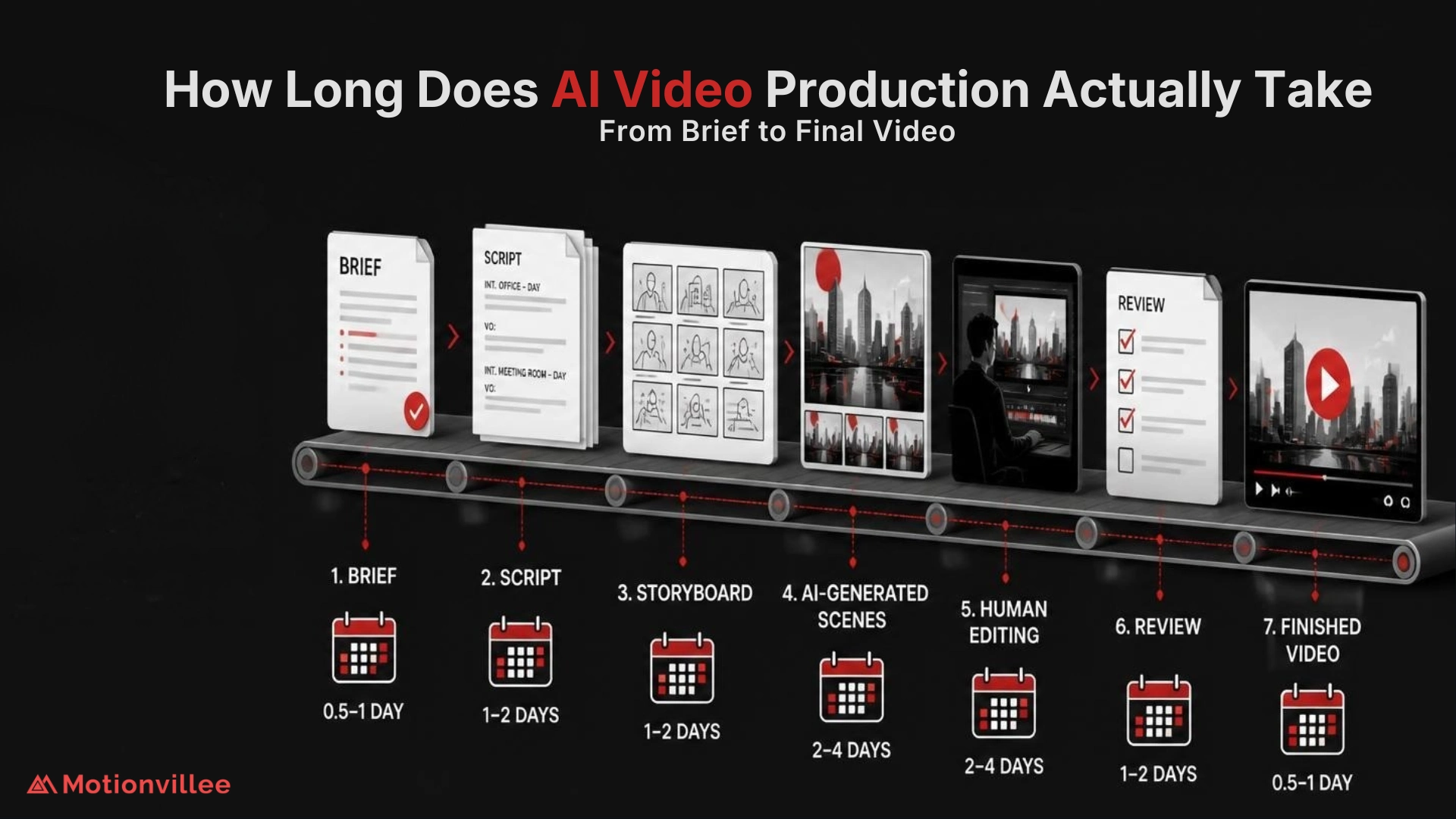
The AI video production process timeline usually includes brief, script, storyboard, AI production, editing, review, and final delivery.
| Stage | Typical timeline | Business purpose |
| Brief and direction | 1 to 3 days | Aligns goal, audience, CTA, channel |
| Script | 1 to 5 days | Turns the message into a clear buyer story |
| Storyboard | 2 to 5 days | Checks whether the visual logic supports the message |
| AI production | 2 to 7 days | Builds the first usable video version |
| Editing | 2 to 5 days | Makes the asset usable across formats |
| Review and revisions | 2 to 7 days | Protects accuracy, brand fit, and stakeholder confidence |
| Final delivery | 1 to 2 days | Exports campaign ready assets |
This gives most teams a realistic window of 1 to 3 weeks for a strong AI assisted business video. That estimate assumes the brief is clear and feedback is consolidated.
The biggest mistake is treating AI production as the whole timeline. It is only one part of the video turnaround time.
What Happens During the Brief Stage?
The brief stage usually takes 1 to 3 days because it decides the direction of the entire video.
This stage defines the audience, video goal, funnel stage, core message, product details, CTA, brand tone, format, channel, and required versions.
A weak brief creates delays later because AI tools need specific direction to produce useful output. This is an inference from production planning, not a published benchmark. When the brief is vague, teams usually spend more time reviewing, rewriting, and correcting outputs.
For Motionvillee, an AI video production partner for B2B brands, the brief is not admin work. It is where timeline risk is reduced before production starts.
What Happens During Script and Storyboard?
Script and storyboard can take 3 to 10 days together, depending on complexity and stakeholder feedback.
AI can create faster first drafts, but the final script still needs human judgment. The script decides whether the buyer understands the problem, the product, the proof, and the next step.
Storyboard planning matters most when the video explains a complex SaaS product, financial product, cybersecurity service, or technical workflow. AI can suggest scene ideas, but humans still need to check whether the flow makes business sense.
Vidyard’s 2025 Video in Business Benchmark Report analyzed more than 1 million B2B videos and found that businesses are creating video at significant scale [Vidyard, 2025]. That supports the need for repeatable production systems, but it does not isolate AI only timelines. (Vidyard)
What Delays AI Video Production the Most?
AI video production is usually delayed by unclear decisions, not the tools themselves.
Common delays include an unclear brief, too many messages in one video, late script changes, changing product details, too many stakeholders, scattered feedback, missing brand assets, voiceover changes after editing, late compliance review, and requests for new versions after the final edit.
This is where AI video production mistakes becomes relevant. Most delays are process issues, not AI tool issues.
The key point: most timeline delays happen before or after AI production, not inside the AI tool.
Timeline by AI Video Production Method
Different methods create different timelines because urgency, review depth, and business risk are not equal.The best route depends on what the video needs to achieve. A simple internal update can move fast. A sales enablement video needs clarity and proof. A website hero video needs stronger polish because it affects first impression and trust.
For deeper testing on timing, use AI video production time study
Can AI Video Production Be Completed in 24 to 48 Hours?
Yes, AI video production can be completed in 24 to 48 hours when the scope is simple, short, and based on approved content.
This works best for social clips, internal updates, simple avatar videos, captioned short videos, webinar clips, and basic product announcements.
It is not ideal for complex explainers, website hero videos, product launches, high trust sales videos, multiple stakeholder projects, or videos that need detailed planning.
The real question is not how fast can AI videos be produced. It is whether the fast version is good enough for the business moment.
Fast AI video production can work for simple formats, but complex SaaS videos need enough time for message clarity, product accuracy, and final review.
Premium SaaS Explainer Video for Product Marketing | Motionvillee
Does AI Always Reduce Video Production Time?
AI does not always reduce time if the team uses it without a clear workflow.
AI can create more drafts, more options, and more versions. That can increase review work when nobody filters the output. Weak prompts can also create generic scripts, inaccurate product details, inconsistent visuals, and stakeholder confusion.
TechRadar reported in 2026 that demand for AI video creation services increased 66% in the second half of 2025, citing rising business interest in AI video across marketing and internal communication [TechRadar, 2026]. This shows demand is rising, but it does not prove every AI video project becomes faster. (TechRadar)
The better question is what affects AI video production timeline. The answer is scope, approvals, content readiness, quality expectations, and review discipline.
How to Shorten the Timeline Without Hurting Quality
A clear brief saves more time than any AI tool.
Choose one audience. Approve one core message. Prepare brand assets early. Share product screenshots or demo access. Confirm the CTA. Limit stakeholders. Give consolidated feedback. Avoid script changes after storyboard approval. Decide formats before editing. Use AI where it fits the video job.
Quality still matters. Wyzowl’s finding on video quality and trust suggests that faster production should not come at the expense of brand confidence [Wyzowl, 2026]. For more on that tradeoff, read what affects AI video production quality . (Synthesia)
Final Takeaway: How Long From Brief to Final Video?
The answer to how long from brief to final video depends on the business risk of the asset.
A simple AI video may take a few days. A business ready AI assisted video may take 1 to 3 weeks. A hybrid AI plus custom video may take 2 to 4 weeks.
So instead of asking only how long does AI video production take, ask:
How much planning, review, and polish does this video need to create the right business outcome?
Motionvillee brings 15+ years of production experience to AI video production, helping brands move faster without turning speed into a quality risk.