
What VSL Length We Tested and Why
We tested three versions of the same B2B VSL script because most advice about VSL length is too generic.
Some teams assume a shorter video sales letter will always perform better because buyers have less time. Others believe a longer sales video works better because it gives more room for proof, objections, and persuasion.
Both views are incomplete.
B2B buyers do not drop off only because a video is long. They drop off when the next section does not give them a reason to keep watching.
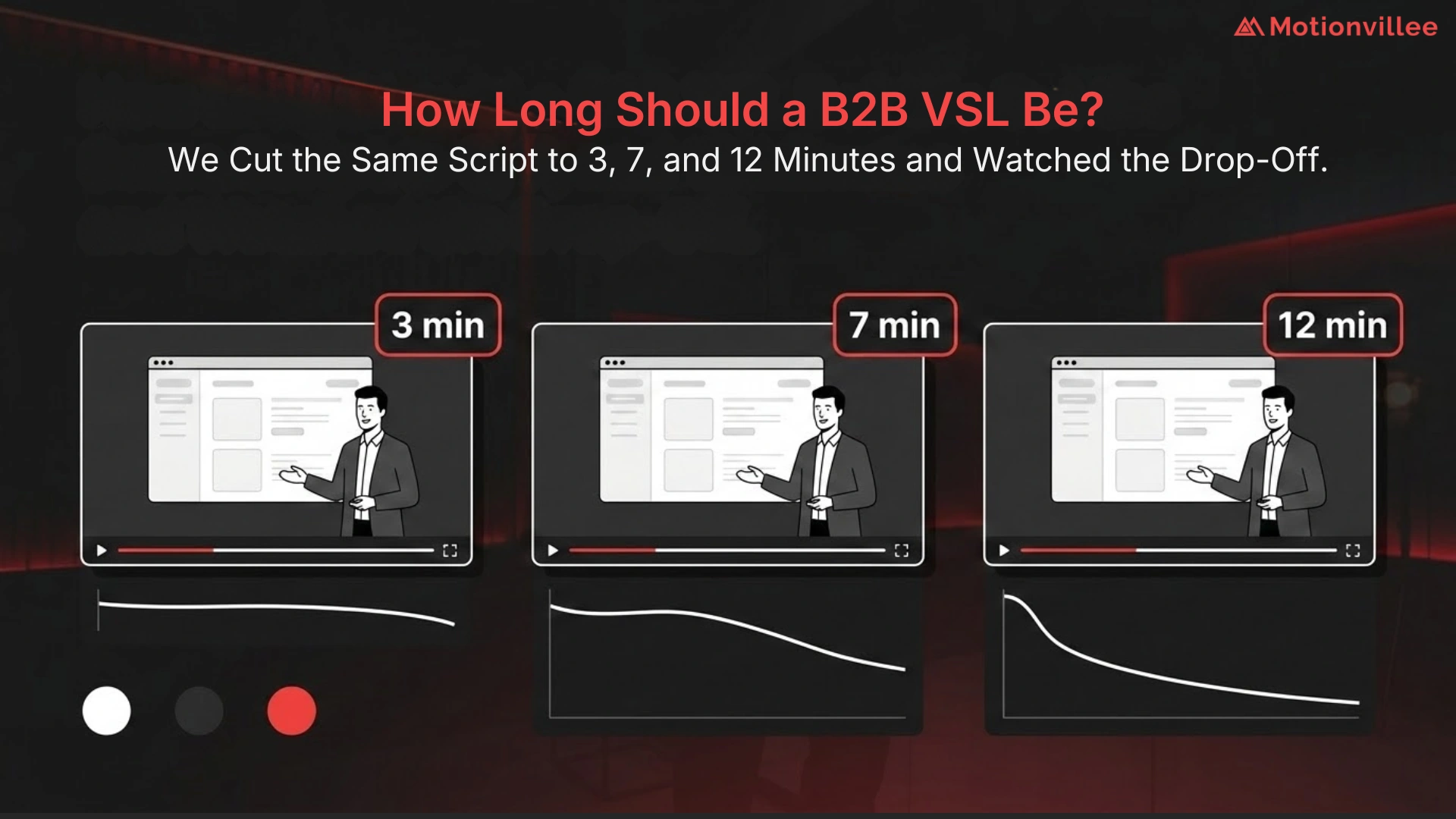
That is why we cut the same script into three versions: 3 minutes, 7 minutes, and 12 minutes.
The goal was to see how length changed attention, message clarity, proof, CTA timing, and perceived business value.
Why B2B VSL Length Matters Now
B2B VSL length matters because buyers are doing more research before they speak to sales.
Gartner reports that 67% of B2B buyers prefer a rep free experience [Gartner, 2026]. This does not mean buyers never want sales help. It means content must answer more questions earlier in the journey.
A VSL has to explain the problem, show why it matters, introduce the offer, build trust, handle doubt, and make the next step feel worth taking.
If the video is too short, it may create interest but not enough confidence.
If it is too long, it may give more detail but lose attention before the strongest proof appears.
So the real question is not only, “how long should a VSL be?”
The better question is:
How much does this buyer need to understand before they are ready to move?
How We Cut the Script Into 3, 7, and 12 Minutes
We kept the core message the same across all three versions.
The audience, offer, main problem, proof angle, and CTA stayed consistent. What changed was depth.
| Version | What Stayed | What Changed |
| 3 minute VSL | Problem, offer, one proof point, CTA | Reduced story, objections, and detail |
| 7 minute VSL | Problem, offer, proof, objections, CTA | Balanced clarity and persuasion |
| 12 minute VSL | Full problem setup, proof, objections, CTA | Expanded context, examples, and decision support |
This helped us compare video sales letter length without changing the entire message.
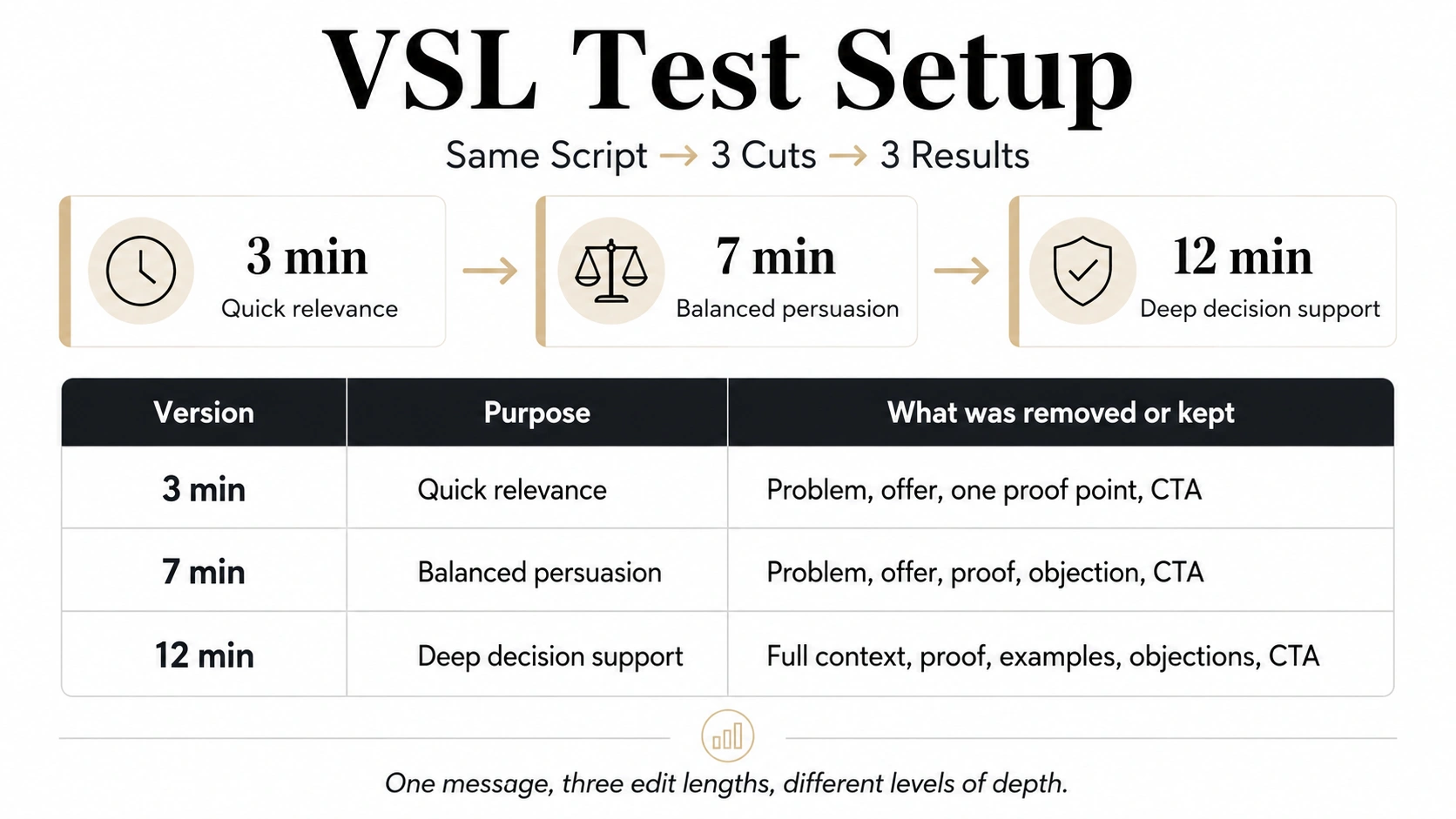
Test setup: We kept the same core VSL message and changed only the depth of the 3, 7, and 12 minute versions.
What Happened With the 3 Minute VSL
The 3 minute VSL moved fast and was easier to finish.
It worked best when the buyer already understood the problem or only needed a quick reason to care.
The opening felt sharper. The CTA arrived faster. The message was easy to scan mentally. But the proof section felt compressed, and objections were mostly skipped.
Vidyard reports that videos under one minute retain 65% of viewers to the end, while videos longer than 20 minutes retain 20% [Vidyard, 2024]. This supports the value of shorter formats for attention, but it does not prove shorter videos always convert better.
The 3 minute version was strong for retargeting, simple offers, warm audiences, and quick lead qualification.
Its weakness was confidence.
It created interest, but for complex offers, it did not always give buyers enough proof to act.
What Happened With the 7 Minute VSL
The 7 minute VSL gave the message more space without making the video feel heavy.
It had enough time to explain the problem, introduce the offer, show proof, handle one or two doubts, and guide the viewer to the CTA.
This version worked best for problem aware and solution aware buyers.
It was long enough to create trust, but short enough to avoid unnecessary repetition.
In our review, this felt like the strongest middle option for VSL marketing because it balanced buyer education with attention risk.
The 7 minute version was not automatically better. It worked because each section had a job.
- Problem.
- Cost of inaction.
- Offer.
- Proof.
- Objection.
- CTA.
That structure kept the message moving.
What Happened With the 12 Minute VSL
The 12 minute VSL had the most room for explanation, but also the highest risk of drop off.
It worked only when the viewer had strong intent or the offer needed deeper education.
The extra time helped with proof, examples, objections, risk reversal, and decision support. But the longer version became weaker when the setup repeated the same pain point or delayed proof for too long.
The lesson was important:
Do long VSLs work for B2B? Yes, but only when the extra time adds new buyer value.
A 12 minute VSL should feel like chapters, not one long pitch.
If the viewer keeps learning something useful, the length can support the decision. If the message repeats itself, the video feels longer than it is.
What the Drop Off Data Showed
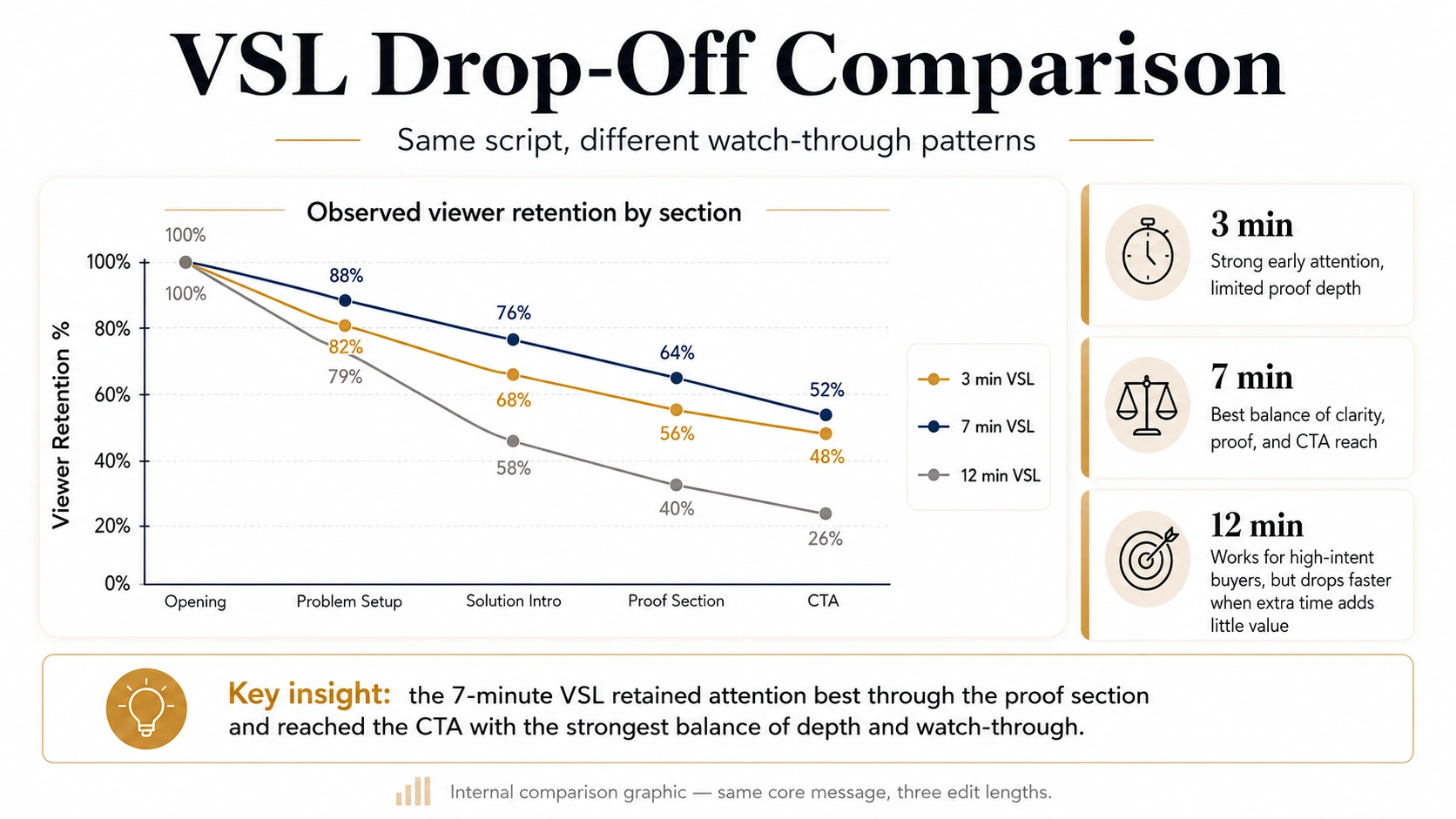
The biggest drop off pattern was not tied to a specific timestamp.
It happened when the video stopped moving the idea forward.
Viewers dropped off during slow brand introductions, generic problem setup, repeated claims, delayed proof, feature explanations without buyer context, and CTAs that arrived after attention had already fallen.
This connects with a broader conversion issue: many videos do not fail because they are too long, but because they delay relevance. B2B Video Best Practices: Why Most Video Ads Fail to Convert explains that pattern from the paid video side.
The key finding was simple:
Every minute has to earn the next minute.
The Main Difference Between the 3 Lengths
| Factor | 3 Minute VSL | 7 Minute VSL | 12 Minute VSL |
| Best fit | Quick interest | Consideration | Serious evaluation |
| Buyer stage | Early to mid funnel | Mid funnel | Mid to late funnel |
| Strength | Fast clarity | Balanced persuasion | Deep education |
| Weakness | Limited proof | Needs tight pacing | Higher drop off risk |
| Best CTA | Learn more or book intro | Book demo or view offer | Schedule call or request proposal |
| Main risk | Too shallow | Repetition | Too much setup |
This answers what is the best length for a VSL more accurately than giving one fixed number.
The best length depends on buyer intent, offer complexity, and decision risk.
How to Structure a B2B Video Sales Letter
The structure should match the buyer’s readiness.
A 3 minute VSL should focus on one problem, one promise, one proof point, and one CTA.
A 7 minute VSL should add context, objection handling, and a stronger proof section.
A 12 minute VSL should include deeper education, more examples, risk reduction, and decision support.
| Buyer Situation | Better Length |
| Buyer is cold and barely problem aware | 3 minutes |
| Buyer knows the problem and wants context | 7 minutes |
| Buyer is evaluating a complex solution | 7 to 12 minutes |
| Buying committee needs proof | 12 minutes |
| Offer is simple and low risk | 3 minutes |
| CTA is a proposal or strategy call | 7 to 12 minutes |
This is also the practical answer to is a 3 minute VSL better than 12 minutes.
It depends on what the buyer already understands.
How to Justify VSL Investment Internally
A longer VSL needs a stronger business case.
Wyzowl reports that 82% of marketers say video has given them a good ROI [Wyzowl, 2026]. Content Marketing Institute also found that 61% of B2B marketers expected investment in video to increase in 2025 [CMI, 2025].
Those figures support video investment broadly, but they do not prove that every long VSL is worth producing.
The internal case should focus on where the VSL will be used:
Landing page conversion.
Webinar follow up.
Sales nurture.
Retargeting.
Proposal support.
Demo intent.
If the VSL will support multiple funnel stages, the investment becomes easier to defend. For CFO level planning, 13 Data Points Your CFO Needs to See Before Approving Video Production Budget is useful when connecting video cost to measurable business outcomes.
How One VSL Script Can Become Multiple Funnel Assets
One strong VSL for B2B marketing can become several assets.
A 12 minute version can support high intent landing pages. A 7 minute version can support webinar follow up or nurture. A 3 minute version can support retargeting. A 60 second cut can support social. A 30 second cut can support paid ads.
Proof clips can support sales follow up. Objection clips can support email sequences.
This matters because the best length for B2B sales video is not always one final cut.
Often, the strongest approach is one core message adapted by buyer intent.
What We Found After Cutting the Same Script Into 3 Lengths
After cutting the same script into 3, 7, and 12 minute versions, the biggest lesson was clear:
The best length is not the shortest version.
It is the shortest version that gives the buyer enough clarity and confidence to act.
The 3 minute version worked when the buyer needed quick relevance.
The 7 minute version worked when the buyer needed context and proof.
The 12 minute version worked when the buyer needed deeper confidence.
So instead of asking how long should a B2B VSL be, ask:
How much does this buyer need to understand before they are ready to move?
Motionvillee helps B2B teams turn complex offers into clear video assets that support buyer understanding, sales conversations, and pipeline. For teams that need a strategic video partner before production starts, explore Motionvillee as an Explainer Video Company