
Why Linear Funnels Are Dead: The Non-Linear Buyer Journey Framework for B2B Video
Your buyers aren’t following your funnel anymore. They’re jumping between awareness and decision stages, consuming content in unpredictable patterns, and making purchase decisions through messy, non-linear paths you can’t control.
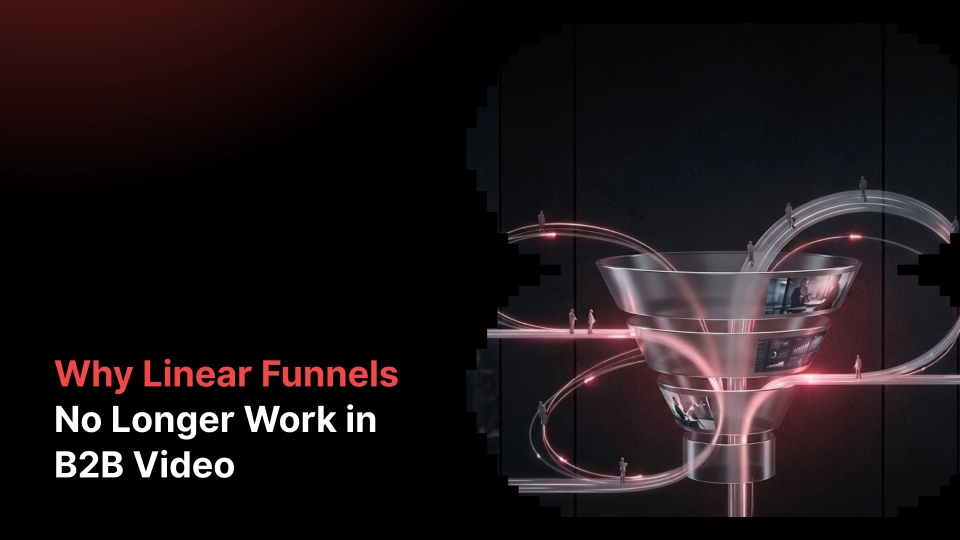
The traditional linear funnel (awareness → consideration → decision) assumes buyers move in straight lines. But in 2026, the non-linear buyer journey B2B reality looks completely different. Your prospects watch a case study video before your explainer. They read competitor comparisons after booking demos. They revisit your homepage five times across three months.
Linear funnels are dead. Here’s the framework that replaces them.
What Is the Non-Linear Buyer Journey in B2B?
The non-linear buyer journey is the unpredictable, multi-touchpoint path buyers actually take before purchasing, jumping between awareness stages without following traditional funnel logic.
Unlike linear funnels that predict sequential movement, non-linear journeys acknowledge reality. Your buyers consume content in loops. They enter at different stages. They move backward and forward unpredictably.
This matters for video strategy because most B2B companies still create content for imaginary linear paths. They produce one awareness video, one consideration video, one decision video and expect buyers to watch them in order.
They don’t.
Why Did Linear Funnels Stop Working?
Linear funnels stopped working because buyer behavior changed faster than marketing frameworks. Three shifts killed the traditional funnel:
The Self-Education Explosion
Buyers now complete 70% of their purchase journey before contacting sales. They’re researching independently, watching competitor videos, reading third-party reviews, and forming opinions without your involvement.
Your linear funnel assumed you controlled the education process. You don’t anymore.
The Multi-Stakeholder Reality
B2B purchases involve 6-10 decision makers on average. Each stakeholder enters your content ecosystem at different stages, with different questions, consuming different formats.
Your CFO watches ROI videos, CMO watches strategy videos, andy our IT Director watches technical demos. None of them follow your funnel in sequence.
The Content Overload Problem
Buyers consume 13+ pieces of content before purchasing. They’re jumping between your blog, your competitor’s case study, an industry report, a LinkedIn post, your demo video, and analyst reviews.
Linear funnels can’t map this chaos. This is why building a full-funnel video strategy requires rethinking how content connects across touchpoints.
How Does the Non-Linear Buyer Journey Actually Work?
The non-linear buyer journey works through messy loops, random entry points, and unpredictable touchpoint sequences rather than sequential funnel stages.
Here’s what actually happens:
Random Entry Points
Buyers enter your ecosystem anywhere. Someone discovers you through a case study video (bottom funnel content). Another person finds your awareness-stage blog post. A third person lands on your pricing page directly from Google.
Your funnel assumed everyone starts at awareness. They don’t.
Stage Hopping
Buyers don’t move awareness → consideration → decision in clean lines. They watch your explainer video production services (awareness), then immediately check pricing (decision), then go back to reading competitor comparisons (consideration).
The path looks more like a pinball machine than a funnel.
The Loop-Back Pattern
Buyers revisit the same content multiple times. They watch your demo video three times across two months, return to your homepage six times, and re-read your case study after initial conversations.
Linear funnels assume one-time consumption. That’s not how humans make high-stakes decisions.
What Does This Mean for Your B2B Video Strategy?
This means you need video content designed for random access, not sequential viewing. Your video strategy must work regardless of which video someone watches first.
Stop creating videos for funnel stages. Start creating videos for decision jobs.
Decision Jobs Replace Funnel Stages
Instead of “awareness video” or “decision video,” think about the job each video performs. What specific question does this video answer, doubt does it eliminate, and what comparison does it resolve?
Understanding what video assets every SaaS company needs starts with mapping these decision jobs, not funnel positions.
Modular Content Over Sequential Series
Each video should stand alone. No video should require watching another video first to make sense. Your explainer video should work whether someone watches it first or fifth.
This is why SaaS video production services that understand non-linear journeys create modular content systems, not linear video sequences.
What Is the Non-Linear Video Framework?
The non-linear video framework maps content to buyer questions and decision jobs instead of funnel stages. Here’s how it works:
Question-Based Video Architecture
Organize videos around the questions buyers actually ask, not the stages you want them in. Your video library becomes a question-answering system.
- “What does your platform actually do?” – Core explainer
- “How is this different from [Competitor]?” – Differentiation video
- “What results have similar companies achieved?” – Case study compilation
- “How complex is implementation?” – Technical walkthrough
- “What does this cost in real terms?” – ROI breakdown
Each video answers one specific question completely.
The Hub and Spoke Model
Create one comprehensive hub video that explains your core value. Then produce multiple spoke videos that deep-dive into specific questions, objections, or use cases.
Buyers can start anywhere in the system. The hub video provides context when needed. Spoke videos provide depth when required.
Cross-Stage Content Design
Design each video to serve multiple funnel stages simultaneously. A well-crafted case study video educates unaware buyers (awareness), proves capabilities to evaluating buyers (consideration), and eliminates final doubts for near-decision buyers (decision).
Stop forcing videos into single-stage boxes. The reality is that video strategy isn’t about style, it’s about selling the next step in each buyer’s unique journey.
How Do You Map Content to Non-Linear Journeys?
You map content by identifying decision jobs, not funnel positions. Here’s the process:
Step 1: List Every Question Buyers Ask
Audit your sales calls, support tickets, lost deal post-mortems, and demo questions. Extract every question prospects ask during the buying process.
Don’t categorize them by funnel stage yet. Just list them.
Step 2: Identify Question Clusters
Group similar questions together. You’ll find natural clusters around topics like implementation complexity, pricing models, competitive differentiation, technical capabilities, and results proof.
Each cluster represents a decision job your content must perform.
Step 3: Create Video for Each Cluster
Produce one definitive video that answers each question cluster completely. These videos become your content foundation that works regardless of when buyers discover them.
Working with experienced USA video production teams helps create these modular, question-focused video systems faster.
How Do You Optimize Video Distribution for Non-Linear Journeys?
You optimize distribution by making every video accessible from multiple entry points. Buyers should find the right video regardless of where they enter your ecosystem.
Multi-Format, Multi-Channel Distribution
Place the same core videos across multiple channels. Your explainer video should live on your homepage, your LinkedIn, your YouTube channel, your email nurture sequences, and your sales enablement docs.
You can’t predict where buyers will look for answers. Be everywhere.
Intelligent Video Recommendations
After someone watches one video, suggest the most relevant next video based on their current question, not the next funnel stage. Use viewing behavior and page context to recommend intelligently.
If someone watches your technical demo, they probably want implementation details next, not an awareness-stage brand story. Think about which video types outperform landing pages for different buyer contexts.
Search-Optimized Video Titles
Title videos based on the questions they answer, not marketing jargon. “How Our Platform Reduces Implementation Time by 40%” outperforms “Streamlined Implementation Excellence.”
Question-based titles help buyers find exactly what they need, regardless of their current stage.
What Metrics Matter for Non-Linear Video Strategies?
Track video engagement patterns and question coverage, not linear funnel progression. Traditional funnel metrics break down in non-linear journeys.
Video Constellation Patterns
Map which videos buyers watch together, regardless of sequence. If people who watch Video A and Video C convert at higher rates, that’s a pattern worth optimizing for even if it defies funnel logic.
Question Coverage Rates
Measure what percentage of buyer questions your video library answers. Audit sales conversations to identify gaps. If 40% of prospects ask about integration complexity but you have no video addressing it, that’s a strategic gap.
Multi-Touch Attribution Models
Credit multiple videos for conversions instead of forcing last-touch or first-touch attribution. Non-linear journeys involve multiple touchpoints. Your attribution model should acknowledge that reality.
Understanding what sales impact to expect from videos at each funnel stage helps you set realistic expectations for multi-touch conversions.
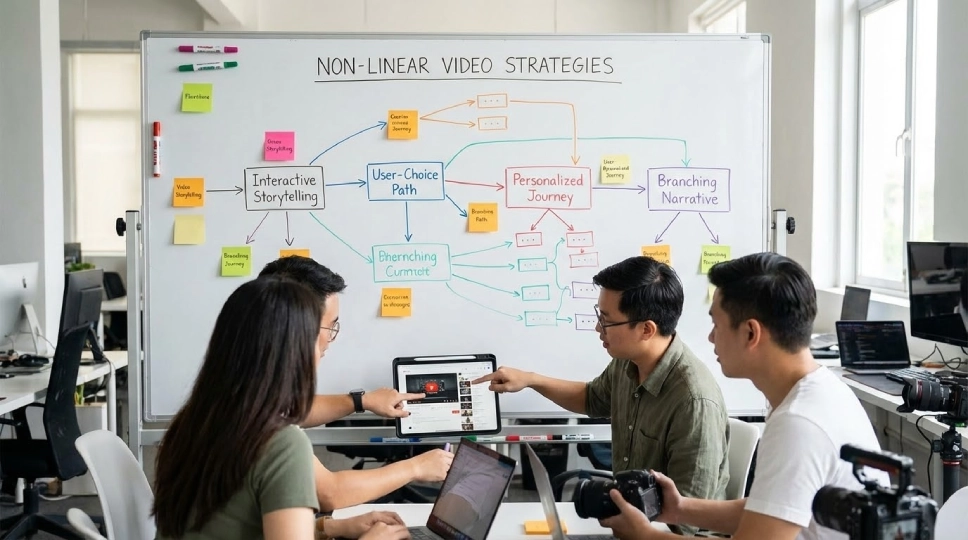
How Does This Framework Change Video Production Priorities?
This framework shifts priorities from funnel-stage coverage to question-comprehensiveness. You need depth over breadth.
Stop producing one video per funnel stage. Start producing comprehensive answers to high-value questions. Better to have five videos that completely answer the top five buyer questions than fifteen shallow videos scattered across funnel stages.
Quality Per Question Over Quantity Per Stage
Invest production budget in making each question-focused video definitive. When someone asks “How does implementation work?” your video should be so comprehensive they never need to ask again.
One exceptional video that completely resolves a buyer question is worth more than three mediocre funnel-stage videos.
How Do You Structure Internal Video Navigation?
Structure navigation around buyer questions and decision jobs, not funnel stages. Your video library should function like a question-answering system, not a linear course.
Question-Based Video Hub Pages
Create dedicated hub pages for major question categories. A “Pricing & ROI” hub page houses all videos related to cost, value, and financial decision making. A “Technical Capabilities” hub houses all videos about features, integrations, and technical specifications.
Buyers can dive straight into the question category most relevant to them.
Related Question Linking
Link videos based on question relationships, not funnel sequence. After someone watches “How does implementation work?” suggest “What resources do we need internally?” and “How long until we see results?” These questions naturally follow each other in buyers’ minds.
This is exactly how to use explainer videos in every step of your sales journey without forcing linear progression.
What About Sales Enablement in Non-Linear Journeys?
Sales enablement shifts from stage-based content delivery to question-responsive video sharing. Equip sales teams to share the right video for the right question, regardless of deal stage.
Question-to-Video Sales Playbooks
Create playbooks that map common objections and questions to specific videos. When a prospect asks “How does this compare to [Competitor]?” your sales team knows exactly which 90-second video to share in the follow-up email.
Speed to answer matters more than funnel stage alignment.
Video Combinations for Complex Questions
Some questions require multiple videos to answer completely. Document these video combinations in your sales enablement materials. For “What’s the total cost of ownership?” you might share your pricing video + ROI calculator video + implementation timeline video together.
How Do You Maintain Consistency Across Non-Linear Content?
Maintain consistency through core messaging pillars, not forced funnel narratives. Every video should reinforce your key differentiators while answering different questions.
Messaging Pillars in Every Video
Identify your three core differentiators. Weave these into every video regardless of the specific question being answered. Your implementation video, pricing video, and case study video should all subtly reinforce why you’re different.
This creates thematic consistency without requiring sequential viewing. It also taps into why 95% of B2B SaaS buying decisions come from emotion, not logic by maintaining emotional resonance across all touchpoints.
Why Traditional Video Agencies Struggle With This Framework
Traditional agencies struggle because they’re trained to think in linear funnels, not question-response systems. They’ll pitch you an awareness video, a consideration video, and a decision video because that’s the framework they know.
This framework requires different thinking. It requires understanding your buyers’ actual questions, mapping decision jobs, and creating modular content systems that work in any order.
Most agencies haven’t made this shift yet.
What Questions Should Your Video Library Answer?
Your video library should answer every significant question buyers ask between initial interest and final purchase. Here are the universal question categories most B2B buyers need answered:
- Core Understanding: “What does this actually do?”
- Differentiation: “How is this different from alternatives?”
- Proof: “Has this worked for companies like ours?”
- Implementation: “How complex is this to set up?”
- Value: “What results can we expect?”
- Cost: “What does this actually cost us?”
- Risk: “What are the risks and how are they mitigated?”
- Resources: “What do we need internally to make this work?”
Build your video library around these question categories, not funnel stages.
How Long Does It Take to Build a Non-Linear Video System?
Building a comprehensive non-linear video system takes 3-6 months and 8-15 core videos. You need enough content to answer your buyers’ major questions, but you don’t need to answer every possible question immediately.
Phase 1: Core Question Videos (Month 1-2)
Start with your five most frequently asked questions. These become your foundation videos. Produce one definitive video for each question.
Phase 2: Gap Analysis and Expansion (Month 3-4)
Audit which questions remain unanswered. Prioritize based on how often they appear in sales conversations and how significantly they impact purchase decisions.
Phase 3: Optimization and Distribution (Month 5-6)
Refine distribution based on viewing patterns. Identify which video combinations drive conversions. Optimize recommendation logic and internal navigation.
What Makes a Good Non-Linear Framework Video?
A good non-linear framework video completely answers one specific question, works as a standalone piece, and subtly reinforces core differentiators. It should satisfy a viewer whether they watch it first or fifth.
Complete Question Resolution
The video should fully answer its target question without requiring viewers to watch other content first. Someone should walk away thinking “That completely addressed what I needed to know.”
Context-Independent Design
The video should make sense without prior context. Brief setup context at the beginning ensures new viewers understand what they’re watching, regardless of their entry point.
Natural Next Question Prompts
Good videos create natural curiosity about related questions. After explaining “What does this cost?” a good video naturally prompts questions like “What ROI can we expect?” This guides non-linear exploration without forcing it.
How Do You Measure Success in Non-Linear Video Strategies?
Measure success through question coverage rates, engagement depth, and multi-touch conversion impact rather than funnel stage progression.
The Question Coverage Metric
Track what percentage of sales questions your video library addresses. Start by documenting every question from the last 20 sales conversations. Calculate how many have corresponding videos. Target 80%+ coverage of high-frequency questions.
Engagement Depth Score
Measure how many videos buyers watch before converting, not just which stage they’re in. Buyers who engage with 4+ videos convert at higher rates than those who watch 1-2 videos, regardless of the specific sequence.
Question-to-Conversion Paths
Map which questions, when answered via video, most strongly correlate with conversion. If prospects who watch your implementation video convert at 3x the rate of those who don’t, that video has proven strategic value regardless of its “funnel stage.”
What Common Mistakes Kill Non-Linear Video Strategies?
The biggest mistake is reverting to funnel-stage thinking when planning content. Other critical mistakes include:
Creating Stage-Dependent Videos
Videos that only make sense if you’ve watched previous content break the non-linear model. Every video must work independently.
Ignoring Actual Buyer Questions
Creating videos based on what you want to say rather than what buyers want to know. Your video library should be buyer-question-driven, not marketing-message-driven.
Forcing Linear Navigation
Website designs that hide videos behind “Next” buttons or require watching videos in sequence. Make all content immediately accessible from multiple entry points.
Under-Investing in Core Videos
Spreading budget across many shallow funnel-stage videos instead of creating fewer, deeper question-resolution videos. Quality per question beats quantity per stage.
How Do You Train Teams on Non-Linear Thinking?
Train teams by shifting from stage-based to question-based vocabulary. Stop saying “top of funnel content” and start saying “initial question-answering content.”
Question Mapping Workshops
Run workshops where sales and marketing teams map every question buyers ask. Organize these by decision job, not funnel stage. This shared question library becomes your content planning foundation.
Buyer Journey Story Sessions
Have sales teams share real buyer journey stories. Map the actual sequence of questions, content consumed, and decision points. These stories reveal the chaotic, non-linear reality of modern B2B buying.
A comprehensive SaaS video marketing strategy guide helps align your entire team around question-based thinking rather than stage-based frameworks.
Why Most B2B Companies Will Resist This Framework
Most companies will resist because linear funnels are comfortable, measurable, and match existing org structures. Your marketing automation is built for funnel stages, reporting dashboards track funnel progression, and your content calendar is organized by funnel stage.
Adopting non-linear thinking requires organizational change, not just content strategy change.
But here’s the reality: Your buyers already moved to non-linear journeys. Your frameworks haven’t caught up yet. The question isn’t whether to adapt. The question is how quickly you can rebuild your content systems to match how buyers actually behave.
Within 90 days, you can produce the 5-8 core videos that answer your buyers’ most critical questions. You gain a question-answering video system that works regardless of viewing sequence. Your prospects find answers faster, sales conversations become more qualified, and your conversion rates improve because you’re finally matching content to actual buyer behavior.
The companies that make this shift now gain 12-18 months of competitive advantage over those still clinging to linear funnel logic.
Ready to build a video system that matches how your buyers actually make decisions? Let’s map your buyers’ real questions and create content that answers them, regardless of the order they’re asked.