
Why Use GIFs in Marketing? 7 Advantages of GIFs That Drive Engagement
In today’s fast-scrolling digital world, capturing attention in the first few seconds is everything. Static visuals often get overlooked, while long-form videos demand more time than many users are willing to give. Brands need content that is quick, expressive, and instantly engaging.
GIFs (Graphics Interchange Format) are short, looping animations that combine the visual appeal of video with the simplicity of images. Lightweight, easy to share, and instantly eye-catching, GIFs have become a powerful communication tool across social media, websites, emails, and messaging platforms.
The advantages of GIFs go far beyond simply adding movement to your content. In a crowded digital landscape, GIFs help brands stand out, communicate faster, and increase engagement, without significantly increasing production costs.
If you’re evaluating GIFs in marketing, this guide will help you decide whether they deserve a place in your strategy and how to use them effectively.
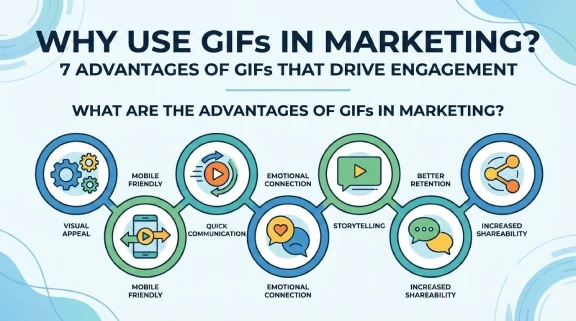
What Are the Advantages of GIFs in Marketing?
Before diving deeper, here’s why brands are increasingly investing in GIF marketing:
- They grab attention instantly
- They increase social engagement
- They improve email click-through rates
- They communicate emotion clearly
- They’re lightweight and cost-effective
- They work across platforms
- They simplify product demos
Unlike video, animated GIFs autoplay automatically. Unlike static images, they move. That balance makes them uniquely powerful.
Now let’s examine each advantage in detail.
1. GIFs Grab Attention Faster Than Static Images
One of the biggest advantages of GIFs is their ability to immediately capture attention.
The human brain processes visuals 60,000 times faster than text, and movement naturally attracts attention due to motion sensitivity in our visual system. In busy social feeds, that subtle movement can make the difference between being ignored and being noticed.
Social posts with visual content receive 2.3x more engagement than text-only posts. That immediate visibility matters.
This makes the statistic itself clickable, which feels more integrated and authoritative.
Netflix, for example, frequently uses looping reaction GIFs on Twitter to spark conversations around new releases. The movement draws the eye without overwhelming the viewer.
You become instantly noticeable without shouting louder.
2. GIFs Increase Social Media Engagement
The data consistently supports this. Tweets with GIFs receive up to 55% more engagement than those without, according to Twitter’s internal data.
Brands like Wendy’s use reaction GIFs to drive conversational engagement, making their content feel responsive and human rather than promotional.
Across platforms, GIFs serve different roles. On Twitter, they work well for reactions and live commentary. On Instagram Stories, they can highlight features or promotions. On LinkedIn, subtle product demo GIFs or feature reveals feel professional and informative.
You don’t just become visible you become interactive.
3. GIFs Communicate Faster Than Video in Many Cases
While video has its place, GIFs often outperform it for quick, focused communication.
Videos require sound, longer attention spans, and higher production effort. GIFs deliver a single message in just 2–6 seconds. They loop automatically and eliminate friction.
Slack frequently uses short looping UI GIFs to showcase product updates instead of lengthy walkthrough videos. The result is clearer, faster understanding with less cognitive effort.
For quick demos, feature highlights, and small updates, GIFs often strike the perfect balance.
4. GIFs Improve Email Marketing Performance
When used strategically, GIFs can significantly enhance email engagement.
Including the word “GIF” in subject lines can increase open rates by up to 6% as stated in Experian’s study . Inside the email, animated product showcases can display multiple angles or steps within a single frame.
E-commerce brands often use GIFs to demonstrate product features dynamically instead of relying on multiple static images.
To use them effectively in email, keep the file size under 1MB when possible, design the first frame as a fallback image, and focus on a single clear call-to-action.
You become more clickable without adding more copy.
5. GIFs Convey Emotion More Effectively
Emotion drives memory and purchasing decisions, and GIFs excel at expressing emotion quickly.
They can showcase before-and-after transformations, reaction moments, satisfaction, or excitement. Duolingo, for example, uses expressive mascot GIFs to strengthen its brand personality across platforms.
Movement adds nuance that static images often lack. That emotional clarity improves recall and relatability.
You become more human and more memorable.
6. GIFs Are Cost-Effective Compared to Video
Producing a full marketing video typically requires scripting, shooting, editing, and post-production.
In contrast, a promotional GIF can be created from screen recordings, short video clips, or simple animations. Many SaaS brands convert feature demos into looping tutorial GIFs for landing pages, reducing production time while increasing clarity.
The result is faster content cycles, lower costs, and greater agility.
You become efficient instead of resource-heavy.
7. GIFs Work Across Marketing Channels
One of the strongest advantages of GIFs in marketing is versatility.
The value of GIFs is evidently positive on Twitter, Instagram, LinkedIn, Facebook, email campaigns, and landing pages. Unlike many video formats, GIFs don’t depend on sound or complex player compatibility. They autoplay, loop, and function consistently across platforms.
That flexibility allows you to reuse assets without redesigning for every channel.
You become platform-flexible without increasing production complexity.
When Should You Use GIFs And When Should You Not?
GIFs work best when demonstrating a product feature, showing UI changes, creating reaction-based content, highlighting promotions, or simplifying tutorials.
They are less suitable when deep storytelling is required, when audio is essential, when page load speed is extremely sensitive, or when animation risks distracting from clarity.
The real advantage of GIFs lies in clarity through motion not decoration.
Best Practices for Using GIFs Effectively
Keep them short, ideally 2–6 seconds. Focus on one message per GIF. Optimize file size. Ensure seamless looping. Align the tone with the platform professional on LinkedIn, expressive on Instagram, timely and conversational on Twitter.
Effective GIF engagement comes from precision, not excess.
Final Thoughts: Should You Use GIFs in Your Strategy?
If you’re evaluating the advantages of GIFs, the data and use cases are clear.
They increase engagement.
They simplify communication.
They reduce production cost.
They improve clarity.
The real power of GIFs in marketing isn’t just movement it’s focus.
When used strategically, you don’t simply add animation.
You become clearer.
You become more engaging.
You become easier to remember.
That’s why more brands are investing in GIF marketing today.