
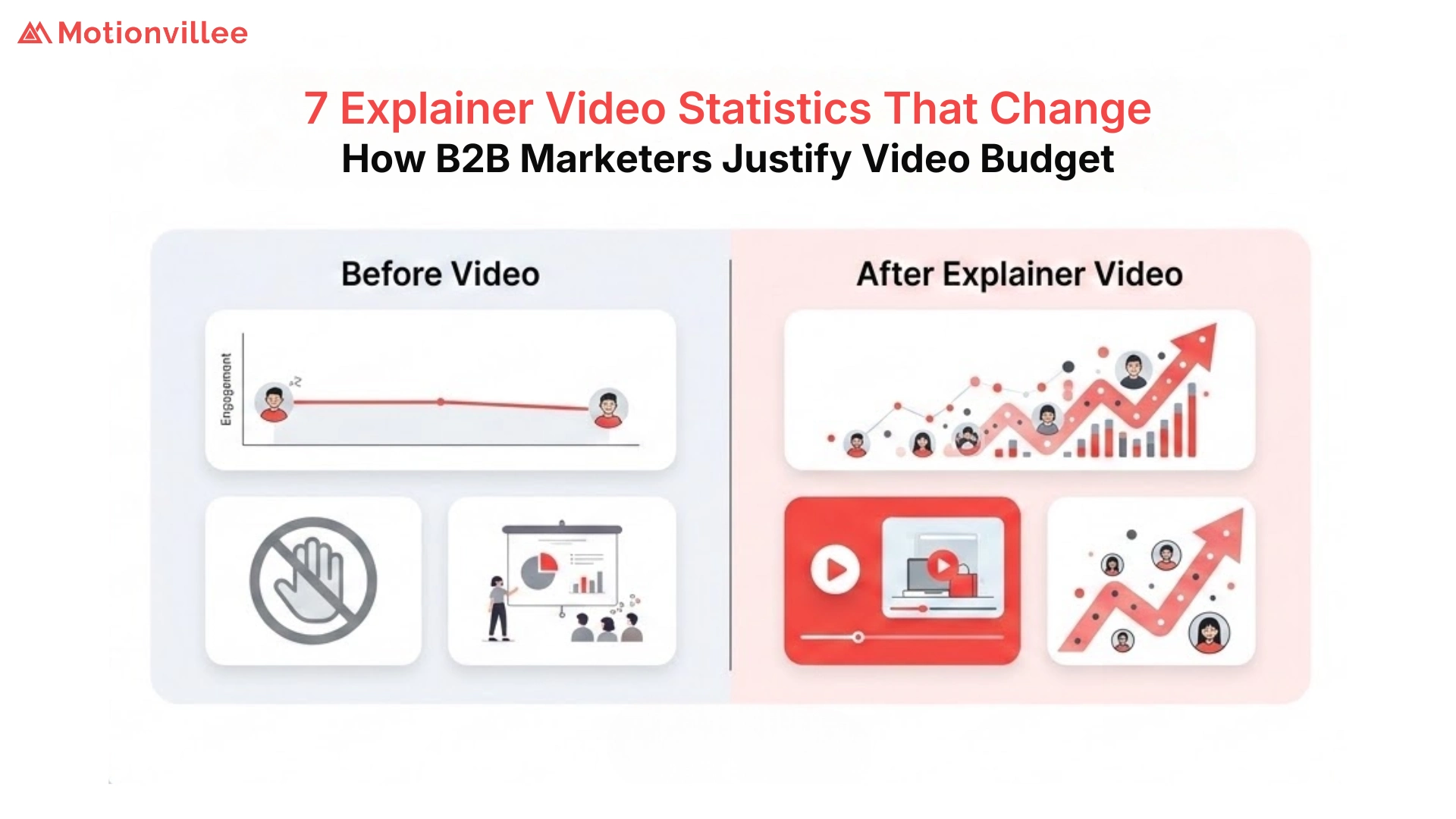
7 Explainer Video Statistics That Change How B2B Marketers Justify Video Budget
For years, B2B teams justified video budgets the same way:
“We need more brand awareness.”
“Video is engaging.”
“Competitors are doing it.”
That approach worked when video was treated as a creative asset.
It doesn’t work anymore.
Today, budgets are under more scrutiny. Marketing leaders are expected to connect spending directly to business outcomes. Views alone are no longer enough. Teams need stronger reasons to justify investments.
And that has changed the conversation around explainer videos.
The question is no longer:
Should B2B brands invest in video?
The question is:
Can B2B brands afford not to?
Because recent data shows that video is no longer a nice addition to the funnel. It has become part of how buyers evaluate products, build trust, and move toward decisions.
Let’s break down seven statistics that are changing how marketers think about video budgets in 2026.
1. 91% of Businesses Use Video as a Marketing Tool
According to research from Wyzowl, 91% of businesses now use video as part of their marketing strategy.
Source:
Wyzowl Video Marketing Statistics Report
That number matters because video is no longer considered experimental.
It has become standard.
Ten years ago, teams justified video budgets because they wanted to stay ahead.
Today many teams justify video budgets because they cannot afford to fall behind.
The competitive question has shifted from:
“Should we create videos?”
To:
“What happens if competitors communicate better than we do?”
This supports Video-first marketing strategy
Because in crowded B2B categories, communication itself becomes a competitive advantage.
2. Video Helps Buyers Understand Products Faster
Research from Wyzowl consistently shows that consumers say video helps them understand products and services more effectively.
Source:
Product understanding through video
This matters more for B2B than many marketers realize.
B2B products are often:
- Technical
- Process heavy
- Difficult to visualize
- Multi-layered
Explainer videos compress understanding.
Instead of reading multiple pages, buyers can process information visually in minutes.
And speed of understanding often impacts buying momentum.
If buyers understand value faster, they move faster.
3. Buyers Spend Significant Time Researching Before Sales Conversations
Research from 6sense shows that B2B buyers increasingly complete large parts of the purchasing journey independently.
Source:
6sense Buyer Experience Research
That means prospects interact with:
- Landing pages
- Product videos
- Case studies
- Documentation
- Demos
Long before speaking with sales.
Your explainer video is often functioning like a salesperson before sales ever enters the conversation.
That changes how teams justify budgets.
Because video is not only a marketing asset anymore.
It has become part of customer acquisition infrastructure.
4. Video Can Increase Time Spent on Pages
Research frequently shows that users spend more time engaging with pages containing video content.
Source:
HubSpot Video Marketing Insights
This matters because attention is increasingly difficult to earn.
Longer engagement often creates:
- Better product understanding
- More interaction
- Increased trust
- Higher conversion opportunities
B2B marketers once optimized primarily for clicks.
Now they optimize for attention quality.
And video helps extend that attention.
5. 89% of Marketers Report Positive ROI From Video
According to research from Wyzowl, a large percentage of marketers say video delivers positive return on investment.
Source:
Wyzowl Video ROI Statistics
This changes budget conversations significantly.
Historically, video production felt expensive.
But marketers increasingly view video as:
- Reusable content
- Sales support material
- Funnel assets
- Conversion infrastructure
One explainer video can support:
- Homepage experiences
- Paid campaigns
- Sales enablement
- Product launches
- Email campaigns
The ROI discussion becomes broader than views.
6. Buyers Prefer Self Service Experiences
According to research from McKinsey & Company, B2B buyers increasingly prefer self guided experiences.
Source:
McKinsey B2B Buying Research
Modern buyers increasingly want to:
- Explore independently
- Research privately
- Understand products before calls
Explainer videos support this behavior perfectly.
Because they allow buyers to learn without friction.
This aligns with Self-guided buyer education
As buying becomes more independent, explainer videos become more important.
7. People Remember Visual Information Better Than Text Alone
Research in cognitive science repeatedly shows that visual processing supports stronger information retention compared with text only experiences.
Source:
Visual learning research overview
For marketers this matters because understanding alone is not enough.
Buyers also need to remember products later.
Because B2B purchasing often involves:
- Multiple meetings
- Internal discussions
- Long decision cycles
Explainer videos improve recall.
And recall increases the likelihood of remaining in consideration.
Why Video Budget Conversations Have Become Harder in B2B
A few years ago, marketing teams had more flexibility when allocating creative budgets.
If campaigns generated visibility, engagement, and traffic, that was often enough justification.
Today expectations are different.
Leadership teams increasingly ask:
- What pipeline impact did this create
- Did this improve conversion rates
- Did this support revenue goals
- Did this reduce acquisition costs
Marketing budgets are now evaluated with far greater scrutiny.
And that has changed how teams think about video investments.
Because video is still sometimes viewed internally as a production expense rather than a business asset.
That perception creates problems.
Explainer videos rarely function inside one isolated campaign.
A single video may support:
- Homepage experiences
- Sales conversations
- Email campaigns
- Paid advertising
- Product launches
- Customer onboarding
And when one asset influences multiple parts of the funnel, measuring it through one metric becomes difficult.
This is where many organizations underestimate video impact.
Not because video underperforms.
Because attribution models often fail to capture everything it contributes.
Modern budget conversations increasingly require broader thinking.
The question is no longer:
“Did the video generate views?”
The question becomes:
“Did the video help buyers move faster?”
That shift changes everything.
The Shift From Content Creation to Buyer Enablement
Many of the strongest B2B teams are changing how they think about content.
Instead of asking:
“What content should we create?”
They ask:
“What helps buyers make decisions faster?”
That distinction matters.
Because modern buyers increasingly educate themselves before speaking with sales.
According to research from 6sense, buyers often complete significant portions of the decision journey independently.
Source:
6sense Buyer Journey Research
By the time demo requests happen, prospects frequently already have opinions about:
- Product fit
- Competitor comparisons
- Use cases
- Pricing expectations
- Implementation concerns
And much of that understanding comes through content.
This supports Buyer education through visual content Because better understanding frequently creates stronger buying momentum.
Why Explainer Videos Continue Delivering Value After Launch
Unlike campaign assets that disappear after a launch period ends, explainer videos often continue creating value for months or even years.
One well-produced video can support multiple teams simultaneously.
Marketing teams may use it for awareness.
Sales teams may use it during outreach.
Customer success teams may use it for onboarding.
Product teams may use it for education.
That long-term utility changes ROI conversations dramatically.
Because suddenly the discussion stops being:
“How much did we spend?”
And becomes:
“How many business functions benefited?”
That broader perspective creates a much stronger case for investment.
Especially in B2B environments where content increasingly supports multiple stages of the customer journey.
Explainer videos rarely create value once.
Their impact compounds over time.
What These Statistics Actually Change
These numbers shift how teams justify video budgets.
Instead of saying:
“We need video because everyone uses video.”
The conversation becomes:
“We need video because buyers increasingly rely on video to understand products and make decisions.”
That is a completely different argument.
Video moves from creative expense to business asset.
Final Thought
Video budgets become easier to justify when teams stop treating videos as isolated content pieces.
Explainer videos influence:
- Buyer understanding
- Trust
- Product education
- Conversion journeys
- Sales enablement
And the data increasingly supports that impact.
The strongest B2B marketers are no longer asking whether video deserves a budget.
They are asking how much growth poor communication may already be costing.