
9 Types of Explainer Videos: Which One Actually Moves B2B Buyers to Act
B2B buying behavior has changed significantly.
Buyers no longer rely on a single sales conversation to understand products. They research independently, compare multiple solutions, consume content across channels, and often involve several decision-makers before a purchase ever happens.
That creates a challenge for marketers.
Because creating “an explainer video” is no longer enough.
The bigger question becomes:
Which type of explainer video actually helps buyers move forward?
Not every explainer video drives the same outcome. Some create awareness. Some build trust. Some simplify complex ideas. Others reduce hesitation before conversion.
And using the wrong video at the wrong stage can quietly hurt performance.
So instead of asking “Should we create an explainer video?” the better question is:
What type of explainer video matches buyer intent?
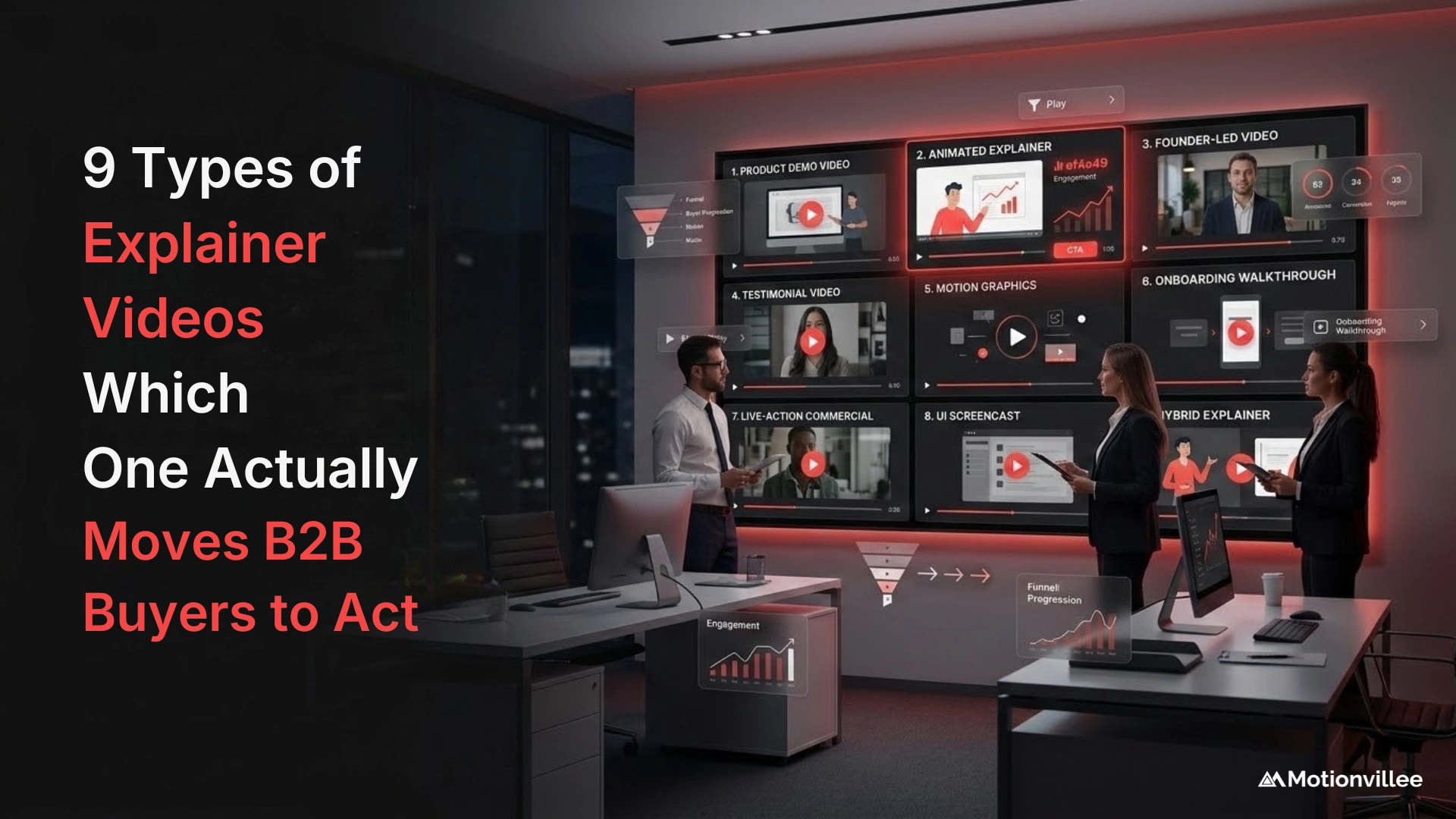
Let’s break down the nine major explainer video formats and understand where they actually influence B2B buying decisions.
1. Animated Explainer Videos
This is often the first format people think of.
Animated explainers use illustrations, motion graphics, icons, transitions, and storytelling to simplify ideas.
They work especially well when products are:
- Complex
- Technical
- Difficult to visualize
- Process-heavy
For many B2B products, value is not immediately visible.
Think about:
- AI workflows
- SaaS platforms
- Cloud infrastructure
- Financial software
- Automation systems
Explaining these through text alone can feel overwhelming.
Animation simplifies abstract concepts by creating visual understanding.
Instead of reading long explanations, buyers can see processes happening in front of them.
This aligns closely with Animated storytelling for product clarity
Because when complexity becomes visual, understanding happens faster.
2. Product Demo Videos
Product demo videos focus on showing instead of explaining.
Rather than discussing benefits theoretically, they display:
- Actual product workflows
- Features in use
- Real interface walkthroughs
- User actions
These videos become especially effective in middle and bottom-funnel stages.
At this point buyers already understand the problem.
Now they want answers to questions like:
“Can this fit our workflow?”
“How difficult is implementation?”
“Does this actually solve our issue?”
Demo videos reduce uncertainty.
And uncertainty is often what slows buying decisions.
Instead of imagining how products work, buyers can see functionality directly.
That builds confidence.
3. Whiteboard Explainer Videos
Whiteboard videos use hand drawn visuals that unfold progressively while narration guides viewers.
There’s a reason this format remains popular.
People naturally follow progression.
The brain becomes curious about what appears next.
These videos work well for:
- Educational content
- Consulting services
- Process explanations
- Internal training
- Technical breakdowns
Their simplicity often becomes an advantage.
Because in B2B communication, clarity usually beats visual overload.
Whiteboard explainers create focus without distracting viewers with excessive motion.
4. Motion Graphics Videos
Motion graphics use:
- Animated charts
- Text elements
- Graphs
- Data visualization
- Icons
Rather than traditional storytelling.
These are particularly effective for:
- Research heavy content
- Industry reports
- Product positioning
- Statistics driven communication
B2B buyers consume significant amounts of information before purchasing.
But large reports and long documents create friction.
Motion graphics help transform information into something easier to absorb.
According to Wyzowl research, video remains one of the strongest tools for simplifying communication and improving understanding.
Source:
Wyzowl Video Marketing Statistics
Instead of reading pages of content, buyers can process insights visually.
5. Live Action Explainer Videos
Sometimes buyers want people, not graphics.
Live-action videos introduce:
- Real people
- Physical environments
- Human interaction
- Customer situations
This format becomes powerful where trust matters heavily.
Examples include:
- Healthcare
- Enterprise consulting
- Recruitment
- Professional services
- Finance
Human faces create familiarity.
And familiarity often influences trust.
A software animation may explain functionality.
But a real person explaining outcomes can create emotional connection.
That human layer matters more than many B2B teams realize.
6. Customer Testimonial Videos
People trust customers more than brands.
That has become increasingly true.
Customer testimonial videos showcase:
- Challenges faced
- Problems solved
- Experiences
- Results achieved
Instead of saying:
“Our platform improves efficiency.”
You show:
“Here’s how this company reduced approval time by 40%.”
That feels believable.
Buyers naturally look for validation.
Especially during high-consideration purchases.
This supports Customer proof for conversions
Because trust often removes hesitation faster than features do.
7. Interactive Explainer Videos
Traditional videos are passive.
Interactive videos create participation.
Instead of simply watching, users can:
- Select journeys
- Explore features
- Personalize experiences
- Navigate paths
Examples include:
- Product tours
- Interactive demos
- Learning experiences
As B2B buying becomes increasingly self-service, interactive content becomes more valuable.
Because buyers increasingly prefer exploring products independently rather than scheduling calls immediately.
8. Educational Thought Leadership Videos
Not every explainer video should sell directly.
Some should educate.
Educational videos focus on:
- Industry insights
- Trends
- Best practices
- Frameworks
- Thought leadership
These videos create value before purchase intent even exists.
Over time they build:
- Trust
- Authority
- Brand familiarity
By the time buyers enter your funnel, they already know who you are.
And trust formed before selling often converts better than trust built afterward.
9. Hybrid Explainer Videos
Hybrid videos combine multiple formats together:
- Animation
- Motion graphics
- Screen recordings
- Live action
- Product demonstrations
This gives marketers flexibility.
For example:
A video may begin with animation explaining a problem, transition into product demonstrations, then finish with customer testimonials.
Hybrid formats are becoming more common because buyers consume information differently.
Different communication challenges often require different approaches.
One style rarely solves everything.
Which Video Type Actually Drives Action
Here’s where many B2B teams become confused.
No explainer format is universally best.
The strongest choice depends on:
- Funnel stage
- Product complexity
- Industry
- Buyer intent
- Objective
For awareness:
- Animated explainers
- Educational videos
For consideration:
- Product demos
- Motion graphics
For conversion:
- Testimonials
- Product walkthroughs
This idea connects closely with Matching content to buyer goals
Because content performs better when aligned with buyer intent.
Why Many Teams Choose the Wrong Format
Many companies choose formats emotionally:
“Animation feels modern.”
“Competitors use live-action.”
“Motion graphics look premium.”
But buyers don’t care about format.
They care about understanding.
If your video makes products easier to understand, trust, and remember the format worked.
If not, even expensive production becomes ineffective.
Final Thought
Explainer videos are not just content assets.
They’re decision tools.
The right format simplifies complexity, reduces friction, and helps buyers move toward action faster.
The wrong format creates noise.
And in B2B marketing, cutting through noise often matters more than creating more content.