
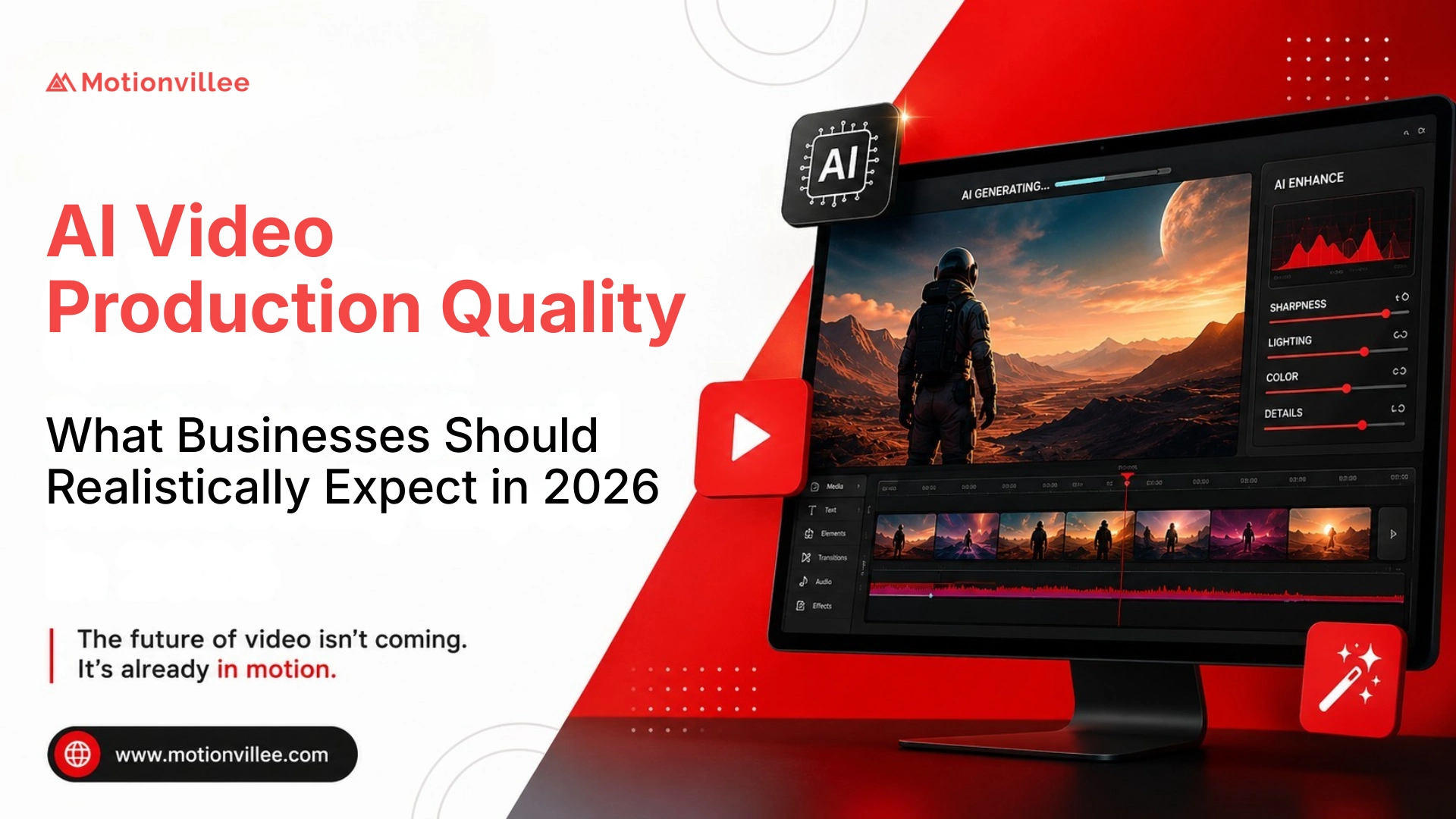
What Does AI Video Production Quality Mean in 2026?
AI video production quality means more than whether the video looks clean. It means the video is clear, accurate, on brand, useful, and trustworthy enough for the channel where it will be used.
That is the uncomfortable truth for marketing leaders. An AI video can look polished and still fail if the script is generic, the product explanation is wrong, or the CTA does not match the buyer’s stage.
Wyzowl reports that 63% of video marketers used AI video tools to help create or edit marketing videos, while 89% of consumers say video quality impacts their trust in a brand [Wyzowl, 2026]. The limitation is that this is survey based evidence, not a direct test of AI generated content performance. Still, it shows why quality now matters as much as speed. (Wyzowl)
Motionvillee is an AI video production company for SaaS, tech, cybersecurity, fintech, and finance brands that need AI assisted videos to support business outcomes, not just content volume. For a deeper quality framework, read [Link: what affects AI video production quality → /what-affects-ai-video-production-quality/].
What Quality Can Businesses Realistically Expect From AI Video Production?
Businesses can expect strong AI video quality for structured, repeatable, and clear formats, but not every AI video will feel like a premium brand film.
AI can help create clean visuals, usable voiceovers, captions, avatars, rough edits, and multiple versions faster than many manual workflows. IAB reported that nearly 90% of advertisers were using or planning to use generative AI to build video ads, and buyers projected generative AI creative could reach 40% of all ads by 2026 [IAB, 2025]. This supports the business trend, but it does not prove that every AI ad is high quality. (IAB)
The practical expectation is clear: AI can produce usable business video when the format is simple and the brief is specific. It struggles when the video needs emotion, originality, exact product logic, or deep brand control.
Where AI Video Quality Is Already Strong
AI video quality is strongest when the video’s job is clear and the production format is repeatable.
AI works well for social clips, webinar cutdowns, AI avatar updates, product update videos, training videos, FAQ videos, captioned short videos, internal communication, simple explainers, multilingual versions, voiceover drafts, and ad variations.
Vidyard’s 2025 benchmark report analyzed more than 1 million B2B videos and notes that businesses are creating video at significant scale, with AI tools helping teams move from experimentation toward broader implementation [Vidyard, 2025]. This is useful B2B evidence, but it does not isolate AI only video quality. (Vidyard)
For business teams, the inference is simple: AI video is strongest when scale and consistency matter more than emotional depth.
Where AI Video Quality Still Falls Short
AI video quality still falls short when the video needs strong emotional nuance, original storytelling, detailed brand control, or complex product understanding.
The common failure points are generic scripts, similar looking visuals, flat voice delivery, unnatural avatar expressions, inconsistent visual style, weak product logic, poor transitions, incorrect technical details, weak brand differentiation, and CTAs that feel added at the end.
IAB’s 2026 AI research also points to a widening gap between consumer attitudes and advertiser assumptions about AI in advertising [IAB, 2026]. That means marketers should not assume AI generated content will automatically be accepted as credible or persuasive. (IAB)
As an AI video production company, Motionvillee treats AI output as a starting point when the video needs buyer trust. The final asset still needs human judgment around accuracy, brand fit, and message relevance.
What Script and Visual Quality Should Look Like
A strong AI assisted script should explain one clear idea, connect the product to a buyer problem, and support the next step.
Weak scripts often sound polished but say very little. They use broad claims, overused phrases, vague benefits, and CTAs that do not match the buyer’s stage.
Visual quality should make the message easier to understand. Clean visuals are not enough if scenes feel random, UI details are inaccurate, or the style does not match the brand. Good video quality means the viewer understands the product faster and trusts the company more.
This is where pricing and quality connect. Lower budgets may work for simple content, but more important assets need deeper review.
How Quality Expectations Change by Video Type
Not every business video needs the same quality level. The quality standard should match the risk and use case.
| Video type | Quality expectation |
| Internal update | Clear, fast, accurate |
| Social clip | Hook driven and platform ready |
| AI avatar video | Natural enough for the use case |
| Training video | Accurate and easy to follow |
| Product update video | Clear and product correct |
| Paid ad video | Strong hook, CTA, and visual clarity |
| Sales enablement video | Trustworthy and buyer focused |
| Website explainer | High clarity and brand polish |
| Product launch video | Stronger direction and review |
An internal update can be useful without premium polish. A website explainer or product launch video carries more business risk because it shapes buyer perception, sales confidence, and brand trust.
For budget based quality decisions, read [Link: AI video production budget comparison → /ai-video-production-budget-comparison/].
When Is AI Video Quality Good Enough?
AI video quality is good enough when the video’s job is simple, repeatable, and low risk.
It can work well for internal updates, FAQ videos, training content, product updates, social cutdowns, webinar clips, basic explainers, ad testing, and short educational videos.
The business logic is straightforward: when the goal is speed, clarity, and repeatability, AI quality can be enough. When the goal is premium trust, emotional storytelling, or major conversion impact, AI alone may not be enough.
Motionvillee uses AI video production to create videos for marketing, sales, onboarding, and customer education, but the level of human review changes based on the business risk of the asset.
When Is AI Video Quality Not Enough?
AI video quality may not be enough when the video has to carry high trust, strong emotion, or major business impact.
Be careful with website hero videos, brand story videos, investor videos, customer story videos, product launch videos, enterprise sales videos, complex SaaS explainers, compliance sensitive videos, and videos with detailed product claims.
In these cases, hybrid or traditional production may be safer because the business risk is higher. AI can still support drafts, versions, captions, and repurposing, but the final asset needs more human control.
Many AI video production mistakes come from approving videos because they look finished rather than because they are strategically ready. For practical examples, read [Link: AI video production mistakes → /ai-video-production-mistakes/].
How Should Businesses Review AI Video Quality Before Approval?
Do not approve an AI video only because it looks finished. Review it like a business asset.
| Review question | Why it matters |
| Is the message clear in the first few seconds? | Protects attention |
| Is the product explained accurately? | Protects trust |
| Does the video sound like the brand? | Protects consistency |
| Do the visuals support the message? | Improves clarity |
| Does the voice feel natural enough? | Builds credibility |
| Are captions correct? | Protects meaning |
| Is the CTA clear? | Supports action |
| Is the video right for the channel? | Improves performance |
| Would sales or marketing actually use it? | Measures business value |
This checklist is not a scientific scoring model. It is a practical approval tool for marketing teams that need to avoid publishing AI content that looks clean but underperforms.
Final Takeaway: What Quality Should Businesses Expect in 2026?
In 2026, businesses should expect strong AI video production quality for structured, repeatable, and clear formats, but human review remains essential for strategy, product accuracy, brand trust, and final polish.
The better question is not only can AI videos look professional. The better question is:
What quality level does this video need to create trust, clarity, and business impact?
Motionvillee brings 15+ years of production experience to AI video production, helping B2B brands use AI where it speeds execution while keeping human judgment where quality affects buyer confidence.