
What Video We Produced Twice and Why
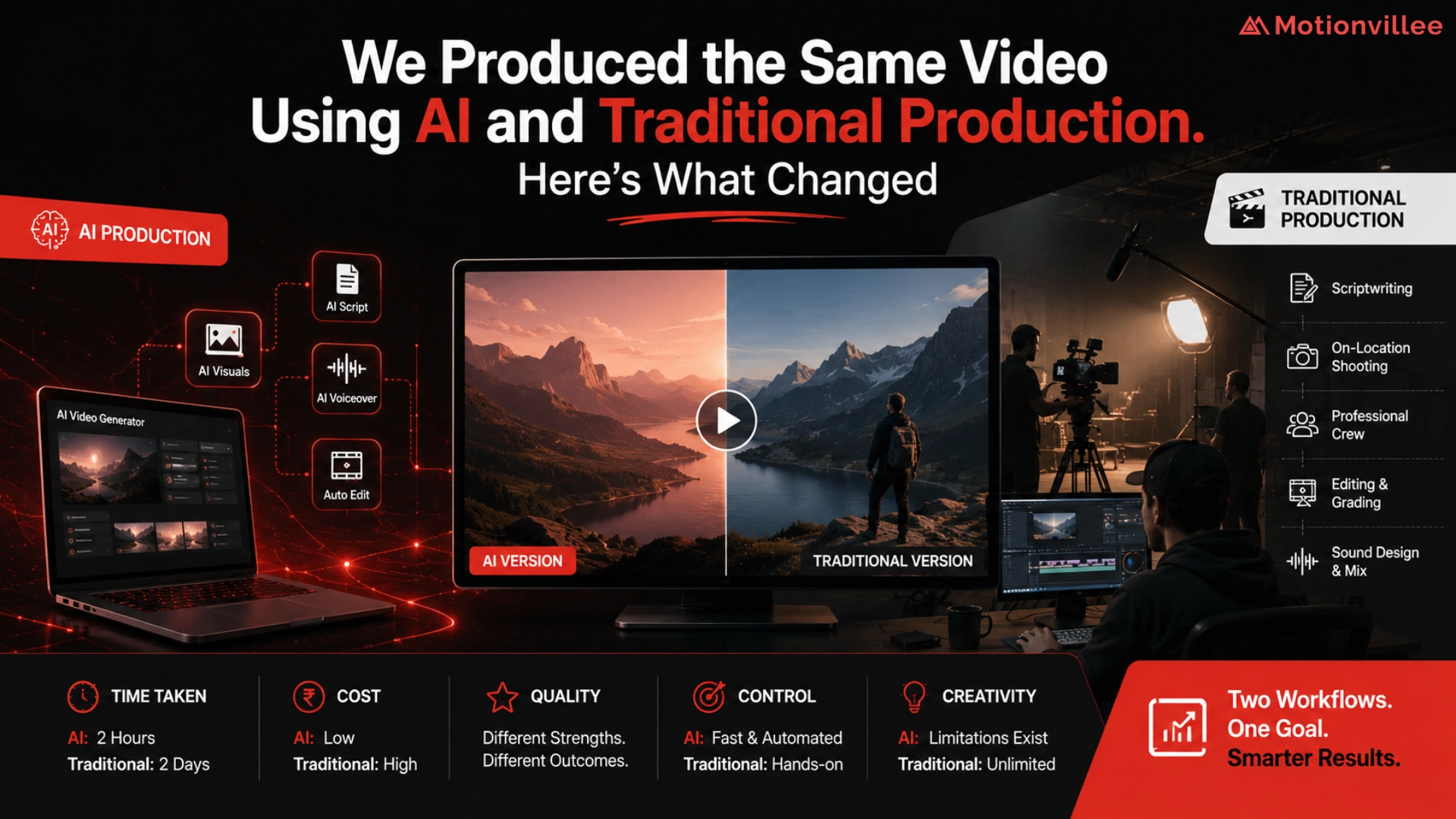
We produced the same video using AI and traditional production because most comparisons are too theoretical.
Business leaders do not only need to know whether AI is faster or traditional production is better. They need to know which method creates a video that is clear, usable, credible, and worth the investment.
So we used the same brief and produced two versions: one through an AI assisted workflow and one through a traditional workflow. This was an internal Motionvillee comparison, not a controlled academic study, so the findings should be read as practical workflow evidence, not universal proof [Motionvillee Internal Test, 2026].
This matters now because 63% of video marketers say they have used AI tools to create or edit marketing videos, up from 51% the previous year [Wyzowl, 2026]. That shows adoption is rising, but it does not prove AI is right for every buyer facing asset. (Wyzowl)
For the broader context, this test sits inside the bigger shift toward [Link: AI video production → /ai-video-production/].
What Stayed the Same in Both Versions
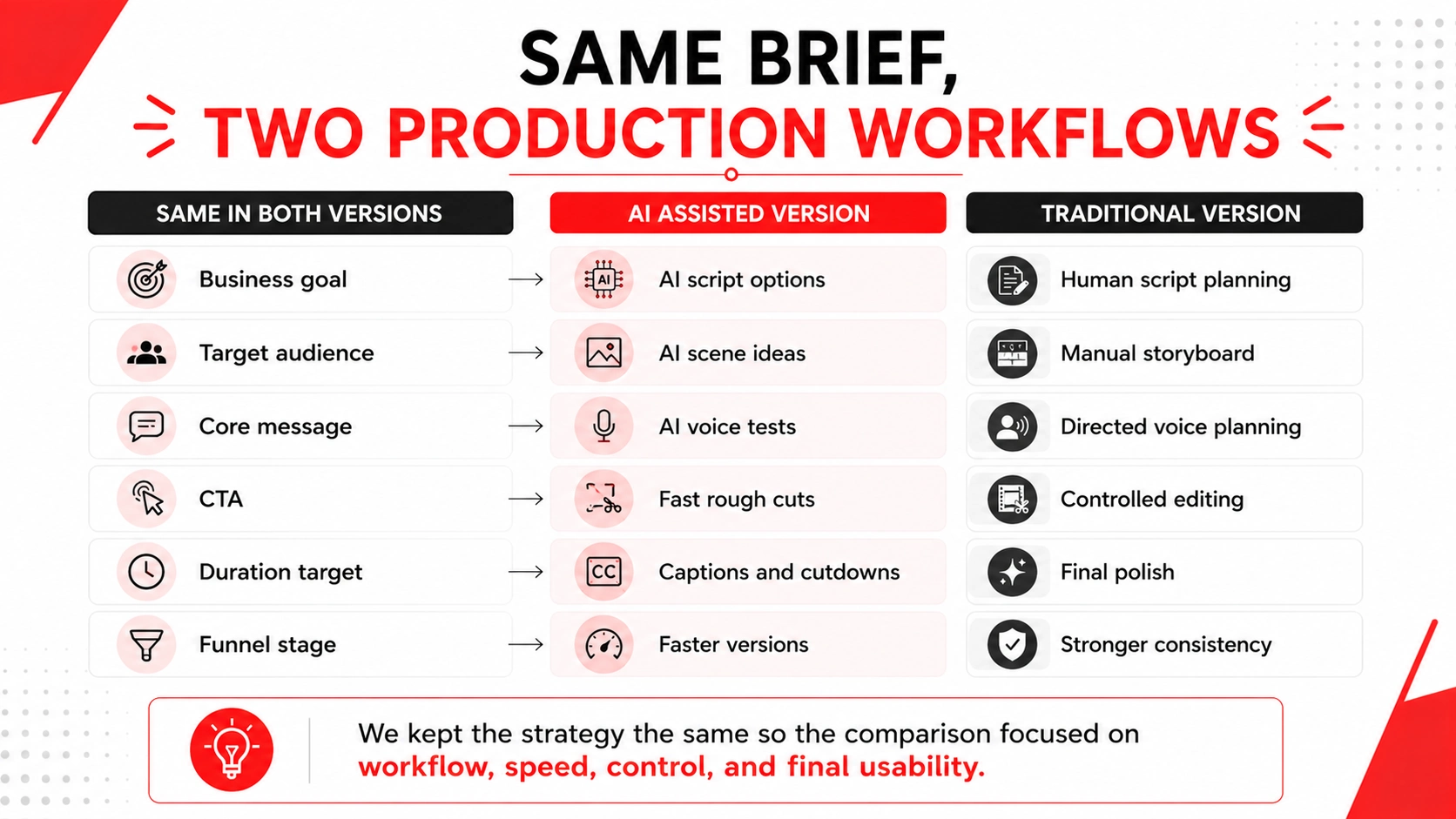
Both versions used the same business goal, audience, core message, CTA, duration target, brand direction, and funnel stage.
This made the video comparison fairer.
If the brief changes, the result becomes a comparison of two different strategies, not two different production models. Keeping the strategy constant helped us isolate what changed because of the workflow.
The limitation is important: one test does not prove one method is always better. It shows how each approach behaves when the business objective stays fixed.
What Changed in the AI Production Workflow
AI changed the speed of the first version.
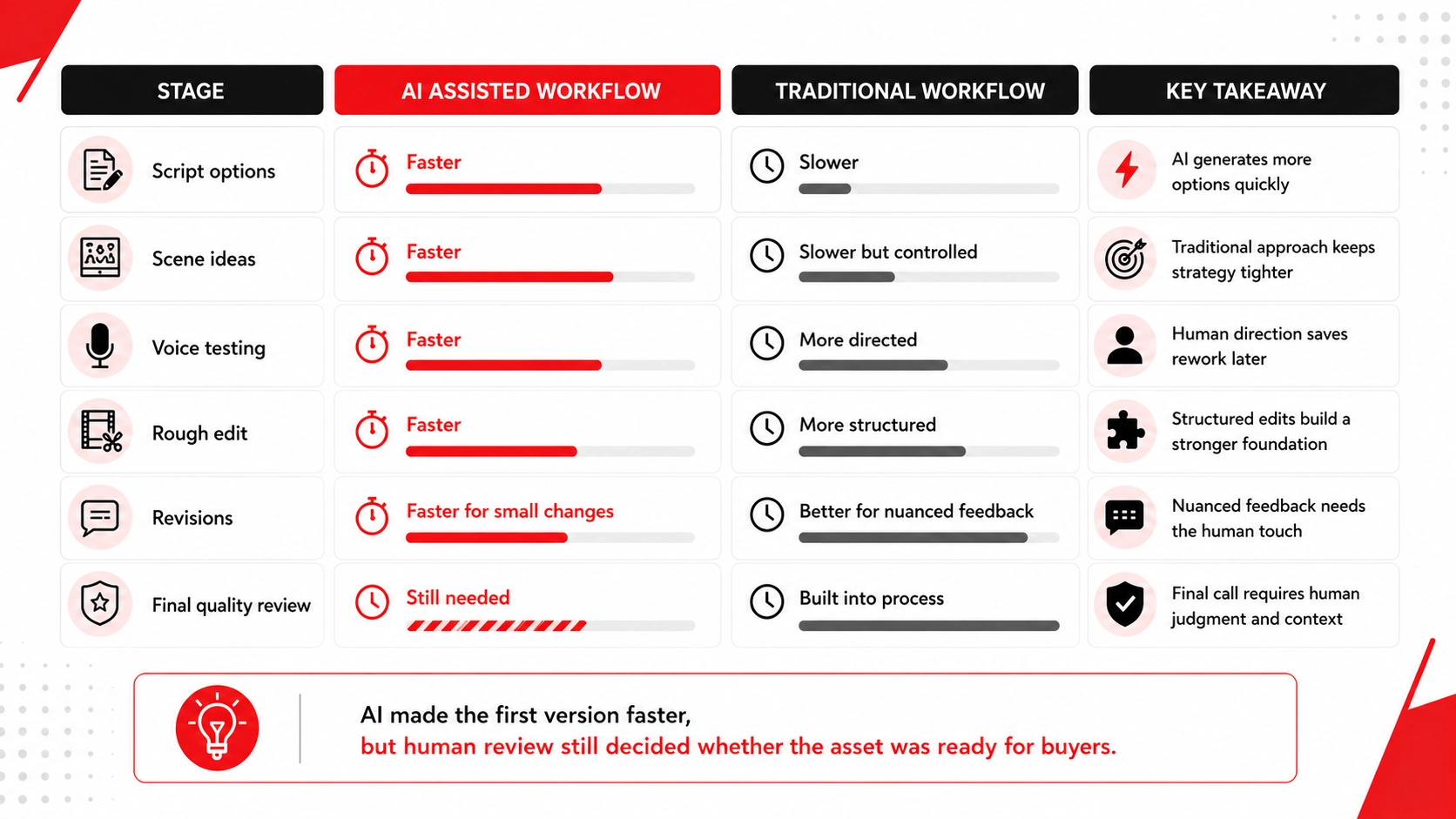
The AI assisted version moved faster across script options, early scene ideas, voice testing, rough edits, format changes, captions, and cutdowns.
That speed matters because marketing teams often need multiple assets for paid ads, social, sales follow up, and product education. Deloitte Digital notes that generative AI is moving toward broader customer facing use, but CMOs still need systems where human creativity and machine intelligence work together [Deloitte Digital, 2026]. (Deloitte)
The counterpoint: the AI version still needed human review. The first draft was faster, but not automatically ready for business use.
What Changed in the Traditional Production Workflow
Traditional production changed the level of control.
The traditional version took more time because more judgment happened before execution. The message, visual flow, pacing, and final polish were more intentional
That extra control matters most when the video carries brand authority, sales trust, or market positioning. In our view, this is where [Link: AI video production vs traditional video production → /ai-video-production-vs-traditional-video-production/] becomes a business decision, not only a production choice.
The limitation: traditional production can still fail if the strategy is unclear. More time does not guarantee a stronger asset.
What Changed in Speed
AI was faster in early drafts and versioning. Traditional production was slower but more controlled.McKinsey’s 2025 State of AI research says organizations are trying to redesign workflows to capture measurable value from AI, not simply adopt tools [McKinsey, 2025]. That matched our finding: speed helped only when the workflow had clear review points. (McKinsey & Company)
What Changed in Cost
AI reduced effort in repeatable tasks, but it did not remove the cost of strategy, review, and final judgment.
AI helped reduce cost pressure for rough drafts, cutdowns, social versions, internal videos, and repeat formats [Motionvillee Internal Test, 2026].
Traditional production cost more because it required more custom planning, creative control, and final polish.
The business takeaway: lowest cost is not always best cost. A low cost video can become expensive if it confuses buyers, weakens trust, or gives sales a poor asset to use in active conversations.
That is why the benefits of AI video production are strongest when AI reduces friction without weakening the message.
What Changed in Script Quality
AI helped create options quickly. Human editing made the message stronger.
The AI draft was useful as a starting point, but it sometimes leaned on broad claims and generic phrasing. Human review improved buyer context, removed weak lines, and made the CTA more natural
This is an inference from our test: AI is useful for speed, but message strength still depends on business judgment.
What Changed in Storyboarding
AI created more options. Traditional production created a more controlled visual journey.
AI helped generate early scene ideas and visual references faster. Some were useful, but others felt too broad or disconnected from the brand.
Traditional storyboarding gave stronger pacing and clearer visual logic [Motionvillee Internal Test, 2026].
The practical point: AI is useful for exploration. Traditional planning is stronger when the video must carry a precise market message.
What Changed in Visual Quality
The biggest visual difference was consistency.
AI visuals could look polished in parts, but consistency across the full video needed more review. Product accuracy, style continuity, and brand fit were harder to control [Motionvillee Internal Test, 2026].
Traditional production gave stronger consistency across scenes, motion, and visual direction.
The counterargument is that AI visual quality is improving quickly. But for high trust business videos, the current business question is not whether AI can create visuals. It is whether those visuals stay accurate and credible across the full asset.
What Changed in Revisions
AI was better for quick iteration. Traditional production was better for controlled refinement.
AI made text updates, caption changes, format shifts, and small cutdowns faster.
Traditional revisions took longer, but they were better when stakeholder feedback required message nuance, product detail correction, or brand specific refinement [Motionvillee Internal Test, 2026].
This is why AI video workflow comparison should focus on revision quality, not only first draft speed.
What Changed in Final Usability
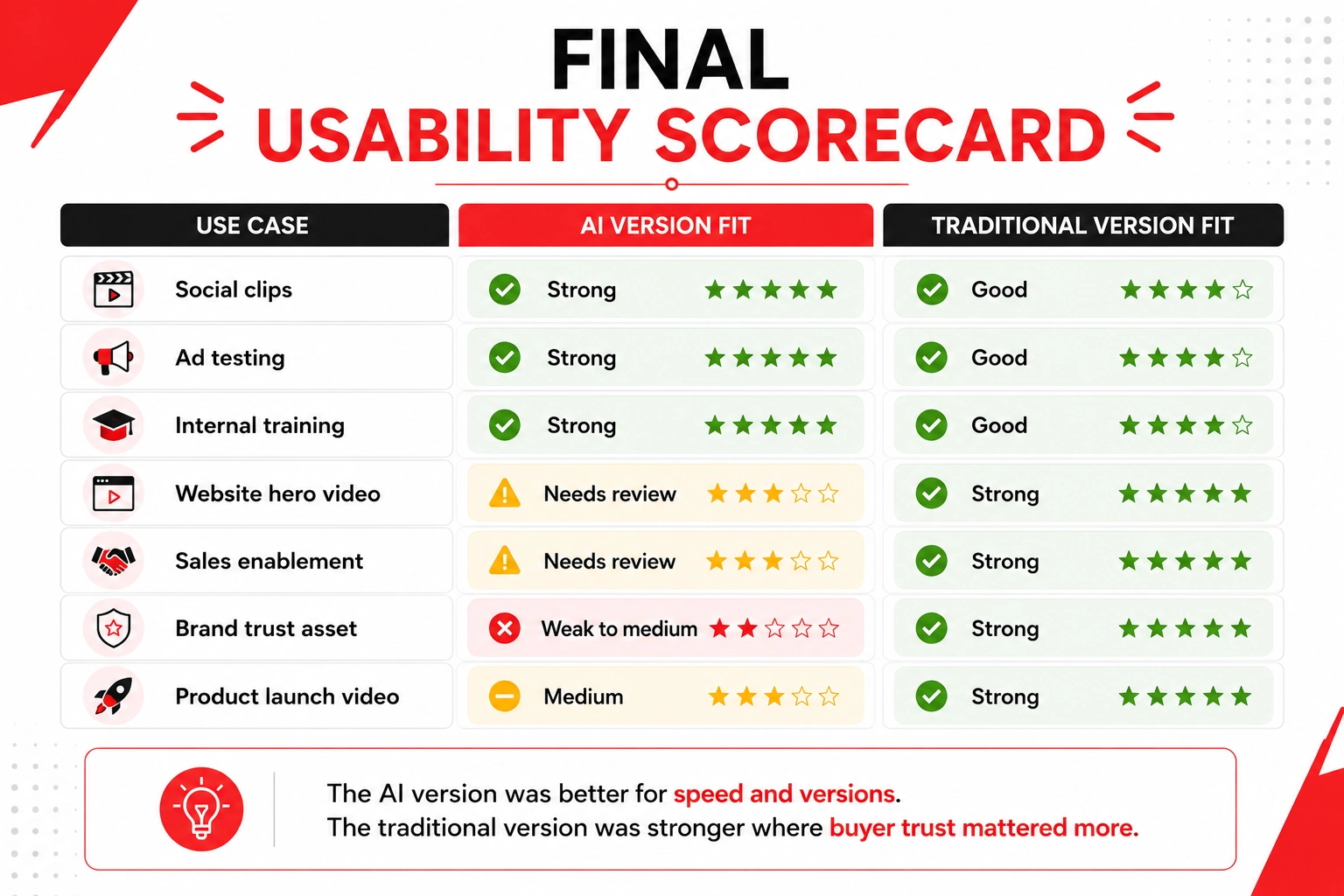
The AI version was more useful for speed, testing, and multiple versions. The traditional version was stronger for trust, brand perception, and high intent use.
The AI version worked better for social clips, ad tests, internal training, localization, and product update formats.
The traditional version worked better for website use, sales enablement, campaign launches, and long term brand assets.
This is the real answer to what changes when you use AI video production: speed improves first, but control becomes the tradeoff.
The Main Difference We Noticed
The main difference was speed vs control.
| Area | AI assisted version | Traditional version |
| Best strength | Speed and versioning | Control and polish |
| Best use | Testing, social, updates | Brand, sales, campaigns |
| Weakness | Generic output risk | Longer timeline |
| Script | Fast first draft | More strategic from start |
| Visuals | Faster options | More consistent execution |
| Revisions | Faster small changes | Stronger refinement |
| Cost | Lower for repeatable assets | Higher for custom quality |
| Final fit | Scale and testing | Trust and premium positioning |
This also answers how different is AI video from traditional video. The difference is not only how the asset is made. It is how much control you keep over the final business impression.
What Surprised Us Most
The AI version was not weak because AI was used. It became weak when the brief was weak.
When the brief was specific, AI helped. When the brief was vague, the output became generic quickly [Motionvillee Internal Test, 2026].
That finding matters for marketers. AI cannot guess your positioning, sales objections, buyer doubts, or competitive context.
Traditional production also fails with a weak brief, but AI exposes weak inputs faster.
For related practical patterns, see AI video production workflow lessons
When AI Production Worked Better
AI production worked better when speed, volume, and repeatability mattered more than premium creative depth.
Best fit:
- Social media videos
- Paid ad variations
- Product update videos
- Webinar clips
- Internal explainers
- Training videos
- Localization
- Long content repurposing
- Hook testing
This is where AI video production can improve production efficiency without carrying the full burden of brand trust.
When Traditional Production Worked Better
Traditional production worked better when trust, quality, and control mattered more.
Best fit:
- Brand story videos
- High value product explainers
- Customer stories
- Website hero videos
- Investor videos
- Sales campaign videos
- Complex SaaS videos
- Emotional storytelling
This is also where AI can replace traditional video production becomes the wrong question. The better question is whether AI can protect the business role of that specific video.
What This Means for Businesses Choosing Between AI and Traditional Production
Businesses should choose based on the job of the video, not the trend behind the workflow.
| Business need | Better approach |
| Need many versions quickly | AI assisted production |
| Need premium brand trust | Traditional production |
| Need product accuracy and speed | Hybrid workflow |
| Need social content at scale | AI assisted production |
| Need a launch video | Traditional or hybrid |
| Need training content | AI assisted production |
| Need sales enablement assets | Hybrid workflow |
If your team is also comparing tools, this test pairs naturally with AI video tools tested across real projects
Why the Best Workflow May Be Hybrid
The strongest workflow was not fully AI or fully traditional. It was hybrid.
AI helped with speed, options, cutdowns, and repeatable tasks.
Human direction protected strategy, buyer clarity, brand trust, and final judgment.
HubSpot’s 2026 State of Marketing report frames AI, brand point of view, trust, efficiency, and growth as major marketing priorities [HubSpot, 2026]. That supports the hybrid view: use AI to increase useful output, but keep human control over the message that affects buyer confidence. (HubSpot)
What We Found After Producing the Same Video Twice
AI changed the speed. Traditional production changed the control.
The AI version helped us move faster, test more ideas, and create more versions.
The traditional version helped create a stronger final asset for trust, clarity, and brand impact.
So the real question is not, “Should businesses use AI or traditional production?”
The better question is: “What does this video need to do for the business, and which workflow gives it the best chance to work?”
For Motionvillee, the future is not AI replacing production. It is business led video systems where AI improves speed, and human judgment protects the message that drives the pipeline.