
Why Are Businesses Looking at AI Video Production?
Businesses are looking at AI video production because video demand has outgrown the old one asset at a time production model.
The benefits of AI video production are strongest when AI helps your team create more useful videos faster, while human review protects clarity, brand trust, and business value.
Marketing teams now need paid ads, social clips, product videos, sales assets, onboarding videos, training content, and customer education. Wyzowl reports that 63% of video marketers have used AI tools to create or edit marketing videos, up from 51% the previous year [Wyzowl, 2026]. (Wyzowl)
That does not mean AI replaces strategy. It means businesses are trying to remove production friction. For the wider context, read the AI video production guide
What Are the Main Benefits of AI Video Production?
The main benefits are faster output, lower production friction, easier repurposing, better testing, and more video coverage across the buyer journey.
For a business, AI video benefits should be measured by usable assets, not just output volume. A faster draft only matters if it helps your buyer understand, trust, or act sooner.
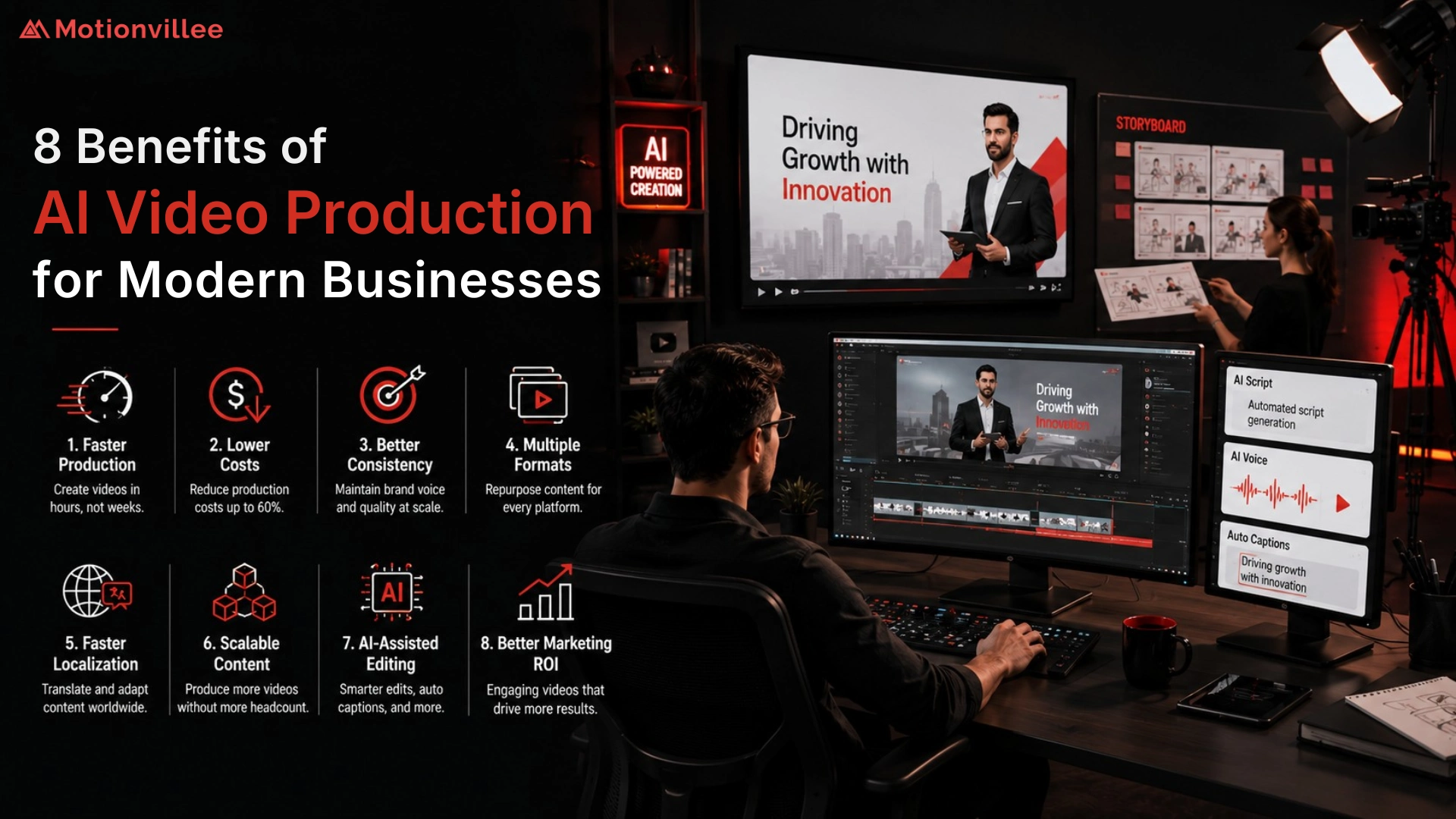
The 8 major benefits are:
- Faster production timelines
- Lower cost for repeat content
- More video versions from one idea
- Better testing for ads and social
- Easier personalization and localization
- Faster repurposing of existing content
- Stronger support for sales and onboarding
- Better use of human creative time
1: AI Video Production Speed Up Content Creation
AI video production speeds up content creation by reducing repeat work in early drafts, captions, edits, translations, and short clips.
AI can help teams create first drafts faster. It can support script ideas, subtitle generation, rough edits, resizing, clip selection, and translated versions.
The key phrase is the first draft. AI should not be treated as instant final production for high trust business content.
A 2025 study analyzing 274 YouTube how to videos found that creators use generative AI across planning, scriptwriting, visual creation, audio, editing, titles, and subtitles [Anderson and Niu, 2025]. (arXiv)
For business teams, the practical takeaway is simple. You move faster when AI handles repeat tasks, while humans decide what is actually worth publishing.
2: AI Reduces Video Production Costs
AI can reduce video production costs when the format is repeatable, structured, or based on existing content.
AI may lower effort for repeated cutdowns, captioned edits, draft scripts, internal training clips, and versioning. These are areas where manual production time can add up.
But AI does not make every video cheap. Premium brand films, customer stories, complex explainers, and executive videos still need stronger human direction.
This is why cost should be judged by video risk. A social clip and a flagship product story should not follow the same production model.
For a clearer breakdown of when AI fits and when traditional production matters, read AI video production vs traditional video production
3: AI Helps Businesses Create More Video Versions
AI helps businesses create more versions by adapting one core idea into different lengths, hooks, formats, and channels.
One idea can become a 15 second ad, a 30 second LinkedIn clip, a long YouTube edit, an email video, a sales follow up, or a captioned mobile version.
This matters because one video rarely fits every funnel stage.
A buyer seeing your brand for the first time needs a different message than a prospect comparing vendors after a demo.
The advantage of AI video production for content scale is not just more files. It has more relevant touchpoints.
4: AI Improves Video Testing for Marketing Teams
AI improves testing by making it easier to create multiple creative angles without starting from zero each time.
Teams can test different hooks, CTAs, pain points, formats, lengths, voiceovers, and platform versions.
That gives marketing leaders more learning loops.
Instead of guessing which message will work, you can test what improves engagement, demo clicks, cost per qualified lead, and sales follow up performance.
HubSpot’s 2026 State of Marketing report frames AI, brand point of view, trust, and growth as major marketing priorities [HubSpot, 2026]. (HubSpot)
That matters because testing should not only chase views. It should help you find the message that moves the right buyer forward.
5: AI Supports Personalization and Localization
AI supports personalization and localization by helping create language, region, role, and segment versions faster.
AI can assist with translated voiceovers, localized subtitles, region specific edits, role based versions, and personalized sales videos.
For example, a CFO may need a cost and ROI angle. A CMO may need a pipeline and campaign performance angle. A customer success leader may need onboarding clarity.
Caution is important. Literal translation can miss tone and business meaning. Localization still needs human review, especially for finance, cybersecurity, healthcare, and enterprise buyers.
6: AI Makes Content Repurposing Easier
AI makes repurposing easier by turning long form content into shorter video assets for different channels.
A webinar can become short LinkedIn clips. A product demo can become sales snippets. A founder interview can become social posts. A training session can become learning modules.
This helps your team get more value from content you already paid to create.
It also supports AI video for business marketing because your best ideas do not stay trapped inside one long recording.
For the process behind this, read how AI video production works
7: AI Video Production Supports Sales and Customer Education
AI video production supports sales and education by helping teams create repeatable videos that answer common buyer and user questions.
These videos can include product walkthroughs, feature explainers, sales follow ups, FAQ videos, onboarding clips, renewal education, and internal training.
This connects directly to revenue work.
When prospects understand your product before a call, sales teams spend less time explaining basics and more time handling real buying questions.
Motionvillee’s own audience research shows that decision makers want pipeline qualified leads, ROI clarity, and a trusted partner, while influencers struggle to simplify complex SaaS offerings and prove marketing ROI.
That is where business video becomes useful. It helps buyers arrive more informed.
8: AI Helps Creative Teams Spend Time Better
AI helps creative teams spend less time on repeat tasks and more time on message, strategy, quality, and buyer clarity.
AI can reduce time spent on resizing, captions, rough drafts, clipping, and formatting.
That gives your team more room to focus on the work that affects trust: what the buyer needs to understand, what the sales team keeps repeating, and what message should lead the campaign.
Deloitte Digital’s 2026 marketing trends report says generative AI is moving toward broader customer facing use, while CMOs need systems where human creativity and machine intelligence work together [Deloitte Digital, 2026]. (Deloitte)
That is the right model. AI handles repeat work. People protect judgment.
Which Businesses Benefit Most From AI Video Production?
Businesses with frequent, structured, repeatable video needs benefit most from AI video production.
Best fit businesses include:
- SaaS companies
- Tech companies
- B2B service companies
- Training heavy businesses
- Sales led companies
- Product led companies
- Teams running paid ads
- Teams with webinars, demos, or product updates
The advantages of AI video production are strongest when your team already has clear knowledge but struggles to turn that knowledge into enough useful video assets.
When Are the Benefits of AI Video Production Limited?
The benefits are limited when the video needs deep trust, original storytelling, sensitive positioning, or premium brand impact.
AI is useful for speed and scale, but not every video should feel automated.
Be careful with:
- Main brand films
- High value sales videos
- Enterprise explainers
- Investor videos
- Customer testimonials
- Category positioning videos
- Complex product launch videos
McKinsey’s State of AI research shows that adoption is growing, but scaling AI into measurable business impact remains difficult for many companies [McKinsey, 2025]. (McKinsey & Company)
That limitation applies here too. Tools can speed up production, but strategy decides whether the output helps the business.
How Can Businesses Get the Most Value From AI Video Production?
Businesses get the most value when they start with the message, then choose the tools.
Use this checklist:
- Define the business goal
- Know the target audience
- Write a strong script
- Choose the right AI workflow
- Keep human review in place
- Create multiple versions
- Track business outcomes
- Improve based on performance
If you need strategy, scripting, review, and campaign ready assets, use this guide to choose the right AI video production company
For practical execution patterns, the AI video production workflow lessons can help you avoid treating tools as the strategy.
Conclusion: What Is the Biggest Benefit of AI Video Production?
The biggest benefit of AI video production is not speed alone. It is the ability to produce more useful video assets without pushing every task through a slow manual process.
AI helps you move faster. Human direction keeps the message useful.
For modern businesses, the strongest approach is usually a clear workflow where AI handles repeat work while people protect buyer clarity, brand trust, and business impact.
That is how AI video moves from content output to pipeline support.