
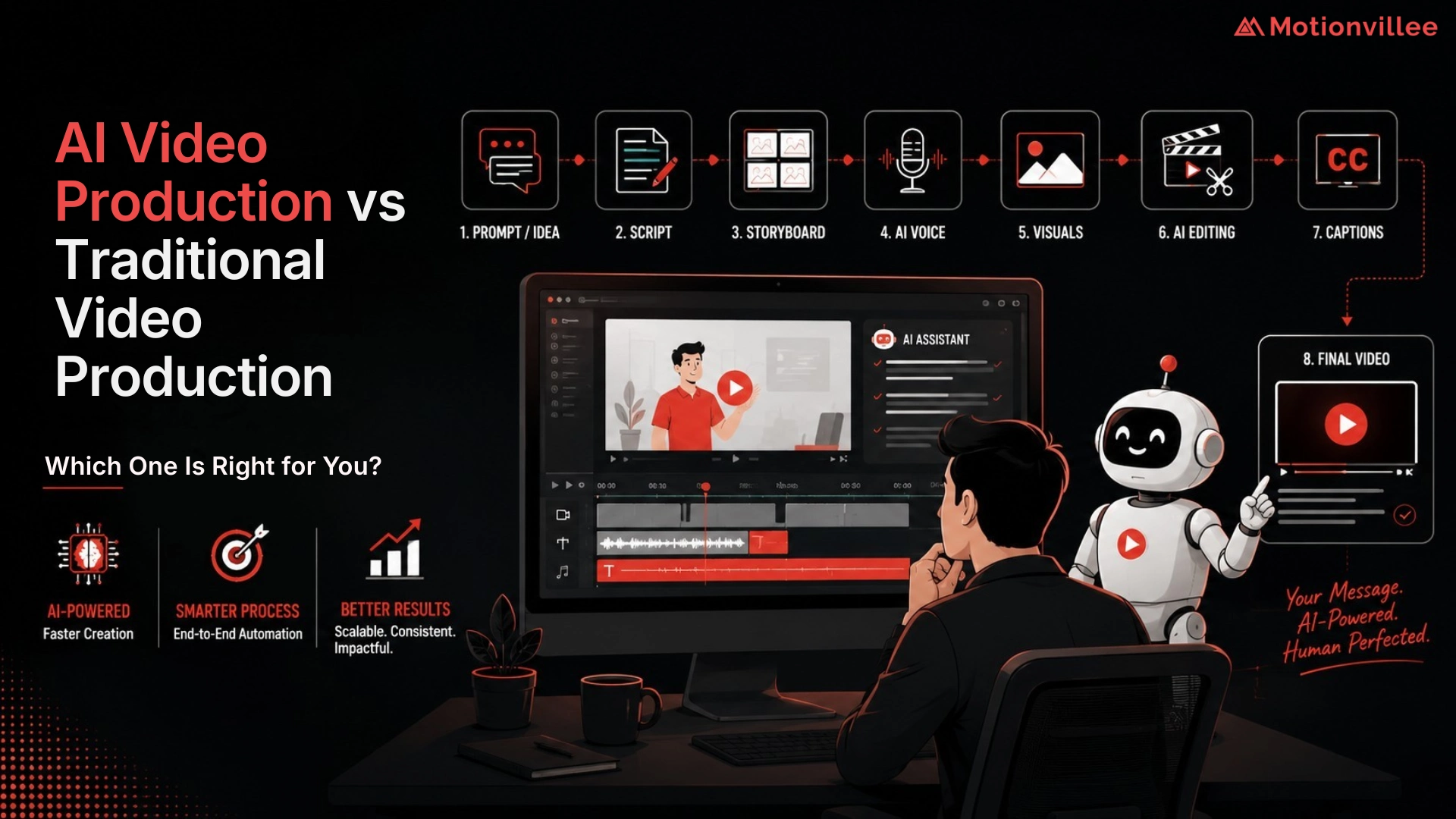
Introduction: Why Are Businesses Comparing AI and Traditional Video Production?
Businesses are comparing AI video production vs traditional video production because the pressure to produce more video has increased, but the risk of publishing weak video has not gone down.
AI can help you create more assets faster. Traditional production can help you protect trust, originality, and brand perception.
The mistake is treating them as competitors. They are better seen as different production models for different business risks.
Wyzowl reports that 63% of video marketers have used AI tools to create or edit marketing videos, up from 51% the previous year [Wyzowl, 2026]. That shows adoption is rising, but it does not prove AI is right for every business video.
For the full overview, read the AI video production guide
What Is the Main Difference Between AI and Traditional Video Production?
The main difference is control. AI video production is built for speed, repeat formats, and versioning. Traditional video production is built for custom messaging, original execution, and higher trust moments.
For business leaders, the question is not which method is newer.
The question is which method fits the risk, audience, and revenue role of the video.
AI video production is useful when the message is clear and your team needs more versions. Traditional video production is stronger when the video needs to shape how buyers see your company.
How Does AI Video Production Compare to Traditional Production?
AI is usually stronger for speed and scale, while traditional production is stronger for trust, originality, and premium brand control.
| Factor | AI video production | Traditional video production |
| Best business role | Scale repeat content | Build trust and authority |
| Speed | Faster for drafts and versions | Slower but more controlled |
| Cost | Lower for repeat formats | Higher for custom assets |
| Message depth | Works when the message is clear | Stronger for complex stories |
| Brand perception | Needs careful review | Easier to make brand specific |
| Best fit | Ads, clips, updates, training | Brand films, demos, testimonials |
| Risk | Generic output if unmanaged | Budget waste if strategy is weak |
| Scale | Strong for many variations | Strong with a planned asset system |
McKinsey’s 2025 AI research says measurable value depends on how AI is integrated into real business operations, not only on adoption [McKinsey, 2025]. The same applies to video. Tools alone do not create business impact.
When Should You Use AI Video Production?
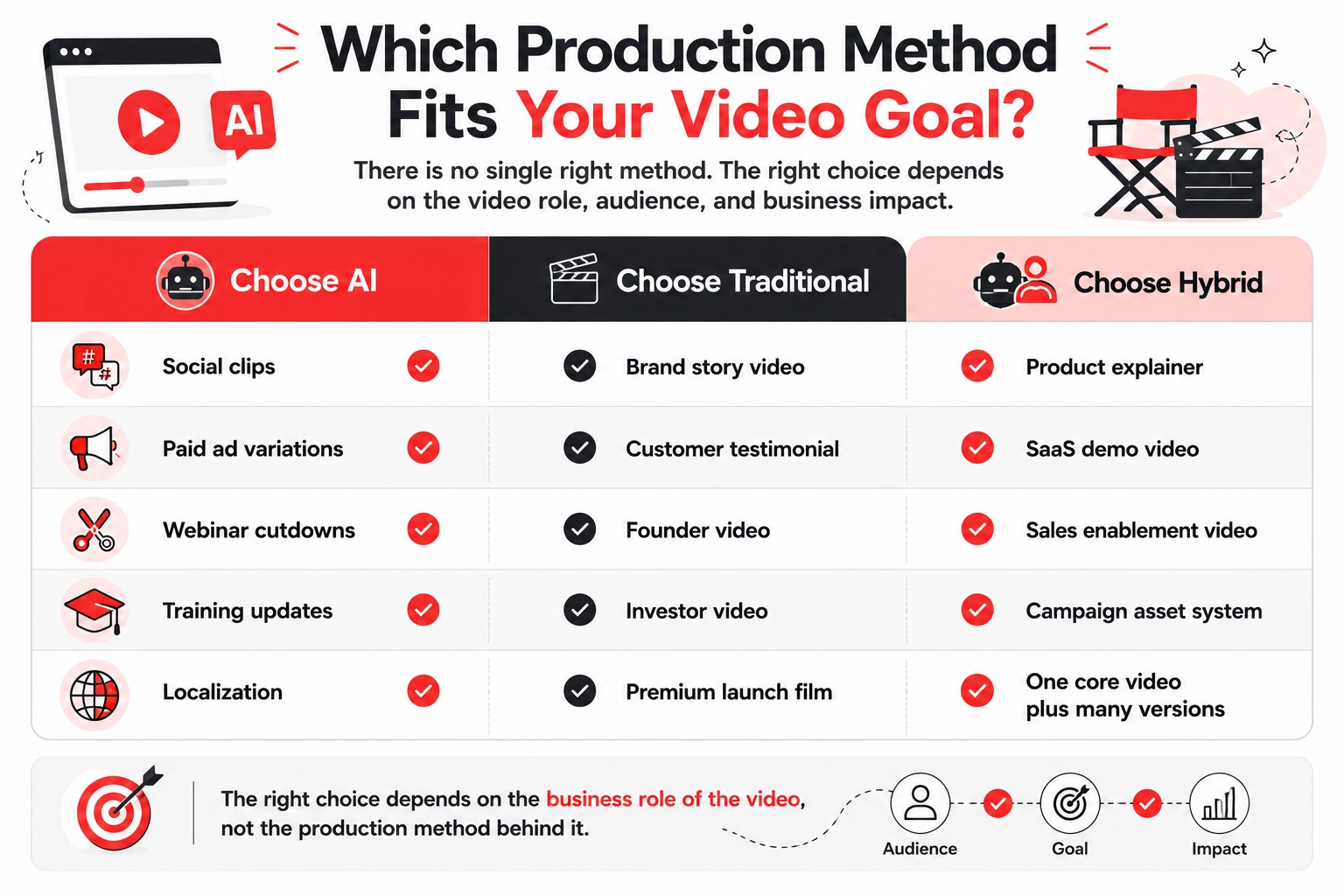
You should use AI video production when the message is already clear and the business needs more versions, faster testing, or repeat content across channels.
AI is strongest when the business risk is low and the cost of delay is higher than the cost of imperfection.
Use AI for:
- Social clips
- Paid ad variations
- Webinar repurposing
- Product update videos
- Training videos
- Internal communication
- Simple tutorial videos
- Captioned short videos
- Localization
- First draft concepts
This is where AI video production pros and cons become practical.
The advantage is speed. The risk is publishing content that looks complete but feels generic, unclear, or disconnected from the buyer.
When Is Traditional Video Production Better?
Traditional video production is better when the video will shape how serious buyers judge your company.
This includes videos that sit on your homepage, support enterprise sales, introduce leadership, explain a complex product, or act as proof during a high value buying process.
Use traditional production for:
- Brand story videos
- Hero explainer videos
- Enterprise product demos
- Customer testimonial videos
- Founder videos
- Investor videos
- Campaign launch videos
- High value landing page videos
- Complex SaaS product stories
- Category positioning videos
A cheap video is expensive if it makes your product harder to trust.
Here is the kind of video where traditional or hybrid production makes more sense. Watch how the story, pacing, visuals, and trust signals work together, not just how polished it looks.
Which One Is Better for Explainer and Product Demo Videos?
For serious explainer videos and product demos, hybrid production is usually the safest choice because these assets need both clarity and efficiency.
AI can support captions, cutdowns, drafts, and variations.
But the core message still needs human judgment because a demo or explainer often decides whether the buyer understands the product before speaking to sales.
This is why AI video vs traditional video is not a simple winner.
For low risk product updates, AI may be enough. For sales assets that explain complex value, hybrid is usually stronger.
For product explainers, AI can support drafts and versions, but the core message still needs human planning.
A good explainer does not only show the product. It helps buyers understand why the product matters.
Which One Is Better for Paid Ads and Social Videos?
AI video production is often better for paid ads and social videos because these channels need frequent testing and many versions.
Paid and social campaigns often need:
- Multiple hooks
- Different CTAs
- Shorter cuts
- Platform sizes
- Captioned edits
- Fast creative testing
- Fresh variations
HubSpot’s 2026 State of Marketing report highlights AI, brand point of view, trust, and growth as major marketing themes [HubSpot, 2026].
That matters because testing more versions only helps if the message still feels credible.
For a broader view of the upside, read the benefits of AI video production
Which One Is More Cost Effective?
AI is usually more cost effective for repeatable content, while traditional production is more cost effective when the video must build trust or explain complexity.
Cost effectiveness is not the cheapest invoice.
A lower cost video can become expensive if it weakens trust, confuses the product, or gives sales a weaker asset to use in active deals.
Judge cost by the role of the video.
A social test can be cheap. A sales asset should be judged by whether it improves understanding, confidence, and conversion quality.
Ask:
- Will buyers use this video to judge the brand?
- Does this video support active sales conversations?
- Does the product need careful explanation?
- Is the video low risk or high risk?
- Do we need one asset or many versions?
Which One Gives Better Quality?
Traditional production usually gives better quality for brand critical videos, while AI production can work well for structured, repeatable content.
Quality should not only mean visual polish.
For business video, quality means:
- Message clarity
- Buyer confidence
- Visual consistency
- Product accuracy
- Story flow
- Brand fit
- CTA strength
Deloitte Digital says generative AI is moving from experimentation to broader marketing adoption, but also says human creativity and machine intelligence need to work together [Deloitte Digital, 2026].
That supports the hybrid view.
What Are the Risks of Each Approach?
AI risks generic output, while traditional production risks higher cost without a clear use plan.
AI risk is not only that the video looks generic.
The bigger risk is that it sounds confident while saying something that does not match your product, your buyer, or your sales reality.
AI risks include:
- Generic scripts
- Unnatural avatars
- Inconsistent visuals
- Weak brand tone
- Wrong claims
- Template based output
- Poor buyer understanding
Traditional risk is not only cost.
The bigger risk is producing one polished asset without a plan for how it will support the funnel after launch.
Traditional risks include:
- Longer timelines
- Higher cost
- Overproduction
- One video serving too many goals
- Slow revisions
- No versioning plan
- Weak distribution strategy
Traditional production still fails if the strategy is weak. AI still fails if the message is unclear.
Is Hybrid Video Production the Best Option?
Hybrid video production is often the best option when one core message needs to become many useful assets without losing quality.
This is the model many marketing teams actually need.
Create one strong core video. Then use AI supported workflows to turn it into paid ad cuts, LinkedIn clips, sales follow up videos, onboarding snippets, and email assets.
That is often the strongest answer to AI vs human video production.
Use AI for speed and variation. Use human direction for message, accuracy, and trust.
For practical execution, read AI video production workflow lessons
How Do You Decide Which Production Method Is Right?
You should decide based on what the video is responsible for in the business.
If you need help evaluating partners, use this guide to choose the right AI video production company
Conclusion: Which One Is Right for You?
The right choice is not about whether AI or traditional production is better. The right choice is about what the video is responsible for.
If the video needs speed, testing, and repeat output, AI is useful.
If the video needs trust, originality, and high value perception, traditional production is safer.
If the video needs to become a full funnel asset system, hybrid is usually the strongest route.
For Motionvillee, the practical answer is simple: choose the production model based on the business role of the video, not the production trend behind it.