
Why Is AI Video Production Becoming Important for Businesses?
AI video production is becoming important because businesses need to explain faster, publish more often, and stay visible across more channels without increasing production pressure.
Most companies do not have a video idea problem. They have a video output problem.
Marketing needs ads. Sales needs demo support. Customer teams need onboarding clips. Product teams need feature updates. Leadership wants the brand to feel consistent across every touchpoint.
Wyzowl reports that 63% of video marketers have used AI tools to help create or edit marketing videos, up from 51% the previous year [Wyzowl, 2026]. That shows AI is becoming part of normal video workflows, not just a side experiment. (Wyzowl)
But AI alone does not solve the business problem. It only increases output.
The real advantage comes when businesses use AI to remove repeat production work while people protect the message, buyer clarity, and brand trust.
What Is AI Video Production?
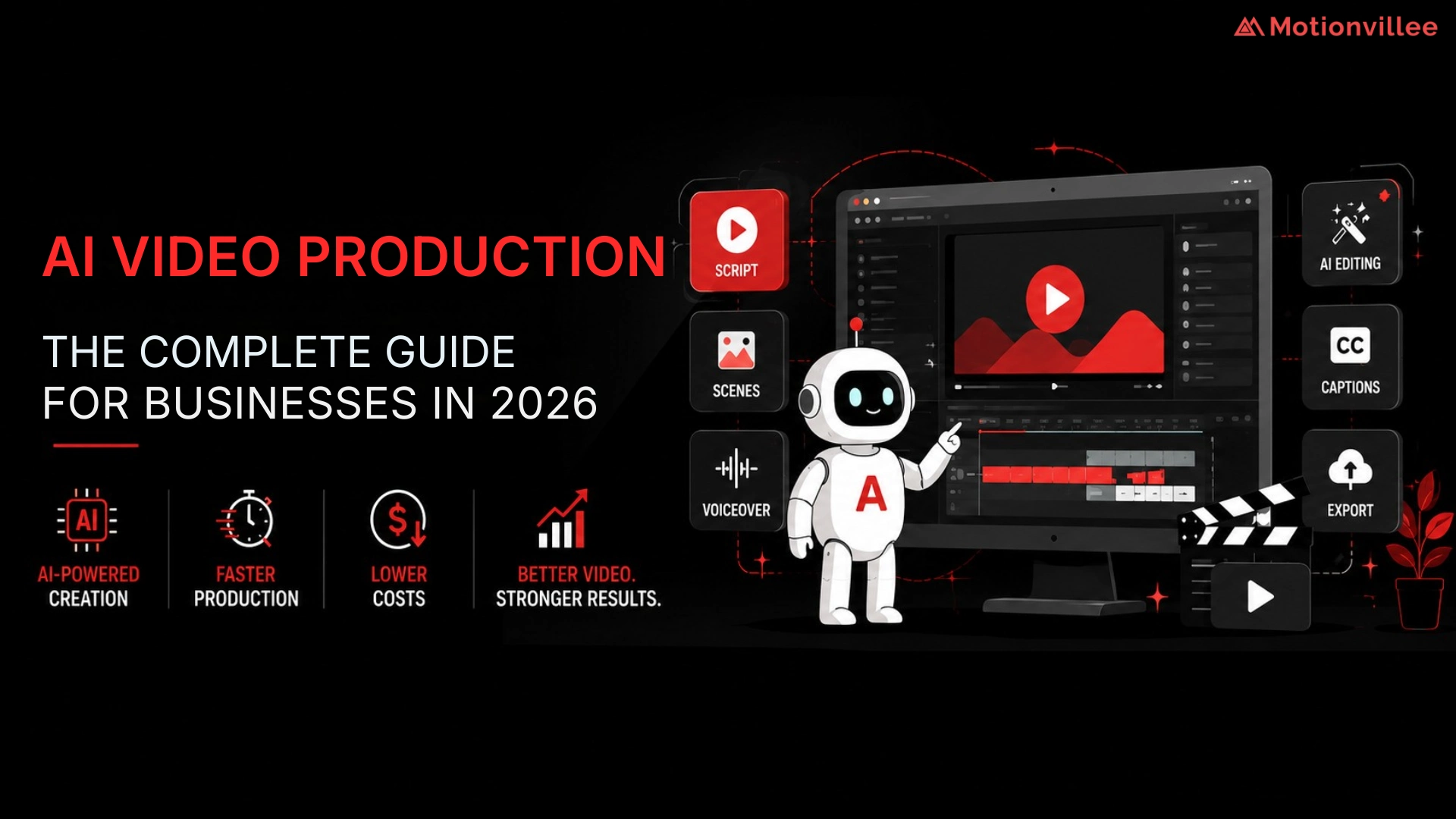
AI video production is the use of AI tools to perform video tasks that were earlier done manually by writers, editors, designers, voice artists, animators, and production teams.
For businesses, it does not always mean a fully AI generated video.
It can mean using tools like Runway, Synthesia, HeyGen, Descript, Pictory, ElevenLabs, Midjourney, Adobe Firefly, or Canva AI to speed up scripting, editing, voiceover, avatars, visuals, subtitles, translations, and content repurposing.
Common use cases include:
- Drafting video scripts
- Creating AI voiceover
- Using AI avatars for structured messages
- Repurposing webinars into clips
- Generating subtitles and translations
- Creating quick social video variations
- Supporting internal training and onboarding
How Does AI Video Production Work?
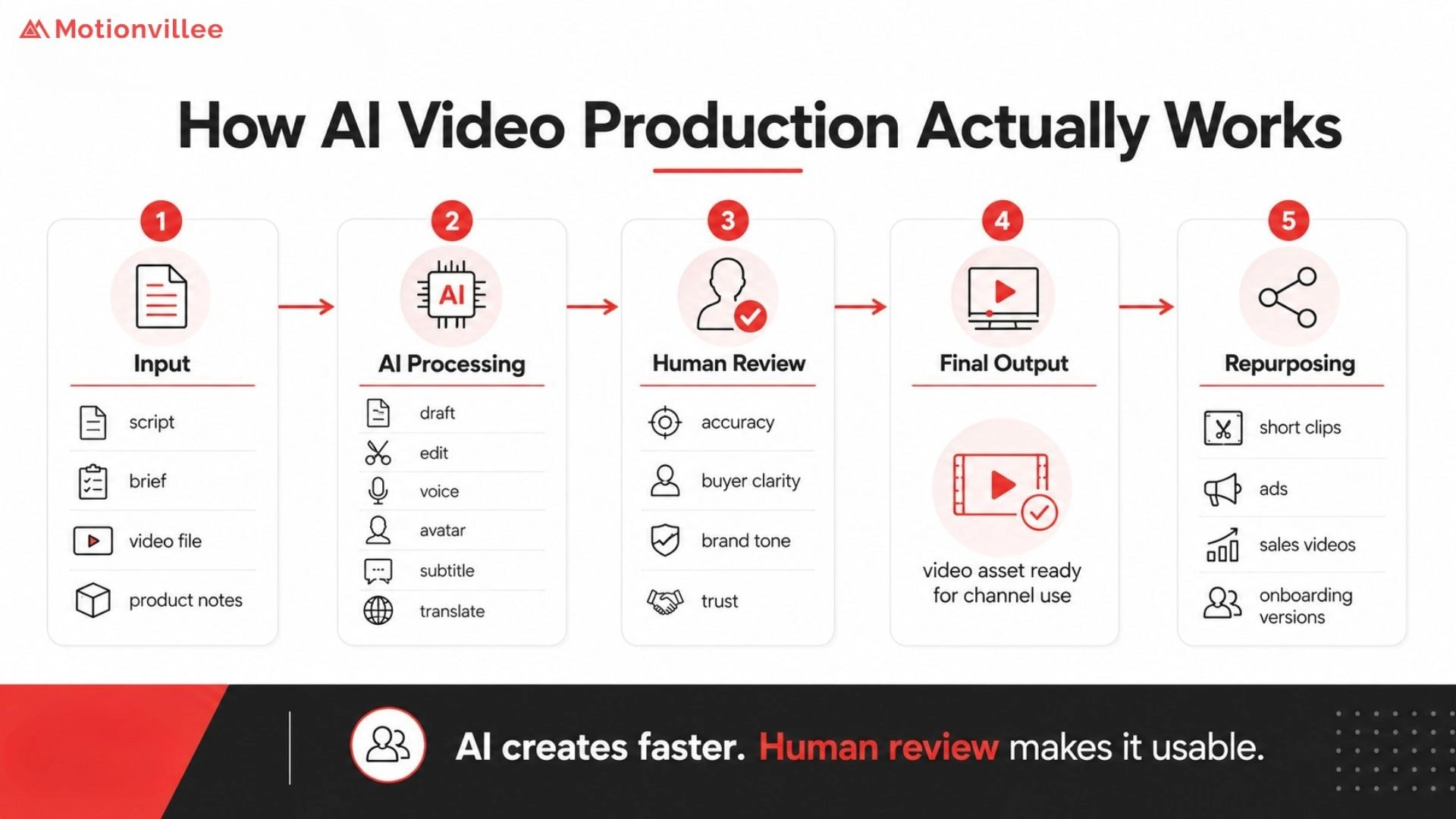
AI video production works by giving AI tools a clear input, such as a script, prompt, video file, product brief, or brand direction, and using those tools to generate, edit, translate, resize, or repurpose video content.
The basic workflow looks like this:
- Define the business goal
- Identify the audience and funnel stage
- Plan the core message
- Choose the right AI support
- Produce the video asset
- Review for accuracy, tone, and trust
- Create versions for the right channels
The best results happen when a human team defines the message first. AI can help produce the asset, but it cannot automatically know your buyer, your sales objections, your product positioning, or your brand risk.
McKinsey’s 2025 State of AI report shows that companies are still working through how to move from AI adoption to measurable business impact [McKinsey, 2025]. That same challenge applies to video. Faster output only helps when the content is accurate, useful, and business ready. (McKinsey & Company)
What Types of Business Videos Can Be Created With AI?
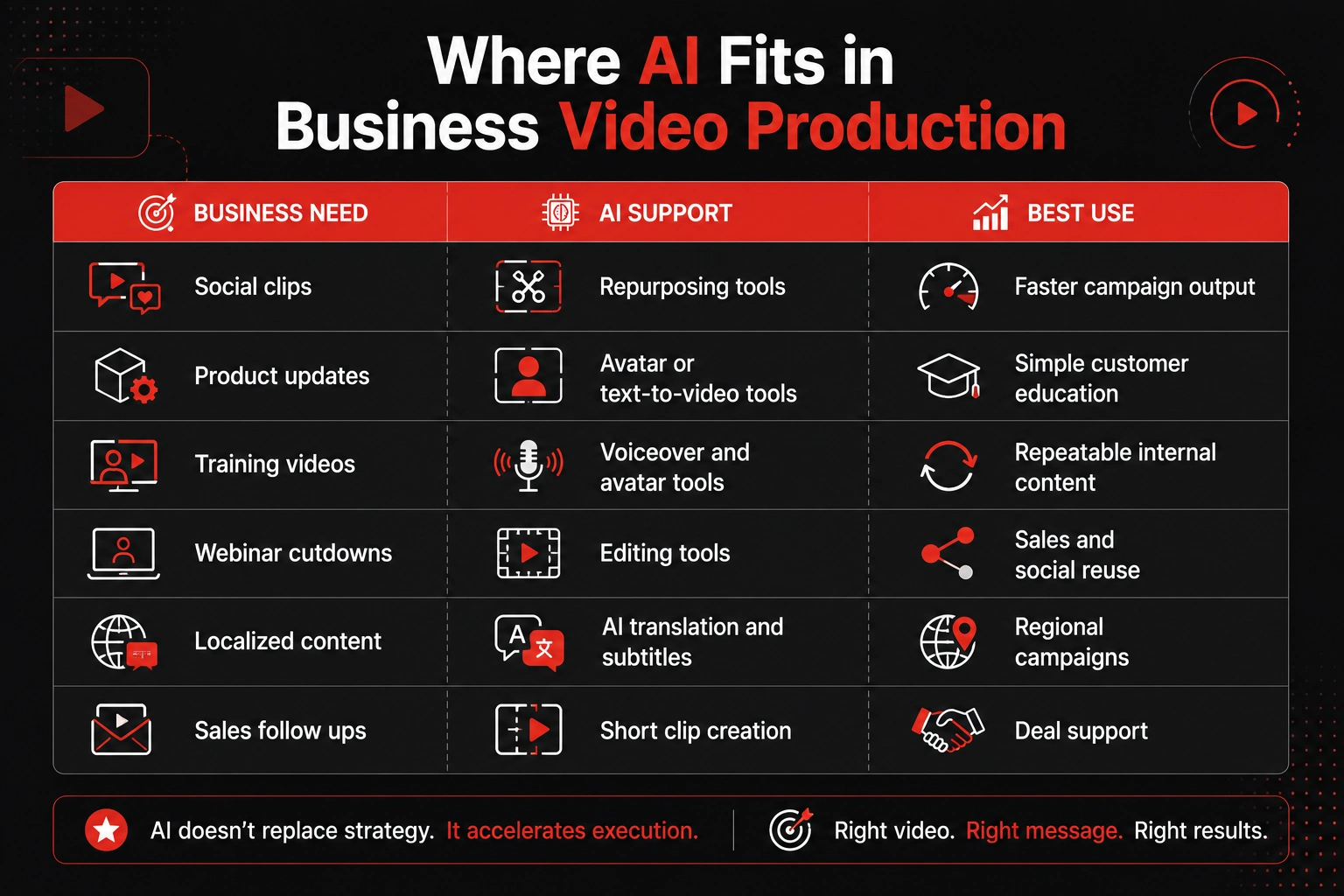
AI can support business videos that are structured, repeatable, and content heavy.
That includes social videos, paid ad variations, product update videos, training clips, onboarding videos, webinar cutdowns, sales follow up videos, FAQ videos, internal communication videos, and multilingual versions.
For example, a webinar can become several LinkedIn clips, a short email video, a sales enablement snippet, and a retargeting asset. A product update can become a customer education video instead of another long written announcement.
The business value is not only speed. The value is making your existing knowledge easier to use across marketing, sales, and customer education.
What Are the Main Benefits of AI Video Production for Businesses?
The main benefits of AI video production are speed, scale, repurposing, testing, localization, cost control, sales support, and better use of creative time.
These benefits matter because businesses no longer need one video for one channel. They need multiple useful video assets across ads, websites, sales, onboarding, webinars, and customer education.
The strongest benefits are:
- Faster first drafts
- More content variations
- Easier repurposing
- Lower friction for repeat formats
- More testing options for ads and social
- Better support for sales and onboarding teams
HubSpot’s 2026 State of Marketing report highlights AI, brand trust, and sharper brand point of view as major priorities for modern marketing teams [HubSpot, 2026]. That is an important caution. AI can increase output, but trust still depends on clarity and relevance. (HubSpot)
For a deeper breakdown, readers can explore the 8 Benefits of AI Video Production for Modern Businesses
Where Does AI Video Production Work Best?
AI video production works best when the video job is clear, repeatable, and low risk.
It is useful for:
- Social clips
- Webinar repurposing
- Tutorial videos
- Product education
- Ad variations
- Localized versions
- Internal training
- Sales follow up clips
- Updating old content
AI is useful when your team already knows what message needs to be produced, but needs a faster way to turn that message into video assets.
Deloitte Digital’s 2026 marketing trends report says generative AI is moving from experimentation toward broader customer facing use, but it also says CMOs need systems where human creativity and machine intelligence work together [Deloitte Digital, 2026]. (Deloitte)
That is the right lens. AI helps when speed and scale matter. It does not remove the need for judgment.
Where Does AI Video Production Still Need Human Direction?
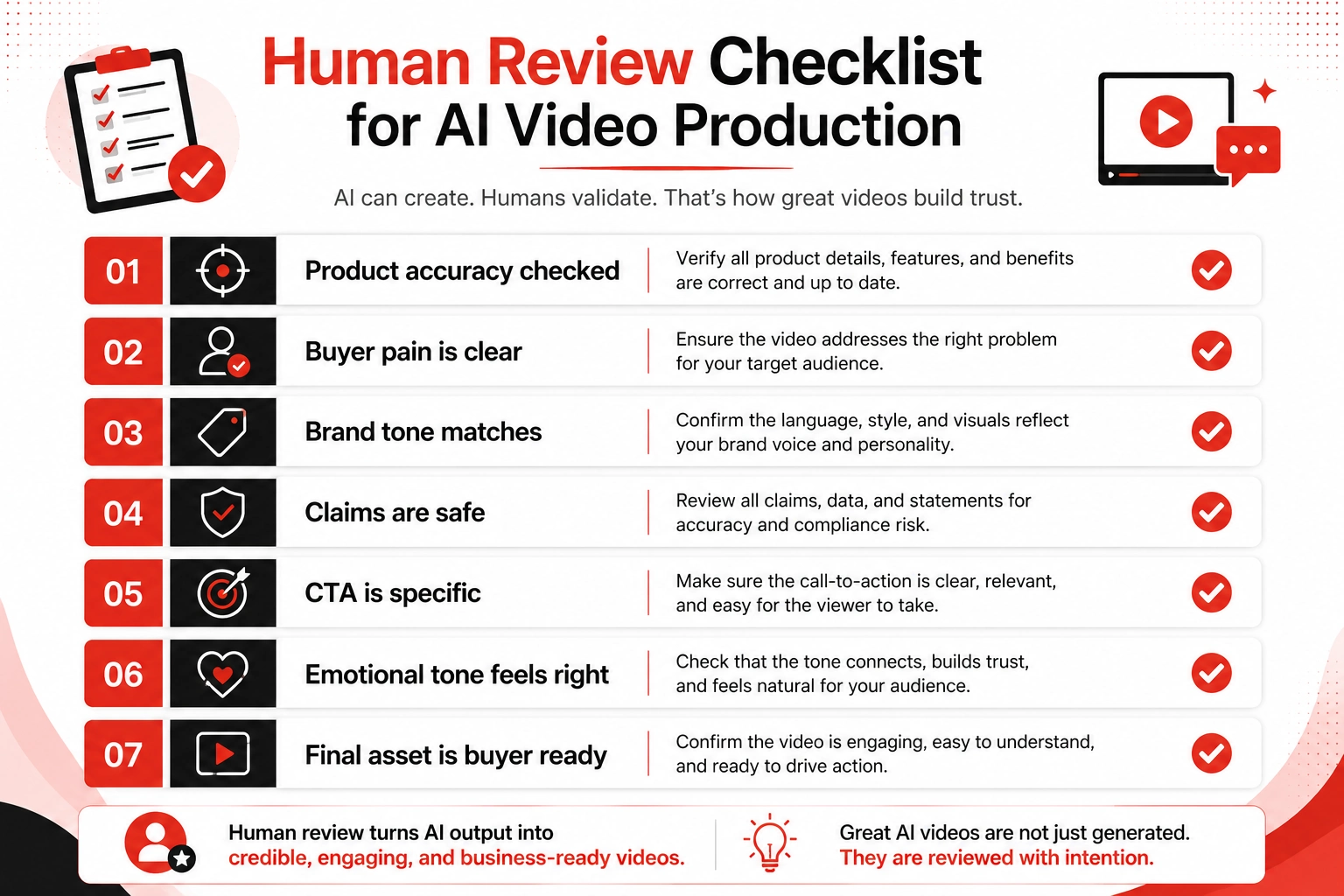
AI still needs human direction for message clarity, brand tone, buyer insight, accuracy, and final quality control.
This is where many AI video projects succeed or fail.
AI can create a draft, but it cannot sit in your sales calls, hear why prospects hesitate, understand why competitors win attention, or decide which message will make your product easier to buy.
Human review protects:
- Product accuracy
- Buyer relevance
- Brand tone
- Legal and compliance risk
- Emotional nuance
- CTA clarity
- Final trust
If your message is unclear, AI will usually make the problem faster, not better.
AI Video Production vs Traditional Video Production: What Is the Difference?
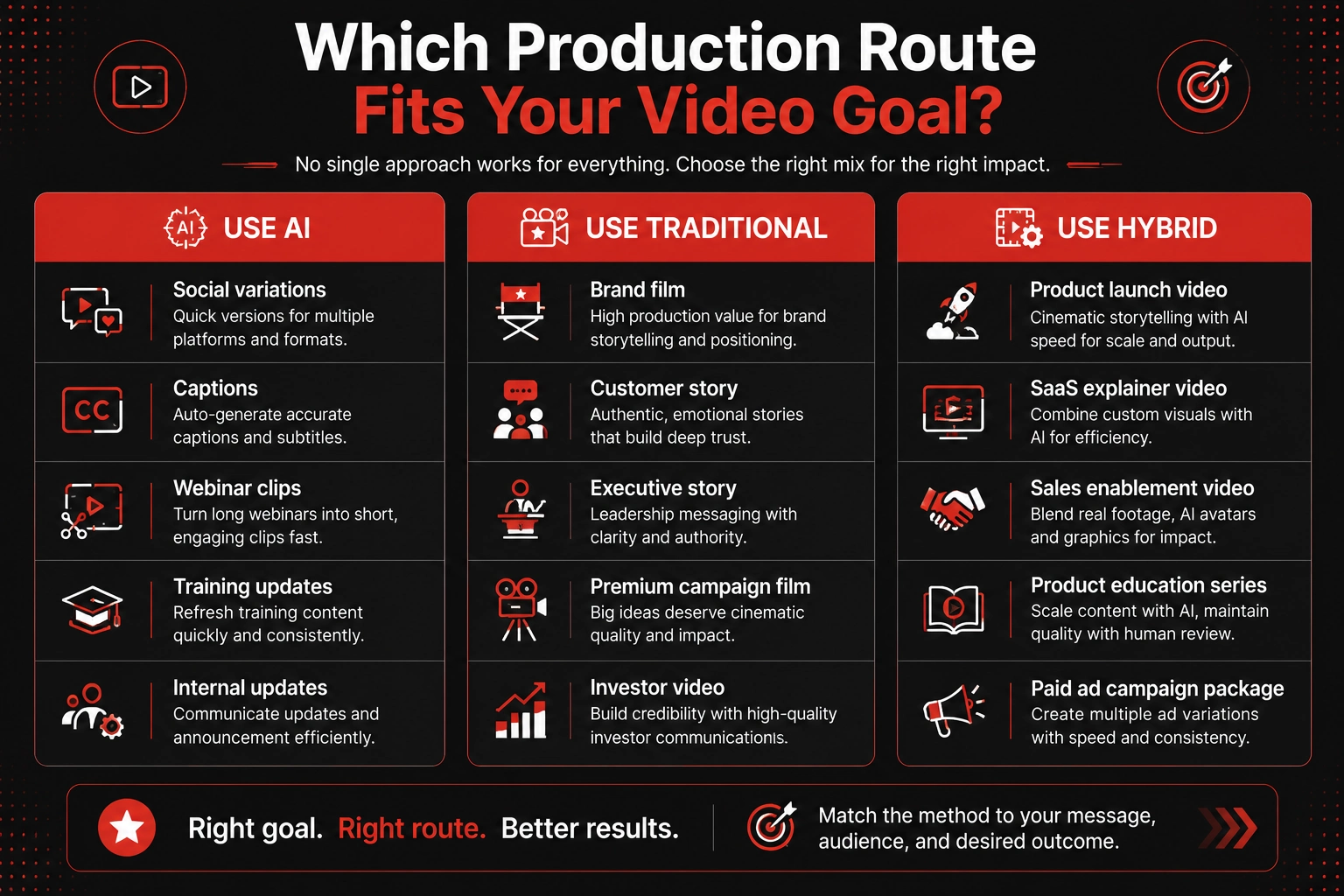
AI video production is usually faster and more flexible, while traditional video production offers more control, originality, and premium brand depth.
AI is useful when you need volume, versions, speed, or lower friction.
Traditional production is stronger when the asset carries high business risk, such as a flagship brand film, executive story, customer proof video, or major product launch.
The better decision is not AI or traditional. It is fit for purpose.
Use AI when speed and variation matter. Use traditional production when trust, originality, and high value perception matter. Use a hybrid model when you need both scale and quality.
For a deeper comparison, link readers to AI Video Production vs Traditional Video Production: Which One Is Right for You
How Should Businesses Choose Between DIY AI Tools and a Production Partner?
Businesses should use DIY AI tools for low risk drafts, tests, and internal content. They should use a production partner when the video affects brand trust, sales conversations, product understanding, or customer acquisition.
| Use case | Best route |
| Internal update | DIY AI tools |
| Social test | DIY AI tools |
| Webinar clip | AI assisted workflow |
| Sales asset | Production partner |
| Brand or launch video | Production partner |
| Enterprise buyer education | Hybrid partner |
A useful next step is AI Video Production Agency vs Doing It Yourself: An Honest Breakdown for Business Owners
What Should Companies Know About AI Video Production in 2026?
Companies should know that AI is not a shortcut. It is a production support system that works only when strategy comes first.
The biggest mistakes are:
- Starting with tools instead of message
- Using generic scripts
- Ignoring brand tone
- Publishing without human review
- Using AI avatars where trust matters
- Measuring views instead of business outcomes
Real tests often show the same pattern. Some tools save time. Some need heavy editing. Some outputs look usable at first, but fail when reviewed for buyer clarity.
For original testing context, see We Produced the Same Video Using AI and Traditional Production. Here’s What Changed and 50 Hours of AI Video Production Testing: 9 Lessons That Changed Our Workflow
When evaluating tools, avoid treating the software list as the strategy. A better resource is We Tested 15 AI Video Tools Across Real Projects. Here’s What Was Actually Worth Using
Is AI Video Production Good for Business?
AI video production is good for business when it helps you create useful video assets faster without weakening trust, clarity, or brand quality.
It can support awareness videos, paid ad variations, product education, demo support, sales follow ups, onboarding, and localized content.
The better question is not “Can AI make videos?”
The better question is, “Can this workflow help your business explain better, test faster, and support the pipeline?”
For business videos, the real question is whether the output helps buyers understand faster and trust you sooner.
Conclusion: What Should Businesses Take Away From AI Video Production?
AI video production is not just about making videos faster. It is about building a smarter way to produce business content at scale.
The strongest companies will use AI to reduce repeat work, create more relevant versions, repurpose existing knowledge, and support buyers across the funnel.
But human direction stays critical.
AI can produce. People decide what should be said, why it matters, and whether the final video can be trusted.
When you are ready to make a production decision, use How to Choose the Right AI Video Production Company for Your Business as a practical next step.
For Motionvillee, the role is simple: help businesses find the right mix of AI assisted and traditional video production so the output supports clarity, trust, and measurable growth.