
Introduction: Why Are Business Owners Comparing AI Video Agencies and DIY Tools?
Business owners are comparing AI video production agencies vs DIY because AI tools have made video easier to create, but not easier to get right.
Your team can now generate scripts, avatars, voiceovers, captions, clips, and social cutdowns faster than before. Wyzowl reports that 63% of video marketers have used AI tools to create or edit marketing videos, up from 51% the previous year [Wyzowl, 2026].
But the harder question is not, “Can we make a video?”
The real question is, “Will this video explain our business clearly enough to help buyers trust the next step?”
That distinction matters. A video that looks finished can still weaken your message if it feels generic, unclear, or disconnected from the buyer.
For the wider context, start with the AI video production guide
What Does DIY AI Video Production Mean?
DIY AI video production means your internal team uses AI video tools to create videos without hiring an external production partner.
This usually includes writing scripts with AI, creating avatar videos, generating voiceovers, adding captions, editing short clips, repurposing webinars, resizing videos, and creating simple product updates.
DIY AI video production usually works when your team already knows the message, the format is simple, and the video does not carry major brand or revenue risk.
It is useful for internal drafts, quick updates, social tests, and simple training clips.
What Does an AI Video Production Agency Do Differently?
An AI video production agency turns AI output into buyer-ready video assets by adding strategy, scripting, quality control, campaign context, and business judgment around the tools.
DIY often starts with the tool.
A strong agency starts with a business goal.
The agency’s value is not that it has access to tools. Most teams can access tools. The value is knowing what to say, what to remove, what to review, and where the final asset should be used.
McKinsey’s 2025 State of AI report notes that many organizations are still working through how to turn AI use into measurable business impact [McKinsey, 2025]. That same point applies here.
AI can generate output. It cannot automatically create a video that supports pipeline, sales conversations, or customer education.
When Does DIY AI Video Production Make Sense?
DIY AI video production makes sense when the video is simple, low risk, and not central to brand trust or sales conversion.
DIY works best when the audience is internal, the message is simple, and the cost of a weak video is low.
Good DIY use cases include:
- Internal updates
- Training drafts
- Webinar cutdowns
- Simple captions
- Rough product updates
- Social media tests
- First draft concepts
- Internal onboarding clips
If the video is going to prospects, investors, enterprise buyers, or paid traffic, DIY needs stricter review.
DIY works well when speed matters more than polish and the cost of getting it wrong is low.
When Should You Hire an AI Video Production Agency?
You should hire an AI video production agency when the video has to influence how buyers understand, trust, or evaluate your company.
This includes any video that your sales team uses in active deals, your paid campaigns use to attract leads, or your website uses to explain the offer before a call.
Good agency use cases include:
- Website explainer videos
- Product demo videos
- Paid ad campaigns
- Brand story videos
- Sales enablement videos
- Investor videos
- Launch campaign assets
- Complex SaaS product videos
If the video affects how buyers understand your product, the cost of poor messaging is often higher than the production cost.
That is where AI video production services can create more value than DIY tools alone.
What Are the Pros of Doing AI Video Production Yourself?
The main advantage of DIY AI video production is speed and lower upfront cost for simple content.
DIY can help you test ideas quickly, repurpose existing content, create drafts, and handle small updates without waiting on an outside team.
It also gives your internal team more control over fast moving content.
The advantage is practical. You can move quickly when the stakes are low.
But that does not mean DIY is the right choice for every business video.
What Are the Cons of Doing AI Video Production Yourself?
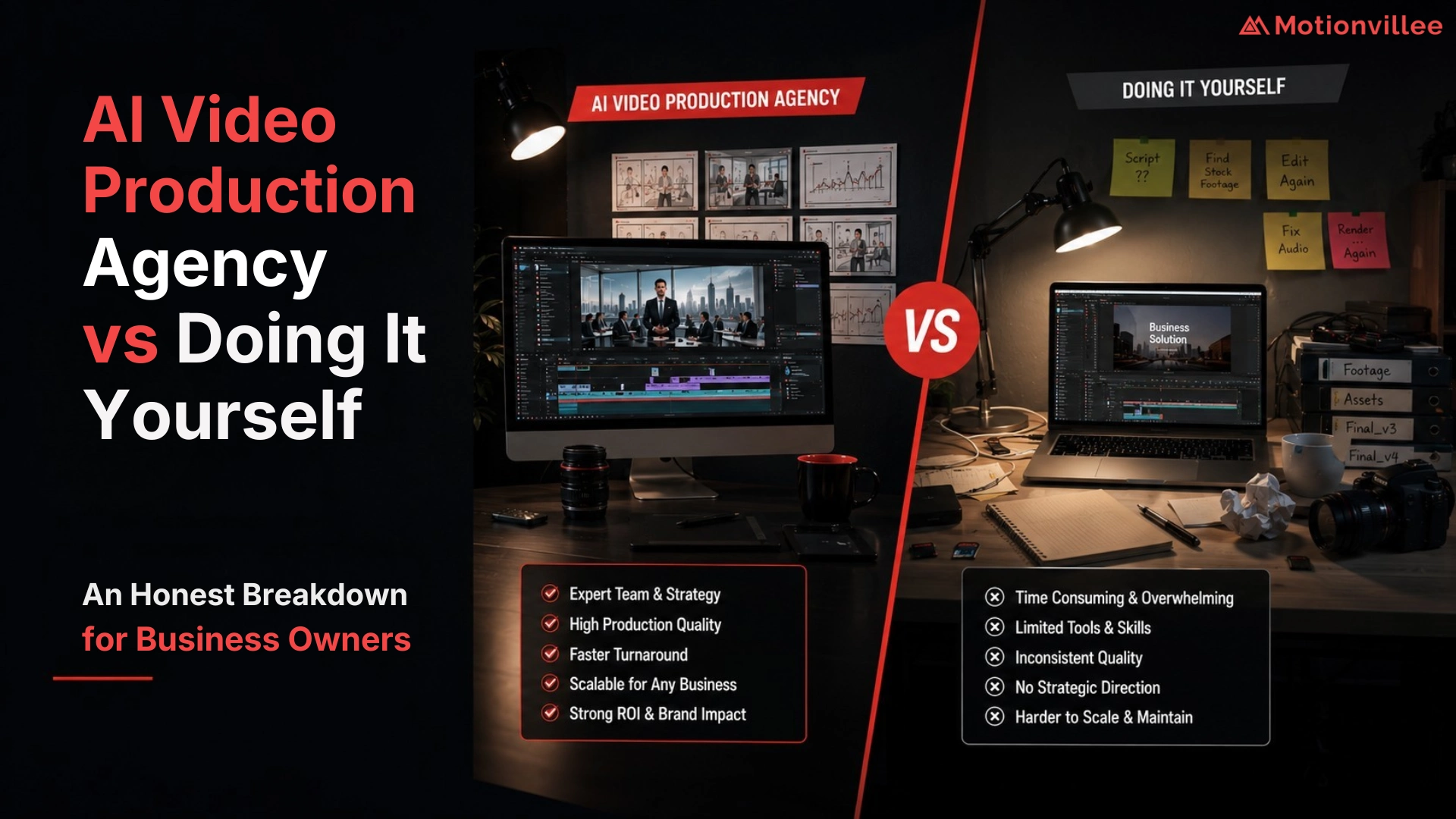
The biggest downside is that the video can look finished but still fail to communicate clearly.
Common DIY risks include:
- Generic scripts
- Weak story structure
- Poor buyer insight
- Overused templates
- Inconsistent brand tone
- Time spent learning tools
- No clear review process
- Inaccurate product claims
- Videos that do not support pipeline
The hidden cost of DIY is not the tool subscription. It is the internal time spent turning tool output into something your buyers can trust.
A 2025 analysis of 274 YouTube how to videos found that generative AI is used across planning, scriptwriting, visual creation, audio, editing, titles, and subtitles, but the study focuses on creator use cases, not business revenue impact [Anderson and Niu, 2025].
That limitation matters. Tool use does not automatically equal business quality.
What Are the Pros of Hiring an AI Video Production Agency?
The main advantage of hiring an agency is that you get clearer strategy, stronger execution, and less production burden on your internal team.
A good AI video agency for business can help with message structure, script quality, brand consistency, editing judgment, version planning, and final review.
Your team gains video output without managing every prompt, edit, script, tool, and revision internally.
This is especially useful when your team is already overloaded and needs campaign ready assets, not another tool to manage.
What Are the Cons of Hiring an AI Video Production Agency?
The main downside is higher upfront cost and the need to choose the right partner.
An agency costs more than DIY tools. It also requires a clear brief, internal alignment, and feedback from your team.
Poor agencies may overpromise. Some rely too heavily on tools. Others may deliver polished videos that still miss the buyer context.
That is why you should review the process, strategy, and quality control before hiring.
For a deeper selection guide, read choose the right AI video production company
Which Option Is More Cost Effective?
DIY is more cost effective for simple, repeatable, low risk content. An agency is more cost effective when the video supports sales, trust, paid campaigns, or complex product explanation.
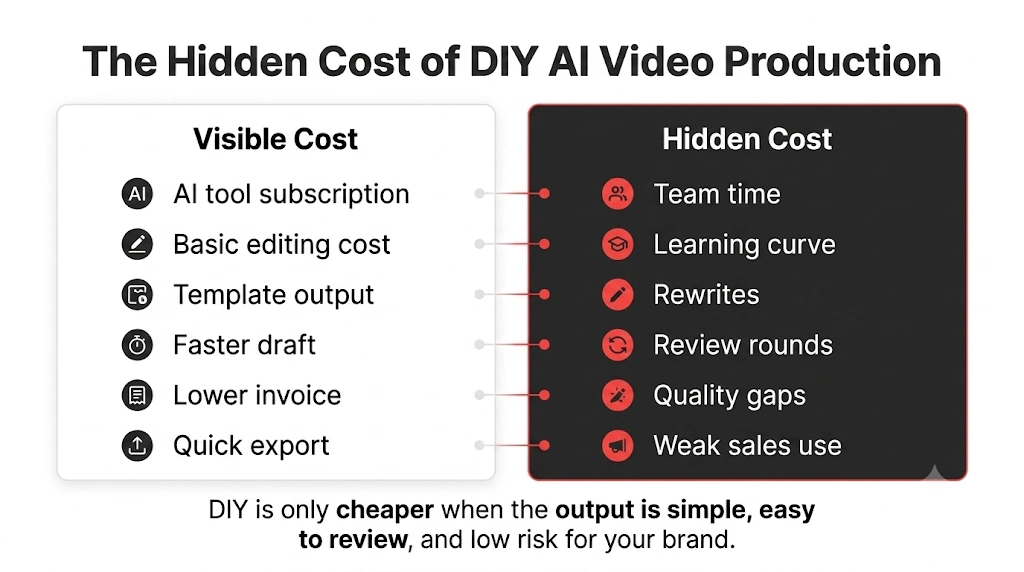
DIY looks cheaper because the invoice is smaller.
But the real cost includes the time your team spends learning tools, rewriting scripts, fixing unclear edits, reviewing accuracy, and creating versions that still may not be campaign ready.
DIY cost includes:
- Tool subscriptions
- Team time
- Learning curve
- Revisions
- Quality gaps
- Opportunity cost
Agency cost includes:
- Strategy
- Scriptwriting
- Production
- Editing
- Quality control
- Versioning
- Delivery support
The cheapest option is not always the lowest cost option if the video affects buyer trust.
For related context, see the benefits of AI video production
Which Option Saves More Time?
DIY saves time when the task is small. An agency saves time when the asset requires strategy, review, and multiple versions.
A five minute caption task may not need an agency.
A website explainer that needs script clarity, product accuracy, stakeholder review, and campaign versions usually does.
| Task | DIY AI tools | AI video production agency |
| Simple captions | Faster | Not always needed |
| Webinar clips | Fast if team knows tools | Faster at scale |
| Script strategy | Can take longer | Stronger and faster |
| Brand quality | Needs internal review | Built into process |
| Complex explainers | Often messy | Better managed |
| Campaign assets | Time heavy | More efficient |
Deloitte Digital’s 2026 marketing trends report says generative AI is moving from experimentation toward broader marketing use, but CMOs need systems where human creativity and machine intelligence work together [Deloitte Digital, 2026].
That supports the practical answer. Use AI for repeat work. Use people for judgment.
Which Option Gives Better Quality?
An agency usually gives better quality for business critical videos because quality is not just about visuals.
Quality means:
- Clear buyer problem
- Strong product context
- Credible message
- Brand fit
- Natural pacing
- Clear CTA
- Funnel alignment
DIY can produce decent output. But the quality ceiling depends on your team’s skill, time, and review process.
If the video must support leads, sales, or customer confidence, you need more than a fast draft.
What Should You Never DIY?
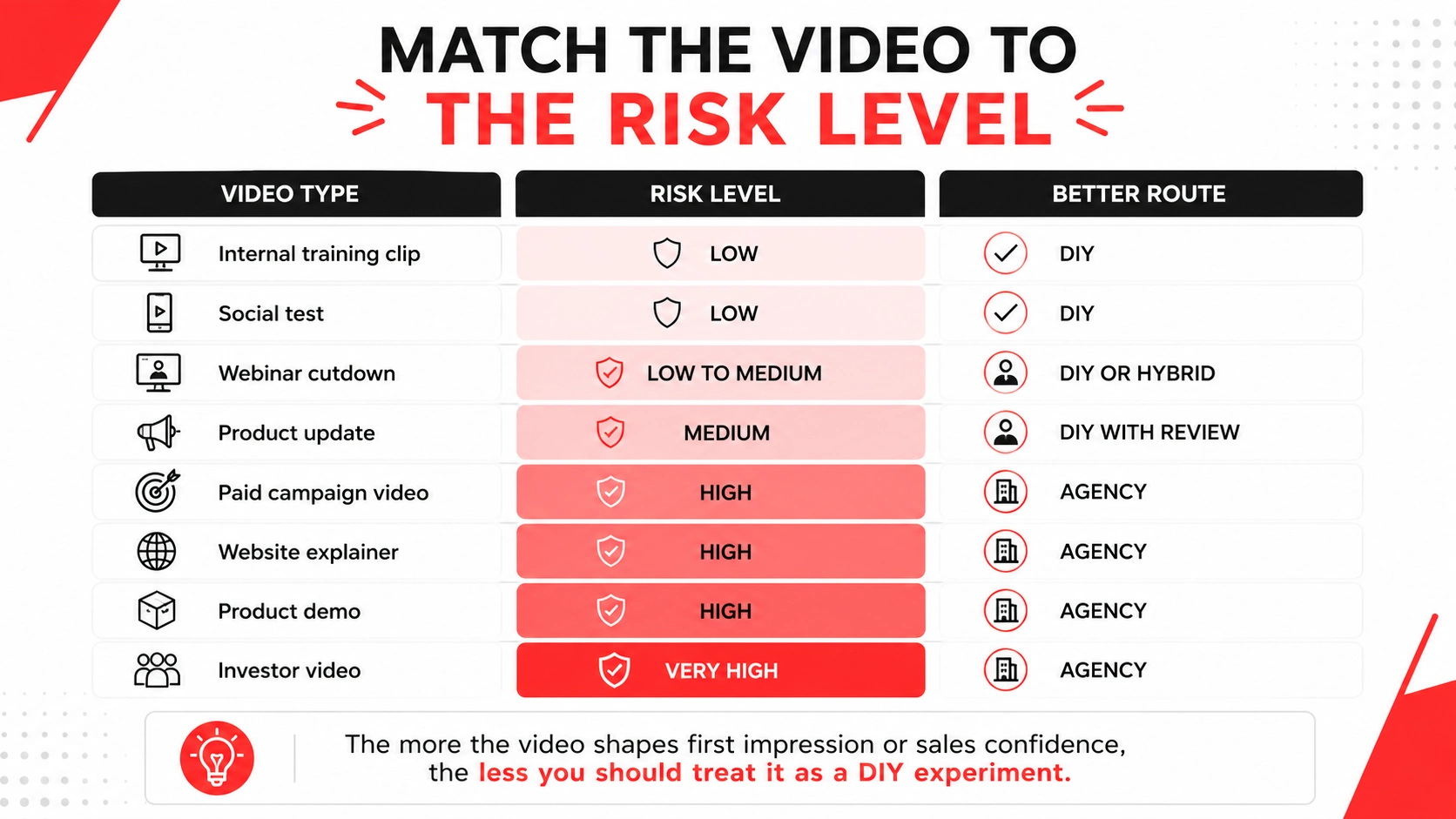
Never DIY the videos that carry your company’s first impression or strongest sales argument.
Avoid DIY for:
- Main website explainer
- Enterprise sales video
- Investor video
- Brand story video
- Customer testimonial
- Major launch video
- Paid campaign hero asset
- Complex product demo
- Category positioning video
These videos need more than tool output.
They need clarity, trust, buyer context, and business judgment.
What Should You Definitely DIY?
You should DIY videos where speed matters more than polish and the audience will not judge your company’s credibility from the asset.
Good DIY candidates include:
- Internal training clips
- Product update snippets
- Short FAQ videos
- Meeting recap clips
- Draft concepts
- Simple tutorials
- Captioned webinar clips
This keeps your team fast without risking your strongest buyer facing assets.
Is a Hybrid Approach Better Than Choosing One Side?
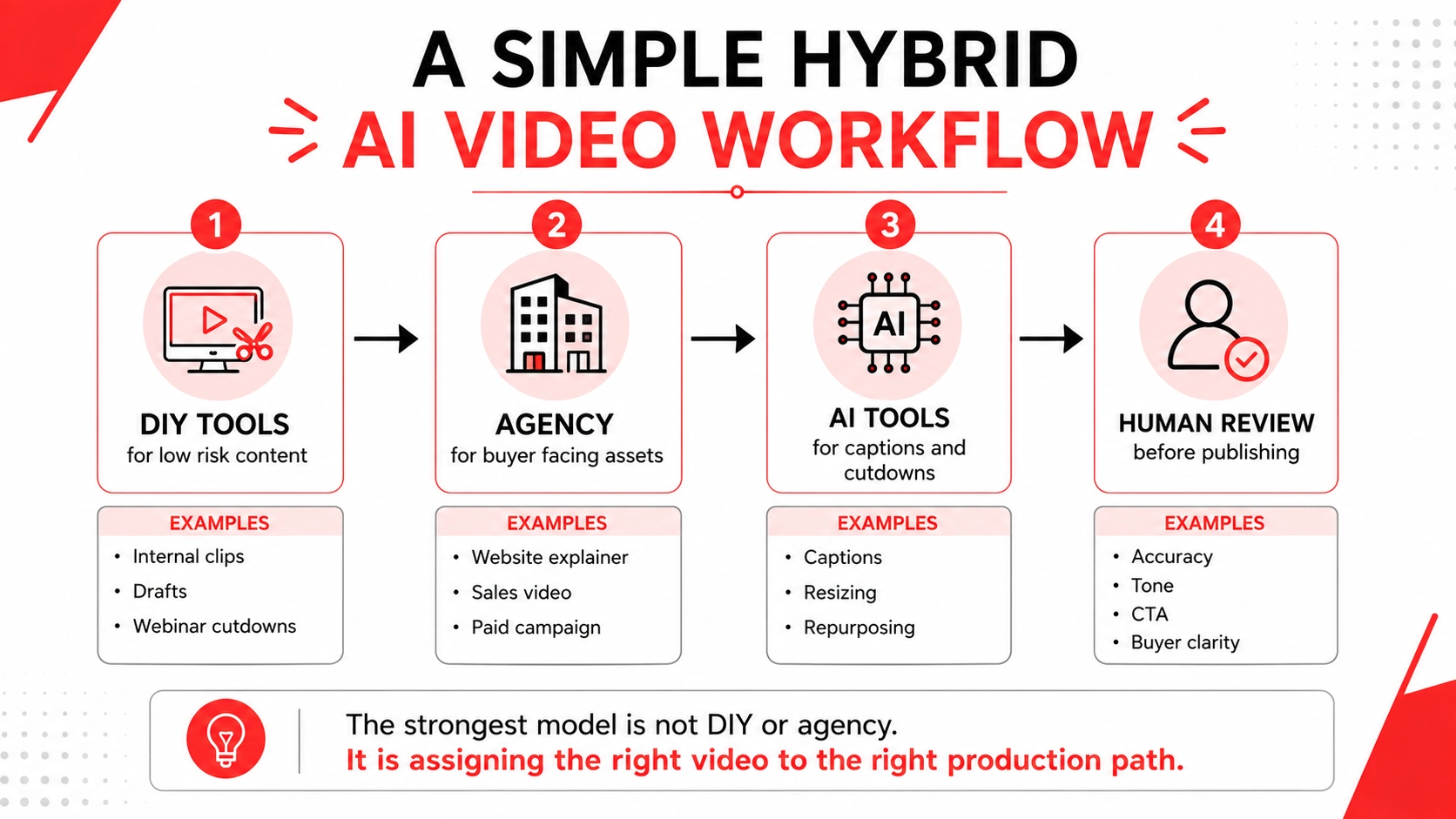
A hybrid approach is often best because it lets your team move fast on low risk content while a partner protects the assets that influence buyers.
For example, your team can DIY webinar clips and internal updates, while an agency builds the website explainer, paid ad concept, sales enablement video, and launch assets.
A smart hybrid system could look like this:
- DIY for internal updates and rough social tests
- Agency for website, sales, and campaign assets
- AI tools for captions, cutdowns, and repurposing
- Human review for public facing content
This is different from choosing between AI and people.
It is about assigning the right work to the right system.
For a broader production model comparison, read AI video production vs traditional video production
How Should Business Owners Decide?
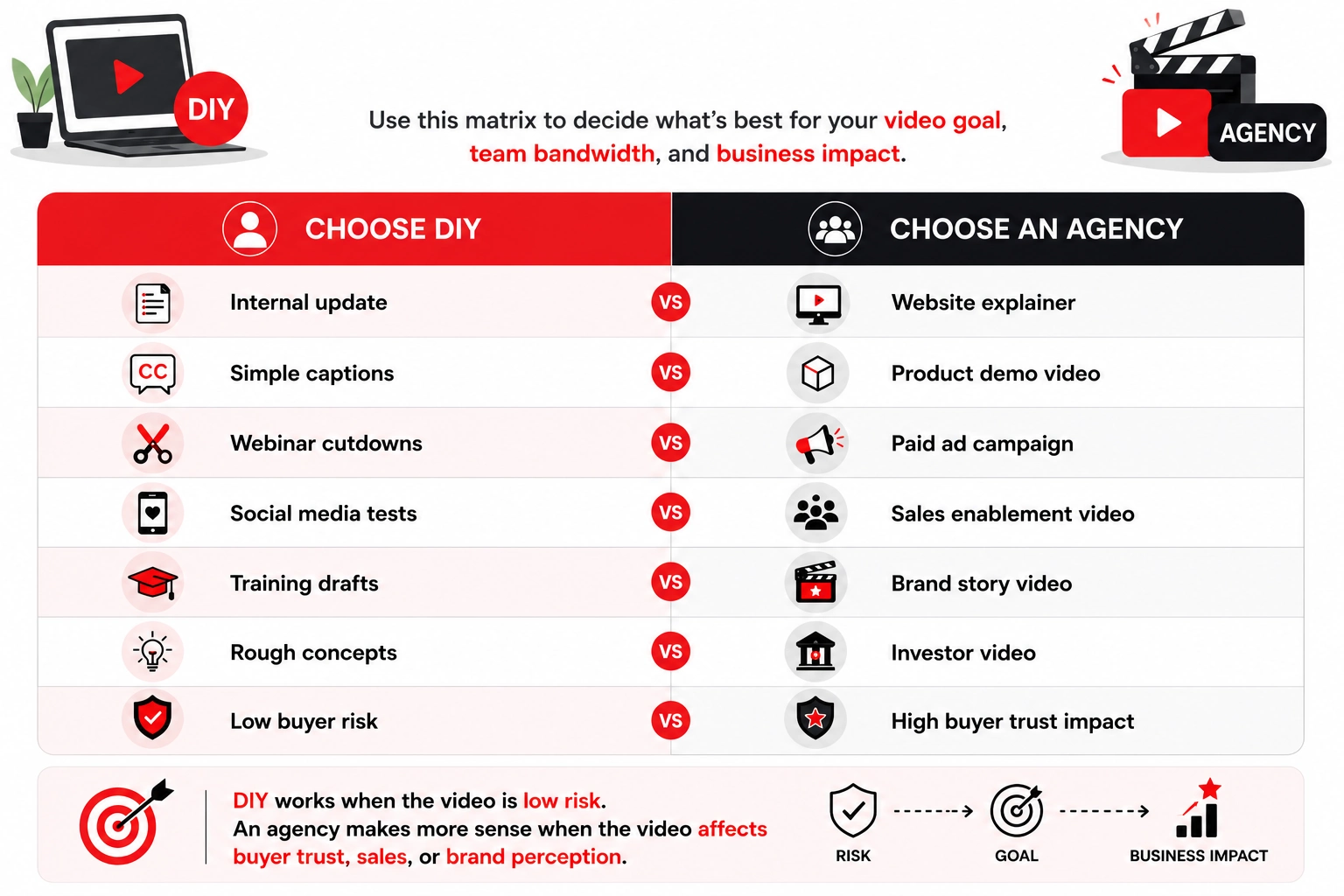
Business owners should decide based on video risk, internal skill, timeline, budget, and revenue impact.
For execution patterns, the AI video production workflow lessons can help you avoid treating tools as the strategy.
Conclusion: Should You Hire an Agency or Do AI Video Production Yourself?
The real choice is not whether AI tools or agencies are better. The real choice is how much business risk the video carries.
If the video is simple, internal, and low risk, DIY AI tools are often enough.
If the video must explain the offer, support sales, or shape how buyers judge your company, an agency is usually the safer investment.
For most growing businesses, the strongest model is hybrid: use DIY tools for speed, and use an AI video production agency when clarity, trust, and revenue impact matter.
That is how AI assisted video production becomes useful. Not because it replaces judgment, but because it helps your team produce more while protecting the message that moves buyers forward.