
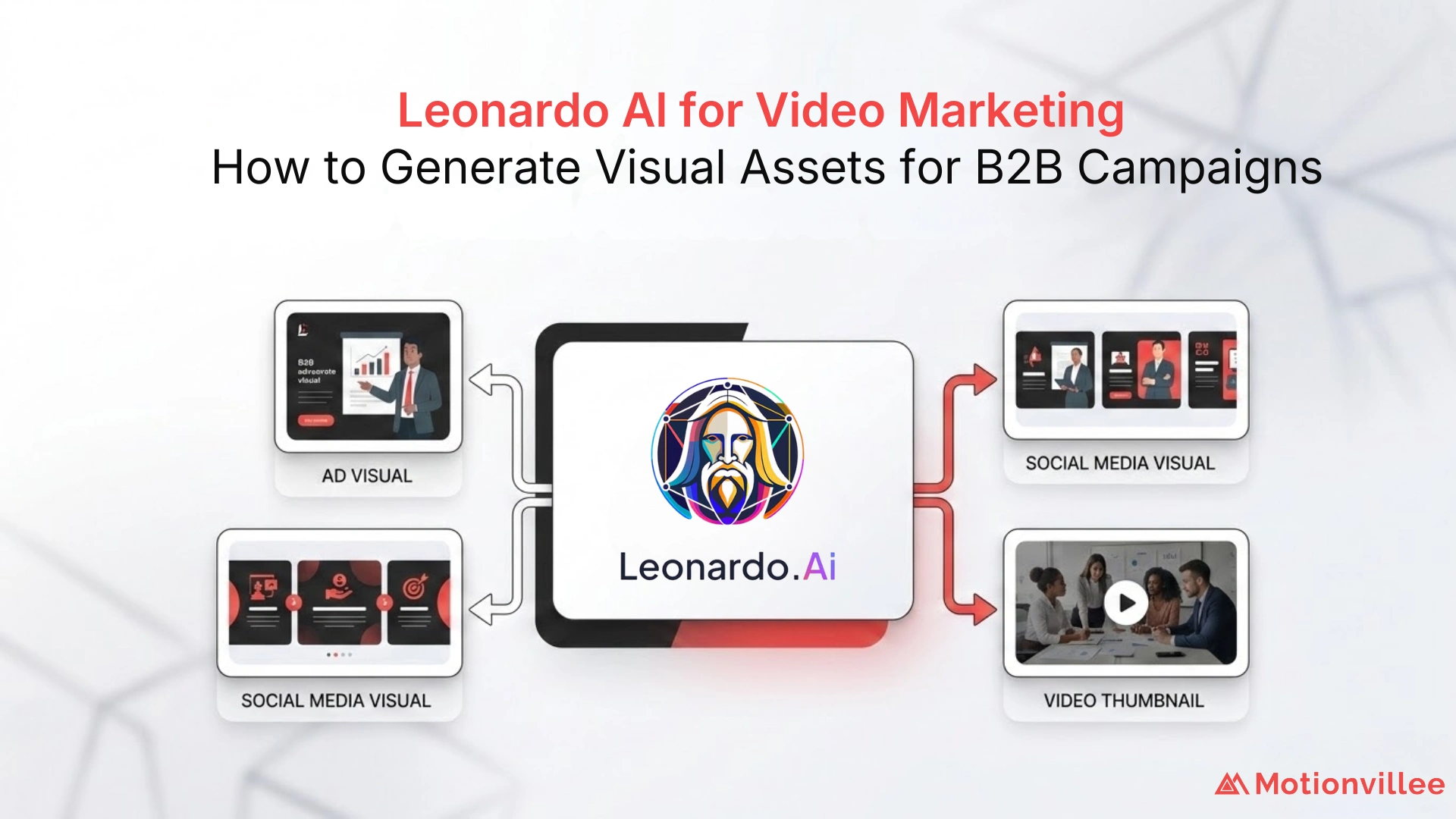
Leonardo AI for Video Marketing: How to Generate Visual Assets for B2B Campaigns
B2B marketing teams are creating more visual content than ever before.
Not just videos.
Today brands need:
- Social graphics
- Ad creatives
- Storyboards
- Video concepts
- Product visuals
- Campaign thumbnails
- Landing page assets
- Presentation visuals
- Short-form content graphics
And the demand keeps growing.
The problem is that traditional creative production is often slow. Designers, motion teams, marketers, and content teams all operate on different timelines. Creating custom visuals for every campaign can quickly become expensive and time-consuming.
That’s one reason AI-powered creative platforms are gaining attention.
Among them, Leonardo AI has become increasingly popular because it focuses heavily on visual generation and creative asset production.
Instead of starting every campaign with a blank canvas, marketers can generate concepts, imagery, design elements, and visual references within minutes.
For B2B teams working with constant content demands, that can significantly accelerate production workflows.
But where does Leonardo AI actually fit into video marketing?
And can it generate meaningful value beyond image creation?
Let’s break it down.
What Is Leonardo AI?
Leonardo AI is a generative AI platform designed to create visual assets from prompts.
Users can generate:
- Marketing visuals
- Concept art
- Product imagery
- Character designs
- Creative scenes
- Background assets
- Storyboards
- Campaign graphics
Unlike some AI tools focused exclusively on text to image creation, Leonardo places stronger emphasis on creative workflow flexibility.
Teams can experiment with:
- Custom models
- Style consistency
- Asset refinement
- Visual iteration
This becomes useful for B2B marketing teams because campaigns often require multiple visual variations quickly.
Instead of waiting through multiple production rounds, marketers can test ideas early.
Source:
Leonardo AI Official Website
Why Visual Asset Creation Has Become a Bigger Challenge
Content volume has expanded dramatically.
One campaign no longer means:
- One landing page
- One video
- One social post
Today campaigns often require dozens of assets.
Examples include:
- LinkedIn graphics
- YouTube thumbnails
- Webinar visuals
- Display advertisements
- Short-form video assets
- Presentation graphics
And every platform requires slightly different formats.
This creates production pressure.
Marketing teams increasingly face a scale problem rather than a creativity problem.
That’s why AI generated visual workflows are becoming more attractive.
Because marketers are asking:
“How can we create more without expanding production timelines?”
1. Generate Storyboards Before Video Production Starts
One of Leonardo AI’s strongest use cases is pre-production visualization.
Before animation or video creation begins, teams can generate storyboard concepts quickly.
For example:
A B2B SaaS company launching a workflow automation campaign might need visuals showing:
- Team collaboration
- Productivity challenges
- Dashboard interactions
- AI assistance
Instead of spending days creating draft concepts manually, teams can generate multiple visual directions quickly.
This creates faster alignment between:
- Marketing teams
- Designers
- Stakeholders
- Video teams
This supports Visual planning for explainers
Because stronger pre-production often reduces revisions later.
2. Create Visual Assets for Explainer Videos
Explainer videos frequently require supporting assets such as:
- Icons
- Background scenes
- Characters
- Concept visuals
- Environment references
Leonardo AI can help generate these early-stage assets.
This becomes especially useful for:
- SaaS explainers
- AI product videos
- Educational content
- Concept-driven campaigns
Rather than searching endlessly through stock libraries, teams can generate custom visuals aligned with campaign messaging.
That creates stronger visual consistency.
3. Build Faster Social Campaign Variations
Most campaigns today involve multiple platforms.
One campaign may require:
- LinkedIn creatives
- Instagram graphics
- YouTube thumbnails
- Display ads
- Short-form video assets
Creating separate versions manually takes time.
Leonardo AI helps teams experiment with multiple visual directions quickly.
Instead of building every variation from scratch, marketers can test:
- Different styles
- Visual concepts
- Layout approaches
- Creative directions
That flexibility becomes useful during rapid campaign execution.
4. Create Concept Visuals for Product Marketing
Some B2B products are difficult to visualize.
Especially:
- AI software
- Cloud systems
- Backend platforms
- Data infrastructure products
You cannot easily photograph these products.
And screenshots alone often feel limiting.
AI-generated imagery helps visualize abstract concepts.
For example:
Instead of showing a dashboard screenshot repeatedly, marketers can create conceptual visuals representing:
- Automation
- Data movement
- AI workflows
- System intelligence
This aligns closely with Visual storytelling for complex products
Because difficult concepts become easier to understand visually.
5. Improve Creative Brainstorming Sessions
Sometimes teams don’t need final assets.
They need ideas.
Leonardo AI works well during brainstorming because it reduces the time between imagination and visualization.
Instead of describing concepts endlessly during meetings:
Teams can generate:
- Style references
- Scene ideas
- Mood exploration
- Visual themes
That speeds up creative discussions.
Because stakeholders often react more effectively to visuals than descriptions.
What Leonardo AI Does Well
Leonardo performs especially well when marketers need:
- Fast concept generation
- Storyboard ideas
- Campaign visuals
- Creative experimentation
- Asset variations
The platform reduces creative bottlenecks.
Instead of waiting for every concept to move through traditional design cycles, teams can test ideas earlier.
And earlier testing usually creates faster execution.
Where Leonardo AI Still Has Limitations
AI-generated visuals are improving quickly.
But limitations still exist.
For example:
- Brand consistency may require refinement
- Text rendering can remain inconsistent
- Human details occasionally appear inaccurate
- Complex scenes sometimes need editing
For highly polished campaigns, designers still play an important role.
AI accelerates creation.
It does not fully replace creative teams.
The strongest workflows often combine:
AI speed + human refinement.
Not AI instead of humans.
Why AI Visual Tools Matter for Video Marketing
Video production rarely starts with editing.
It starts with ideas.
Visual references.
Concept development.
Story planning.
That early stage often consumes more time than people realize.
Leonardo helps shorten those early workflows.
And that matters because content expectations continue increasing.
This supports Content formats for business growth
Because scaling content often depends on reducing creative friction.
Final Thought
AI tools like Leonardo are changing how B2B teams create visual assets.
Not because they eliminate production work.
But because they accelerate the earliest and slowest stages of creativity.
For video marketers, that creates meaningful advantages:
- Faster ideation
- More experimentation
- Better visual planning
- Increased content output
And as B2B content demands continue growing, workflows that create speed without sacrificing creativity will become increasingly valuable.