
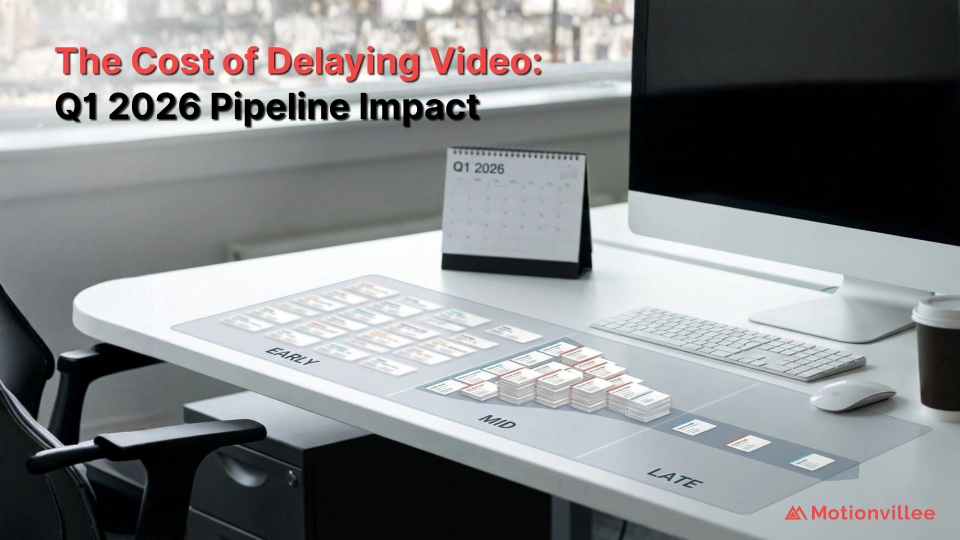
The Real Cost of Delaying Video: Pipeline Impact Analysis for Q1 2026
Your CMO says “Let’s push video to Q2”, VP of Sales agrees the timing isn’t right, and your CEO questions the ROI before seeing results. So video gets delayed another quarter while you focus on “priorities.” The delaying video marketing cost isn’t visible in your budget spreadsheet. It hides in missed pipeline opportunities, extended sales cycles, and prospects choosing competitors with clearer value communication.
By the time Q1 2026 ends without video, you’ll have lost $150,000 to $300,000 in addressable pipeline you can’t recover.
This isn’t theoretical loss. It’s qualified prospects who ghosted because they didn’t understand your value. Deals that stalled in evaluation because stakeholders couldn’t articulate your differentiation. Sales cycles that stretched 40% longer because buyers lacked the clarity to decide.
What Does Delaying Video Actually Mean?
Delaying video means postponing production and deployment of visual content that educates prospects, demonstrates value, and accelerates purchase decisions, typically justified by timing, budget, or resource constraints.
Teams delay video with logical-sounding reasons. “We’re launching a new website first.” “We need to finalize messaging.” “Budget is tight this quarter.” “Sales is too busy to participate.”
Each reason feels valid in isolation. But the collective impact is three months without the clarity tool that converts 30-50% more prospects than text alone.
Delaying isn’t canceling. But in B2B, delayed is often a softer version of canceled. Q2 becomes Q3. Q3 becomes next fiscal year. “Later” becomes never.
Why Do Smart Teams Delay Video Investment?
Smart teams delay video because ROI seems uncertain without precedent, production feels complex and time-consuming, messaging appears to need finalization first, and other urgent initiatives compete for budget and attention.
The ROI Uncertainty Trap
You haven’t done video before. How do you justify investment without proof it works? This creates a catch-22: no investment without proof, no proof without investment.
So video gets delayed while you seek certainty that only comes from implementation.
The Complexity Overwhelm
Video production involves scripts, voiceovers, design, animation, revisions, and distribution planning. The perceived complexity triggers delay. “Let’s wait until we have bandwidth.”
Complexity becomes an excuse for postponement. Understanding video strategy as a powerful tool reduces this perceived complexity.
The Messaging Perfection Fallacy
“We can’t do video until our messaging is finalized.” But messaging is never truly final. Waiting for perfect messaging means infinite delay.
Video doesn’t require perfect messaging. It requires good enough messaging to start testing and improving.
The Priority Competition
Product launches, website redesigns, trade shows, and hiring all compete for resources. Video loses priority battles because impact feels less immediate than these initiatives.
Urgent crowds out important until quarters pass without video.

What Pipeline Impact Happens in a Single Quarter Without Video?
One quarter without video costs B2B companies 20-30% of addressable pipeline through longer sales cycles, higher abandonment rates, lower demo conversion, and competitive losses to companies with clearer value communication.
Let’s calculate real Q1 2026 impact for a typical B2B SaaS company:
Baseline Assumptions
1,500 qualified monthly website visitors
4,500 total qualified visitors Q1 2026
3% demo conversion rate (text only)
135 Q1 demo requests
25% demo-to-opportunity rate
34 Q1 opportunities created
With Video Impact (Conservative Estimates)
Video increases demo conversion 40% (3% to 4.2%)
189 Q1 demo requests (+54 demos)
Video improves demo quality, increasing opp rate 30% (25% to 32.5%)
61 Q1 opportunities created (+27 opportunities)
The Q1 2026 Loss From Delay
27 lost opportunities × $25,000 average deal size × 30% win rate = $202,500 in lost Q1 pipeline
This is the invisible delaying video marketing cost hiding in your “we’ll do it next quarter” decision. Understanding the $47K mistake of launching without video shows similar hidden costs.
How Does Video Delay Impact Different Funnel Stages?
Video delay impacts awareness stage through lower engagement rates, consideration stage through extended evaluation periods, decision stage through stalled technical reviews, and retention stage through higher support costs from confused customers.
Awareness Stage Impact
Without video, prospects spend 40% more time on your website trying to understand basics. Many abandon before comprehension. This reduces top-of-funnel conversion by 25-35%.
Q1 2026 awareness loss: Approximately 1,350 prospects who visited but left confused.
Consideration Stage Impact
Prospects researching solutions can’t quickly compare your approach to alternatives without video demonstration. They either spend excessive time figuring it out or eliminate you early.
Q1 2026 consideration loss: Approximately 50 prospects who evaluated competitors with clearer communication.
Decision Stage Impact
Champions building internal business cases need video to demonstrate value to stakeholders. Without it, they struggle to advocate effectively, extending decision cycles 30-50%.
Q1 2026 decision loss: Approximately $80,000 in deals that could have closed but will slip to Q2 or Q3.
What Does Q1 2026 Delay Mean for Full Year Revenue?
Q1 2026 video delay creates 12-month revenue impact through lost early opportunities, extended pipeline development time, and competitive positioning disadvantages that compound throughout the year.
The Compound Loss Effect
Q1 loss: $202,500 in addressable pipeline
But Q1 opportunities that close typically do so in Q2-Q3. Delaying video to Q2 means Q2 production, Q3 pipeline impact, Q4 revenue realization.
You’ve lost 6-9 months of video-driven pipeline generation. That’s $600,000-$900,000 in annual revenue impact from a single quarter delay decision.
The Competitive Positioning Cost
While you delay, competitors deploy video. Prospects comparing solutions see their clear value demonstration versus your text descriptions. This positioning disadvantage persists all year.
Even after you launch video in Q2, you’re playing catch-up rather than leading.
The Sales Efficiency Drag
Without video, sales reps spend 40% of demo time explaining basics. This inefficiency continues all Q1, reducing sales capacity by approximately 35%.
That’s equivalent to losing 1.75 sales reps’ productivity for an entire quarter. Understanding 13 reasons to build video strategy prevents this waste.
How Do You Calculate Your Specific Delaying Video Marketing Cost?
Calculate your specific cost by multiplying quarterly qualified traffic by video conversion improvement percentage, then applying your average deal size and win rate to the incremental opportunity volume video would create.
Step 1: Determine Quarterly Traffic Volume
Monthly qualified website visitors × 3 months = Q1 qualified traffic
Example: 1,500 × 3 = 4,500 Q1 qualified visitors
Step 2: Calculate Current Conversion
Q1 traffic × current demo conversion rate = Q1 demos
Example: 4,500 × 3% = 135 Q1 demos
Step 3: Project Video Impact
Video typically improves demo conversion 35-50%. Use 40% as conservative estimate.
Current rate × 1.40 = video-enhanced rate
Example: 3% × 1.40 = 4.2% conversion with video
Step 4: Calculate Incremental Demos
Q1 traffic × video conversion rate = video-driven demos
Video demos – current demos = incremental demos
Example: (4,500 × 4.2%) – 135 = 54 additional Q1 demos
Step 5: Apply Your Opportunity Rate
Incremental demos × demo-to-opportunity rate = additional opportunities
Example: 54 × 25% = 13.5 additional opportunities (conservative, as video also improves opp rate)
Step 6: Calculate Pipeline Value
Additional opportunities × average deal size = delay cost
Example: 13.5 × $25,000 = $337,500 Q1 pipeline loss from video delay
This is your specific delaying video marketing cost for Q1 2026.
What About Companies That Already Have Some Video?
Companies with some video still face delay costs when they postpone strategic expansion, replacement of outdated content, or filling gaps in funnel coverage, typically losing 15-20% of potential video ROI.
The Single Video Limitation
You have one homepage explainer from 2023. It’s outdated, doesn’t reflect new positioning, and serves only top-of-funnel visitors. Mid and bottom-funnel prospects get no video support.
Delaying expansion means losing 60% of video’s potential impact.
The Incomplete Coverage Problem
You have product demo video but no pricing explainer, no customer testimonials, and no use case demonstrations. Prospects get clarity on functionality but confusion on everything else.
Partial video is better than none, but still loses significant conversion potential. Learning about SaaS video marketing strategy shows comprehensive coverage needs.
How Does Delay Cost Compare to Production Investment?
Delay cost typically exceeds production investment by 10-20x, with $15,000 video investment preventing $150,000-$300,000 in Q1 pipeline loss, creating negative cost of delay.
The Investment Reality
Professional B2B video package (3-4 strategic videos): $8,000-$18,000
Single 60-90 second explainer: $3,000-$8,000
Production timeline: 4-6 weeks
Average USA market investment: $6,300 per 60-second video
The Delay Cost Reality
Q1 2026 pipeline loss: $150,000-$300,000
Annual revenue impact: $600,000-$900,000
Sales capacity waste: Equivalent to 1.75 reps for one quarter
The ROI Math
$10,000 average investment preventing $200,000 Q1 loss = 2,000% ROI
Payback period: Approximately 7-14 days after video deployment
Every week of delay costs approximately $15,000-$23,000 in lost pipeline opportunity.
The question isn’t “Can we afford video?” It’s “Can we afford another quarter without it?” Understanding explainer video budget planning shows how to justify investment.
What If You’re Planning Major Website Redesign?
Website redesigns justify video deployment, not delay, because video content remains valuable regardless of site design and actually provides clarity while new site development occurs.
The “Wait for Website” Fallacy
Teams delay video waiting for website redesigns that take 3-6 months. This creates 6-9 month total delay including video production after site launch.
Result: Nearly a full year without video while competitors capture market share.
The Platform Independence Reality
Video content works on current sites, future sites, LinkedIn, YouTube, email campaigns, and sales presentations. It’s not website-dependent.
You can deploy video now and easily transfer to redesigned site later.
The Competitive Bridge Strategy
Use video on current site while redesigning. This maintains competitive positioning during transition rather than going dark for months.
Video provides clarity during the confusion period when your site is in flux.
How Do Sales Cycles Extend Without Video?
Sales cycles extend 30-50% without video because prospects require more meetings to gain understanding, stakeholders need repeated explanations, and buying committees struggle to align without visual demonstration.
The Explanation Meeting Multiplier
With video: 2-3 meetings to close (discovery, demo, proposal)
Without video: 4-5 meetings to close (discovery, educational demo, follow-up demo for stakeholders, technical review, proposal)
Additional meetings add 2-3 weeks per deal on average.
The Stakeholder Alignment Problem
Champions explaining your solution to CFOs, CTOs, and other decision makers struggle without video. Verbal explanations create inconsistent understanding.
This misalignment extends cycles while stakeholders ask for “more information” repeatedly.
The Q1 2026 Cycle Impact
If your average cycle is 60 days without video and 45 days with video, that’s 25% time reduction.
Q1 deals closing in 45 days versus 60 days means February closes versus March closes. That’s revenue recognition in Q1 versus Q2.
Video delay doesn’t just impact volume. It impacts timing of revenue realization. This relates to 21 signs it’s time to invest in video.
What About Internal Stakeholder Alignment on Video Investment?
Internal stakeholder alignment requires showing specific delay costs tied to company metrics, competitive analysis of video adoption, and phased approach reducing perceived risk.
The CFO Conversation
CFOs care about ROI and payback periods. Show them: $15,000 investment preventing $200,000 Q1 pipeline loss with 7-10 day payback.
This makes video a revenue protection investment, not marketing spend.
The CEO Perspective
CEOs care about competitive positioning and growth trajectory. Show them: Competitors have video, we don’t. This creates 6-9 month positioning disadvantage.
Frame video as competitive necessity, not optional enhancement.
The VP Sales Angle
Sales leaders care about quota attainment and rep productivity. Show them: Video reclaims 40% of demo time, equivalent to gaining 1.75 reps’ capacity without hiring.
This makes video a sales enablement tool with measurable efficiency gains.
How Does Q1 Delay Impact Annual Planning Cycles?
Q1 delay impacts annual planning by pushing video ROI realization to Q4 or next fiscal year, missing current year revenue targets and requiring budget reallocation in future planning.
The Fiscal Year Timing Problem
Delay Q1 → Production Q2 → Deployment Q3 → Pipeline impact Q4 → Revenue Q1 next year
You’ve shifted video revenue impact to next fiscal year, missing current year targets the video could have helped achieve.
The Budget Cycle Complication
Annual budgets are set. Delaying video to Q2 often means reallocating from other Q2 initiatives or waiting until next fiscal year’s budget cycle.
This creates another 12-month delay beyond the initial Q1 postponement.
The Planning Precedent
Teams that delay video in Q1 often delay again in Q2, Q3, and Q4. “Not the right time” becomes perpetual excuse.
Break this pattern by committing to Q1 2026 production regardless of competing priorities. Understanding explainer video costs helps with budget planning.
What’s The Opportunity Cost of Video Budget Reallocation?
Opportunity cost of video budget reallocation is typically negative, meaning video delivers higher ROI than alternative investments, making reallocation value-positive rather than sacrificial.
Common Budget Reallocations
Trade show booth: $25,000 for 3-day event reaching 500 prospects
Video package: $10,000-$15,000 for permanent asset reaching unlimited prospects
Paid ads: $3,000/month reaching 10,000 impressions with 2% CTR
Video on site: One-time $10,000-$15,000 converting 35-50% more of existing traffic
The ROI Comparison
Trade show: $50 cost per prospect interaction, temporary impact
Paid ads: $150 cost per click, ongoing monthly cost
Video: $10,000-$15,000 one-time investment, permanent asset, improving existing traffic conversion 40%
Video typically outperforms alternative marketing investments by 3-5x ROI.
How Do Competitors Gain Advantage During Your Delay?
Competitors gain advantage during your delay by capturing prospects comparing solutions, establishing clarity leadership, and converting confused buyers leaving your website without understanding.
The Comparison Disadvantage
Prospect evaluates three vendors: Competitor A (clear video explainer), Competitor B (clear video explainer), Your company (text-only descriptions).
Which vendor gets eliminated first? The one creating comprehension friction.
The Clarity Leadership Position
Competitors with video become “the clear choice” literally. Your delay positions you as the complex, harder-to-understand option.
This perception persists even if your product is superior.
The Conversion Capture
Prospects visit your site, get confused, and search for clearer alternatives. They find competitors with video explaining similar solutions clearly.
Your delay directly feeds competitor pipelines. This is part of understanding video strategy beyond style.
What’s The Risk of Producing Video “Too Early”?
Risk of producing video “too early” is minimal compared to delay cost, as imperfect early video delivers 70-80% of optimal video value while perfect delayed video delivers zero value during delay period.
The Perfectionism Paralysis
Teams delay seeking perfect messaging, perfect timing, and perfect conditions. But perfection never arrives.
Good enough video deployed today beats perfect video planned for next quarter.
The Iteration Advantage
Early video provides real performance data guiding improvements. Delayed video lacks this learning cycle.
You can’t optimize what doesn’t exist yet.
The Update Reality
“What if we need to update it?” Video updates cost $800-$2,500 typically for script and visual changes. Delaying video costs $50,000-$75,000 monthly in lost pipeline.
Updates are investments. Delays are losses.
How Does Video Delay Impact Marketing Team Productivity?
Video delay impacts marketing productivity by requiring longer content creation for similar impact, reducing campaign performance without visual assets, and creating explanation burden across all channels.
The Content Efficiency Loss
Without video, blog posts need 2,000 words explaining what 90-second video demonstrates. Email campaigns struggle engaging subscribers with text alone. Social posts lack the viral potential of video content.
Every content type works harder for weaker results without video assets.
The Campaign Performance Gap
Paid ad campaigns without video convert 40-60% worse than video-enabled campaigns. This means spending more to acquire fewer leads.
Marketing efficiency suffers measurably without video assets.
The Explanation Overhead
Marketing teams repeatedly explaining product value in emails, decks, one-pagers, and campaigns because no video exists to reference.
This redundant explanation work costs approximately 15-20 hours weekly across marketing teams. Understanding hidden costs of video production includes these efficiency losses.
What Questions Should Leadership Ask Before Delaying Video?
Leadership should ask: What is our calculated delay cost? How does that compare to investment? What competitive disadvantage does delay create? Can we afford the pipeline loss?
Question 1: What’s Our Delay Cost?
Use the calculation framework earlier in this article. Quantify specific Q1 2026 pipeline loss from postponing video.
Vague delay costs enable procrastination. Specific numbers demand decisions.
Question 2: What’s The ROI Comparison?
Compare video investment to alternatives. Which delivers higher return? Which prevents more revenue loss?
Evidence-based allocation beats intuition-based budgeting.
Question 3: What’s The Competitive Impact?
Research competitors. How many have video? How does their clarity compare to yours? What positioning advantage do they gain?
Competitive pressure often breaks delay inertia.
Question 4: What’s Our Risk Tolerance?
Can you afford losing $200,000+ in Q1 2026 addressable pipeline? What if delay extends to Q2, Q3, or indefinitely?
Frame delay as accepting revenue loss risk, not avoiding investment risk.
How Fast Can Video Production Happen If Q1 Starts Soon?
Video production can complete in 4-6 weeks from kickoff to deployment, meaning January start delivers February launch, capturing 60% of Q1 2026 value despite late start.
The Accelerated Timeline
1 Week: Strategy, scripting, and storyboarding
2-3 Week: Design and animation production
4 Week: Revisions and finalization
5 Week: Delivery and deployment
Total: 5 weeks from decision to live video
The Partial Quarter Value
Even if production completes mid-February, you capture February and March impact. That’s 2/3 of Q1 value versus 0% from full delay.
Partial quarter beats no quarter.
The Momentum Advantage
Q1 production creates momentum for Q2-Q4. Full year benefits compound from Q1 start.
Start now captures maximum annual value. Waiting captures minimum. Working with experienced explainer video production services accelerates timelines.
What’s The “Do It Right Later” vs “Do It Good Enough Now” Decision?
“Do it good enough now” delivers 70-80% value immediately while “do it right later” delivers 0% value during delay and risks never happening, making immediate action superior despite imperfection.
The 80/20 Implementation
Good enough video addressing 80% of clarity needs deployed now creates more value than perfect video addressing 100% deployed later.
Revenue happens during deployment, not during planning.
The Perfectionism Cost
Seeking perfect messaging, perfect visuals, and perfect timing costs $50,000-$75,000 monthly in lost pipeline while you refine.
Perfectionism is expensive luxury companies with delaying video marketing cost problems can’t afford.
The Iteration Path
Deploy good video now. Gather performance data. Optimize based on real results. This creates better outcomes than theoretical perfection.
Data-driven optimization beats speculation-based perfection. Understanding things founders should know about costs helps make informed decisions.
How Do You Prevent Future Video Delays?
Prevent future delays by establishing video as standing budget line item, creating quarterly production schedules, building content libraries systematically, and making video part of product launch processes.
The Standing Budget Allocation
Allocate $12,000-$20,000 annually for video production, updates, and expansion. This prevents budget debates delaying each project.
Video becomes ongoing investment like paid ads, not exceptional project requiring special approval.
The Quarterly Production Rhythm
Q1: Homepage explainer and product demo
Q2: Customer testimonials and use case videos
Q3: Technical deep dives and implementation guides
Q4: Updates and optimization based on annual performance
Rhythm prevents delay by making production expected, not exceptional.
The Launch Integration
Make video mandatory component of product launches. Feature releases include demo videos. New positioning includes updated explainers.
Integration prevents delay by making video non-negotiable part of go-to-market.
What Results Can Companies Expect From Avoiding Delay?
Companies avoiding delay typically see 35-50% increase in demo requests, 25-35% shorter sales cycles, 40% improvement in sales productivity, and 3-5x ROI within first quarter of deployment.
Real B2B companies acting in Q1 versus delaying:
Company A (acted in Q1): February video launch, March pipeline impact, 47% increase in demo requests, $284,000 additional Q1 pipeline, $780,000 annual revenue lift.
Company B (delayed to Q2): June video launch, July pipeline impact, missed entire Q1-Q2 opportunity window, playing catch-up in H2 versus leading in H1.
The difference isn’t just quarterly. It’s annual trajectory. Early movers compound advantages. Late movers spend the year recovering.
Your Q1 2026 delay decision determines whether you lead or follow in video-driven conversion for the entire year. Every week of postponement costs $15,000-$23,000 in addressable pipeline you’ll never recover.
The calculation is simple: $10,000-$15,000 video investment prevents $200,000+ quarterly pipeline loss. Payback hap
pens in 7-14 days. The opportunity cost of delay exceeds investment cost by 15-20x.
Smart teams don’t ask “Should we invest in video?” They ask “How quickly can we deploy?” Working with SaaS video production services that understand B2B urgency accelerates time-to-value.
Ready to stop hemorrhaging pipeline to clarity failure? Let’s calculate your specific delaying video marketing cost and create deployment timeline recovering Q1 2026 value before the quarter ends.
The companies dominating 2026 started video in Q1. The companies catching up delayed another quarter. Working with USA video production teams with rapid deployment capability helps you join the leaders.
Q1 2026 starts now. Delay or deploy. The choice determines your year.