
What Is the AI Video Production Cost in 2026?
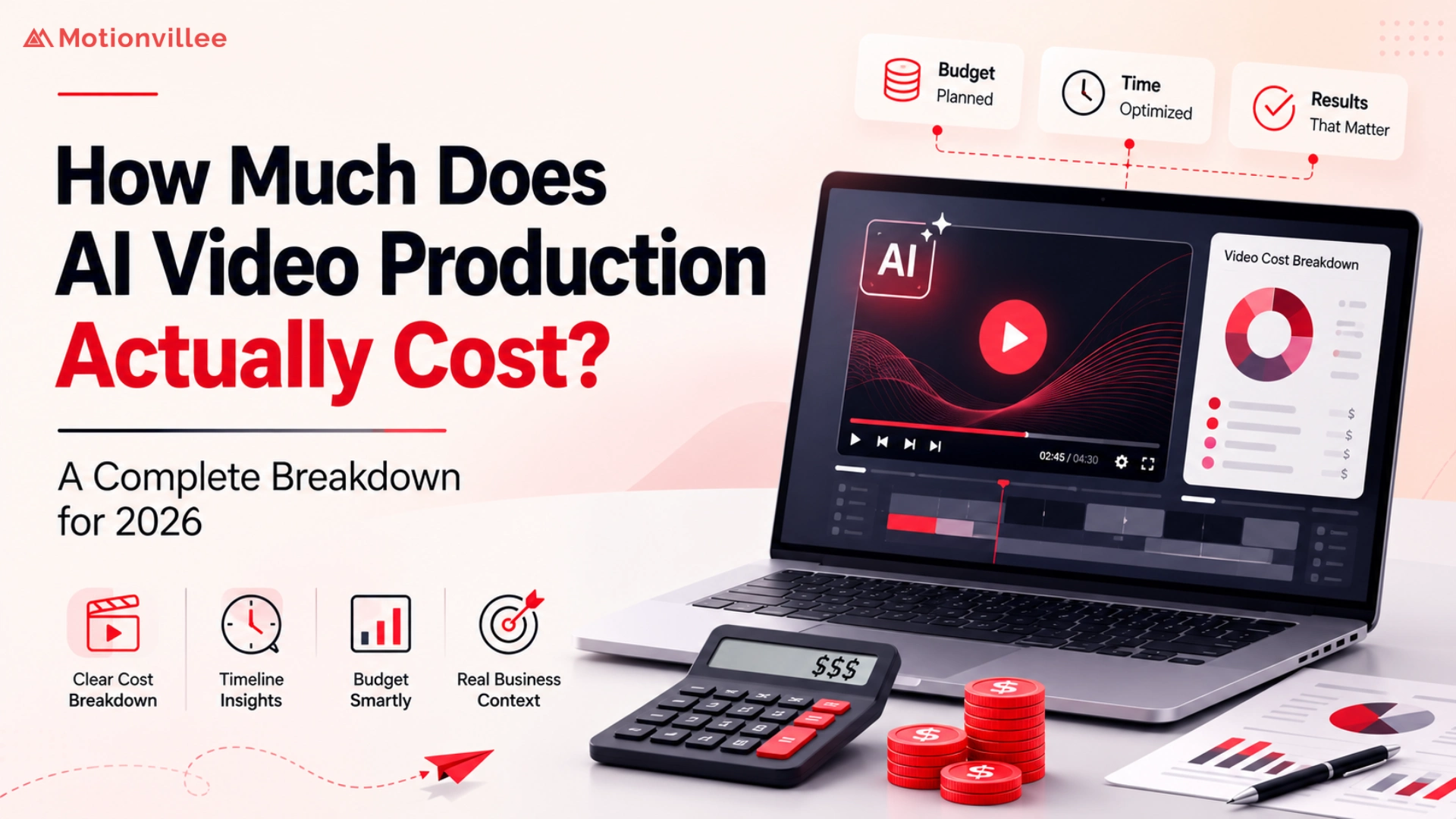
AI video production costs can range from $20 to $300+ per month for DIY tools, $500 to $5,000+ for simple project support, and $3,000 to $30,000+ for business ready or hybrid production.
The uncomfortable truth is simple: AI can make video creation faster, but it does not automatically make every business video low cost, clear, or ready to publish.
A simple AI generated clip may only need a software plan. A buyer ready explainer, product demo, or sales asset costs more because the budget covers strategy, scriptwriting, editing, product accuracy, brand review, revisions, and final versions.
How Much Does AI Video Production Actually Cost?
The cost of AI video production depends on the business role of the video, not only the tool used to create it.
Here is a practical planning range for 2026. These are Motionvillee planning estimates, not fixed market prices, because most provider quotes depend on scope.
| AI video production route | Estimated planning range | Best fit |
| DIY AI tools | $20 to $300+ per month | Internal drafts, simple clips, testing |
| Freelancer or small team | $500 to $5,000+ per project | Basic edits, short videos, simple campaigns |
| AI video production company | $3,000 to $15,000+ per project | Business ready videos, explainers, sales assets |
| Hybrid AI plus custom production | $8,000 to $30,000+ per project | Complex SaaS videos, paid campaigns, launch assets |
| Traditional production | $15,000 to $50,000+ per project | Brand films, testimonials, premium shoots |
For comparison, Synthesia lists its Starter plan at $29 per month, and Runway lists its Standard plan from $12 per month when billed yearly [Synthesia, 2026; Runway, 2026]. These software prices show the entry point for AI video creation, not the full video production cost for a business ready asset. (Synthesia)
Motionvillee is an AI video production company that helps B2B brands decide when a lean AI format is enough and when a higher trust asset needs human strategy, scripting, review, and campaign planning.
Why Does AI Video Pricing Vary So Much?
AI video pricing varies because “AI video” can mean anything from a template avatar clip to a campaign asset built for sales, ads, and landing pages.
At the lower end, you may pay for tool access and a simple output. At the higher end, you pay for the work that makes the video useful to buyers: message clarity, product understanding, brand fit, editing, review, and versions.
One quote may include an AI avatar, voiceover, captions, and one export. Another may include strategy, scriptwriting, storyboard planning, AI assisted production, custom editing, product review, revisions, and files for ads, social, sales, and landing pages.
The word “AI” does not define the price. The scope does.
What Do You Actually Pay For in AI Video Production?
You pay for the thinking and review that turn AI output into a usable business asset.
| Cost area | What it includes | Why it matters |
| Strategy | Goal, audience, funnel stage, CTA | Keeps video tied to outcomes |
| Scriptwriting | Hook, message, structure | Decides whether buyers understand |
| Story planning | Scene flow and logic | Prevents generic output |
| AI tools | Avatar, voice, visuals, captions | Supports speed |
| Creative direction | Style, tone, brand fit | Protects credibility |
| Editing | Cuts, timing, captions, formats | Makes the asset usable |
| Revisions | Feedback and corrections | Protects accuracy |
| Versioning | Social, ad, sales, landing page cuts | Improves campaign value |
This is where businesses often underestimate AI video cost. The tool may create a draft, but someone still has to decide whether the video is clear, accurate, on brand, and useful for the buyer.
Cost Breakdown by AI Video Type
Different AI video formats carry different budgets because each format carries a different business risk.
| AI video type | Cost level | Best fit |
| AI social clips | Low | Repurposing blogs, webinars, podcasts |
| AI avatar videos | Low to mid | Training, FAQs, internal updates |
| AI edited webinars | Low to mid | Long form content repurposing |
| AI product update videos | Mid | SaaS releases, customer education |
| AI assisted explainers | Mid to premium | Website, sales, campaigns |
| Hybrid AI plus custom production | Premium | Complex products, launch campaigns |
The useful question is not only how much does AI video production cost. The better question is: what business risk does this video carry?
A product update can stay lean. A sales enablement video needs deeper message review. A website explainer should not feel like quick tool output because buyers may use it to judge credibility.
A simple product demo or product focused video can stay lean when the message is clear, the format is focused, and the business risk is lower.
SaaS Explainer Video Example | Best Product Demo | Shopilly
This type of product focused video works best when the goal is clarity, not premium brand storytelling.
DIY AI Tools vs AI Video Production Company Cost
DIY AI tools have a lower upfront cost, but they often shift strategy, review, and cleanup work to your internal team.
| Option | Cost level | Best for | Main limitation |
| DIY AI tools | Low | Simple videos and experiments | Needs internal time and skill |
| Freelancer | Low to mid | One off execution | Quality can vary |
| AI video agency | Mid to premium | Business ready videos | Higher project cost |
| Hybrid production partner | Premium | Strategy plus scalable output | Needs clear collaboration |
A Lemonlight cost analysis frames the market through route based tiers, from DIY tools to full service AI video partners and traditional production. Its examples are provider specific, so they should be treated as directional rather than universal pricing benchmarks [Lemonlight, 2026]. (Synthesia)
DIY can work for internal updates. But if your buyer sees the video before speaking to sales, quality matters more. For that decision, read [Link: AI video production quality → /ai-video-production-quality/].
What Hidden DIY Costs Do Businesses Miss?
DIY AI video production often looks lower cost because tool fees are visible and internal time is not.
Hidden costs include writing time, prompt testing, tool switching, product review, brand review, caption corrections, re editing, stakeholder feedback, and remakes.
The hidden cost is not always weak visuals. It is unclear messaging that makes buyers work harder to understand your product.
That cost appears later as slow approvals, weak campaign results, unclear product explanations, or assets your sales team refuses to use.
What Makes AI Video Production More Cost Efficient?
AI video production becomes more cost efficient when the format is simple, repeatable, and based on existing content.
Lower scope projects usually have short duration, a clear script, existing brand assets, simple voiceover, few revisions, limited custom visuals, fewer output versions, and low business risk.
Good fit examples include internal training videos, FAQ videos, webinar clips, product update snippets, and social cutdowns.
Wyzowl’s 2026 survey reports that 91% of businesses use video as a marketing tool, while 63% of video marketers have used AI tools to help create or edit marketing videos. Wyzowl also notes that 19% of marketers who do not use video cite lack of time, while 24% cite expense as a barrier [Wyzowl, 2026]. This supports the demand for faster and more scalable production, but it is survey evidence from 266 respondents, not audited performance data. (Wyzowl)
Lower scope videos work best when the message is simple, the format is repeatable, and the business risk is low. That is why they usually require a leaner production budget.
What Makes AI Video Production More Expensive?
AI video production becomes more expensive when the video needs to build trust, explain complexity, or support revenue.
Cost rises when the project includes a complex SaaS product, multiple buyer personas, custom messaging, product UI scenes, brand specific visuals, many stakeholders, multiple versions, rush timing, compliance review, or human editing after AI output.
The more trust the video needs to build, the more human direction matters.
That is why the AI video production budget for a website explainer or sales video should not be compared with an internal training clip. The business risk is different.
For timing tradeoffs, read [Link: AI video production timeline → /ai-video-production-timeline/].
For higher budget AI assisted videos, the cost is usually tied to buyer clarity and trust. A SaaS explainer like this shows why product understanding matters more than simply generating a video quickly.
LeadSquared – High-Velocity Sales CRM | SaaS Explainer Video by Motionvillee
Is AI Video Production More Cost Efficient Than Traditional Video?
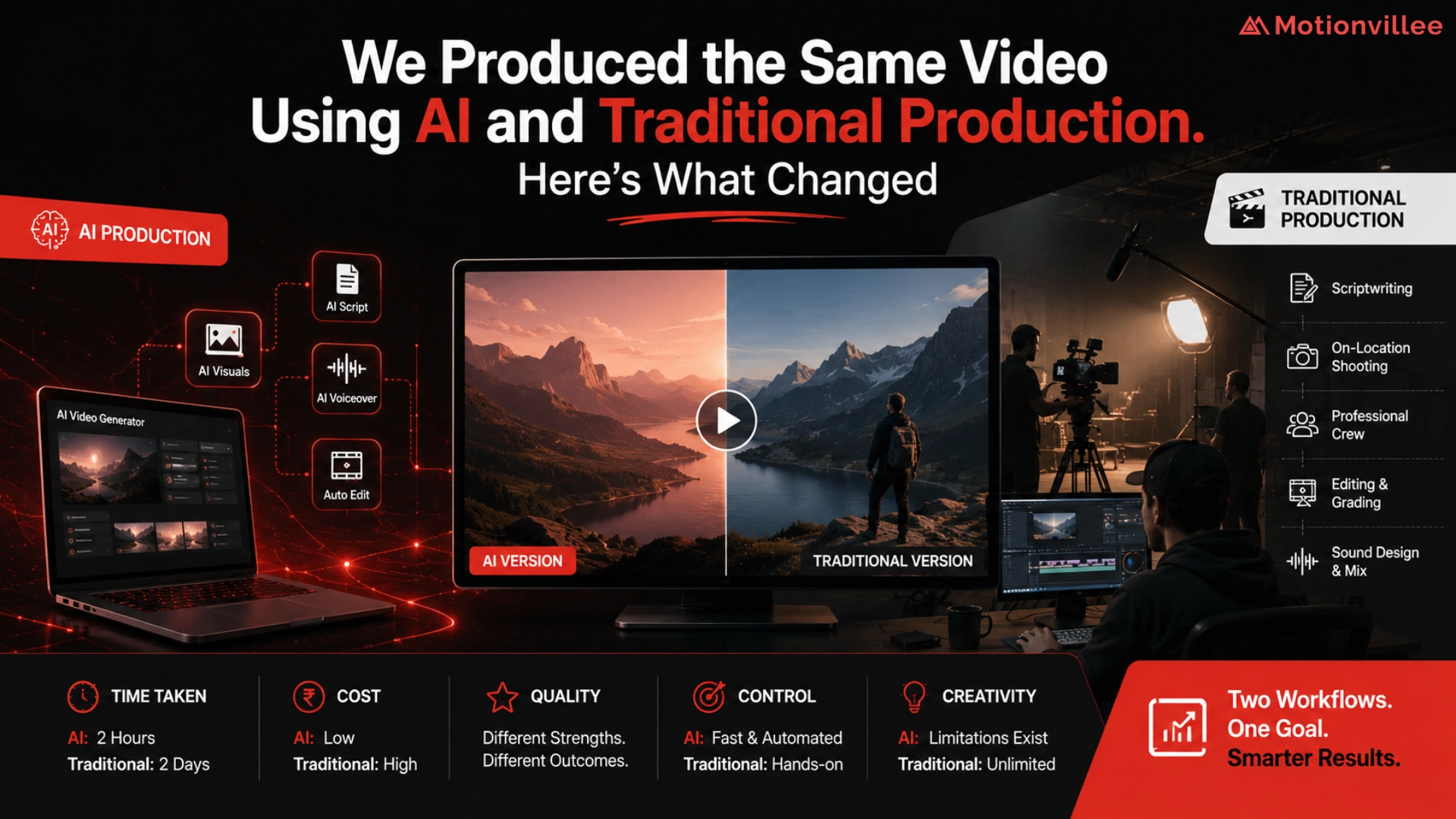
AI video production can be more cost efficient for repeatable assets, but it is not always the better cost choice when the final video needs heavy correction or custom work.
| Need | More cost efficient option |
| Social cutdowns | AI assisted production |
| Training videos | AI video production |
| Product updates | AI assisted production |
| Premium brand film | Traditional production |
| Customer story | Traditional or hybrid |
| Complex SaaS explainer | Hybrid |
| Paid ad variations | AI assisted production |
So, is AI video production cheaper than traditional video? For SEO search intent, the answer is: often yes for captions, versions, repurposing, training, and short updates. Not always for brand films, emotional stories, customer testimonials, or complex launch assets.
The answer depends on what the video has to do.
How Should a Business Budget for AI Video?
A business should budget for AI video based on the video’s role in revenue, not only the production method.
| Use case | Budget mindset |
| Internal update | Keep it simple and fast |
| Social content | Prioritize volume and testing |
| Paid ads | Budget for variations and review |
| Product update | Prioritize clarity and accuracy |
| SaaS explainer | Budget for script and story quality |
| Website hero video | Prioritize trust and brand quality |
| Sales video | Budget for buyer understanding |
| Customer onboarding | Prioritize accuracy and repeat use |
This is where ROI matters. Wyzowl reports that 85% of video marketers say video helped generate leads, 83% say it increased sales, and 57% say it reduced support queries [Wyzowl, 2026]. These are self reported outcomes, so they should guide measurement questions, not replace your own attribution model. (Wyzowl)
AI video production companies like Motionvillee should be evaluated on whether they connect cost to business use: acquisition, sales enablement, onboarding, customer education, or retention.
For stronger benchmarking, read [Link: AI video production cost study → /ai-video-production-cost-study/].
How Can You Reduce AI Video Production Cost Without Hurting Quality?
The best way to reduce cost is to remove confusion before production starts.
Start with one goal, one audience, one clear message, ready brand assets, approved product details, and one feedback owner. Then use AI where it saves time: captions, rough cuts, resizing, repurposing, and first draft concepts.
Use human review where buyer trust matters: script clarity, product accuracy, brand tone, visual consistency, CTA logic, and final approval.
The logic is simple. Unclear inputs create more revisions. More revisions increase cost.
What Does AI Video Production Actually Cost?
AI video production cost depends on the role the video plays in your business.
A simple AI clip can be low cost because the message is simple, the format is repeatable, and the risk is low. A business ready AI assisted video costs more because it needs strategy, scriptwriting, visual direction, editing, review, and versions your team can actually use.
So the better question is not only: what is the cost of AI video production?
It is:
What level of clarity, trust, and pipeline support does this video need to create?
If the video supports acquisition, sales enablement, onboarding, or retention, cost should be judged against business value, not just production output. For that measurement layer, read [Link: AI video production ROI → /ai-video-production-roi/].
Motionvillee is an AI video production partner for B2B brands that need video to support buyer understanding, sales confidence, and measurable growth, not just content volume.