
B2C vs B2B Video Marketing: Why Emotion Beats Logic in Consumer Brands
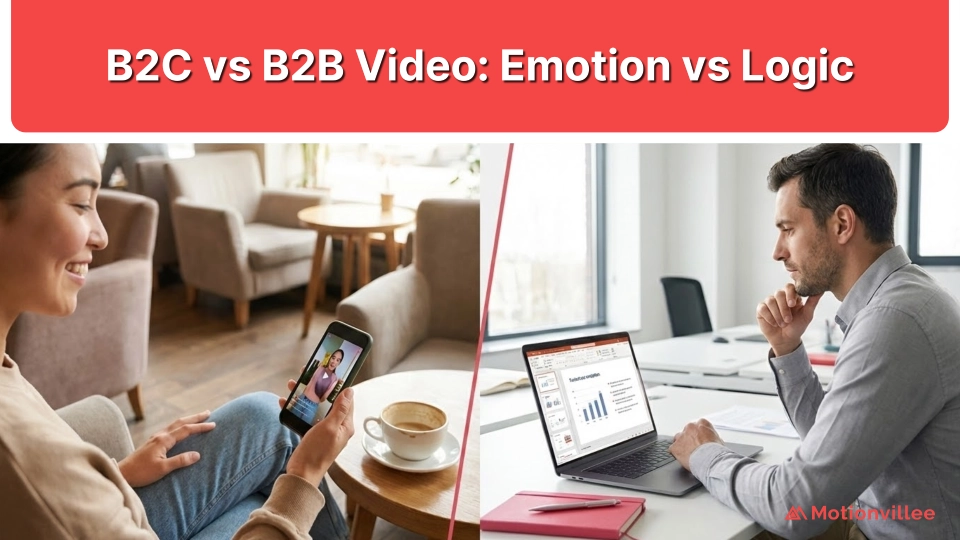
B2C video marketing strategy prioritizes emotional connection over logical persuasion, with consumer brands achieving 3-5x higher engagement through entertainment-first storytelling, 3-second hook urgency, and social-native formats that B2B rational approaches cannot replicate in direct-to-consumer contexts.
The Fundamental Difference Between B2C and B2B Video Strategy
B2C video marketing strategy succeeds through emotion-driven storytelling triggering immediate purchase decisions, while B2B approaches emphasize logical feature explanation supporting committee-based evaluation, with consumer brands requiring entertainment value, social shareability, and impulse conversion that business buyers never demand.
Decision-making differences create opposite video requirements:
- B2C buyers make individual emotional decisions in minutes or seconds
- B2B buyers conduct rational group evaluation over weeks or months
- Consumer purchases involve low commitment and easy reversal
- Business purchases require justification and stakeholder approval
- B2C success demands viral potential and social amplification
B2C vs B2B video performance benchmarks:
- B2C average engagement rate: 4.8% (B2B: 2.1%)
- B2C optimal video length: 15-30 seconds (B2B: 60-90 seconds)
- B2C conversion window: Minutes to hours (B2B: Days to months)
- B2C share rate: 3.2% of viewers (B2B: 0.4% of viewers)
- B2C entertainment requirement: Critical (B2B: Optional)
Understanding what explainer videos are and how they work provides foundation for recognizing how video fundamentals adapt across B2C and B2B contexts despite shared production mechanics.
Why Emotion Wins in B2C: The Psychology of Consumer Decision-Making
Emotion dominates B2C video marketing strategy because consumer purchases stem from feeling-driven impulse rather than rational analysis, with neuroscience showing emotional brain regions activate 3-5 seconds before logical processing during purchase decisions for personal consumption.
The Instant Gratification Window: 3 Seconds or Nothing
Consumer attention spans force 3-second hook requirements where B2C video marketing strategy either captures interest immediately or loses viewers forever, with entertainment value, visual surprise, or emotional resonance needed within opening frames before scrolling continues.
3-second hook elements for B2C:
- Visual pattern interrupt standing out in social feeds
- Emotional facial expression triggering mirror neuron response
- Unexpected movement or transformation creating curiosity
- Relatable problem presentation generating instant recognition
- Bold text overlay communicating benefit without sound
B2B videos tolerate 8-12 second introductions because business buyers arrive with research intent, while consumer scrolling behavior demands immediate value delivery preventing instant abandonment.
Impulse Purchase Triggers vs Considered Evaluation
B2C purchasing psychology responds to scarcity, social proof, and lifestyle aspiration triggers activating emotional purchase decisions, while B2B evaluation requires ROI justification, feature comparison, and risk mitigation that emotion cannot satisfy alone.
| Decision Factor | B2C Priority | B2B Priority |
|---|---|---|
| Primary trigger | Emotional desire | Logical need |
| Decision speed | Seconds to minutes | Days to months |
| Purchase justification | Personal feeling | Committee approval |
| Risk tolerance | High (easy returns) | Low (hard to reverse) |
| Information depth | Surface-level benefits | Detailed specifications |
The Role of Identity and Aspiration
Consumer brands sell identity transformation and lifestyle aspiration rather than product features, with effective B2C video marketing strategy showing who viewers become through purchase rather than explaining what products do functionally.
Identity-based messaging examples:
- Fitness products: Show confident transformation, not exercise mechanics
- Fashion brands: Display lifestyle aspirations, not fabric specifications
- Food products: Evoke joy and connection, not nutritional details
- Beauty products: Promise self-expression, not ingredient lists
- Home decor: Sell aesthetic identity, not manufacturing quality
The Dual-Audience Framework: When B2C Brands Need Both Approaches
Sophisticated B2C video marketing strategy employs dual-audience framework recognizing some consumer products require both emotional connection and logical persuasion, with entertainment-first approach for social discovery complemented by education-focused content for purchase-stage evaluation.
Top-of-Funnel: Pure Emotion for Discovery
Discovery-stage B2C video prioritizes entertainment, shareability, and emotional resonance over product explanation, with brand awareness and social amplification goals requiring content that audiences enjoy independent of purchase intent.
Top-funnel B2C video characteristics:
- Entertainment value justifying watch without product interest
- Social shareability encouraging organic distribution
- Minimal product presence avoiding overt advertising feel
- Emotional storytelling creating brand affinity
- Hook-driven structure optimized for platform algorithms
Examples of emotion-first discovery content:
- Nike: Inspirational athlete stories with minimal product focus
- Dove: Self-esteem and beauty standard commentary
- Apple: Lifestyle vignettes demonstrating creative expression
- Red Bull: Extreme sports content as entertainment
Mid-Funnel: Emotional Benefits With Proof Points
Consideration-stage B2C video blends emotional desire with logical validation through customer testimonials, before-after demonstrations, and benefit proof that maintains entertainment value while addressing purchase hesitation.
Mid-funnel content balance:
- Lead with emotional benefit or customer story
- Include social proof through user-generated content
- Demonstrate results visually without technical detail
- Address common objections through authentic testimonials
- Maintain entertainment pacing preventing educational dryness
Bottom-Funnel: Logical Reassurance for Purchase Confidence
Purchase-stage B2C video provides logical reassurance through detailed product demonstrations, specification explanations, and FAQ addressing that supports emotional purchase decision with rational validation for higher-consideration products.
When B2C needs logical content:
- Electronics: Feature comparison and technical specifications
- Appliances: Durability proof and warranty explanation
- Vehicles: Safety ratings and performance data
- Furniture: Material quality and construction details
- Supplements: Ingredient transparency and efficacy studies
Understanding different explainer video styles and when to use each one helps teams select appropriate visual approaches matching funnel stage and emotional vs logical content balance.
Platform-Specific B2C Video Strategy: Where Emotion Lives
B2C video marketing strategy requires platform-specific optimization recognizing different social networks demand unique content approaches, with TikTok prioritizing raw authenticity, Instagram favoring aesthetic polish, and YouTube supporting longer storytelling unavailable on short-form platforms.
TikTok and Instagram Reels: Raw Authenticity Wins
Short-form vertical video platforms reward authentic, unpolished content over professional production, with algorithm prioritization favoring native-feeling videos that match platform culture rather than obvious advertising disrupting entertainment flow.
TikTok/Reels B2C strategy:
- 15-30 second maximum length for completion rates
- Vertical 9:16 format filling mobile screens
- Native trends and audio usage signaling platform fluency
- Hook within first 1-2 seconds preventing scroll
- Captions essential for sound-off viewing
- Authentic, conversational tone avoiding corporate polish
Instagram Feed and Stories: Lifestyle Aesthetics
A Instagram requires polished aesthetic consistency aligning with aspirational lifestyle positioning, with feed videos showcasing product within curated environments and Stories enabling authentic behind-scenes connection balancing feed perfection.
<strong>Instagram B2C video types:
- Feed videos: Polished product showcases in aspirational settings
- Stories: Authentic day-in-life content and user-generated reposts
- Reels: Entertainment-first content with product integration
- IGTV: Longer tutorials or deep-dive product explanations
<h3>YouTube: Long-Form Storytelling and Education<p>A YouTube supports extended B2C video content enabling detailed product reviews, unboxing experiences, and tutorial content that short-form platforms cannot accommodate, with search-driven discovery favoring educational value over pure entertainment.
<h4><strong>YouTube B2C content opportunities:
- Product review videos: Detailed examination and demonstration
- Unboxing content: First-impression excitement and discovery
- Tutorial videos: Product usage and styling inspiration
- Brand story: Company origin and mission communication
- Comparison videos: Competitive product evaluation
Understanding YouTube distribution strategy for explainer videos and how to repurpose explainer videos for social media platforms provides tactical guidance for multi-platform B2C video deployment.
Facebook: Community and Shareability
A Facebook video strategy emphasizes shareability and community engagement through relatable content triggering emotional reactions that drive organic distribution through friend networks and group sharing behavior.
Facebook B2C video tactics:
- Square 1:1 format optimizing feed placement
- Emotional storytelling triggering reaction and sharing
- Community-focused content resonating with specific groups
- Longer videos (60-180 seconds) supported by platform
- Native upload prioritized over external links
The 3-Second Hook Framework: Capturing Consumer Attention
B2C video marketing strategy demands systematic 3-second hook framework ensuring immediate attention capture, with pattern interrupts, emotional triggers, and visual surprises preventing scroll-past abandonment that kills campaign performance before messaging delivery.
Pattern Interrupt Techniques
Pattern interrupts break expected social feed scrolling rhythm through unexpected visual elements, surprising movements, or contrasting colors that force momentary attention pause enabling message delivery window.
Effective pattern interrupt tactics:
- Rapid zoom: Sudden close-up or pull-back creating visual surprise
- Color flash: Bright contrasting color against muted feed
- Unexpected object: Unusual item or action creating curiosity
- Face close-up: Human face triggering instinctive attention
- Text reveal: Bold text appearing with dynamic animation
- Sound spike: Audio peak cutting through background noise
Emotional Hook Triggers
Emotional hooks leverage universal human experiences and feelings creating instant recognition and connection, with relatable problems, aspirational scenarios, or humorous situations generating engagement before product introduction.
Hook emotion categories:
- Frustration: “Tired of [common problem]?” immediate relatability
- Aspiration: Visual of desired lifestyle or transformation
- Curiosity: Unexpected claim or surprising demonstration
- Humor: Relatable comedic situation or unexpected punchline
- Validation: “You’re not alone in [feeling/situation]”
- FOMO: Social proof or scarcity suggesting missed opportunity
The “Stop-Scroll” Visual Formula
Stop-scroll formula combines movement, contrast, and human elements in opening frame creating visual composition that subconsciously prevents scrolling through motion detection, color contrast, and face recognition instincts.
Visual formula components:
- Human face or eyes in first frame (instinctive attention)
- High contrast colors against typical feed aesthetics
- Movement or transformation within first second
- Text overlay communicating benefit without sound
- Centered composition drawing eye to focal point
Story Frameworks That Work for B2C: Beyond Problem-Solution
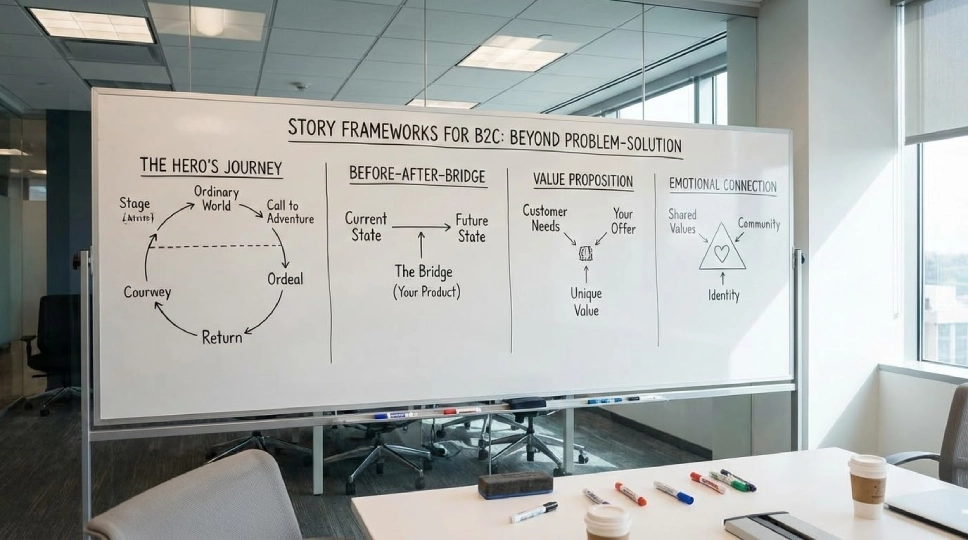
B2C video marketing strategy employs diverse storytelling frameworks beyond basic problem-solution structure, with transformation narratives, lifestyle vignettes, and user-generated authenticity creating emotional connections that rational product explanations cannot achieve.
The Transformation Story Arc
Transformation narratives show relatable before-state evolving into aspirational after-state with product as catalyst, creating powerful emotional journey that viewers project onto their own lives imagining similar transformation.
Transformation arc structure (30-60 seconds):
- Before state (5-8 sec): Relatable frustration or dissatisfaction
- Discovery moment (3-5 sec): Product introduction as solution
- Transformation montage (10-15 sec): Visual change demonstration
- After state (8-12 sec): Aspirational result and emotional payoff
- Call-to-action (3-5 sec): Clear next step for viewers
The Day-in-the-Life Vignette
Lifestyle vignettes integrate product naturally into aspirational daily routines, showing target audience members living desired lifestyle with product as seamless component rather than focus, selling identity over utility.
Vignette framework elements:
- Authentic morning routine featuring product naturally
- Aesthetic environments matching target audience aspiration
- Minimal dialogue favoring visual storytelling and music
- Product integration feeling organic not forced
- Lifestyle emphasis over product feature explanation
The User-Generated Authenticity Model
User-generated content frameworks leverage customer authenticity and relatability, with real user stories, unboxing reactions, and genuine testimonials creating trust that polished brand content cannot replicate for skeptical consumers.
UGC framework types:
- Unboxing reactions: Genuine excitement and first impressions
- Before-after transformations: Real customer results
- Tutorial content: Users showing product application
- Testimonial stories: Personal experience narratives
- Challenge participation: Branded hashtag engagement
Understanding how to promote animated explainer videos provides broader distribution context that B2C brands can adapt for consumer-focused video promotion across multiple channels.
B2C Video Length Strategy: When Shorter Always Wins
B2C video marketing strategy demands ruthless length optimization with 15-30 seconds as sweet spot for social platforms, recognizing consumer attention scarcity and entertainment competition require immediate value delivery unlike B2B’s educational tolerance.
Platform-Specific Length Guidelines
Optimal B2C video length varies by platform algorithm priorities and user behavior patterns, with short-form platforms penalizing longer content through reduced distribution while YouTube supports extended storytelling for engaged audiences.
| Platform | Optimal Length | Maximum Before Dropoff |
|---|---|---|
| TikTok | 15-21 seconds | 30 seconds |
| Instagram Reels | 15-30 seconds | 45 seconds |
| Instagram Feed | 30-45 seconds | 60 seconds |
| 30-60 seconds | 90 seconds | |
| YouTube Shorts | 15-45 seconds | 60 seconds |
| YouTube Main | 60-180 seconds | 600 seconds |
The Information Density Challenge
Short B2C video format requires exceptional information density communicating brand value proposition, emotional benefit, and call-to-action within 15-30 seconds demanding ruthless editing and visual storytelling over narration.
Maximizing short-form information density:
- Visual demonstration replacing verbal explanation
- Text overlays communicating benefits without audio
- Fast pacing maintaining engagement through transitions
- Single-message focus avoiding multiple concepts
- Implied context rather than complete story setup
When B2C Can Go Longer: YouTube and High-Intent Content
YouTube search-driven discovery and subscription-based viewing enables longer B2C content for product-curious audiences actively seeking detailed information, with tutorial videos, reviews, and brand stories justified for consideration-stage viewers.
Long-form B2C content opportunities:
- Product tutorials: Detailed usage demonstration (2-5 minutes)
- Brand story videos: Company mission and values (3-8 minutes)
- Unboxing experiences: Full product reveal (5-15 minutes)
- Comparison videos: Detailed competitive analysis (8-12 minutes)
- Customer testimonials: In-depth transformation stories (3-6 minutes)
Call-to-Action Strategy: Immediate vs Considered Actions
B2C video marketing strategy requires different call-to-action approaches than B2B, with consumer brands emphasizing immediate low-commitment actions like “Shop Now,” “Learn More,” or “Try Today” rather than “Schedule Demo” or “Contact Sales” requiring multi-step evaluation.
The Impulse Purchase CTA
Impulse purchase CTAs capitalize on emotional peak created by video content, directing viewers to immediate purchase opportunity while desire remains high before rational second-guessing undermines emotional buying decision.
Effective B2C CTAs:
- “Shop Now” with direct product page link
- “Get Yours Today” emphasizing immediate availability
- “Limited Time Only” triggering scarcity urgency
- “Join 10,000+ Happy Customers” leveraging social proof
- “Try Risk-Free” removing purchase hesitation
The Micro-Commitment Ladder
Higher-consideration B2C products benefit from micro-commitment ladder starting with low-risk action like “Learn More” or email signup building toward purchase through progressive engagement rather than demanding immediate sale.
Micro-commitment progression:
- Watch video (no commitment)
- “See How It Works” (learn more page)
- “Get Free Guide” (email capture)
- “Start Free Trial” (usage commitment)
- “Buy Now” (purchase conversion)
Social Engagement CTAs
Brand awareness-focused B2C video employs social engagement CTAs like “Share with a friend,” “Tag someone who needs this,” or “Use #BrandHashtag” prioritizing organic distribution over immediate conversion for top-funnel content.
Understanding how to use explainer videos in paid ads to lower cost per lead and how to optimize landing pages with explainer videos provides tactical guidance for conversion-focused B2C video implementation.
Production Value: When Polish Matters vs When Authenticity Wins
B2C video marketing strategy requires strategic production value decisions balancing professional polish signaling quality against authentic rawness building trust, with platform, audience, and product category determining optimal production approach.
High-Production Scenarios
Premium products, established brands, and aesthetic-focused categories benefit from high production value signaling quality, craftsmanship, and aspirational positioning through cinematic visuals, professional color grading, and polished editing.
Products requiring high production:
- Luxury goods: Fashion, jewelry, high-end electronics
- Automotive: Vehicle aesthetics and performance
- Beauty products: Visual transformation and results
- Home decor: Lifestyle aspiration and design quality
- Travel and hospitality: Destination beauty and experience
Authentic Low-Production Scenarios
User-generated content, behind-scenes footage, and social-native video benefit from authentic low-production aesthetics building trust and relatability through rawness, with excessive polish creating distance and advertising skepticism.
Content types favoring authenticity:
- Customer testimonials: Real user experiences
- Behind-the-scenes: Company culture and process
- Tutorial content: Practical demonstration over aesthetic
- Social media native: Platform-matching authenticity
- Founder stories: Personal connection and vulnerability
The Hybrid Approach
Sophisticated B2C brands employ hybrid production approach mixing polished flagship content establishing brand quality with authentic user-generated content building community trust, creating comprehensive content library serving different audience segments and funnel stages.
Working with experienced explainer video production services, specialized SaaS video production teams for consumer-facing software, and professional USA video production companies ensures B2C video quality meets strategic requirements while maintaining authentic connection with target audiences.
Measuring B2C Video Success: Metrics That Actually Matter
B2C video marketing strategy requires different success metrics than B2B, with view-through rates, social engagement, and direct attribution to purchases providing clearer performance indicators than B2B’s longer-cycle pipeline metrics.
Engagement Rate: The Ultimate B2C Metric
Engagement rate combining likes, comments, shares, and saves reveals content resonance better than view count alone, with high engagement signaling emotional connection triggering algorithm amplification and organic distribution.
B2C engagement benchmarks:
- Excellent: 8%+ engagement rate
- Good: 4-8% engagement rate
- Average: 2-4% engagement rate
- Poor: <2% engagement rate
View-Through Rate and Completion
View-through rate measuring percentage watching 75%+ of video duration indicates content quality and hook effectiveness, with completion rates directly affecting platform algorithm distribution decisions favoring engaging content.
Completion rate targets:
- TikTok/Reels: 70%+ completion ideal
- Instagram Feed: 60%+ completion strong
- Facebook: 50%+ completion acceptable
- YouTube: 40%+ completion good
Direct Response Attribution
E-commerce B2C brands measure video performance through direct purchase attribution using UTM parameters, promo codes, and platform pixel tracking connecting video views to conversions within hours or days unlike B2B’s months-long cycles.
Attribution tracking methods:
- UTM parameters on all video links
- Video-specific promo codes measuring conversion
- Platform pixels tracking view-to-purchase journeys
- Post-purchase surveys asking discovery source
- Cohort analysis comparing video-exposed vs control groups
Common B2C Video Mistakes: Learning From B2B Approaches
B2C brands commonly fail by importing B2B video strategies emphasizing logic over emotion, creating feature-focused content instead of benefit-driven storytelling, and prioritizing information density over entertainment value that consumer audiences demand.
The Feature-Dump Mistake
Feature-focused B2C video listing product specifications and technical details fails because consumer buyers care about emotional benefits and lifestyle transformation rather than rational feature comparison that B2B audiences require.
Feature-dump symptoms:
- Listing multiple product features without emotional context
- Technical jargon alienating non-expert consumers
- Comparison tables and specification charts
- Voiceover-heavy narration over visual storytelling
- Missing human element and relatable scenarios
The Explanation Overload
Over-explaining products through detailed demonstrations and instruction creates educational content appropriate for B2B but boring for consumer audiences seeking entertainment and emotional connection before purchase consideration.
The Corporate Tone Error
Professional corporate tone working for B2B credibility feels distant and inauthentic in B2C contexts where conversational warmth, humor, and personality create connection that formal business communication prevents.
Tone adjustment from B2B to B2C:
- B2B: “Our platform enables enterprise teams to…” → B2C: “You’ll love how easy this makes…”
- B2B: “Featuring industry-leading technology…” → B2C: “It just works, beautifully.”
- B2B: “Schedule a demonstration…” → B2C: “Try it today!”
- B2B: “Optimize workflow efficiency…” → B2C: “Save time for what matters.”
The Step-by-Step B2C Video Creation Framework
B2C video marketing strategy succeeds through systematic framework ensuring emotion-first approach, platform optimization, and conversion focus from concept through distribution, with each step prioritizing consumer psychology over rational persuasion.
Step 1: Define Emotional Core (Not Product Features)
Begin by identifying single dominant emotion or desire your product fulfills, whether confidence, joy, relief, belonging, or aspiration, with emotional core guiding all creative decisions preventing feature-focused drift.
Emotional core discovery questions:
- How do customers feel before finding your product?
- What emotional transformation does your product create?
- What does your product enable them to become?
- What fear or frustration does it eliminate?
- What aspiration or desire does it fulfill?
Step 2: Script for 3-Second Hook (Then Build Backward)
Design opening 3 seconds first ensuring attention capture through pattern interrupt, emotional trigger, or visual surprise, then build remaining content supporting hook promise rather than creating full script and adding hook afterward.
Hook-first scripting process:
- Write 5-10 different hook concepts
- Test hooks with target audience or team
- Select strongest hook creating curiosity or emotion
- Build 15-30 second script delivering hook promise
- Add clear call-to-action at conclusion
Step 3: Choose Platform and Optimize Format
Select primary distribution platform before production determining aspect ratio, length, and style conventions matching platform culture and algorithm priorities rather than creating generic content attempting cross-platform deployment.
Platform-specific optimization:
- TikTok: 9:16 vertical, 15-21 seconds, authentic style
- Instagram Reels: 9:16 vertical, 15-30 seconds, aesthetic polish
- Instagram Feed: 1:1 square or 4:5 vertical, 30-45 seconds
- Facebook: 1:1 square, 30-60 seconds, sharable emotion
- YouTube: 16:9 horizontal, 60-180 seconds, search-optimized
Step 4: Production With Emotion Priority
Execute production prioritizing emotional moments over technical perfection, with genuine reactions, authentic scenarios, and human connection receiving more attention than lighting precision or audio polish for most B2C contexts.
Step 5: Edit for Pacing and Music
Edit aggressively maintaining fast pacing through quick cuts, transition variety, and dynamic camera movement, with music selection driving emotional tone and energy level more powerfully than visual elements alone.
B2C editing best practices:
- Scene changes every 2-4 seconds maintaining attention
- Music-driven pacing matching beat and energy
- Text overlays ensuring sound-off comprehension
- Color grading creating consistent aesthetic
- Captions for accessibility and platform algorithms
Step 6: Test, Measure, Iterate
Launch with small budget testing multiple creative variations measuring engagement rate, completion rate, and conversion tracking, then scale investment behind winning variations while continuously testing new concepts preventing creative fatigue.
Testing framework:
- Create 3-5 video variations testing different hooks
- Run small budget ($50-$200) on each variant
- Measure engagement and conversion within 48 hours
- Scale budget on top 1-2 performers
- Create new variations weekly preventing ad fatigue
Building Your Emotion-First B2C Video Strategy
B2C video marketing strategy succeeds through emotion-first approach prioritizing entertainment, social shareability, and immediate conversion over rational explanation, with 3-second hooks, transformation storytelling, and platform-native optimization creating consumer engagement that logic-focused B2B approaches cannot achieve.
Core B2C video principles:
- Emotion drives consumer decisions faster and stronger than logic
- 3-second hooks represent difference between success and scroll-past
- Platform-specific optimization beats generic cross-platform content
- Transformation storytelling creates powerful identification and desire
- Authentic rawness often outperforms corporate polish for trust building
Dual-audience framework recognizes sophisticated B2C brands need both emotion-driven discovery content and logic-based consideration content, with entertainment-first approach capturing attention complemented by educational reassurance supporting purchase decisions.
Platform-specific strategy adapts to algorithm priorities and user behavior, with TikTok rewarding authentic rawness, Instagram requiring aesthetic polish, and YouTube supporting extended storytelling that short-form platforms cannot accommodate.
The 3-second hook framework using pattern interrupts, emotional triggers, and stop-scroll visuals prevents abandonment before message delivery, with systematic hook creation and testing improving performance across all platforms and campaigns.
Production value decisions balance professional polish signaling quality against authentic rawness building trust, with strategic approach matching product category, audience expectations, and content purpose rather than defaulting to maximum production budget.
Step-by-step creation framework ensures emotion-first approach from concept through distribution, with emotional core definition, hook-first scripting, platform optimization, and systematic testing creating repeatable process for consistent B2C video success.
Schedule a strategy call with Motionvillee to develop emotion-driven B2C video marketing strategies combining entertainment value, platform optimization, and conversion focus that transform passive viewers into engaged customers through strategic video implementation.