
Demographics vs Psychographics: What Really Drives Video Engagement
Making videos that work well is not only related to quality of production and distribution; it is more to do with knowing your audience. Even today, many companies use demographics a lot, yet most times the results are mediocre.
By 2026, there will be a need for marketers to think of not only their target audience, but what matters to them, that is the essence of psychographics.
What are demographics in video engagement?
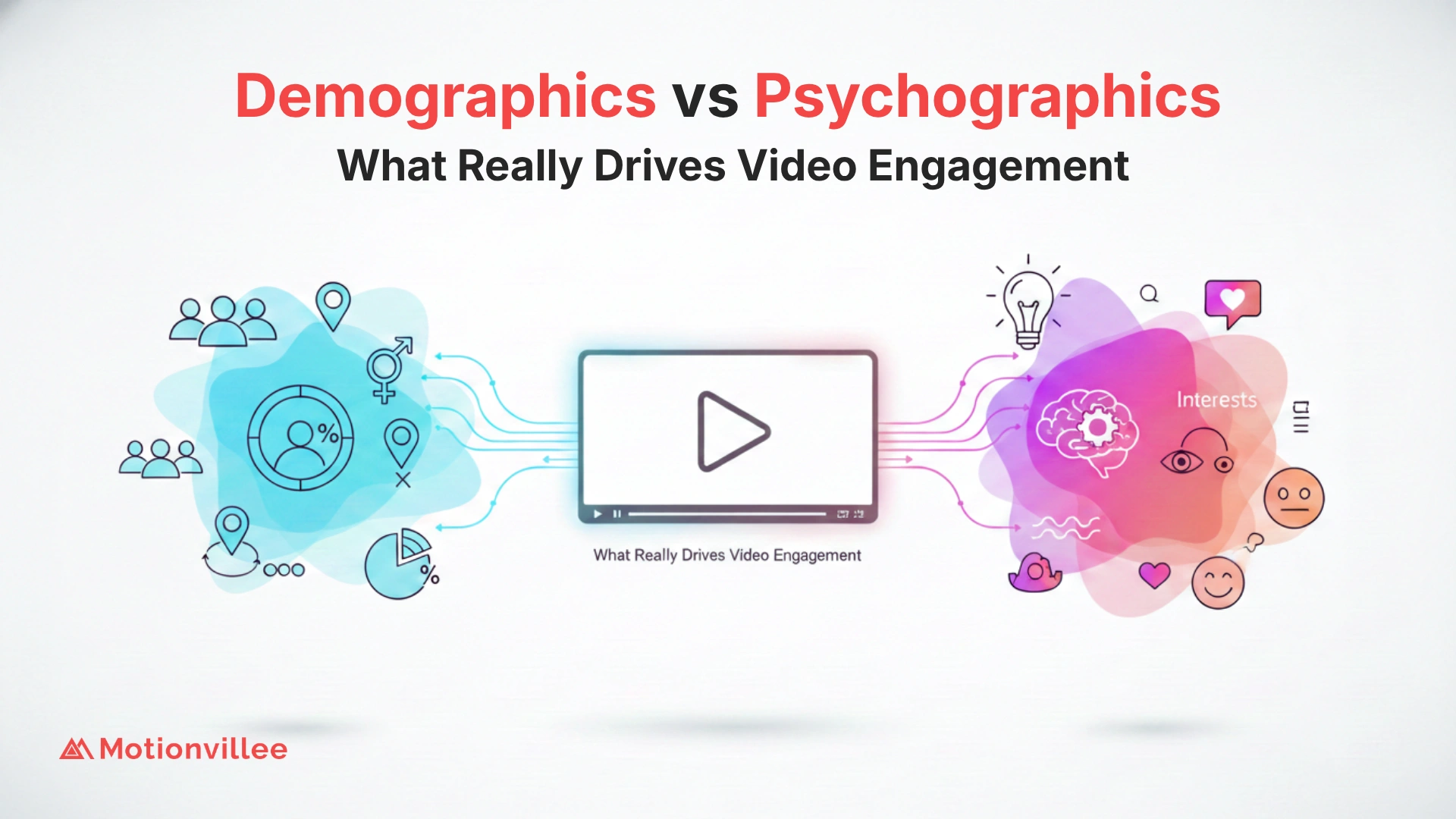
Demographic factors determine who you’re reaching out to. These include age, gender, geographic location, income, job, and level of education.
Such information is simple to obtain and widely applied in ad systems. It allows brands to divide their audience and plan distribution channels. As an example, targeting “male individuals aged 25-40 living in cities” for the promotion of some sports programs.
Unfortunately, such statistics cannot give a deeper understanding. It tells about who the person is, but fails to answer about his/her needs, pain points, and reasons for being interested in the clip you offer.
The real world shows that people with the same demographic factors behave differently. One will enjoy the video till the end, while another one scrolls it off instantly.
Demographics are helpful in targeting, but they don’t cover behavioral traits.
What are psychographics in video engagement?
Psychographics help us understand why our target audience behaves that way. It doesn’t use identity but rather mindset.
The following are included under the definition of psychographics:
- Interest or preference
- Values or beliefs
- Lifestyle
- Challenges or problems
- Motivation or goals
It helps us to ask important questions like:
- What problem is he/she trying to solve?
- What motivates him/her to watch videos?
- Which content resonates with him/her?
For instance, we would not go by marketing professionals but rather people who experience problems with poor campaign performance and need help.
This difference between identity and motivation leads to effective video views.
Why do demographics alone fail to drive video engagement?
Demographics fail because it does not consider intent, emotion, and context.
The viewer chooses within seconds if he/she should watch the video or not. The choice is based on relevance rather than demographics. If the video does not seem relevant to the viewer from the first second, it gets skipped.
Two viewers who have identical demographic data can be different in their behavior depending on:
- Their issues/challenges
- Their awareness
- Their emotional state
That’s why videos that target only by demographics end up being boring and average.
If you do not know the needs of your audience, your video will not resonate with the viewers.
Why do psychographics drive higher video engagement?
Psychographics motivate engagement in content since it resonates with what the consumer is going through at that moment in time.
If your video captures an issue that people are really facing, you immediately get their attention. And this relevance prevents the scrolling process.
For example:
- “Boost your marketing efforts”
- “Frustrated because you don’t have many conversion rates on your ads?”
Clearly, the latter is way more engaging.
Here’s why:
- It feels personal
- It tackles actual problems
- It evokes emotions
How do pain points improve video engagement using psychographics?
Pain points immediately add relevance to your content.
When a video tackles a particular pain point, the value of the video is immediately apparent without any confusion.
For instance:
- “Why aren’t your ads converting?”
- “Boost engagement with your videos”
- “Don’t waste money with bad targeting”
These headlines perform better than others simply because they address real problems.
Moreover, pain points instill a sense of urgency in the viewer.
Once a viewer sees his/her problem being addressed, he/she will be eager to find the solution.
The result is:
- Increased watch time
- Greater engagement
- Improved retention
How do values and beliefs influence video engagement?
Beliefs and values make for an emotional connection.
The closer content is to people’s beliefs, the more trust it can establish. In some cases, this connection becomes much more important than the content itself.
For instance, Nike creates advertising campaigns based on determination, ambitions, and self-confidence. These messages resonate because they reflect what their customers want to be.
Your content will be:
- Authentic
- Trustworthy
- Shareable
People respond better to content that matches their values.
How does lifestyle affect video engagement patterns?
Lifestyle determines how people consume content.
The contemporary audience comprises mostly mobile users who have little time to spare.
They often watch videos when they have a few minutes to spare or when they are multitasking.
This explains the dominance of short-form videos on apps such as TikTok since they suit fast consumption behavior.
Lifestyle impacts:
- When they consume
- How long they watch
- Their preferred medium
For instance:
- Working professionals enjoy watching quick and informative videos
- Students can relate to entertaining videos
- B2B clients appreciate educational information
How can brands use psychographics to improve video engagement?
Brands could increase engagement through focusing on motivation and addressing problems rather than targeting audience types.
It means:
- Pinpointing pain points
- Knowing audience needs
- Making content which addresses these needs
One good example here is HubSpot which creates educational videos dealing with actual problems to get and retain their audience.
In order to do this:
- Analyzing audience behavior and feedback
- Pinpointing engagement patterns
- Building content based on these patterns
What is the role of messaging in psychographic driven video engagement?
Message plays a role in how effective your content becomes.
Even with good ideas, bad messages lessen effectiveness. Your message must be in line with how your target market thinks.
A good message:
- Is clear and concise
- Is casual and familiar
- Uses words the audience uses
For instance:
- Professional: “Improve your digital marketing strategy”
- Simple: “Are your ads not working for you?”
Which one would you like more?
Which matters more for video engagement: demographics or psychographics?
Psychographics play a vital role due to their direct impact on attention and behavior.
While demographics help in finding the target audience, psychographics help in engaging them.
The right approach to marketing is:
- Using demographics for targeting
- Using psychographics for creating contents
Conclusion: What really drives video engagement?
Video engagement is driven by psychographics because they relate to actual human psychology.
The best campaigns incorporate both:
- Demographics to target the right audience
- Psychographics to create relevant videos
Videos that show real-life issues and emotional stories will engage their audience.