

Explainer Video Cost by Style: 2D vs 3D vs Whiteboard
Explainer video cost by style varies dramatically, with whiteboard animation starting around $1,500-$3,000 per minute, 2D animation ranging from $3,000-$8,000, and 3D animation commanding $8,000-$20,000 or more depending on complexity and production quality.
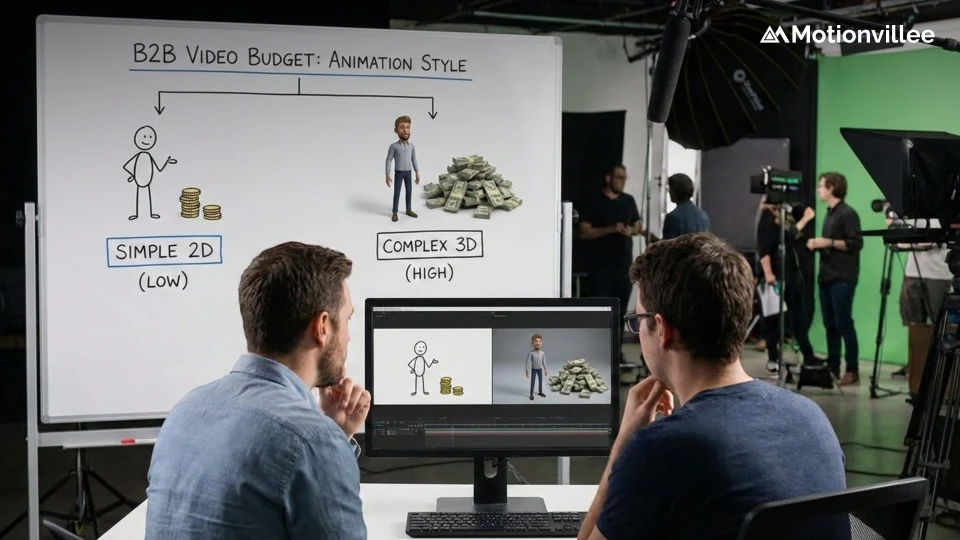
Why Animation Style Dramatically Impacts Your Video Budget
Animation style represents the single largest cost driver in explainer video production, with pricing differences of 300-500% between styles due to production complexity, required expertise, rendering requirements, and timeline variations.
Two 60-second videos with identical scripts can cost vastly different amounts:
- Whiteboard animation: $2,000-$4,000
- 2D custom animation: $5,000-$10,000
- 3D photorealistic animation: $15,000-$25,000
Why style creates such dramatic cost differences:
- Production workflows vary from simple illustration to complex 3D modeling
- Required expertise ranges from 2D illustrators to specialized 3D technical artists
- Timeline differences span 3-4 weeks for whiteboard to 8-12 weeks for 3D
- Revision complexity increases exponentially with animation sophistication
Understanding what explainer videos are and how they work helps teams recognize that style selection should align with both message requirements and budget realities rather than choosing styles based solely on aesthetic preferences.
Understanding the Three Major Explainer Video Styles
The three dominant explainer video styles serve different purposes, appeal to distinct audiences, and deliver varying production value at dramatically different price points.
2D Animation: The Versatile Industry Standard
A 2D animation creates flat, two-dimensional graphics with movement, representing the most versatile and widely used explainer video style across industries and budgets.
2D animation characteristics:
- Characters and objects exist on flat planes without depth dimension
- Color palettes and design styles range from minimalist to highly detailed
- Movement created through frame-by-frame animation or digital rigging
- Production workflows accommodate various complexity levels and budgets
2D animation spans the widest price range because it encompasses everything from simple motion graphics using basic shapes to sophisticated character animation with complex movements and detailed environments.
3D Animation: Photorealistic Depth and Dimension
A 3D animation adds depth dimension through modeling, texturing, and rendering processes that create realistic or stylized three-dimensional objects with lighting, shadows, and perspective.
3D animation defining features:
- Objects exist in three-dimensional space with height, width, and depth
- Camera movements rotate around subjects showing multiple angles
- Lighting and shadows create realistic depth perception
- Rendering converts 3D models into final video frames through processing
3D animation always costs significantly more than 2D because it requires specialized modeling software, powerful rendering hardware, and technical expertise beyond traditional animation skills.
Whiteboard Animation: Educational Simplicity That Converts
A Whiteboard animation simulates hand-drawing illustrations on white backgrounds, creating educational content that emphasizes clarity and concept explanation over visual sophistication.
Whiteboard animation elements:
- Black line drawings appearing progressively as if drawn in real-time
- White or light-colored backgrounds minimizing visual distraction
- Hand illustrations moving across screen simulating drawing process
- Focus on concept clarity rather than aesthetic complexity
Whiteboard animation costs less than other styles because simplified visual approach requires less illustration detail, minimal color work, and straightforward animation techniques that experienced animators execute efficiently.
2D Animation Cost Breakdown: What You’ll Actually Pay
2D animation pricing spans $1,500-$20,000 per minute depending on whether you choose template-based production, custom original design, or premium character animation with sophisticated movements.
Entry-Level 2D: Template-Based Production Pricing
Template-based 2D animation costs $1,500-$3,000 per minute by using pre-designed character libraries, stock visual elements, and standardized animation movements that reduce custom design time.
| Service Level | Price Per Minute | What’s Included | Best For |
|---|---|---|---|
| DIY platforms | $0-$500 | Self-service templates, limited customization | Internal training, quick updates |
| Budget freelancers | $1,000-$2,000 | Template characters, basic customization | Startups, proof of concept |
| Template studios | $2,000-$3,500 | Professional templates, brand colors | Small businesses, social content |
Template approach limitations:
- Generic characters lack unique brand personality
- Limited animation movements constrain storytelling flexibility
- Visual style matches other companies using same templates
- Customization requests quickly push costs toward custom pricing
Understanding how much explainer videos actually cost helps teams evaluate whether template savings justify reduced brand differentiation versus investing in custom design.
Mid-Tier Custom 2D: Original Design Cost Factors
Custom 2D animation with original character design and brand-specific visual style costs $4,000-$10,000 per minute, representing the sweet spot for most B2B companies seeking professional quality.
Custom 2D production elements:
- Original character design matching brand personality
- Custom color palettes reflecting brand identity
- Unique visual style differentiating from competitors
- Flexible animation accommodating complex messaging
Cost factors within custom 2D range:
- Character complexity: Simple geometric vs detailed anthropomorphic figures
- Scene quantity: 5-8 scenes vs 12-15 scene variations
- Movement sophistication: Basic transitions vs fluid character animation
- Background detail: Minimalist vs elaborate environment illustration
Mid-tier custom 2D delivers professional quality that represents brands effectively without premium pricing that only Fortune 500 budgets accommodate.
Premium 2D Animation: When Quality Commands Higher Rates
A Premium 2D animation costing $10,000-$20,000+ per minute features cinematic quality with frame-by-frame character animation, detailed environments, sophisticated effects, and production values approaching broadcast standards.
Premium 2D distinguishing characteristics:
- Frame-by-frame character animation with natural, fluid movements
- Highly detailed illustration work in characters and environments
- Complex lighting, shadows, and visual effects
- Multiple revision rounds ensuring perfection at every stage
- Senior animator involvement throughout entire production
Premium 2D makes sense when video represents major brand initiatives, serves as cornerstone marketing asset for multi-year campaigns, or targets audiences expecting Hollywood-quality production standards.
3D Animation Budget Reality: The Premium Investment
3D animation requires minimum $8,000-$12,000 investment for basic projects, with typical business explainer videos costing $12,000-$25,000 and premium photorealistic work exceeding $30,000-$50,000 per minute.
Why 3D Costs 2-4x More Than Comparable 2D Videos
3D animation costs multiply beyond 2D pricing because production adds modeling, texturing, rigging, lighting, and rendering stages that each require specialized expertise and significant time investment.
3D production stages that don’t exist in 2D:
- 3D modeling creating object geometry from scratch
- UV unwrapping preparing models for texture application
- Texturing applying surface details, colors, and materials
- Rigging building skeletal systems for character movement
- Lighting designing multi-source illumination for depth
- Rendering converting 3D scenes into 2D video frames
Rendering alone adds costs 2D never encounters:
- Powerful computers processing hours per frame
- Render farms for complex scenes requiring distributed processing
- Multiple rendering passes for lighting, shadows, reflections
- Revision renders requiring hours of reprocessing for small changes
A 60-second 3D video might require 40-80 hours of rendering time alone, independent of the 150-300 hours of modeling, animation, and lighting work.
Modeling, Texturing, and Rendering: Where 3D Budgets Explode
The three most time-intensive 3D processes account for 60-70% of total production costs through specialized technical work that 2D animation completely avoids.
| 3D Process | Time Required | Specialist Cost | Why It’s Expensive |
|---|---|---|---|
| 3D Modeling | 20-40 hours | $50-$150/hour | Creating geometry from scratch requires technical precision |
| Texturing | 15-30 hours | $40-$100/hour | Surface detail work demands artistic and technical skill |
| Rendering | 40-80 hours | Hardware costs | Computer processing time, render farm fees |
| Lighting | 10-25 hours | $50-$120/hour | Creating realistic illumination requires specialized expertise |
Each revision in 3D multiplies costs exponentially:
- Model changes require re-texturing and re-rigging
- Lighting adjustments necessitate complete re-renders
- Animation revisions demand new rendering passes
- Material changes affect how light interacts across entire scene
When 3D Animation Justifies the Premium Price Tag
3D animation justifies higher investment when products require dimensional visualization, technical accuracy demands realistic rendering, or brand positioning requires premium production values that differentiate from competitors.
Scenarios where 3D delivers superior ROI despite higher costs:
- Physical product demonstrations showing functionality from multiple angles
- Medical or scientific visualization requiring anatomical accuracy
- Architecture or real estate showcasing spatial relationships
- Software UI demonstrations where depth enhances clarity
- Premium brand positioning where production quality signals market leadership
Working with experienced video production services helps teams evaluate whether 3D’s premium investment aligns with messaging requirements or if sophisticated 2D animation achieves comparable impact at lower cost.
Whiteboard Animation Economics: The Budget-Friendly Option
Whiteboard animation offers the most cost-effective explainer video option at $1,500-$5,000 per minute while maintaining professional quality and delivering strong conversion rates for educational content.
Traditional Whiteboard vs Digital Whiteboard Pricing
Traditional whiteboard animation featuring actual filmed hand-drawing costs 30-50% more than digital whiteboard created entirely through software simulation due to filming requirements and production complexity.
| Whiteboard Type | Cost Per Minute | Production Method | Timeline |
|---|---|---|---|
| Digital whiteboard | $1,500-$3,500 | Software-generated drawing simulation | 2-3 weeks |
| Filmed whiteboard | $2,500-$5,000 | Actual filming of hand drawing illustrations | 3-4 weeks |
| Color whiteboard | $2,000-$4,500 | Digital with color illustration elements | 2-4 weeks |
Digital whiteboard dominates the market because software tools create convincing hand-drawing simulations without filming logistics, equipment costs, or physical illustration requirements that traditional approaches demand.
Why Whiteboard Videos Cost Less Than Other Styles
Whiteboard animation achieves lower pricing through simplified visual approach, streamlined production workflow, and reduced illustration complexity compared to full-color character animation or 3D modeling.
Whiteboard cost advantages:
- Line drawings require less illustration time than detailed full-color artwork
- Minimal backgrounds eliminate environment design and rendering
- Drawing animation technique simpler than character rigging and movement
- Black and white palette eliminates color theory and palette development
- Revisions involve redrawing specific elements rather than complex scene reconstruction
Understanding quality differences between budget and premium explainer videos helps teams recognize that whiteboard’s lower cost stems from production efficiency rather than inferior quality or effectiveness.
Limitations That Keep Whiteboard Affordable
A Whiteboard animation maintains lower pricing by accepting visual limitations that other styles avoid, including restricted color options, simplified character design, and educational rather than emotional storytelling approaches.
Whiteboard style constraints:
- Limited character expression through simple line-drawn faces
- Minimal environmental context beyond essential background elements
- Educational tone may not suit emotional or aspirational brand messaging
- Market saturation from widespread use reduces differentiation impact
- Dated aesthetic perception among some audiences preferring modern styles
Whiteboard works brilliantly for concept explanation, process demonstration, and educational content but may not align with premium brand positioning or emotional storytelling requiring sophisticated visual narrative.
Production Complexity: How It Affects Cost Across All Styles
The Production complexity multiplies costs within each animation style through character sophistication, scene transitions, custom asset creation, and visual effects that extend timelines and require specialized expertise.
Character Animation Complexity and Price Implications
A Character complexity represents the largest variable cost driver within animation styles, with pricing ranging from simple geometric shapes to fully rigged characters with facial expressions and natural movements.
| Character Complexity | 2D Cost Impact | 3D Cost Impact | Description |
|---|---|---|---|
| Simple shapes/icons | Baseline cost | +30-40% | Geometric forms, minimal detail |
| Basic characters | +20-30% | +50-70% | Simple features, limited movement |
| Detailed characters | +40-60% | +100-150% | Facial expressions, fluid movement |
| Multiple characters | +60-100% | +150-250% | Several unique designs, interactions |
Character features driving cost increases:
- Facial animation with expressions, lip sync, and emotional range
- Hand gestures and finger movements for natural interaction
- Clothing details, accessories, and prop interactions
- Walking, running, or complex movement cycles
- Character-to-character interactions requiring coordinated animation
Scene Transitions and Visual Effects Cost Multipliers
Scene transitions, visual effects, and motion graphics elements add 15-40% to base animation costs through additional design work, rendering complexity, and specialized technical expertise.
Effects and transitions increasing production costs:
- Custom transitions between scenes beyond simple cuts or fades
- Particle effects for smoke, fire, sparkles, or environmental elements
- Data visualization and animated charts integrating with scenes
- Text animations with kinetic typography beyond basic appearance
- Camera movements creating depth and dimensional perspective
Each effect requires design time, technical implementation, rendering processing, and revision cycles that extend project timelines and increase specialist involvement.
Custom Assets vs Stock Libraries: The Budget Impact
Choosing between custom asset creation and stock library usage creates 30-60% cost differences within the same animation style and quality tier.
Custom asset cost breakdown:
- Character design from scratch: $800-$2,000 per unique character
- Background illustration: $300-$800 per custom environment
- Icon and graphic design: $50-$150 per custom element
- Prop and object modeling (3D): $200-$600 per object
Stock library advantages and limitations:
- Immediate availability reduces project timeline by 1-2 weeks
- Lower upfront costs through library subscription or per-asset licensing
- Generic appearance reduces brand differentiation and uniqueness
- Limited customization options constrain brand alignment
Timeline Differences That Influence Your Final Cost
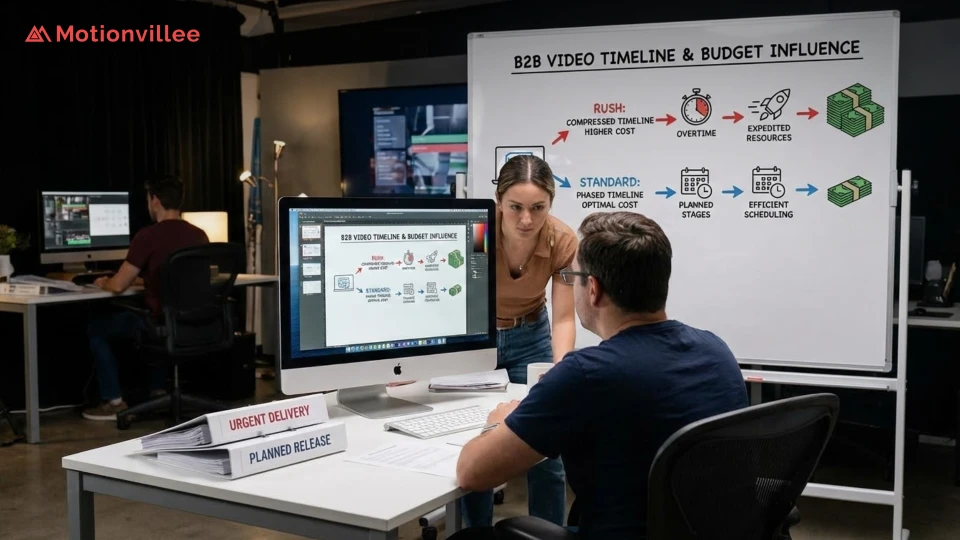
Production timelines vary dramatically by animation style, with whiteboard videos completing in 2-3 weeks, 2D animation requiring 4-6 weeks, and 3D projects extending 8-12 weeks or longer.
2D Animation Production Speed and Scheduling
A 2D animation production typically requires 4-6 weeks from concept to final delivery, with timeline variations based on complexity, revision rounds, and whether custom design or templates drive production.
2D production phase breakdown:
- Script and concept development: 3-5 business days
- Storyboard creation and approval: 5-7 business days
- Illustration and character design: 7-10 business days
- Animation production: 10-15 business days
- Voiceover recording and sound design: 3-5 business days
- Revisions and final output: 3-5 business days
Rush fees for expedited 2D production:
- 20% faster timeline: Additional 15-25% cost
- 30% faster timeline: Additional 30-50% cost
- 50% faster timeline: Additional 60-100% cost or project refusal
3D’s Extended Timeline and Budget Consequences
3D animation extends production timelines to 8-12 weeks minimum due to modeling, texturing, rigging, and rendering stages that cannot be significantly compressed without quality compromise or exponential cost increases.
3D production phase requirements:
- Concept and storyboard: 5-7 business days
- 3D modeling creation: 10-15 business days
- Texturing and material application: 7-10 business days
- Rigging for animation: 5-8 business days
- Animation and camera work: 10-15 business days
- Lighting design: 5-7 business days
- Rendering processing: 5-10 business days
- Post-production and compositing: 5-7 business days
Why 3D timelines resist compression:
- Rendering requires fixed processing time regardless of deadline pressure
- Technical processes like rigging can’t be rushed without breaking models
- Each stage depends on previous stage completion before starting
- Revision cycles multiply timeline impact through rendering requirements
Whiteboard’s Quick Turnaround Economic Advantage
Whiteboard animation delivers fastest production timelines at 2-3 weeks from concept to completion, enabling quick campaign launches while maintaining lower costs through streamlined workflows.
Whiteboard speed advantages:
- Simplified illustration style reduces design iteration cycles
- Drawing animation technique faster than complex character rigging
- Minimal rendering requirements compared to 3D processing
- Straightforward revision process through illustration redrawing
Whiteboard’s rapid turnaround makes it ideal for time-sensitive campaigns, product launches requiring immediate video support, or testing messaging concepts before investing in more expensive animation styles.
Industry-Specific Style Recommendations and Budget Guidance
Different industries achieve optimal ROI with specific animation styles that match their messaging complexity, audience expectations, and typical budget allocations.
Tech and SaaS: Which Style Delivers Best ROI
SaaS and technology companies achieve strongest results with 2D custom animation offering flexibility to explain abstract concepts while maintaining modern aesthetic that tech audiences expect.
Tech industry style recommendations:
- 2D motion graphics: Best for simple software feature explanations ($3,000-$6,000)
- 2D character animation: Ideal for complex SaaS platform demonstrations ($6,000-$12,000)
- 3D animation: Reserved for physical hardware products or premium positioning ($15,000-$25,000)
- Whiteboard: Effective for highly technical concept education ($2,000-$4,000)
Most SaaS companies find sweet spot in $6,000-$10,000 range for custom 2D animation that balances professional quality with reasonable budget allocation.
Healthcare and Medical: When 3D Justifies Higher Costs
Healthcare and medical industries benefit most from 3D animation when anatomical accuracy, device functionality, or spatial relationships require realistic dimensional visualization that 2D cannot achieve.
Medical animation style selection:
- 3D medical visualization: Essential for anatomical education and device mechanisms ($18,000-$35,000)
- 2D patient education: Sufficient for treatment process explanations ($5,000-$10,000)
- Whiteboard: Effective for basic health concept communication ($2,500-$5,000)
Medical device companies and pharmaceutical manufacturers typically allocate $20,000-$40,000 for 3D mechanism of action videos where dimensional accuracy directly impacts regulatory approval and physician adoption.
B2B Services: Whiteboard’s Educational Edge
B2B service companies explaining consulting, financial, or professional services achieve strong conversion with whiteboard animation’s educational approach that emphasizes concept clarity over visual sophistication.
Why whiteboard works for B2B services:
- Professional audiences value information clarity over aesthetic complexity
- Abstract services benefit from conceptual illustration rather than literal depiction
- Educational tone builds credibility for advisory and consulting positioning
- Lower production costs align with service business margins and customer acquisition costs
B2B service firms typically invest $2,500-$5,000 in whiteboard explainers that drive qualified leads through clear value proposition communication.
E-Commerce and Consumer Products: 2D Versatility
E-commerce and consumer product brands leverage 2D animation’s versatility to create engaging product stories with personality, emotion, and brand character that drives purchase decisions.
Consumer product style strategy:
- 2D character animation: Creates emotional connection with lifestyle positioning ($7,000-$15,000)
- 2D motion graphics: Highlights product features and benefits efficiently ($4,000-$8,000)
- 3D product rendering: Shows physical products from multiple angles ($12,000-$20,000)
Consumer brands often produce multiple 2D videos at $5,000-$8,000 each rather than single premium video, enabling testing different messages and audiences before scaling investment.
Hidden Cost Differences Between Animation Styles
Beyond base production costs, animation styles carry different ongoing expenses for revisions, format optimization, and future updates that impact total cost of ownership over video lifespan.
Revision Complexity and Per-Change Pricing Variations
Revision costs scale differently across animation styles, with whiteboard changes costing $200-$400, 2D revisions running $400-$800, and 3D modifications requiring $800-$1,500 due to rendering and technical complexity.
| Revision Type | Whiteboard Cost | 2D Animation Cost | 3D Animation Cost |
|---|---|---|---|
| Script changes only | $150-$300 | $200-$400 | $300-$600 |
| Minor visual edits | $250-$500 | $400-$700 | $800-$1,200 |
| Scene redesign | $400-$700 | $700-$1,200 | $1,500-$2,500 |
| Character changes | $300-$600 | $600-$1,000 | $1,200-$2,000 |
Why 3D revision costs multiply exponentially:
- Model changes require re-texturing entire objects
- Animation adjustments demand complete scene re-rendering
- Lighting modifications affect how all elements interact
- Each revision pass requires 10-20 hours of rendering time
File Format and Platform Optimization Expenses
Creating multiple format versions and platform-specific optimizations costs vary by style complexity, with 3D requiring more processing than 2D or whiteboard for each additional output format.
Multi-format delivery costs by style:
- Whiteboard animation: $300-$600 for complete format suite
- 2D animation: $500-$1,000 for all aspect ratios and platforms
- 3D animation: $1,000-$2,000 due to rendering requirements for each format
3D format costs multiply because each aspect ratio variation requires complete re-rendering with adjusted camera framing and composition optimization that automated tools cannot handle effectively.
Future Update Costs: Which Style Ages Most Affordably
Whiteboard and 2D animation update most cost-effectively at 30-50% of original production cost, while 3D updates often require 50-70% of initial investment due to technical file complexity and rendering requirements.
Annual update budget recommendations:
- Whiteboard: Budget $800-$1,500 annually for minor updates
- 2D animation: Allocate $1,500-$3,000 for periodic refreshes
- 3D animation: Reserve $3,000-$6,000 for product or design changes
Understanding the hidden costs of explainer video production helps teams budget realistically for ongoing video maintenance beyond initial production investment.
Making Your Style Decision Based on Budget and Goals
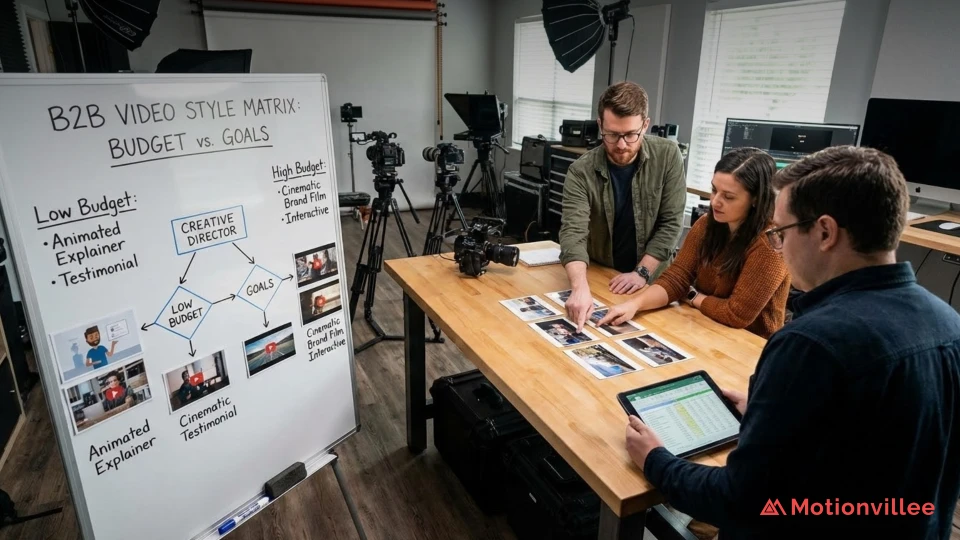
Selecting the right animation style requires balancing available budget, message complexity, brand positioning, audience expectations, and long-term video asset strategy rather than choosing styles based solely on aesthetic preference.
Budget-First Decision Framework for Each Style
Starting with available budget eliminates impractical options immediately, allowing teams to focus decision-making on styles their resources can actually support at quality levels that deliver results.
| Available Budget | Recommended Style | What You Get | What to Avoid |
|---|---|---|---|
| $2,000-$4,000 | Whiteboard or template 2D | Professional educational content | Custom character animation, 3D |
| $4,000-$8,000 | Custom 2D motion graphics | Brand-aligned professional video | Complex character work, 3D |
| $8,000-$15,000 | Custom 2D character animation | Sophisticated storytelling | Premium 3D unless specifically needed |
| $15,000-$30,000 | 3D or premium 2D | High-end production quality | Overproducing simple messages |
Budget constraints aren’t limitations but rather guardrails ensuring investment matches business impact potential and prevents overspending on visual sophistication that audiences don’t require.
When to Stretch Budget for Higher-Cost Styles
Investing beyond comfortable budget ranges makes strategic sense when video serves as cornerstone marketing asset, product requires dimensional visualization, or competitive differentiation demands premium production values.
Situations justifying budget stretching:
- Homepage hero video viewed by majority of website traffic
- Sales presentation shown to every qualified prospect
- Trade show centerpiece representing brand to thousands of attendees
- Investor pitch video critical to funding success
- Product launch video supporting multi-million dollar release
Understanding explainer video budget planning for SaaS teams helps organizations evaluate when premium investment delivers proportional return versus when budget-conscious approaches suffice.
Hybrid Approaches That Blend Styles Strategically
Combining animation styles within single videos or across video series optimizes budgets by using expensive techniques only where they deliver maximum impact while defaulting to cost-effective styles elsewhere.
Effective hybrid strategies:
- 2D animation with 3D product inserts showing physical items dimensionally
- Whiteboard foundation with 2D animated highlights for key moments
- Motion graphics data visualization within character-driven 2D narrative
- 3D product demonstration transitioning to 2D benefit explanation
Hybrid approach budget allocation:
- Allocate 60-70% budget to primary style
- Reserve 30-40% for secondary style inserts or highlights
- Expect 10-15% coordination overhead integrating multiple styles
Hybrid approaches work best when different styles serve distinct functional purposes rather than mixing styles purely for aesthetic variety that complicates production without improving effectiveness.
Choosing the Right Style for Your Budget and Message
Explainer video cost by style varies dramatically, with whiteboard animation starting around $1,500-$4,000 per minute, 2D custom animation ranging $4,000-$12,000, and 3D commanding $10,000-$25,000+ depending on complexity and quality requirements.
Style selection framework summary:
- Whiteboard: Choose for educational content, concept explanation, and budget-conscious projects under $5,000
- 2D animation: Select for brand storytelling, versatile messaging, and budgets $5,000-$15,000
- 3D animation: Reserve for dimensional product visualization, technical accuracy requirements, or premium positioning with $15,000+ budgets
Production complexity within each style creates 100-300% cost variations through character sophistication, scene quantity, custom asset creation, and visual effects that extend timelines and require specialized expertise.
Timeline differences significantly impact total costs, with whiteboard completing in 2-3 weeks, 2D requiring 4-6 weeks, and 3D extending 8-12 weeks or longer due to modeling, rendering, and technical production stages.
Hidden ongoing costs favor different styles, with whiteboard and 2D updating at 30-50% of original cost while 3D modifications require 50-70% of initial investment through rendering and technical file complexity.
Industry-specific recommendations suggest 2D animation for tech and SaaS, 3D for healthcare and medical accuracy, whiteboard for B2B services, and flexible 2D approaches for consumer products based on messaging needs and audience expectations.
Budget-first decision frameworks eliminate impractical options immediately, allowing teams to focus on styles their resources support at quality levels delivering results rather than compromising quality through insufficient investment.
Schedule a strategy call with Motionvillee to evaluate which animation style aligns with your message complexity, budget constraints, and business objectives while ensuring investment delivers measurable ROI through viewer engagement and conversion impact.