
How to Evaluate Video Production Partners: The 15-Question Vetting Framework
Effective video production partner evaluation prevents costly production failures, scope creep, and misaligned expectations by systematically assessing capabilities, process transparency, and strategic fit before contract signature. B2B SaaS companies that skip structured vetting waste an average of $8,000-$15,000 on partnerships producing unusable content or requiring expensive rework.
Why Do B2B Companies Need a Structured Partner Evaluation Framework?
B2B companies need structured video production partner evaluation because portfolio reviews alone miss 12 critical failure points including unclear revision policies, hidden costs, poor communication processes, and strategic misalignment that only emerge during production, causing 40-60% of projects to exceed budget or timeline.
The portfolio problem is simple. Every video production company shows only their best work.
Three videos in their portfolio look incredible. Professional animation, clear messaging, strong outcomes.
What you don’t see: The client they ghosted during revision rounds. The project that took 8 months instead of 8 weeks. The hidden costs that doubled the quoted price.
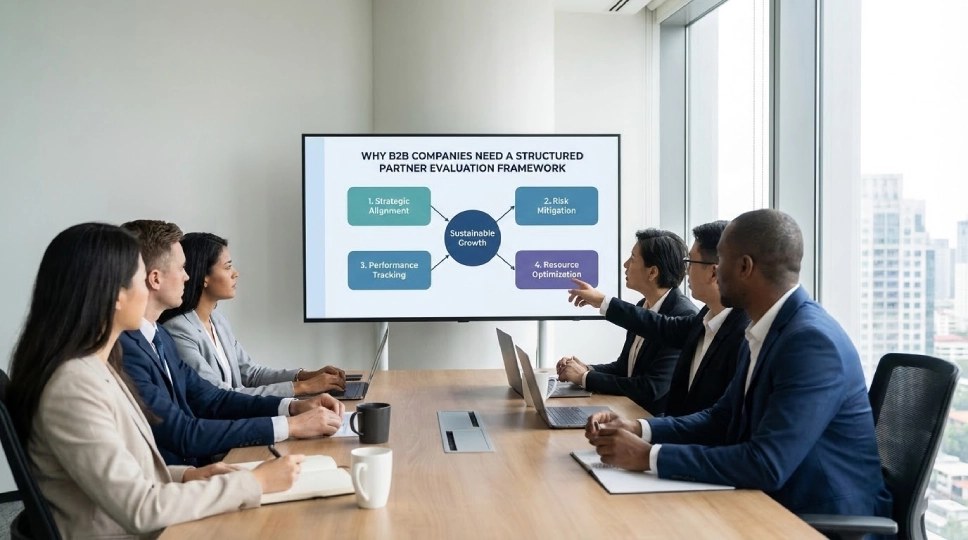
The Hidden Failure Points
Process breakdowns happen in areas portfolios never reveal:
Communication lapses during production causing 2-3 week delays
Unclear revision scope leading to $3,000-$6,000 unexpected charges
Rights restrictions preventing video repurposing for paid ads
Technical incompetence with your specific video format requirements
Strategic blindness to your actual business goals beyond video creation
Without structured evaluation, you discover these problems at week 4 of an 8-week project when switching partners becomes prohibitively expensive.
The Cost of Wrong Partners
Wrong video partners cost more than just wasted production budget.
- Direct cost: $6,000-$12,000 average video investment producing unusable result
- Opportunity cost: 8-16 weeks lost to production cycle requiring restart
- Strategic cost: Delayed product launch or campaign missing market window
- Relationship cost: Internal stakeholder trust damaged by vendor failure
Companies that fail first partnerships often delay 6-12 months before trying again, missing critical growth windows. Understanding how to choose production companies prevents these failures.
What Are the 15 Critical Questions for Video Production Partner Evaluation?
The 15 critical questions for video production partner evaluation span five categories: portfolio depth (questions 1-3), process transparency (questions 4-6), pricing clarity (questions 7-9), technical capabilities (questions 10-12), and strategic alignment (questions 13-15), each revealing different partnership risk factors.
Category 1: Portfolio Depth and Specialization (Questions 1-3)
Question 1: “Show me 5 videos you’ve produced in the past 12 months for B2B SaaS companies in my revenue range ($1M-$50M).”
Why this matters: Recent work in your specific niche proves current capability, not historic capability.
Red flag answer: “We’ve worked with SaaS before but can’t share due to NDAs.” (Every production company has 3-5 shareable case studies)
Strong answer: Provides 5+ recent examples with clear context about client stage, video purpose, and measured outcomes
Question 2: “What percentage of your clients are B2B SaaS versus other industries?”
Why this matters: Specialization depth determines whether they understand your unique challenges or treat you as one-off experiment.
Red flag answer: “We work with all industries.” (Jack of all trades, master of none)
Strong answer: “60-80% of clients are B2B SaaS, with remaining 20-40% in adjacent tech categories.”
Question 3: “Describe a recent project that failed and what you learned.”
Why this matters: Willingness to discuss failures reveals honesty, self-awareness, and continuous improvement commitment.
Red flag answer: “We’ve never had a failed project.” (Impossible or dishonest)
Strong answer: Specific example with honest assessment of what went wrong, how they fixed it, and process changes implemented
Category 2: Process Transparency (Questions 4-6)
Question 4: “Walk me through your production process from kickoff to delivery with specific week-by-week milestones.”
Why this matters: Vague processes indicate wing-it approach causing timeline chaos.
Red flag answer: “It depends on the project.” (No systematic process)
Strong answer: Detailed timeline with specific deliverables: Week 1 (discovery and strategy), Week 2-3 (script and storyboard), Week 4-5 (production), Week 6-7 (revisions), Week 8 (final delivery)
Question 5: “How many revision rounds are included, and what happens if we need more?”
Why this matters: Unclear revision scope is most common source of budget disputes.
Red flag answer: “Unlimited revisions.” (Either dishonest or they’ll stretch timeline to limit your requests)
Strong answer: “2 revision rounds included. Additional rounds billed at $800-$1,500 per round depending on scope. We clearly define what constitutes new round versus minor tweak.”
Question 6: “What communication cadence and tools do you use during production?”
Why this matters: Communication breakdowns cause 80% of project friction.
Red flag answer: “We’ll email you updates.” (No systematic communication)
Strong answer: “Weekly check-in calls on Fridays, Slack channel for quick questions, shared Notion board for milestone tracking, 24-48 hour response time commitment.”
Learning about production workflow stages helps evaluate process answers.
Category 3: Pricing Clarity (Questions 7-9)
Question 7: “Provide itemized quote showing exactly what’s included versus what costs extra.”
Why this matters: Vague quotes hide surprise costs appearing mid-project.
Red flag answer: “Full production: $8,000.” (No breakdown)
Strong answer: “Script development: $1,200, Storyboarding: $800, Animation (90 seconds): $4,500, Voiceover: $400, Music licensing: $300, 2 revision rounds: included, Project management: included. Total: $7,200. Additional costs: Extra revision rounds ($1,000 each), rush delivery ($1,500), custom music ($800-$2,000).”
Question 8: “What payment schedule do you use, and what milestones trigger payments?”
Why this matters: Payment structure reveals risk distribution and project control.
Red flag answer: “100% upfront.” (All risk on you, zero incentive for quality)
Strong answer: “50% deposit to begin, 25% at storyboard approval, 25% at final delivery. Deposit protects our planning investment, milestone payments ensure mutual accountability.”
Question 9: “What’s not included in your standard pricing that clients often assume is included?”
Why this matters: Direct question about hidden costs reveals honesty.
Red flag answer: Defensive response or vague “everything’s included.”
Strong answer: “Stock footage beyond our library ($200-$500), custom illustration versus template-based graphics ($500-$1,500), videos longer than 90 seconds (prorated at $50-$80 per additional 10 seconds), expedited delivery under 6 weeks ($1,000-$2,000 rush fee).”
Understanding budget planning contextualizes pricing answers.
Category 4: Technical Capabilities (Questions 10-12)
Question 10: “What specific tools and software do you use for animation, editing, and delivery?”
Why this matters: Tool proficiency indicates technical sophistication.
Red flag answer: “We use the best tools for each project.” (Vague non-answer)
Strong answer: “After Effects for animation, Premiere Pro for editing, Cinema 4D for 3D elements when needed, Frame.io for client review and approval, export in ProRes 422 for broadcast, H.264 for web, vertical formats for social.”
Question 11: “What file formats and resolutions do you deliver, and can you provide source files?”
Why this matters: Format flexibility determines video repurposing capability.
Red flag answer: “We deliver MP4.” (Limited format knowledge)
Strong answer: “Standard delivery includes 1920×1080 (web), 1080×1920 (vertical social), 1080×1080 (square social) in H.264. Source files (project files and assets) available for additional $1,500-$2,500 depending on complexity, giving you full editing control forever.”
Question 12: “Show me how you handle feedback and revisions during production.”
Why this matters: Revision process clarity prevents miscommunication disasters.
Red flag answer: “Just email us changes.” (No systematic process)
Strong answer: “We use Frame.io for timestamped visual feedback. You mark exact moments needing changes, add comments, we respond with solutions. Clear revision log prevents conflicting feedback. We consolidate all stakeholder input before implementing changes, avoiding back-and-forth revision cycles.”
Reviewing revision processes shows best practices.
Category 5: Strategic Alignment (Questions 13-15)
Question 13: “How do you measure video success, and what metrics do you track post-launch?”
Why this matters: Strategic partners care about business outcomes, not just video completion.
Red flag answer: “We measure by client satisfaction.” (No business metrics)
Strong answer: “We define success metrics upfront: engagement rate (target 40-60% completion), click-through rate on CTA (target 8-15%), demo request lift (target 25-40% improvement). We follow up 30 and 90 days post-launch to track performance and offer optimization recommendations.”
Question 14: “What strategic guidance do you provide beyond video production?”
Why this matters: Partners who understand marketing strategy create more effective videos.
Red flag answer: “We focus on making great videos.” (Execution-only mindset)
Strong answer: “We help with landing page placement strategy, A/B testing approaches for video variations, paid ad integration recommendations, email campaign deployment tactics. We’ve learned through 200+ B2B SaaS projects what works where.”
Question 15: “How do you handle rush projects or emergency requests after initial engagement?”
Why this matters: Partnership flexibility determines whether they can scale with your evolving needs.
Red flag answer: “We’re usually booked 8-12 weeks out.” (Inflexible capacity)
Strong answer: “For existing clients, we reserve 20% capacity for rush requests. Rush timeline (under 4 weeks) carries 30-50% premium but we can accommodate when needed. We maintain ongoing relationship so you’re never starting from scratch on urgent projects.”
Exploring production techniques reveals technical sophistication.
How Should Companies Weight These 15 Questions in Video Production Partner Evaluation?
Companies should weight video production partner evaluation questions based on project risk profile: portfolio depth (30% weight) and process transparency (30%) matter most for first partnerships, while pricing clarity (20%), technical capabilities (10%), and strategic alignment (10%) increase in importance for ongoing relationships.
The Weighting Framework
First-time partnership (high risk):
- Portfolio depth: 30% (Can they actually deliver what they show?)
- Process transparency: 30% (Will chaos or calm define our relationship?)
- Pricing clarity: 20% (Are we protected from surprise costs?)
- Technical capabilities: 10% (Do they have baseline competence?)
- Strategic alignment: 10% (Nice to have, not critical yet)
Ongoing partnership (established relationship):
- Strategic alignment: 30% (Do they drive business outcomes?)
- Process transparency: 25% (Efficiency matters more over time)
- Technical capabilities: 20% (Advanced needs emerge)
- Pricing clarity: 15% (Less concern after first project success)
- Portfolio depth: 10% (Already proven through delivered work)
The Scoring Method
Rate each question 1-5 based on answer quality:
- 5: Exceptional answer with specific examples and clear processes
- 4: Strong answer with good detail
- 3: Adequate answer but lacks specifics
- 2: Vague or concerning answer
- 1: Red flag answer or refusal to answer
Calculate weighted score: (Category score × Category weight) summed across all 5 categories.
Partner evaluation threshold:
- 4.5-5.0: Exceptional partner, proceed confidently
- 4.0-4.4: Strong partner, proceed with standard contracts
- 3.5-3.9: Adequate partner, increase oversight and contract protections
Below 3.5: High risk, continue searching
The Deal-Breaker Questions
Some questions reveal absolute disqualifiers regardless of weighting:
Question 5 (revision policy): If they refuse to specify revision terms, walk away. This always causes disputes.
Question 7 (itemized pricing): If they won’t provide breakdown, hidden costs are guaranteed.
Question 8 (payment schedule): If they demand 100% upfront, they have quality concerns or cash flow problems.
Any one deal-breaker trumps overall score. Understanding production costs helps identify unreasonable pricing.
What Red Flags Disqualify Video Production Partners Immediately?
Immediate disqualifying red flags include: no recent relevant portfolio work (past 12 months), refusal to provide itemized pricing breakdown, inability to explain revision policy, lack of client references, portfolio showing exclusively outdated work (pre-2023), and defensive responses to process questions revealing poor project management capabilities.
Red Flag Category 1: Portfolio Deception
All portfolio work is 3+ years old: Indicates they’re not actively producing or lost capability
Portfolio shows zero work in your industry: You’ll be their learning experiment
Cannot provide 3 client references: Suggests burned bridges or fabricated work
Portfolio videos lack context: If they won’t explain client goals, outcomes, or constraints, they might not have actually produced the work
Wildly inconsistent quality across portfolio: Indicates inconsistent team or reliance on contractors
Red Flag Category 2: Pricing and Contract Issues
Suspiciously low pricing (40-50% below market): Either inexperienced or will cut quality corners
Refuses itemized breakdown: Hiding costs they plan to charge later
Demands 100% payment upfront: Cash flow problems or quality confidence issues
Vague scope document: Deliberately ambiguous to charge for “scope creep”
No refund or cancellation terms: Traps you regardless of performance
Restrictive usage rights: You pay full price but can’t use video for intended purposes
Red Flag Category 3: Process and Communication
Slow response during sales process: Communication won’t improve during production
Unable to articulate clear timeline: Wing-it approach guarantees delays
Dismissive of your questions: Arrogance causes collaboration breakdown
No project management system: Email chaos incoming
Can’t explain their revision process: Revision disputes are guaranteed
Promises unrealistic timelines: “We can deliver 3-minute custom animation in 2 weeks” is impossible with quality
Red Flag Category 4: Technical Incompetence
Cannot explain technical workflow: Signals amateur operation
Unfamiliar with standard tools: After Effects, Premiere Pro are industry standard for animation
Doesn’t ask about your delivery format needs: Shows lack of distribution knowledge
No backup or disaster recovery plan: One hard drive failure destroys your project
The Walking Away Decision
2+ red flags from same category: Walk away immediately
3+ red flags across categories: High risk partnership
Any single red flag in pricing category: Financial disputes are nearly impossible to resolve mid-project
Save yourself $10,000-$15,000 in wasted investment and 8-12 weeks of lost time by disqualifying bad partners early. Recognizing hidden costs prevents expensive surprises.
How Long Should Video Production Partner Evaluation Take?
Comprehensive video production partner evaluation should take 2-3 weeks spanning initial research (3-5 days comparing 8-12 companies), in-depth vetting (5-7 days interviewing 3-4 finalists), reference calls (2-3 days contacting past clients), and contract negotiation (3-5 days), with rushed evaluations under 1 week missing critical warning signs.
Week 1: Broad Research and Shortlisting (5-7 Days)
1-2 Day: Identify 8-12 potential partners through referrals, searches, industry lists
3-4 Day: Portfolio review, eliminate obvious mismatches (wrong industry, poor quality, outdated work)
5-7 Day: Initial contact with 5-6 remaining candidates, request proposals and pricing
Output: Shortlist of 3-4 finalists for deep evaluation
Week 2: Deep Evaluation (7-10 Days)
1-3 Day: Conduct 60-90 minute discovery calls with each finalist, ask all 15 framework questions
4-6 Day: Review detailed proposals, compare pricing breakdowns, assess process documentation
7-8 Day: Request and review sample project documentation (timelines, revision logs, communication records)
9-10 Day: Conduct reference calls with 2-3 past clients per finalist
Output: Top 1-2 candidates with clear differentiation
Week 3: Final Decision and Contracting (5-7 Days)
1-2 Day: Final negotiation on pricing, timeline, deliverables, and revision terms
3-4 Day: Contract review (involve legal if contract value exceeds $15,000)
5 Day: Contract signature and kickoff scheduling
Output: Signed agreement with clear terms, scheduled project start
The Rush Evaluation Trap
Companies rushing evaluation under 1 week typically face:
45% higher chance of timeline overruns (missing critical process red flags)
60% higher chance of budget disputes (missing pricing ambiguities)
35% probability of complete project restart (wrong partner selection)
Average rush-caused waste: $8,000-$15,000 and 10-16 weeks
Proper 2-3 week evaluation prevents 80% of partnership failures. If your video need is urgent, pay premium for established partner with proven process rather than rushing evaluation of unknown partner. Understanding storyboarding processes reveals quality production approaches.
What Questions Should Companies Ask Reference Clients During Video Production Partner Evaluation?
Reference client questions should focus on partnership reality beyond portfolio: actual timeline versus promised timeline, total cost versus quoted cost, responsiveness during production, handling of unexpected challenges, revision process satisfaction, strategic value beyond execution, and whether they would rehire for next project.
The Reference Call Script
Question 1: “What was your original timeline and budget, and what were the actual final numbers?”
Why this matters: Reveals whether partner delivers on commitments or consistently runs over.
Follow-up: “If there were overruns, how did they communicate and handle them?”
Question 2: “Describe their responsiveness during production. How long did emails and questions typically take to get answered?”
Why this matters: Communication quality determines project stress level.
Follow-up: “Were there any communication breakdowns, and how were they resolved?”
Question 3: “Walk me through the revision process. How many rounds did you use, and were there any disputes about what counted as a new round?”
Why this matters: Revision disputes are most common source of partnership friction.
Follow-up: “Did the final product require fewer or more revisions than you expected?”
Question 4: “What unexpected challenges came up during production, and how did they handle them?”
Why this matters: Problem-solving under pressure reveals true partnership quality.
Follow-up: “Did they proactively identify and prevent potential issues?”
Question 5: “Beyond creating the video, what strategic value did they provide?”
Why this matters: Distinguishes execution vendors from strategic partners.
Follow-up: “Did they help with deployment, optimization, or performance tracking?”
Question 6: “What’s one thing they did that exceeded expectations, and one thing that disappointed you?”
Why this matters: Direct question about highs and lows reveals authentic experience.
Follow-up: “How did they handle the disappointment?”
Question 7: “Would you hire them again for your next video, and why or why not?”
Why this matters: Binary decision reveals true satisfaction beyond polite recommendations.
Follow-up: “Have you actually hired them for subsequent projects?”
Question 8: “What advice would you give me about working with them?”
Why this matters: Opens door for insights they wouldn’t volunteer to direct questions.
Follow-up: “What should I know that I haven’t asked about?”
Reference Call Red Flags
Hesitation before answering whether they’d rehire: Polite way of saying no
Emphasis on “They’re nice people” without production specifics: Code for poor execution
Qualified recommendation: “They’re good if you have time to manage them closely” means high maintenance
Cannot recall specific names of team members: Indicates chaotic handoffs or high turnover
Reluctance to discuss budget: Suggests cost overruns they’re embarrassed about
The Verification Step
Ask partner for 5 references, then: Call all 5 (most companies only call 1-2), Ask partner which reference is most recent, prioritize that call (recent experience most relevant), Search LinkedIn for other clients not on reference list, reach out cold (unscripted references reveal unfiltered truth)
Comprehensive reference checking takes 4-6 hours but prevents 90% of bad partnerships. Learning about animation processes helps evaluate technical quality claims.
How Do Video Production Partner Evaluation Criteria Differ by Project Type?
Video production partner evaluation criteria shift based on project complexity: homepage explainers prioritize strategic clarity and messaging precision (40% weight), product demos require technical sophistication and UI animation capability (40% weight), while testimonials demand interpersonal skills and interview direction expertise (35% weight) alongside production quality.
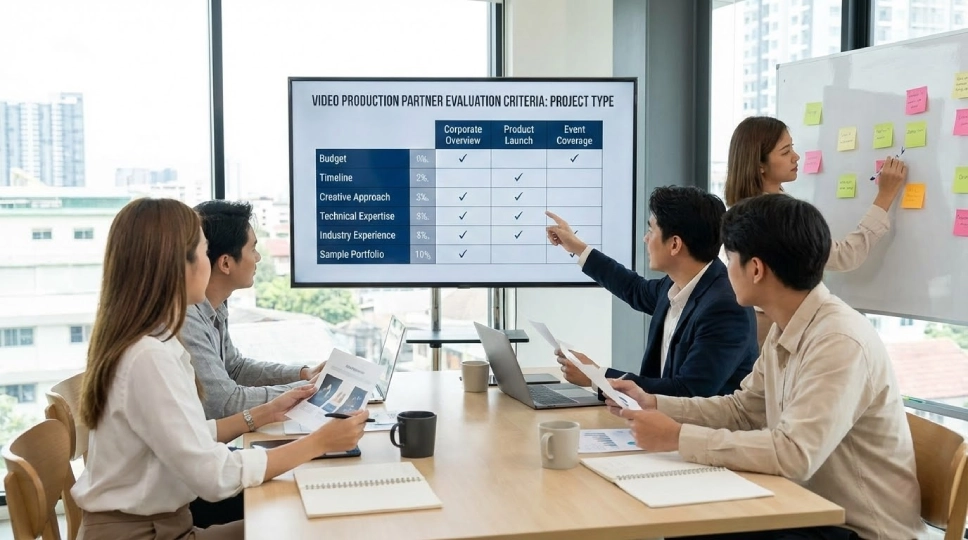
Evaluation Criteria for Homepage Explainer Videos
Primary criteria (40% total weight): Strategic messaging and positioning clarity
Key questions: “How do you help distill complex products into 60-90 second narratives?” “Show me 3 explainers you’ve created for products as complex as ours.”
Red flag: Generic templates with swapped logos rather than custom strategic development
Secondary criteria (35% weight): Animation quality and brand alignment
Key questions: “How do you adapt animation style to match brand personality?” “What’s your process for establishing visual language?”
Tertiary criteria (25% weight): Conversion optimization knowledge
Key questions: “What explainer video practices typically improve conversion rates?” “How do you structure CTAs?”
Evaluation Criteria for Product Demo Videos
Primary criteria (40% weight): Technical sophistication with UI/UX animation
Key questions: “Show me demos you’ve created for technical B2B SaaS products.” “How do you handle screen recording with motion graphics overlays?”
Red flag: Simple screen recordings with basic annotations, no sophisticated UI treatment
Secondary criteria (35% weight): Workflow storytelling ability
Key questions: “How do you determine which features to show in what order?” “Show me before-after examples of demos you improved.”
Tertiary criteria (25% weight): Integration and technical accuracy
Key questions: “What’s your process for ensuring technical accuracy?” “How do you handle APIs, integrations, and complex workflows visually?”
Evaluation Criteria for Customer Testimonial Videos
Primary criteria (35% weight): Interview and directing skills
Key questions: “What’s your process for making nervous executives comfortable on camera?” “Show me raw footage versus final edit.”
Red flag: Stilted, scripted-sounding testimonials lacking authenticity
Secondary criteria (30% weight): Story structure and editing
Key questions: “How do you identify and extract compelling narrative from hour-long interviews?” “What’s your ratio of raw footage to final testimonial?”
Tertiary criteria (35% weight): Production logistics and coordination
Key questions: “How do you handle scheduling, location scouting, and customer communication?” “What happens if customer cancels day-of?”
The Project-Specific Vetting Shortcut
For each project type, demand 3-5 portfolio examples matching that specific format. Don’t accept “we’ve done similar” claims.
Homepage explainer partner must show homepage explainers, not product demos or testimonials. Skills don’t automatically transfer between formats.
Reviewing video design processes reveals quality production approaches.
What Contract Terms Protect Companies During Video Production Partnerships?
Protective contract terms include: specific milestone deliverables with approval gates preventing payment until satisfaction, unlimited usage rights for all marketing channels, 2+ included revision rounds with clear scope definitions, timeline penalties for late delivery, and IP ownership transfer at final payment ensuring full video control without restrictions.
Essential Contract Protection 1: Milestone-Based Payment with Approval Gates
Structure: 30% deposit at signing, 30% at storyboard approval, 20% at first draft delivery, 20% at final delivery
Protection: Never pay next installment until current milestone approved. This prevents paying for unsatisfactory work.
Language: “Payment for subsequent milestones contingent upon Client approval of prior milestone deliverables. Approval defined as written confirmation within 5 business days of delivery.”
Why it matters: Prevents situation where you’ve paid 80% but video is only 40% acceptable
Essential Contract Protection 2: Usage Rights and IP Ownership
Structure: Full IP transfer upon final payment, unlimited usage rights across all channels and timeframes
Protection: Prevents restrictions like “only for website, not paid ads” or “license expires in 12 months”
Language: “Upon receipt of final payment, Client owns all intellectual property rights including but not limited to: broadcast, digital, social media, paid advertising, internal use, third-party distribution. No geographical, temporal, or medium restrictions apply.”
Why it matters: Ensures you can repurpose video freely without additional licensing fees
Essential Contract Protection 3: Revision Scope and Limits
Structure: 2 included revision rounds clearly defined, cost for additional rounds specified upfront
Protection: Prevents disputes about what counts as “revision” versus “new scope”
Language: “Two revision rounds included. Revision defined as modifications to existing approved elements. New concepts, scripts, or visual directions constitute new scope billed at $1,200 per round. Minor tweaks (typo corrections, color adjustments under 3 elements) do not constitute revision round.”
Why it matters: Eliminates most common source of scope creep disputes
Essential Contract Protection 4: Timeline Commitments and Penalties
Structure: Specific delivery dates for each milestone, late delivery penalties
Protection: Incentivizes on-time delivery, compensates you for delays
Language: “Vendor commits to milestone delivery dates: Storyboard (Week 3), First Draft (Week 6), Final Delivery (Week 8). Delays beyond 5 business days result in 5% price reduction per week delayed, maximum 25%.”
Why it matters: Gives you leverage if partner misses deadlines affecting your launch
Essential Contract Protection 5: Cancellation and Refund Terms
Structure: Clear cancellation terms with partial refunds based on work completed
Protection: Exit option if partnership fails without losing entire investment
Language: “Client may cancel anytime. Refund calculated as: Deposit retained if cancellation pre-storyboard. 50% refund if cancellation post-storyboard, pre-animation. No refund if cancellation post-first-draft delivery.”
Why it matters: Prevents being trapped in failing partnership
Essential Contract Protection 6: Source File Delivery
Structure: Option to purchase source files at fixed price, or included in initial contract
Protection: Ensures ability to make future edits without depending on original partner
Language: “Final deliverables include all export formats specified in Scope. Source files (After Effects projects, Illustrator files, audio stems) available for additional $2,000 upon request, or included if specified in initial scope.”
Why it matters: Prevents vendor lock-in for future updates
Strong contracts reduce disputes 85%. If partner resists any of these terms, treat as red flag. Understanding pricing models helps structure fair payment terms.
How Should Companies Evaluate Video Production Partner Strategic Capabilities?
Evaluating video production partner strategic capabilities requires assessing: discovery process depth (do they ask about business goals beyond video specs), metrics orientation (do they care about conversion rates and ROI), distribution knowledge (do they advise on deployment tactics), and performance optimization approach (do they follow up post-launch).
Strategic Capability 1: Business-Focused Discovery
Execution vendor asks: “What style video do you want?” “How long should it be?” “What’s your budget?”
Strategic partner asks: “What business problem does this video solve?” “Who’s the target audience and what stage are they in?” “What action should viewers take after watching?” “What metrics define success?”
Evaluation: Strategic partners spend 60-90 minutes in discovery before discussing video specs. Vendors jump to specs in 15 minutes.
Test question: “Before we discuss the video itself, tell me what questions you need answered about my business and goals.”
Strong answer includes: target audience definition, conversion funnel context, competitive landscape, prior marketing performance, success metrics
Strategic Capability 2: Metrics and ROI Orientation
Execution vendor measures: “Video completed on time and on budget”
Strategic partner measures: “Video drove 35% increase in demo requests and 22% improvement in sales cycle length”
Evaluation: Do they proactively discuss performance tracking and optimization?
Test question: “How do you measure video success, and what performance benchmarks should we expect?”
Strong answer: Specific metrics with realistic benchmarks: 40-60% completion rate, 8-15% CTA click rate, 25-40% conversion lift. Offers post-launch performance review.
Strategic Capability 3: Distribution and Deployment Knowledge
Execution vendor delivers: “Here’s your video file, good luck”
Strategic partner advises: “Place video above fold on homepage, create 15-second teaser for LinkedIn ads, test video versus static image in email subject lines, implement autoplay-muted with captions for mobile”
Evaluation: Do they understand how video fits into broader marketing ecosystem?
Test question: “Beyond creating the video, what guidance do you provide on deployment and optimization?”
Strong answer: Landing page placement recommendations, paid ad integration tactics, email deployment best practices, A/B testing approaches
Strategic Capability 4: Continuous Optimization Approach
Execution vendor: “Project ends at final delivery”
Strategic partner: “Let’s review performance at 30 and 90 days to identify optimization opportunities”
Evaluation: Do they care about long-term performance or just project completion?
Test question: “What happens after launch? Do you help with performance analysis and optimization?”
Strong answer: Scheduled performance review calls, A/B test recommendations, iterative improvement suggestions based on actual data
The Strategic Capability Scoring
Award 1 point for each capability clearly demonstrated:
4 points: True strategic partner, worth premium pricing
2-3 points: Hybrid execution-strategy partner, good value
0-1 points: Pure execution vendor, ensure you provide strategy internally
Note: Execution vendors aren’t bad, they’re just different. Match partner type to your internal capabilities. If you have strong strategy internally, execution vendor suffices. If you need strategic guidance, pay for strategic partner.
What’s the ROI of Thorough Video Production Partner Evaluation?
Thorough video production partner evaluation delivers 800-1,200% ROI by preventing $8,000-$15,000 average partnership failure costs through 15-20 hours of structured vetting, while successful partnerships produce videos generating 3-5x higher conversion rates than rushed vendor selections creating mediocre content.
The Cost of Thorough Evaluation
Time investment: 15-20 hours over 2-3 weeks
Staff cost: $1,500-$3,000 in internal time (at $100-$150 hourly loaded cost for marketing manager)
Out-of-pocket: $0 (evaluation requires only time)
Total evaluation investment: $1,500-$3,000
The Cost of Failed Partnerships (Rushed Evaluation)
Wasted production payment: $6,000-$12,000 for unusable or poor-quality video
Restart cost: Additional $6,000-$12,000 for second attempt with new partner
Time cost: 16-24 weeks lost (8-12 weeks on failed attempt + 8-12 weeks on restart)
Opportunity cost: Missed launch window worth $50,000-$150,000 in delayed revenue
Total failure cost: $62,000-$174,000
The ROI Calculation
Thorough evaluation prevents 70-85% of partnership failures.
Average failure cost: $118,000
Prevention value: $82,600-$100,300 (70-85% of $118,000)
Evaluation investment: $2,250 average
Net ROI: $80,350-$98,050 return on $2,250 investment = 3,571-4,358% ROI
The Quality Differential
Videos from properly vetted strategic partners versus rushed vendor selections show:
45-65% higher completion rates (viewers watch more)
35-50% higher CTA click rates (more engagement)
25-40% higher conversion rates (better business outcomes)
Impact on $10,000 monthly ad spend driving traffic to video landing pages:
Mediocre video (rushed vendor): 1,000 clicks → 300 engaged → 90 demos
Strong video (vetted partner): 1,000 clicks → 500 engaged → 200 demos
Difference: 110 additional demos monthly = 27 additional deals annually at 25% close rate
Revenue impact: $675,000 additional annual revenue (at $25K ACV)
The Compounding Returns
Successful first partnership leads to:
Faster second project (established relationship, no ramp-up)
Lower costs (loyalty discounts, template reuse)
Better outcomes (partner learns your business deeply)
Multi-year value: $50,000-$150,000 savings over 3 years versus churning through failed vendors
Companies that invest 2-3 weeks in thorough evaluation save 6-9 months and $60,000-$170,000 over following 2 years. Understanding cost factors contextualizes evaluation ROI.
When Should Companies Reevaluate Existing Video Production Partners?
Companies should reevaluate existing video production partners annually or when: video performance consistently underperforms benchmarks (completion rates below 40%, conversion lift under 20%), communication quality degrades with slower responses or missed deadlines, pricing increases exceed 15-20% without quality improvements, or business needs evolve beyond partner capabilities.
Reevaluation Trigger 1: Performance Decline
Benchmark comparison showing consistent underperformance:
Completion rate below 40% across last 3 videos (versus 50-60% benchmark)
Conversion lift under 20% (versus 30-50% benchmark)
Demo request rates flat or declining despite video deployment
Action: Request performance review meeting, share data, discuss optimization approaches. If no improvement plan or improvement after 2 videos, begin evaluation of alternatives.
Reevaluation Trigger 2: Communication and Process Degradation
Warning signs of relationship decline:
Response times stretching from 24-48 hours to 3-5 days
Missed milestone deadlines on 2+ consecutive projects
Increased revision cycles (from 2 rounds to 4-5 rounds average)
Declining proactive communication (used to suggest improvements, now silent)
Action: Address directly in feedback meeting. If no improvement after 1-2 projects, partnership has degraded beyond recovery.
Reevaluation Trigger 3: Pricing Creep Without Value Increase
Acceptable: 5-10% annual increase aligning with inflation and skill development
Concerning: 15-25% increase without corresponding quality, speed, or service improvements
Unacceptable: 25%+ increase or new fees for previously included services
Action: Request pricing justification meeting. If increases aren’t tied to clear value additions, get competitive quotes.
Reevaluation Trigger 4: Capability Gap Emergence
Your business evolves beyond partner capabilities:
You need:
- 3D product visualization, they only do 2D animation
- Multi-language versions, they have no localization expertise
- 15-20 videos annually, their capacity maxes at 8-10
You expand to new verticals, they lack relevant industry experience
Action: Discuss capability expansion timeline. If they can’t develop needed capabilities within 3-6 months, evaluate partners with existing capabilities.
The Annual Review Process
Even with strong partnerships, conduct annual formal review:
Performance analysis: Compare completion rates, conversion impact, ROI across all videos
Relationship health: Assess communication quality, timeline adherence, pricing fairness
Competitive landscape: Research 2-3 alternative partners to understand market positioning
Strategic alignment: Confirm partner capabilities still match evolving needs
Output: Decision to continue (with or without adjustments), renegotiate terms, or begin evaluation of alternatives
The Switching Cost Calculation
Before switching partners, calculate transition costs:
Onboarding time: 4-6 weeks for new partner to understand business
Brand consistency risk: First video with new partner may not match existing style
Relationship capital: Loss of institutional knowledge current partner has built
Evaluation investment: $1,500-$3,000 in time to vet new partners
Switch only if: Current partner performance problems exceed $10,000 annual impact, or capability gaps prevent executing critical projects
Healthy partnerships last 3-5+ years with continuous mutual improvement. If you’re evaluating alternatives annually, the relationship isn’t working.
Conclusion
Effective video production partner evaluation using the 15-question framework prevents 70-85% of partnership failures costing $62,000-$174,000 in wasted investment, delayed launches, and poor-quality content requiring expensive rework.
Companies investing 2-3 weeks in systematic vetting see 800-1,200% ROI as proper partner selection produces videos generating 35-50% higher conversion rates than rushed vendor selections, while establishing relationships delivering $50,000-$150,000 value over 3 years.
The questions reveal capabilities portfolios conceal: process transparency, pricing clarity, technical sophistication, and strategic alignment determining whether partnerships thrive or fail mid-project.
Ready to evaluate video partners systematically? Schedule a discovery call with Motionvillee video production to experience the 15-question framework in action and understand how strategic partners differentiate from execution vendors.