
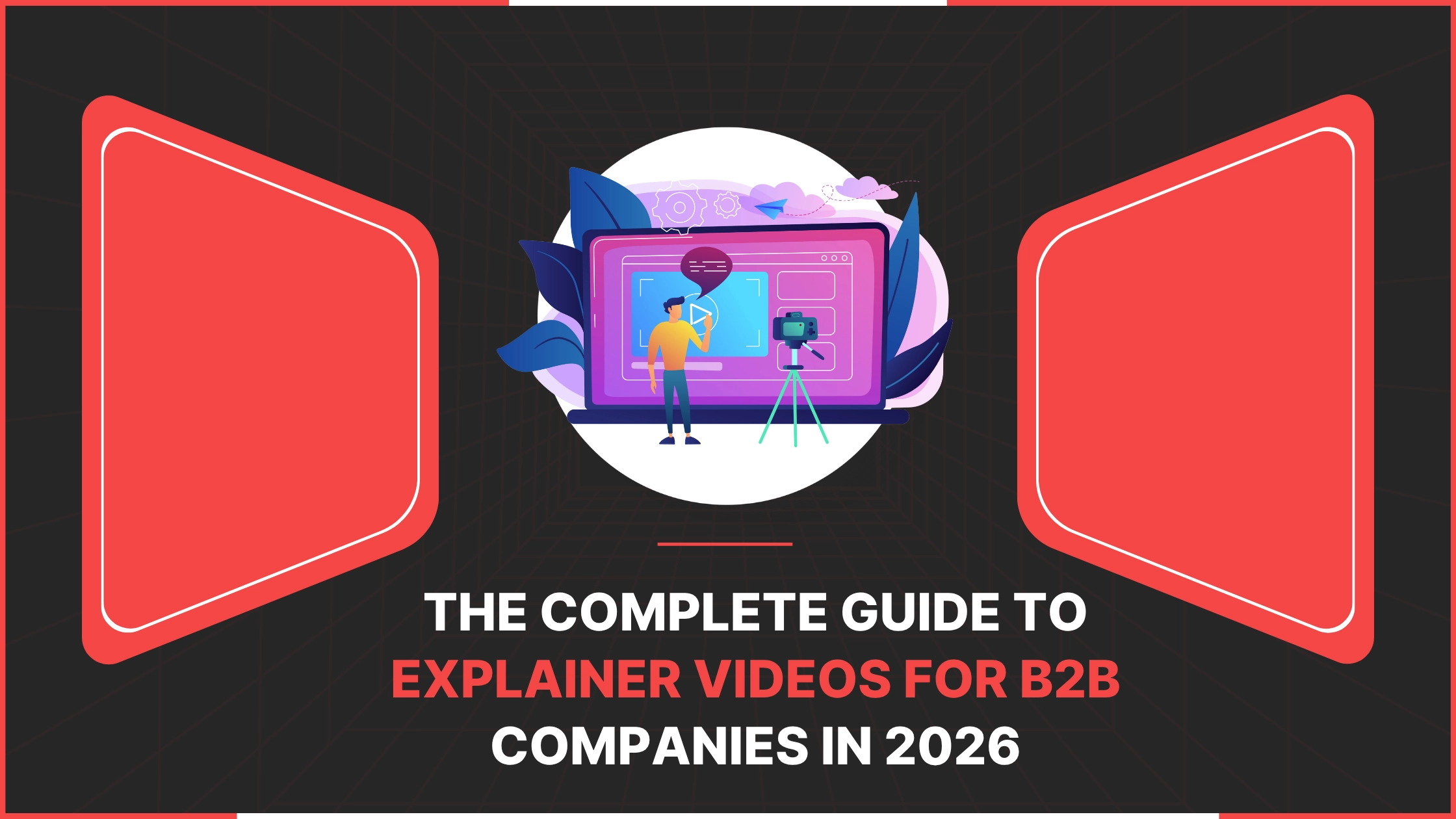
The Complete Guide to Explainer Videos for B2B Companies in 2026
Most B2B companies don’t have a video problem. They have a clarity problem.
Explainer videos were supposed to fix that. And in many cases, they do. But here’s the uncomfortable truth: most of them don’t actually explain anything in a way that changes buyer behavior.
In 2026, that gap has become even more obvious. Buyers move faster, attention spans are shorter, and products are more complex than ever. If your message doesn’t land quickly, it gets ignored just as quickly.
So let’s break down what actually works now, without the fluff.
Why explainer videos still matter (maybe more than ever)
B2B buying is not linear anymore.
A buyer might:
- Watch a video before they ever visit your website
- Compare you with competitors without talking to sales
- Make a shortlist based on a 60–90 second impression
In that environment, explainer videos become a first filter.
Not a brand asset. Not a nice-to-have.
A filter.
Here’s what a good explainer video does:
- Reduces confusion in the first 30 seconds
- Helps the buyer self-identify (“this is for me”)
- Shortens the time from interest to intent
And if it fails at that, it doesn’t matter how polished it looks.
What’s changed in 2026
Most explainer videos still follow an outdated formula:
“Here’s who we are, here’s what we do, here are 6 features.”
That doesn’t work anymore.
What has shifted is how buyers consume information:
1. Attention is now “selective, not scarce”
People don’t lack time. They’re just extremely selective about what deserves it.
2. Context beats detail
A buyer will choose a simpler explanation that fits their situation over a detailed one that doesn’t.
3. One video is no longer enough
You don’t need an explainer video. You need a system of videos.
The role of explainer videos in the B2B funnel today
Explainer videos now sit across the entire funnel, not just the top.
Awareness stage
Here, the goal is simple: make the problem obvious.
Formats that work:
- Problem-focused videos
- Short motion ads
- Industry pain-point narratives
Consideration stage
Now the buyer is comparing.
They want:
- How you solve the problem
- Why you’re different
- What the workflow looks like
Decision stage
At this point, clarity beats persuasion.
Best formats:
- Product walkthroughs
- Sales enablement videos
- Case-study driven explainers
Retention stage
This is often ignored.
But onboarding videos and feature explainers reduce churn and support load significantly.
Types of explainer videos that actually work in B2B
Let’s not overcomplicate this. There are four types that matter most.
1. Problem-first explainer videos
These start with frustration, inefficiency, or cost leakage.
No product talk upfront.
Why they work:
They mirror how buyers actually think. First, they recognize the problem. Then they care about solutions.
Best for:
- Ads
- Cold outreach
- Top-of-funnel landing pages
2. Product explainer videos
This is the classic version, but it needs to be sharper now.
A good product explainer answers:
“What is this, and why should I care in my context?”
Not:
“What does this tool do in general?”
Best for:
- Homepages
- Pitch decks
- Website hero sections
3. Feature-specific micro explainers
Instead of one long video, you break things down.
Each video explains:
- One feature
- One workflow
- One outcome
Why this matters: different stakeholders care about different parts of your product.
Best for:
- Sales follow-ups
- Retargeting
- Onboarding flows
4. Outcome-driven story videos
These focus less on product and more on transformation.
Structure:
Before → Struggle → Change → Result
Best for:
- Enterprise deals
- High-trust sales cycles
- Case study pages
Why most explainer videos fail
Here’s where things usually go wrong.
They start with the company, not the problem
Nobody wakes up caring about your brand story.
They try to explain everything
The moment you explain everything, nothing sticks.
They ignore the buyer’s stage
A first-time visitor and a ready-to-buy lead need completely different messaging.
They rely too much on visuals
Animation doesn’t create clarity. Structure does.
The modern explainer video structure (that actually works)
If you strip everything down, this is the framework that consistently performs:
1. Hook (0–5 seconds)
Show the problem immediately.
No introductions. No branding.
2. Context (5–20 seconds)
Why this problem exists and why it matters.
Make the viewer feel the friction.
3. Insight (20–35 seconds)
What’s actually going wrong in the current system or approach.
4. Solution (35–60 seconds)
Now introduce your product as the simplest way to fix it.
5. Outcome (final 10–15 seconds)
What changes after using it.
Not features. Results.
6. Call to action
One clear next step. Nothing more.
What separates good vs great explainer videos
Most companies think it’s about production quality.
It’s not.
It comes down to three things:
1. Clarity of thinking
If the idea is unclear, no amount of animation will fix it.
2. Precision of messaging
Every line should earn its place. If it doesn’t move understanding forward, it doesn’t belong.
3. Audience alignment
A video for founders is not the same as one for operators or technical teams.
Great videos feel like they were made for one specific person.
Average ones feel like they were made for everyone.
The biggest shift: explainer videos are now modular
In 2026, you don’t build one video and reuse it everywhere.
You build a system:
- One core explainer
- Multiple cutdowns
- Vertical-specific versions
- Feature-specific extensions
- Funnel-specific edits
Think of it less like a “video asset” and more like a content engine.
Final takeaway
Explainer videos still work. But only when they’re built for how people actually decide today.
Not how marketing teams used to structure content.
If your video doesn’t answer three things quickly:
- What problem is this solving
- Why should I care
- What changes for me
It’s not doing its job.
Everything else is decoration.