
What Is a Promo Video and How B2B Companies Use Them to Drive Pipeline
Why Most B2B Pipeline Problems Start with the Wrong Video Format
Most marketing leaders agree that video drives the pipeline. What fewer acknowledge is that the type of video matters far more than the fact that your organization produced one. In 2026, 91% of businesses report using video as a marketing tool [Wyzowl, 2026], yet many of those investments fail to generate measurable pipeline impact. The culprit, according to multiple industry analyses, is format mismatch: organizations commission explainer videos when they actually need promotional content.
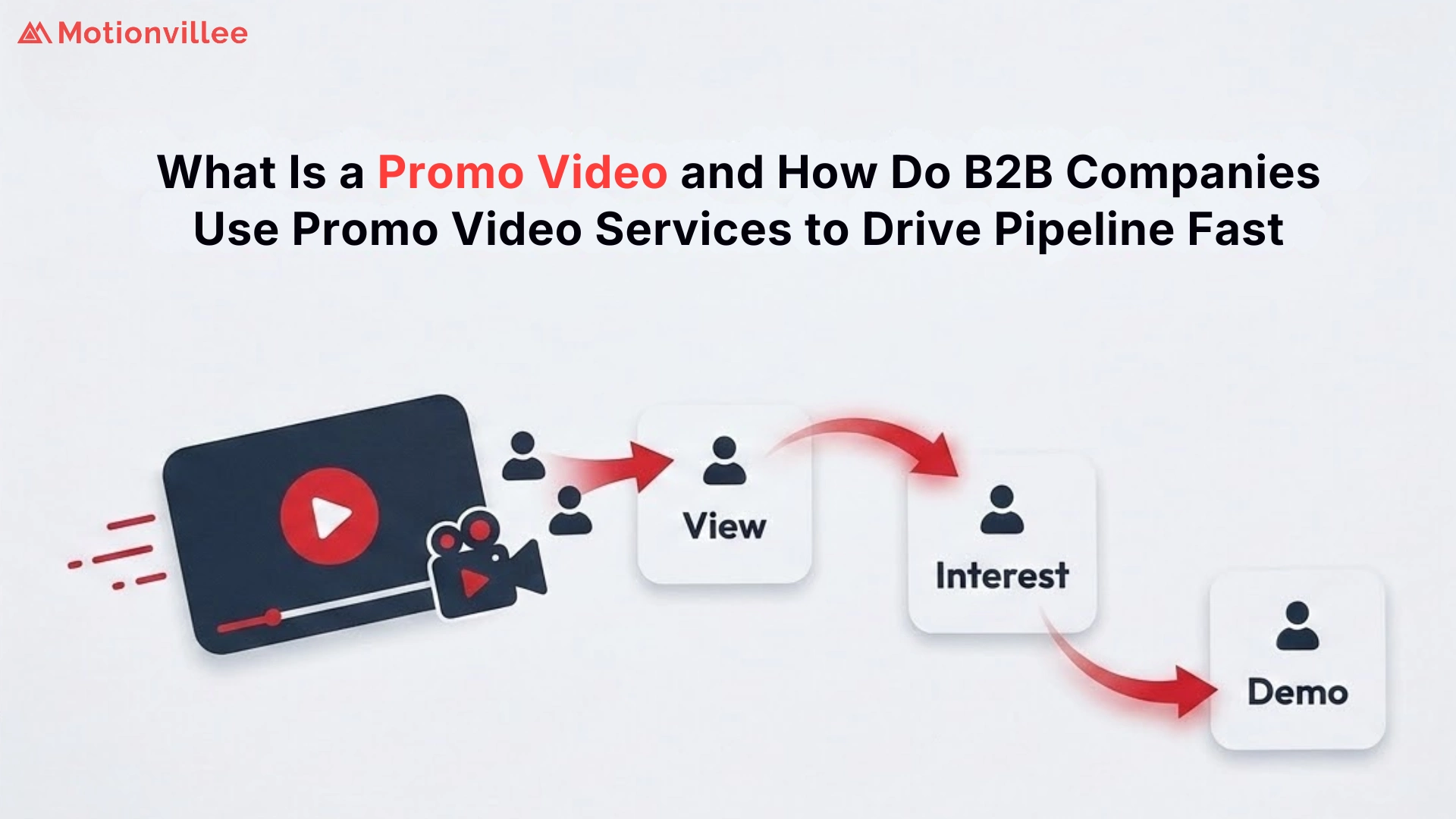
The distinction matters. An explainer video typically educates viewers about how a product works, walking through features and user flows. A promo video is fundamentally different. It is a short, high-impact piece, typically between 30 and 90 seconds, designed to generate excitement, build credibility, and drive a specific business action such as booking a demo, requesting a quote, or visiting a landing page. Where an explainer informs, a promo persuades. For teams exploring the broader landscape of video formats, this resource provides a deeper comparison: Animated Explainer Video for B2B Sales: The Complete Guide for Marketing Teams in 2026
Understanding this distinction is the first step toward using video as a pipeline acceleration tool rather than a content calendar filler.
Why the Pipeline Pressure Makes Promo Video Strategic Now
Two structural shifts in B2B buying behavior make promotional video services particularly valuable at this moment. First, buying committees have expanded significantly. Gartner research indicates that the typical B2B purchase now involves 6 to 10 stakeholders, with some enterprise analyses suggesting the number may be closer to 13 for complex sales [Gartner, 2024]. When that many decision-makers need alignment, a concise, visually compelling promo video can serve as a shared reference point that cuts through lengthy email threads and inconsistent messaging.
Second, attention windows are compressing. LinkedIn reports a 5.60% engagement rate for video content, with watch time up 36% year over year [LinkedIn/Socialinsider, 2025]. These figures suggest that decision-makers are not just watching video; they are choosing it over text-based content when time is limited. Several ROI benchmarks further support the strategic case. Landing pages with video show an 86% higher conversion rate [EyeView/Hostinger, 2025], though it is important to note this lift depends heavily on video relevance and page context. Email campaigns with video achieve up to 300% higher click-through rates [Campaign Monitor, 2025], although performance varies with thumbnail design and whether the video is embedded or linked. Organizations using video in prospect education report a 20-40% reduction in time-to-understanding [ReelFlow, 2025], and 82% of video marketers report a positive return on investment [Wyzowl, 2026].
These are encouraging figures, but they should be read with appropriate caveats. The 86% conversion lift, for example, reflects observed ranges rather than guaranteed outcomes; the underlying study contexts vary by industry and page design. Email click-through improvements depend significantly on whether the recipient sees a static thumbnail or an embedded player. Professional promotional video services can help organizations navigate these variables by tailoring format, length, and placement to the specific demands of each channel.
Where to Deploy a Promo Video for Maximum Pipeline Velocity
Choosing the right channel is as important as producing the right video. Dreamdata’s 2025 analysis of B2B attribution data suggests that LinkedIn delivers 113% return on ad spend, compared to 78% for Google and 29% for Meta platforms [Dreamdata, 2025]. LinkedIn’s share of B2B ad budgets grew 31% over the prior year, reaching 39% of total spend, which indicates where marketing leaders see the strongest return. Short, punchy promo videos are well suited to LinkedIn’s feed algorithm and professional audience. For teams planning a broader social distribution strategy, this guide offers additional tactical detail: Social Media Video Services for B2B Brands: How to Turn Scrollers Into Pipeline
Beyond paid social, paid landing pages represent the highest-impact deployment channel. A well-produced promo video addresses buyer uncertainty at the moment of highest intent. When a prospect arrives on a landing page after clicking an ad or search result, a 60-second promo can communicate value proposition, social proof, and next steps more efficiently than paragraphs of copy. This is where the 86% conversion lift becomes most relevant: the video directly addresses the friction that would otherwise cause the visitor to bounce.Email sequences offer another high-yield channel. Terminus documented a 216% higher response rate when personalized video was included in outreach sequences [Vidyard/SalesLoft, 2024]. While that study focused on personalized sales videos, the underlying principle applies to standardized promo content as well: video in email creates a visual anchor that text alone cannot replicate.Finally, sales enablement is an often-overlooked deployment surface. A persistent promo video asset that lives in the CRM, gets shared during discovery calls, and appears in follow-up materials can reduce the number of preliminary conversations required. Working with a reputable promotional videos company ensures these assets are built for multi-channel reuse from the outset.
Promo Video Formats That Drive the Fastest B2B Results
Not all promo videos serve the same function. Understanding the three primary formats helps marketing teams allocate production budgets where they will generate the most pipeline impact.
Short-Form Social Promos (15-60 Seconds)
These are optimized for feed-based platforms such as LinkedIn, X, and paid social campaigns. Wyzowl’s 2026 survey indicates that 83% of marketers rate videos under 60 seconds as the most effective format for social engagement [Wyzowl, 2026]. The brevity forces discipline: a strong hook in the first three seconds, a single clear value proposition, and a direct call to action.
Product Launch Promos (30-90 Seconds)
Product launch promos combine product demonstration with brand storytelling. They are typically deployed on landing pages, at virtual events, and in sales enablement decks. Unlike feature walkthroughs, these videos focus on outcomes: what changes for the buyer after adoption. Animation is particularly effective for this format because it allows teams to visualize abstract value propositions. Animated promotional videos for business can illustrate complex workflows, data transformations, or integration scenarios that live-action footage would struggle to convey.
Brand Credibility Promos (45-90 Seconds)
These videos serve a trust-building function. They communicate company positioning, client logos, analyst recognition, and team expertise. They are most effective when deployed mid-funnel, after initial awareness has been established but before the prospect is ready for a sales conversation.It is worth distinguishing digital promo content from broadcast television production. TV commercial video production involves different aspect ratios, longer lead times, broadcast compliance requirements, and significantly higher per-unit costs. For teams considering whether digital promo or TV commercial is the right next step, this resource provides a comparative framework:
TV Commercial Video Production for B2B Brands: What Works and What Has Changed in 2026
For most B2B organizations, digital-first promo video delivers stronger pipeline ROI per dollar spent. Selecting the right promo video company means finding a partner who understands B2B buying dynamics, not just production technique.
A Decision Framework for Investing in Promo Video Services
The following four-step framework helps marketing leaders evaluate whether, where, and how to invest in promo video services for pipeline impact.
Step 1: Identify the Pipeline Bottleneck
Before commissioning any video, diagnose where your pipeline is weakest. Is the challenge at the awareness stage, where too few qualified leads enter the funnel? Is it at the conversion stage, where prospects drop off between demo request and close? Or is it cycle length, where deals stall because stakeholders cannot reach consensus? Each bottleneck points to a different video format and deployment strategy.
Step 2: Match Format to the Buyer’s Information Stage
Short-form social promos work best for awareness and initial interest. Product launch promos fit the consideration and evaluation stages. Brand credibility promos serve mid-funnel trust-building. Mapping format to stage prevents the common mistake of using the same asset across the entire funnel.
Step 3: Measure Pipeline Impact, Not Just Views
View count is a vanity metric. The metrics that actually indicate pipeline impact include video-influenced pipeline revenue, conversion lift on pages where the video is deployed, sales cycle compression after video introduction, and cost per pipeline-opportunity influenced by video (CPMO). Building measurement into the strategy from the outset ensures that promotional video production investment is evaluated on business outcomes, not production output.
Step 4: Build for Reuse and Iteration
The most efficient approach to video content treats each production as a modular asset. A single product launch promo can be edited into 15-second social cutdowns, 30-second email versions, and a 90-second sales enablement piece. Planning for modularity during pre-production reduces future costs and accelerates time-to-deploy for new campaigns.
The Strategic Case for Pipeline-First Video
The organizations gaining competitive ground in 2026 are those that treat video as a pipeline acceleration tool, not a brand awareness exercise. They commission promotional video production services with specific funnel objectives, measure impact against pipeline metrics, and iterate based on performance data rather than subjective creative preferences.The question for marketing leaders is no longer whether to invest in video. It is whether your video strategy drives the pipeline or fills content calendars. The distinction is commercially significant, and the format choices outlined in this brief provide a practical starting point for teams ready to close that gap.