
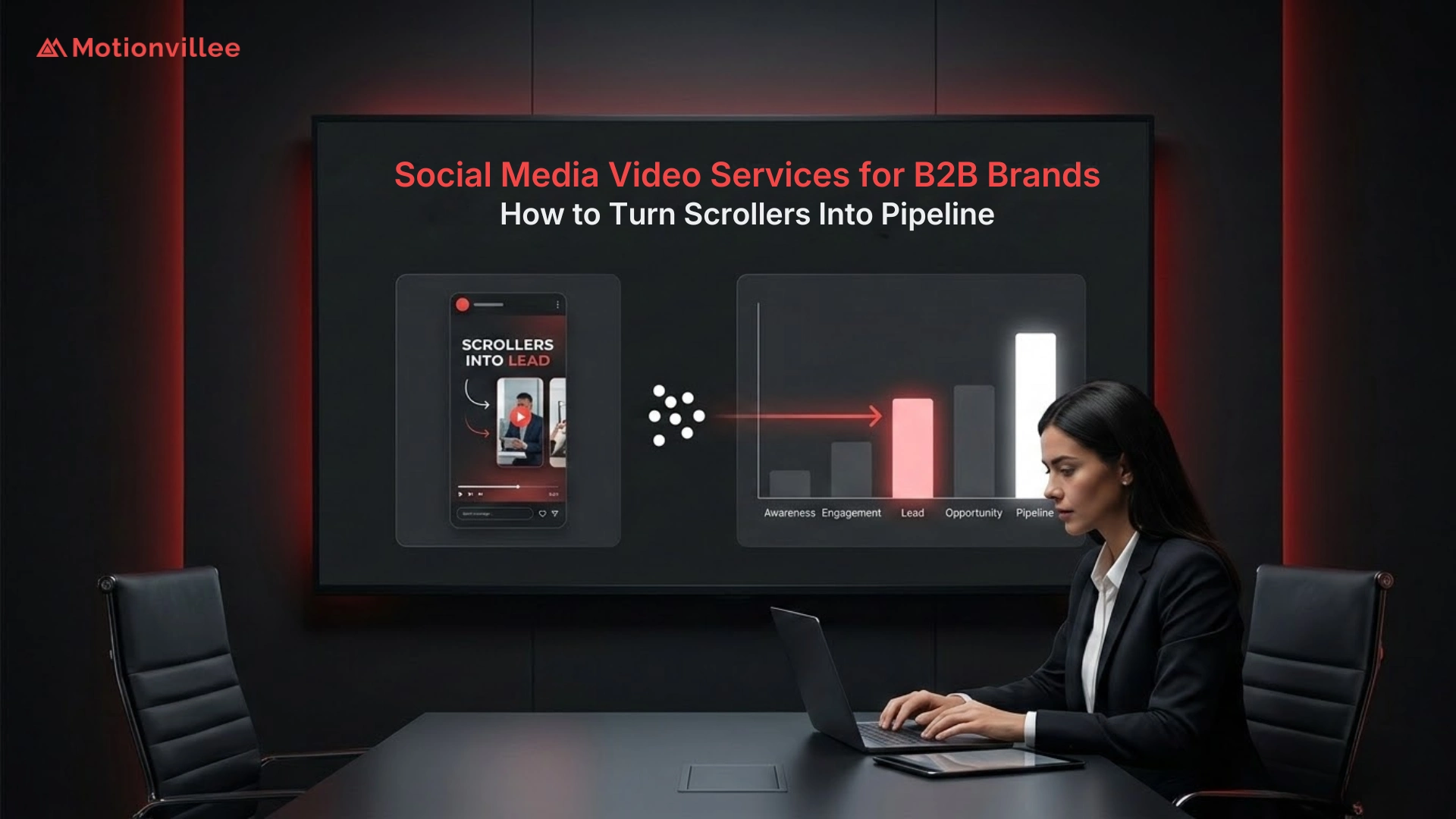
Social Media Video Services for B2B Brands: How to Turn Scrollers Into Pipeline
Your Buyers Are Deciding Before They Ever Talk to Sales
Your most qualified buyer is not on your website right now. They are scrolling through LinkedIn on their phone during a morning commute, watching a 30-second clip from one of your competitors. By the time they reach your landing page, 70% of their purchase decision has already been shaped by what they consumed on social media. This is not speculation. Research from Google and Vidico indicates that 70% of B2B buyers watch video content during their purchase decision process [Google/Vidico, 2025]. Meanwhile, 70% of B2B decision-makers report that social media content influences them before they even begin formal vendor research [WorldMetrics, 2026]. The uncomfortable truth for marketing leaders is this: if your social media video services strategy is an afterthought, you are losing pipeline to competitors whose content is meeting buyers where they already are.
Three Structural Shifts Make Social Video Non-Negotiable
Three forces are converging to elevate social video from a nice-to-have to a strategic imperative.
First, a generational transition is underway. Gen Z professionals are entering B2B buying committees, and as digital natives, they default to social platforms for product research, peer validation, and vendor evaluation. eMarketer reports that 46% of B2B marketers in North America and Europe plan to increase social media content distribution this year, partly in response to this demographic shift [eMarketer/10Fold, 2024].
Second, the buying process has become more self-directed than ever. Gartner research indicates that three-quarters of B2B buyers prefer not to engage a salesperson at all during the evaluation phase [Gartner, 2024]. Your video content must therefore educate and de-risk purchase decisions without a human handoff. Short-form video has emerged as the format buyers trust most: 67% of respondents in a Demand Gen Report survey identified short-form content as the most valuable format for decision-making, and 80% found it the most appealing [Demand Gen Report, 2024].
Third, Forrester’s 2024 research reveals that the average B2B buying committee now involves 13 people across multiple departments [Forrester, 2024]. Social video is uniquely suited to this distributed model because it is shareable, consumable in seconds, and capable of building consensus across stakeholders who may never attend the same sales call.
For marketing leaders evaluating their content mix, an Animated Explainer Video for B2B Sales is worth exploring. Animated explainer content stands out as one of the most repurposable assets in a social distribution strategy. A single 60-second animation can be sliced into platform-specific clips, embedded in email campaigns, and deployed across LinkedIn, Instagram, and YouTube Shorts, delivering compounding returns on the initial production investment.
What Types of Video Actually Drive Engagement on Social
Not all video formats perform equally across B2B social channels. Wyzowl’s 2026 data shows that 69% of video marketers have created social media videos, making it the single most popular video use case this year [Wyzowl, 2026]. The formats that drive measurable pipeline outcomes fall into three categories.
Short-form promos, typically 15 to 60 seconds, dominate LinkedIn and paid social. More than half (55%) of B2B marketers worldwide agree that short-form social videos produce the highest ROI [LinkedIn/Ipsos, 2024]. These formats are particularly effective at the top of the funnel, where the objective is pattern interruption and initial interest capture.
For organizations evaluating what types of content resonate on professional networks, understanding the role of a Promo video is essential. Short promo videos consistently rank as the highest-performing format on LinkedIn and paid social, especially when they lead with a specific business problem rather than a product pitch.
Testimonial and case study clips build mid-funnel trust by showcasing real outcomes from real customers. LinkedIn’s 2025 B2B Benchmark Report found that 94% of marketers identified trust as the key driver of B2B purchasing decisions, and video testimonials are one of the fastest ways to establish that trust at scale [LinkedIn, 2025].
Educational explainers and product demos address bottom-funnel objections by showing exactly how a solution works. Wistia’s research demonstrates that instructional videos consistently out-engage generic brand content, and landing pages with embedded video see up to 86% higher conversion rates than those without [Hostinger/EyeView, 2025].
Platform Strategy and Paid Social
Platform selection determines both creative format and distribution strategy. LinkedIn remains the dominant B2B social platform, with 93% of B2B marketers using it for content marketing and 80% of B2B social media leads originating from the platform [CMI, 2025; LinkedIn, 2024]. LinkedIn video achieves an average engagement rate of 5.60%, outperforming most other content formats [CloselyHQ, 2025]. The optimal LinkedIn strategy combines native video uploads with captions enabled, since 85% of LinkedIn videos are watched on mute.
Instagram Reels and YouTube Shorts serve as secondary channels for brands targeting younger decision-makers. While these platforms generate fewer direct leads for enterprise B2B, they contribute significantly to brand awareness and organic discoverability. Reels perform best with creator-style, behind-the-scenes content, while YouTube Shorts benefits from problem-solution educational formats aligned with search intent.
Organic reach on every major platform is declining, making paid distribution essential for reaching in-market buyers. B2B video ad spending is projected to reach $2.86 billion by 2027, accounting for 11.1% of total B2B digital ad spend [eMarketer, 2025]. However, paid social video requires a fundamentally different production and strategy approach than organic content. The targeting precision, creative format constraints, and measurement frameworks demand specialized expertise.
When evaluating how to choose a video ad company , marketing leaders should prioritize demonstrated experience with account-based targeting, conversion-optimized creative, and attribution modeling that connects video views to downstream revenue.
A Decision Framework for Social Media Video Services
For marketing leaders ready to act, the following framework provides a structured approach to evaluating social media video productions:
Audit your current buyer journey. Map where video could replace or augment existing content touchpoints. Prioritize stages with the highest drop-off rates, since video has been shown to increase web traffic for 82% of marketers and generate leads for 85% [Wyzowl, 2026].
Align formats to funnel objectives. Use short-form promos for awareness, testimonials for consideration, and explainers for conversion. Avoid the common mistake of deploying a single video format across all funnel stages.
Build a repurposable content engine. Invest in foundational assets, such as a core brand video or animated explainer, that can be adapted into eight to twelve platform-specific clips. This approach maximizes ROI per production dollar and ensures consistent messaging across channels.
Measure pipeline impact, not just views. Track video-attributed leads, opportunity influence, and pipeline velocity. The most successful social video agency relationships are those where creative output is directly tied to revenue metrics, not engagement proxies.
The Strategic Outlook
The data is unambiguous. Video is no longer a supplementary channel for B2B brands. It is the primary mechanism through which buyers discover, evaluate, and shortlist vendors. Social media video specifically, where 85% of marketers report that video has directly contributed to increased sales [Wyzowl, 2026], represents the highest-leverage investment a marketing leader can make this year.
The question is no longer whether to invest in social video, but how to invest with precision. Choosing the right social media video company means finding a partner who understands that every second of video must serve a business objective. Whether you are building an in-house capability or engaging a specialized social video production company, the organizations that treat video as a strategic growth driver will define the competitive landscape for years to come.
At Motionvillee, we partner with marketing leaders to build video strategies that are accountable to pipeline. Every piece of content we deliver is designed to move buyers through the funnel. As a dedicated social video production agency, our work is grounded in platform-specific data, buyer psychology, and measurable business outcomes. If you are ready to treat video as the growth lever it is, we are ready to build that strategy with you.