
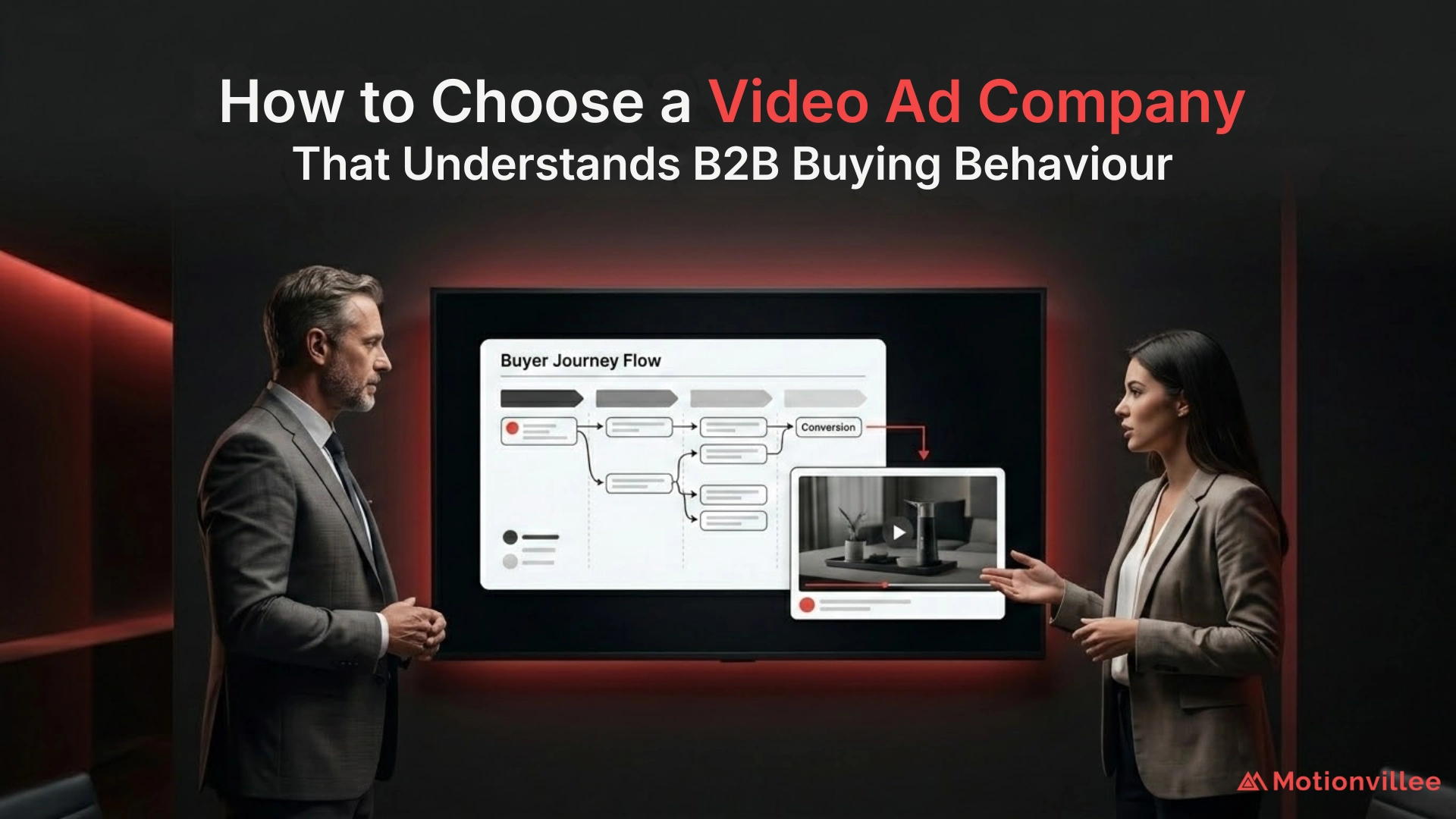
How to Choose a Video Ad Company That Understands B2B Buying Behaviour
Most companies that produce video ads for B2B brands are applying frameworks designed for consumer audiences. The result is a predictable pattern: polished creative, strong view counts in the first 48 hours, and negligible pipeline impact six weeks later. The problem is not the quality of the work. The problem is that the strategic foundation, the understanding of who is watching, why they are watching, and what would compel them to act, is built on B2C assumptions about how purchasing decisions are made.
For a marketing leader at a mid-to-enterprise company, the cost of this mismatch is significant. wasted budget on campaigns that generate awareness but not pipeline.Creative that impresses peers on LinkedIn but fails to move a prospect from research to consideration. Video video ad production that treats every viewer as an individual buyer, when in reality B2B purchasing involves an average of six to ten decision-makers, each with different priorities, concerns, and evaluation criteria [Gartner, 2024]. The challenge is not finding a digital video marketing agency that can produce visually compelling work. The challenge is finding one that understands the structural complexity of B2B buying and builds creative strategy around it.
Why B2B Buying Behaviour Demands a Different Kind of Video Partner
The B2B buying landscape has shifted substantially. Research from 6sense indicates that the average B2B buying cycle now runs approximately 10.1 months globally in 2025, down slightly from 11.3 months in 2024 [6sense, 2025]. More importantly, the composition of buying groups has expanded. Forrester’s analysis found that an average of 13 people within an organisation are involved in a purchasing decision, with 89% of purchases involving two or more departments [Forrester, 2024]. A prospect who watches your video ad is not making a decision. They are building a case that will be evaluated by finance, operations, IT security, legal, and executive leadership.
This structural reality has direct implications for video advertising strategy. Video ads created with a single-viewer, emotional-impulse model, the approach most consumer-focused agencies default to, tend to generate surface-level engagement that does not translate to sales pipeline velocity. In B2B, video must serve a fundamentally different purpose: it must build rational credibility, articulate measurable business value, and provide content that multiple stakeholders can reference independently during their evaluation process. A competent video ad company that grasps this distinction will structure campaigns around funnel stages, stakeholder personas, and measurable business outcomes rather than vanity metrics.
This becomes especially relevant when video advertising sits alongside broader content formats such as animated explainers. For many B2B organisations, video Animated Explainer Video for B2B Sales: The Complete Guide for Marketing Teams in 2026 plays a distinct role in the middle of the funnel, while video advertising operates primarily at the top. Conflating these two functions, or assigning them to a partner that does not distinguish between them, is one of the most common strategic errors in B2B content marketing.
How to Evaluate a Video Ad Company for B2B Fit
The evaluation process for selecting a video marketing agency should begin where the agency presents itself to the market: its own website. A partner that claims to specialise in B2B but whose own site is built around B2C metrics, case studies, and language is unlikely to understand the dynamics of your buying cycle. Before booking a single call, reviewing What to Look for on a Video Production Company Website Before You Sign a Contract can reveal whether an agency’s positioning genuinely aligns with B2B expectations or merely borrows industry terminology.
Beyond the initial signal check, the evaluation should probe three areas. First, does the agency articulate business outcomes as primary deliverables, not just video assets? A creative video marketing agency that understands B2B will frame proposals around pipeline influence, lead quality, and stakeholder engagement rather than view counts and production budgets. Second, does the agency demonstrate an understanding of multi-stakeholder messaging? Can they show examples of work where a single campaign spoke to different decision-makers within the same buying committee, such as a CFO and a VP of Engineering? Third, do they have a methodology for mapping video content to specific stages of the buyer journey, or do they produce generic brand awareness content regardless of funnel position?
Where Your Video Ads Will Run and Why Distribution Matters
The platform where a B2B video ad runs shapes both its creative requirements and its measurement framework. LinkedIn remains the primary paid social channel for B2B advertisers. LinkedIn’s Creative Labs research, which analysed over 13,000 B2B video ads, found that video achieves the highest engagement rates among all ad formats on the platform, approximately 5.6% engagement versus 3.2% for single-image ads [LinkedIn Creative Labs, 2025]. However, click-through rates for LinkedIn video ads typically range between 0.55% and 0.70%, with an average cost per click between $5.50 and $8.00 for most B2B campaigns [LinkedIn Ads Benchmarks, 2026].
These benchmarks matter because they define what success looks like. Any of the digital video advertising companies that present LinkedIn engagement rates of 15% or CTRs of 3% for B2B campaigns are either misrepresenting performance or targeting consumer audiences. Legitimate B2B video ad performance sits within a narrower, more honest band, and the agencies that understand this are the ones that set realistic expectations from the outset.
For marketing leaders exploring how paid social integrates with broader video strategy, understanding the relationship between paid distribution and organic content is essential. The most effective B2B campaigns use paid video ads to drive initial awareness and then convert that attention into pipeline through retargeting sequences and integrated Social Media Video Services for B2B Brands: How to Turn Scrollers Into Pipeline programmes that maintain engagement across the longer B2B decision cycle.
What the Evidence Does Not Show
It is important to acknowledge that the research on B2B video advertising effectiveness carries limitations. The LinkedIn benchmarks cited above represent platform-reported averages, which may include campaigns from industries with shorter buying cycles, such as recruitment software, alongside enterprise SaaS and industrial equipment companies with cycles exceeding 12 months. The causal link between a specific video ad and a closed deal is notoriously difficult to isolate in B2B because purchasing decisions involve multiple touchpoints over months. Video attribution models vary widely, and the metrics that agencies present, engagement rates, view-through rates, brand lift surveys, all measure intermediate effects rather than direct revenue contribution.
Furthermore, the research does not establish that a B2B-specialised video marketing company will always outperform a generalist agency. In some cases, a broader agency with deep platform expertise in LinkedIn or programmatic buying may produce stronger campaign mechanics even if their creative approach is less B2B-native. The evidence suggests that understanding B2B buying behaviour is a significant advantage, but it is one variable among several, including media buying proficiency, data analytics capability, and creative execution quality.
A Practical Framework for Selection
For marketing leaders evaluating potential partners, the following framework offers a structured approach. A video advertising agency should be assessed against four criteria. First, strategic alignment: can the partner articulate how their video ads will influence specific stages of your buying cycle and address the priorities of different stakeholders on the buying committee? Second, evidence of B2B results: do their case studies reference pipeline metrics, deal velocity, or sales enablement outcomes, or do they rely exclusively on vanity metrics like views and impressions? Third, platform fluency: does the partner understand the performance benchmarks, audience targeting options, and creative specifications of the platforms where your ads will actually run? Fourth, measurement philosophy: does the agency propose attribution models that connect video engagement to downstream business outcomes, or do they treat campaign reporting as a standalone deliverable?
Many video ad agencies can pass one or two of these tests. The partners that consistently deliver measurable B2B pipeline impact are those that satisfy all four, treating video advertising not as a creative service but as a demand generation discipline.
The Strategic Imperative
The B2B buying environment will only grow more complex. As buying committees expand and decision cycles lengthen, the gap between generic video advertising and strategically informed video ads services will widen. Among the best video marketing agencies, those that will define the next decade of B2B demand generation understand buying behaviour as deeply as production quality. The opportunity for marketing leaders is not simply to find a better vendor. It is to find a strategic partner who can translate the complexity of B2B purchasing into video campaigns that accelerate pipeline and differentiate your brand at every stage of the buyer journey.