
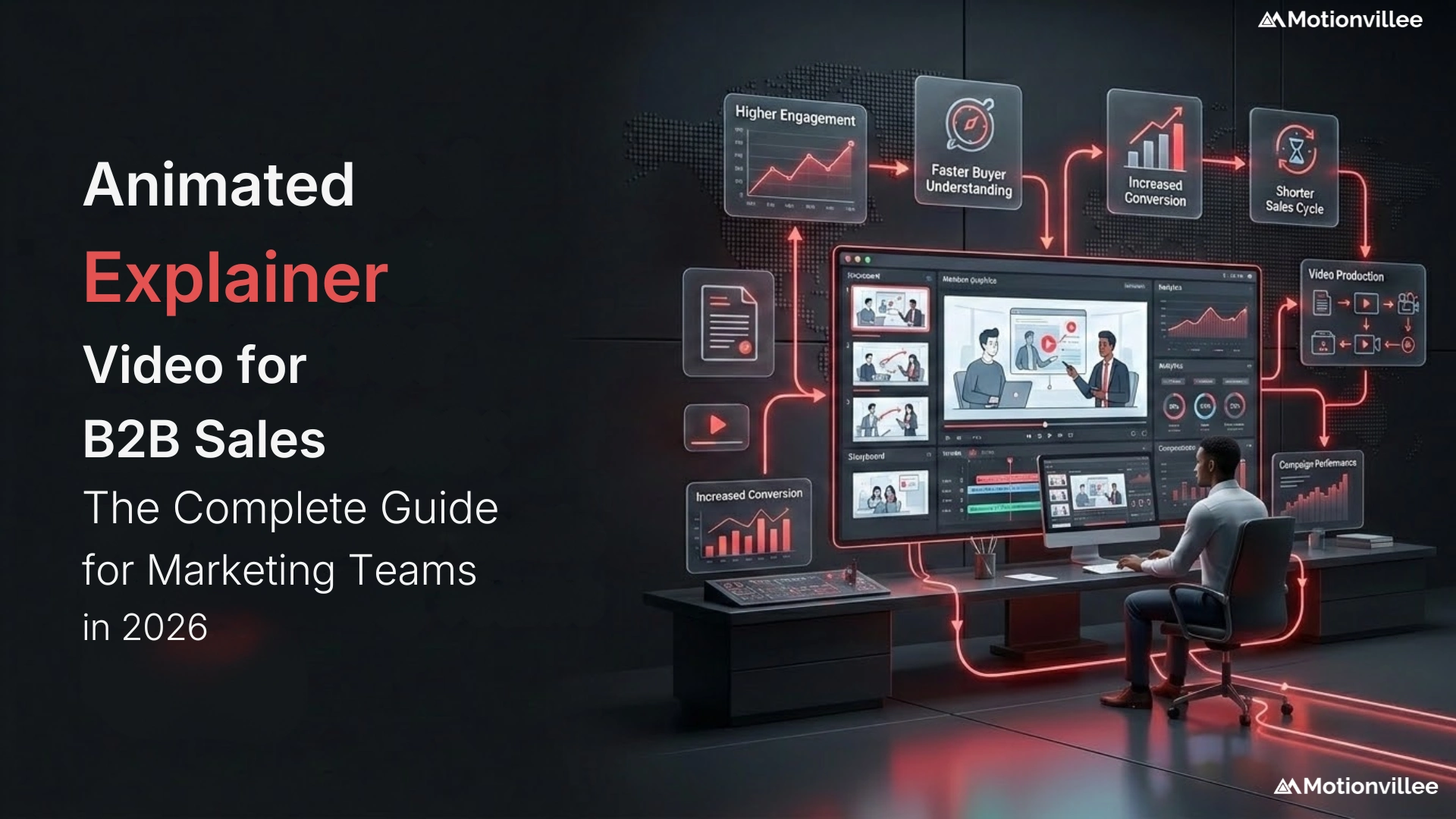
Animated Explainer Video for B2B Sales: The Complete Guide for Marketing Teams in 2026
Your buyer has already decided. According to a DemandGen Report analysis of B2B purchasing behavior, 80% of buyers initiate their first contact with a vendor only after completing 70% of their buying journey independently [DemandGen Report, 2024]. By the time your sales team picks up the phone, the buyer has formed opinions about your category, your competitors, and whether your solution warrants further evaluation. The question is not whether your sales team can close. The question is whether your marketing has earned the right to be considered at all.
In 2026, that consideration window is narrower than ever. B2B sales cycles have lengthened by approximately 25% compared to five years ago, with buying committees now averaging 11 to 13 stakeholders [Forrester, 2024; DemandGen Report, 2024]. Meanwhile, 91% of businesses now use video as a marketing tool, and 47% of B2B marketers rate video as the most effective content type for moving prospects through the sales funnel [Wyzowl, 2026; Ascend2, 2024]. This is not a channel to experiment with later. It is table stakes. Within the video ecosystem, b2b explainer videos have emerged as a particularly strategic asset for mid-to-enterprise brands because they solve a specific problem: communicating complex value propositions to busy, skeptical buying committees in a format that demands minimal effort to consume.
Why B2B Explainer Videos Drive Measurable Pipeline Impact
The data supporting b2b explainer videos is substantial, but what matters is not the aggregate statistics. What matters is the mechanism. Animation abstracts away complexity. For B2B companies selling software platforms, industrial equipment, financial instruments, or compliance solutions, the core challenge is rarely that the product does not work. The challenge is that the buyer cannot easily visualize how it works for their specific situation. A well-structured animated explainer video replaces abstract feature lists with visual narratives that map directly to the buyer’s pain points.
Ninety-three percent of video marketers report that video has helped increase user understanding of their product or service, and 83% say video has directly increased sales [Wyzowl, 2026]. Sixty-eight percent of video marketers have created explainer videos, making it the second most produced video type behind social media content [Wyzowl, 2026]. These figures suggest a clear pattern: teams that invest in explainer content are seeing measurable pipeline impact, not just engagement metrics.
Mapping an Animated Explainer Video for B2B Sales Across the Funnel
An animated explainer video for b2b sales delivers the strongest results when it is designed with a specific funnel stage in mind, not treated as a general-purpose asset.
At the top of the funnel, the objective is awareness. A 60-to-90-second animated explainer introduces a category problem and positions your brand as the authority on solving it. LinkedIn’s 2025 B2B Benchmark Report found that video had become the most popular and effective form of B2B marketing, with 93% of B2B marketers using LinkedIn for content distribution [CMI, 2025; LinkedIn, 2025]. For distribution guidance across these channels, Social Media Video Services for B2B Brands: How to Turn Scrollers Into Pipeline provides actionable frameworks for adapting short-form content for paid and organic social campaigns.
In the middle of the funnel, the explainer video shifts role. It now serves as a differentiation tool, answering the question of why your solution over the alternatives. Landing pages with embedded video see up to 86% higher conversion rates than those without [Hostinger/EyeView, 2025]. At this stage, the video should address specific objections and competitive positioning rather than reciting product features.
At the bottom of the funnel, explainer videos function as sales enablement. Fifty-nine percent of senior executives would rather watch a video than read text if both are available on the same page [Forbes Insight, 2024]. When your internal champion needs to build consensus across the buying committee, a shareable video asset becomes a force multiplier.
Which Industries and Use Cases Benefit Most
Animation is particularly valuable for B2B sectors where the product or service is abstract, technical, or heavily regulated. Healthcare and life sciences companies, for instance, use animated video to make complex medical products understandable to procurement committees and clinical stakeholders. For a deeper look at how this works in practice, How Animated Healthcare Videos Help Complex Medical Products Win More B2B Buyers
documents specific patterns across the healthcare vertical.
Other sectors that benefit strongly include financial services, cybersecurity, insurance, and enterprise technology. In each case, the common thread is identical: the buyer needs to understand a non-visible system, process, or outcome before committing to a sales conversation.
It is worth distinguishing explainer videos from other B2B video formats. A promo video amplifies awareness and generates excitement, while an explainer resolves uncertainty by educating the viewer. Teams that conflate the two often end up with content that neither inspires nor informs. For clarity on this distinction, What Is a Promo Video and How Do B2B Companies Use It to Drive Pipeline Fast outlines how different video types map to different pipeline objectives.
What Makes an Explainer Video Conversion-Focused
The difference between an explainer video that generates views and one that generates pipeline is intentionality. Conversion-focused explainer videos share three attributes.
First, they lead with the buyer’s problem, not the product. A 2026 LinkedIn analysis found that the most effective b2b explainer videos start with the buyer, not the product [LinkedIn, 2026]. Second, they are concise. Seventy-one percent of video marketers believe videos between 30 seconds and two minutes are most effective [Wyzowl, 2026]. Third, they are aligned with brand positioning from the outset. Misalignment between video messaging and brand identity erodes trust, particularly among enterprise buyers.
Understanding why brand alignment must be established before production begins is critical. What Is Branded Video Production and Why B2B Companies Get It Wrong the First Time examines the common pitfalls that lead to wasted production spend and misaligned deliverables.
Before engaging a production partner, marketing teams should understand what the production process entails and how it maps to their timeline. Business Video Production: A Practical Guide for B2B Marketing Teams Who Want Results walks through the full process from creative brief to final delivery, including how to structure milestones and review cycles.
Choosing the Right Production Partner
Selecting a video partner is a strategic decision, not a procurement exercise. The partner must understand B2B buying behavior, not just video production. How to Choose a Video Ad Company That Understands B2B Buying Behaviour provides a framework for evaluating partners based on their ability to connect creative decisions to pipeline outcomes rather than aesthetic preferences alone.
A Decision Framework: Should You Invest in an Explainer Video?
A straightforward framework can help marketing teams determine when an animated explainer video is the right investment.
- Complexity test: Can your value proposition be explained in under 30 seconds of spoken text? If not, animation can help compress complexity into a digestible format.
- Committee test: Does your sale require buy-in from five or more stakeholders? If yes, a shareable video asset reduces the burden on your internal champion and ensures consistent messaging across the committee.
- Differentiation test: Is your competitive advantage difficult to articulate without a visual demonstration? If yes, animation makes the invisible visible.
If your product scores yes on at least two of these criteria, an animated explainer video warrants a place in your content roadmap. If it scores yes on all three, it warrants prioritization this quarter.
The Strategic Outlook
The B2B buying landscape is not going to simplify. Committees will grow larger, sales cycles will remain extended, and buyers will continue conducting more independent research before engaging vendors. In that environment, the brands that win will be those that communicate with the most clarity, in the least amount of time, across the most touchpoints.
Animated explainer videos are not a creative indulgence. They are a strategic tool for reducing the cognitive distance between your solution and your buyer’s understanding of it. The data supports it. The buying committee demands it. The question is whether your content strategy reflects that reality.