
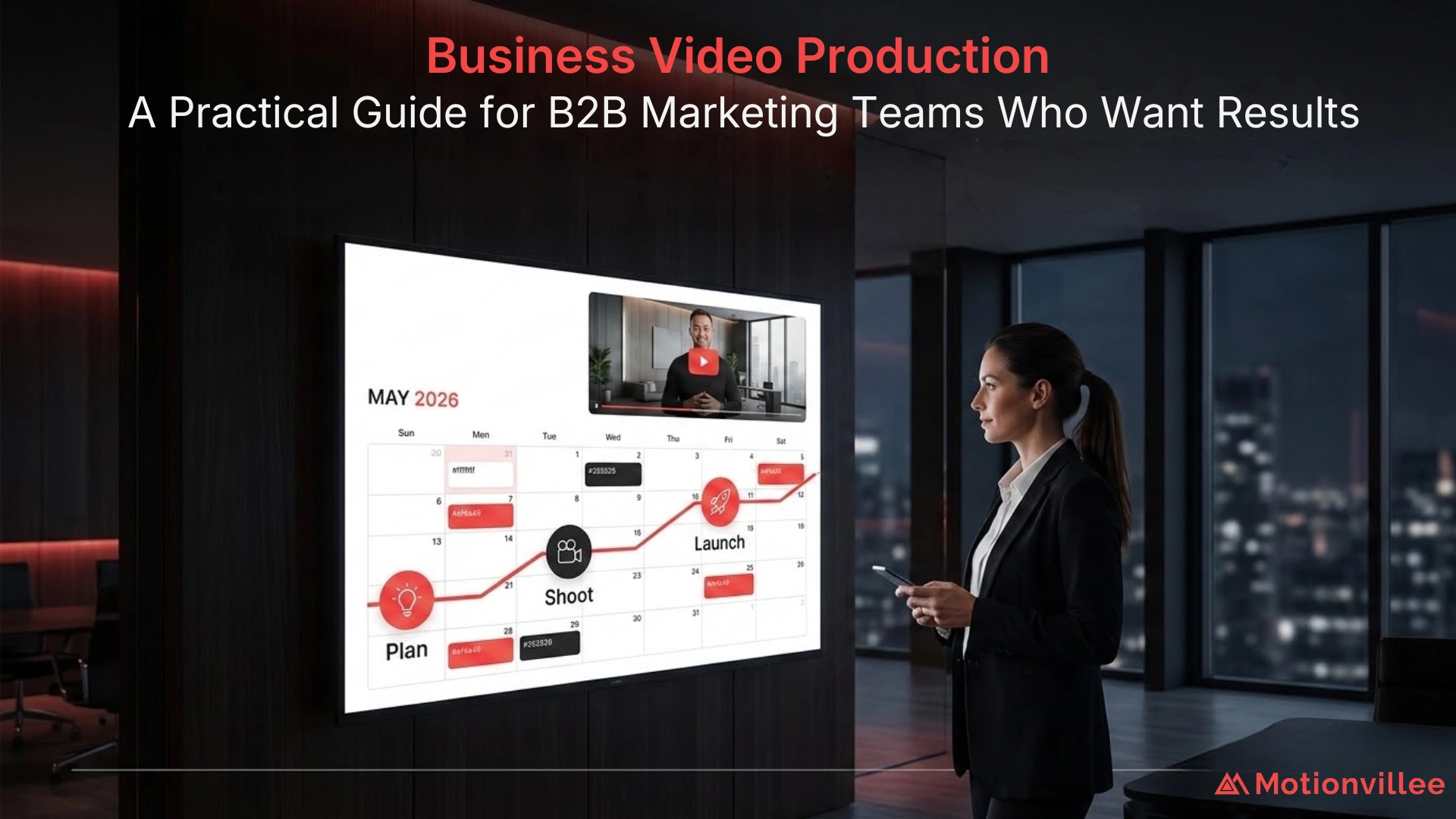
Business Video Production: A Practical Guide for B2B Marketing Teams Who Want Results
Most B2B Video Programs Are Operating Without a Return Framework
Ninety-one percent of businesses now use video as a marketing tool [Wyzowl, 2026]. Yet the majority of those same organizations have no structured framework for measuring whether their video investment is actually generating pipeline. This is the central paradox of B2B video: near-universal adoption, paired with surprisingly little accountability. According to Wistia’s 2026 State of Video Report, which analyzed over 13 million videos and surveyed more than 900 professionals, 51% of companies are keeping their video budgets flat or cutting them this year, even as demand for video content continues to climb [Wistia, 2026]. The reason is not hard to identify. When marketing leaders cannot demonstrate a clear line from video spend to revenue, finance leaders treat video as a cost center. The gap is not creative. It is strategic.
For most B2B organizations, the path into business video production begins with a single asset. Often that first asset is an animated explainer, chosen because it distills a complex value proposition into a format that buyers can absorb in under 90 seconds. That approach is sound as a starting point. But a single video, no matter how well produced, does not constitute a production strategy. Teams that invest in a broader understanding of how video maps to their buyer journey consistently outperform those that treat each video as a standalone project. For marketing leaders defining their initial roadmap, exploring the role of an can clarify how that foundational asset fits within a larger content system.
Why Strategic Production Matters More Than Ever
Three structural pressures are reshaping how B2B marketing teams approach video production. First, budget discipline is tightening. Wistia reports that only 40% of teams plan to increase their video spend in 2026, down from 57% in 2023 [Wistia, 2026]. Meanwhile, companies with over 50 employees significantly ramped up their video output last year, meaning more content must be produced with fewer incremental resources. Second, the buyer journey has become more self-directed. Research from 6Sense suggests that typical B2B buyers do not reach out to sales until they are 61% to 69% of the way through their evaluation process [6Sense, 2025]. Your video content is now doing the heavy lifting of education and de-risking, often without any human sales involvement.
Third, the measurement bar has risen. CMOs and CFOs increasingly expect video programs to demonstrate pipeline influence, not just view counts. Research from Shootsta suggests that organizations with structured ROI tracking frameworks achieve 312% better investment decisions and 89% more accurate budget forecasts than those without [Shootsta, 2025]. These dynamics point to a single conclusion: ad hoc production is no longer tenable. Business video production must be treated as a measurable, repeatable program, not an occasional creative exercise.
The Four Video Formats That Drive B2B Pipeline
Not all video formats serve the same business objective. The most effective B2B video programs align specific formats to specific stages of the buyer journey, rather than deploying a single format across the entire funnel. Research from Wyzowl indicates that 51% of B2B video marketers create primarily live-action content, followed by animated video at 23% and screen-recorded content at 19% [Wyzowl, 2026]. Each format has a distinct role.
Animated explainers and short-form brand videos serve the awareness stage. They introduce a problem and position a solution in a format optimized for social distribution and paid media. Data from Livestorm indicates that 91% of people have watched an explainer video to learn about a product or service [Livestorm, 2025], making this the most broadly consumed video format in the B2B buyer journey.
Product-focused videos, including walkthroughs, screencasts, and demonstration footage, serve the consideration stage. They allow buyers to evaluate functionality before engaging sales. For organizations whose products have a visual or interactive component, understanding the range of Product Videography Services for B2B is critical. A well-produced product video can reduce the number of discovery calls a sales team handles by answering common technical questions before they are asked.
Customer testimonials and case study videos build mid-funnel credibility. LinkedIn’s 2025 B2B Benchmark Report found that 94% of marketers identified trust as the key driver of purchasing decisions [LinkedIn, 2025]. Video testimonials, where a named customer articulates a measurable outcome, remain one of the fastest ways to establish that trust at scale. Finally, educational content such as webinars, how-to guides, and thought leadership interviews serves the decision stage by addressing remaining objections and differentiating from competitors. Wistia’s data shows that over half of companies now repurpose their video content into social clips, with LinkedIn as the top distribution platform [Wistia, 2026].
Building a Production Program That Scales
The distinction between a successful and an unsuccessful B2B video program is rarely about creative quality. It is about operational structure. The most effective programs share four characteristics. First, they define business outcomes before production begins. Every video is assigned a specific funnel stage, target persona, and success metric before a single frame is shot. Second, they build a content calendar anchored by evergreen assets, such as a core brand video or product overview, which can be repurposed into platform-specific clips throughout the year. This approach is central to enterprise video production because it transforms a single production investment into eight to twelve downstream assets.
Third, they allocate budget across production and distribution, not just production alone. Shootsta’s research indicates that companies focusing on strategic distribution alongside production quality achieve 240% higher ROI than those emphasizing production in isolation [Shootsta, 2025]. Fourth, they measure performance against pipeline metrics, not vanity metrics. Leading programs track video-attributed leads, opportunity influence rates, and pipeline velocity rather than views or impressions alone. Goldcast reports that 52% of B2B marketers cite video as their highest-ROI content type [Goldcast, 2025], but that figure correlates strongly with the presence of a structured measurement framework.
How to Choose a Production Partner That Drives ROI
The decision to engage an external production partner is one of the highest-impact hiring decisions a marketing leader makes. It is also one of the most frequently mismanaged. The most common mistake is evaluating partners based on a showreel rather than on business understanding. A portfolio of visually polished work is necessary but insufficient. The partner that delivers measurable ROI understands how videography for business connects to pipeline objectives, not just brand aesthetics.
Evaluation should focus on three dimensions. First, does the partner demonstrate an understanding of your buyer journey and competitive positioning, or do they pitch a one-size-fits-all approach? Second, do they offer a measurement and attribution framework that connects video performance to downstream revenue? Third, can they scale production without a linear increase in cost, for example, by building a content system rather than treating each video as a separate engagement? For teams beginning this evaluation, reviewing guidance on what to look for on a Video Production Company Website can provide a structured starting point for separating strategic partners from transactional vendors.
The Strategic Path Forward
6The evidence is clear. Video is no longer a supplementary channel for B2B brands. It is a primary driver of pipeline generation and buyer trust. Data from Wyzowl indicates that 82% of video marketers report video has directly generated leads, and 83% say it has directly increased sales [Wyzowl, 2026]. But those results are not automatic. They are the product of strategic planning, disciplined measurement, and production that is accountable to business outcomes rather than creative preferences.
The question for marketing leaders is not whether to invest in video, but how to structure that investment for maximum returns. Building a video making business model within your marketing organization means treating production as a system, not a project. It means aligning every asset to a funnel stage, measuring against revenue metrics, and partnering with specialists who understand B2B buying behavior. At Motionvillee, we work with marketing leaders to build video programs that are accountable to the pipeline. Every piece of content we deliver is designed to move buyers through the funnel. Our work is grounded in platform-specific data, buyer psychology, and measurable business outcomes. If you are ready to make your video investment a growth driver rather than a line item, we are ready to build that strategy with you.