
Product Videography Services for B2B: When a Demo Video Is Not Enough
In 2025, 91% of businesses reported using video as a marketing tool, and 93% of those marketers described the return on investment as positive [Wyzowl, 2026]. Yet beneath that headline lies a more uncomfortable reality: most B2B companies are using the same type of video, in the same way, to say the same things. The standard product demo video has become table stakes. It registers a few hundred views on YouTube, sits buried on a product page, and quietly fails to differentiate your brand from the six competitors a buyer evaluates that same afternoon.
The question is not whether to use video. The question is whether your current video strategy, anchored by a basic demo, is actively costing you deals by failing to compete at the level of buyer expectations. For marketing leaders responsible for pipeline growth, understanding the gap between a functional demo video and strategically produced product videography services is no longer optional.
This gap becomes even more critical when you consider that product videography operates alongside other formats, such as Animated Explainer Video for B2B Sales: The Complete Guide for Marketing Teams in 2026 as complementary pillars within a complete B2B video strategy. Each format serves a distinct buyer-stage purpose, and conflating them is a common strategic error.
The B2B Buyer Journey Has Left Demo Videos Behind
The structure of B2B purchasing has changed more in the past three years than in the previous decade. According to Forrester’s research, buyers now complete approximately 70% to 80% of their purchasing journey before engaging with a sales representative [Forrester, 2025]. Gartner’s research further corroborates this, reporting that 75% of B2B buyers prefer a rep-free sales experience entirely [Gartner, 2024]. The implications for content strategy are significant: your prospects are forming opinions, building preference, and narrowing their vendor shortlist based entirely on self-directed content.
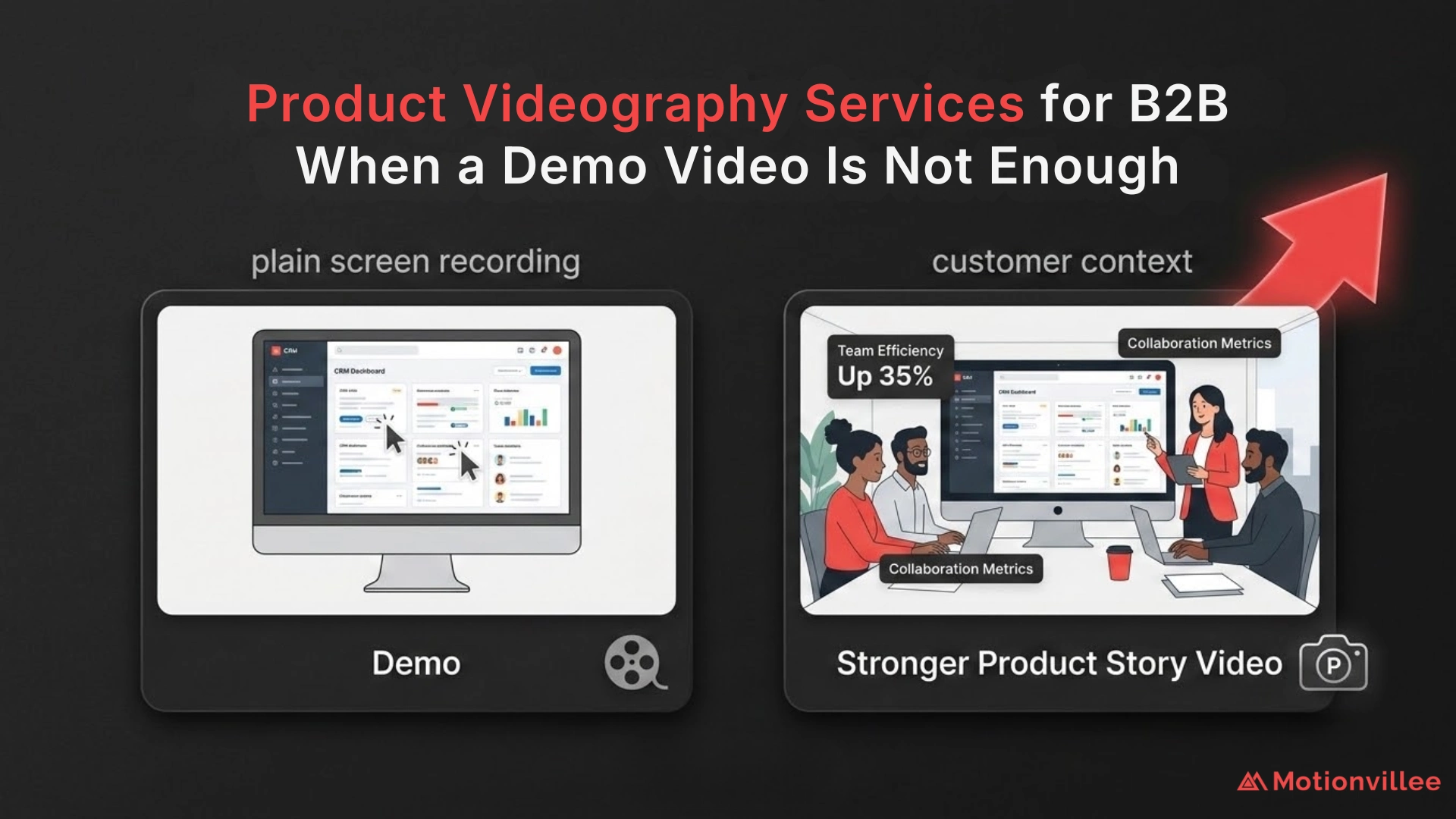
Video is the medium they reach for first. Data from HubSpot’s 2026 marketing report indicates that 51% of consumers rely on product videos specifically to make an educated purchase decision [Plainly/HubSpot, 2025]. And 82% of consumers report being convinced to buy a product or service after watching a marketing video [Wyzowl, 2026]. However, there is a critical distinction that most marketing teams overlook. A demo video shows what a product does. A product videographer communicates why it matters, how it transforms a workflow, and what it feels like to actually use it in a real business context. In a buying environment where prospects are making decisions without your sales team present, the difference between those two messages is the difference between making the shortlist and being eliminated.
The Measurable Limits of a Standard Demo Video
A well-produced demo video is not without value. It reduces support inquiries, accelerates onboarding, and provides a clear feature walkthrough. ContentBeta’s data suggests that prospects who engage with demo content convert at rates 7.9 times higher than those who skip it entirely [ContentBeta, 2025]. That figure alone justifies having a demo. But the data also reveals a ceiling.
Demo videos tend to perform well only at specific stages of the funnel, primarily the bottom, where intent is already established. They are less effective at the top, where awareness and initial trust are being formed, and in the middle, where differentiation and emotional connection drive preference. A Wistia analysis of B2B video performance found that videos between three and thirty minutes perform best when audiences are in research mode, but completion rates for standard demo formats plateau significantly after the first 90 seconds [Wistia, 2026].
Furthermore, 91% of respondents in a 2026 consumer survey stated that video quality directly impacts their trust in a brand, an increase from 87% in 2024 [SellersCommerce, 2026]. A poorly lit, narrated screen recording with stock transitions does not just underperform. It actively undermines brand authority at the exact moment a prospect is deciding whether your company is credible enough to invite into a procurement conversation.
When Product Videography Services Drive Real Business Outcomes
The decision to invest in professional product videography services should be driven by a specific business context, not a general desire for better production quality. Based on market patterns and client outcomes observed across B2B verticals, three conditions consistently signal that a company has outgrown its demo-only approach.
First, when the product is complex or technical, visual storytelling is required to communicate value beyond a feature list. A qualified product videographer can translate intangible capabilities, such as software integration, hardware precision, or workflow automation, into visual narratives that resonate with non-technical stakeholders who hold purchasing authority.
Second, when competitive differentiation is diminishing. In saturated markets, multiple vendors offer near-identical functionality. Search results featuring video content drive 157% more organic traffic compared to text-only results [AIOSEO, 2025]. Companies that invest in higher production value signal market leadership and capture disproportionate attention in search and social feeds.
Third, when the sales cycle involves multiple decision-makers with different priorities. A CTO may respond to technical specifications in a demo. A CFO responds to efficiency gains visualized through real-world application. A VP of Operations responds to workflow transformation. A strategic product video producer can create modular video assets that speak to each stakeholder’s priorities without producing seven separate videos. In each of these scenarios, the role extends beyond operating a camera. It involves translating business strategy, competitive positioning, and buyer psychology into a visual format that moves prospects through the pipeline faster and with greater conviction.
Building a Video Brief That Drives Results
The difference between a demo video brief and a product videography brief mirrors the difference between the videos themselves. A demo brief typically specifies features to cover, screen flows to capture, and narration scripts. A strategic product videography brief specifies business objectives, competitive messaging, target buyer personas, and the emotional response the video is intended to trigger.
For marketing teams evaluating whether to upgrade their approach, the distinction matters. A detailed Business Video Production: A Practical Guide for B2B Marketing Teams Who Want Results outlines how production briefs should be structured around measurable outcomes rather than feature inventories. The best product videography engagements begin not with a short list but with a clear understanding of which stage of the buyer journey the video must influence and what action the viewer should take immediately after watching.
A Decision Framework: Demo Video vs. Product Videography
For marketing leaders deciding where to allocate video budget, the following framework offers a practical starting point. Your current demo video is sufficient if your product is simple, your market is uncontested, your buyers are highly technical and make decisions based on specifications alone, and your competitive position is already dominant.
You should invest in product videography services if any of the following apply: your product requires visual explanation to convey value beyond features, your competitive landscape is tightening and commoditization is a risk, your sales team reports that prospects lose interest or fail to understand differentiation, your organic search visibility for product-related queries is declining, or you are launching a new product into a market where brand awareness is low.
This is not an either-or proposition. Most enterprise B2B companies benefit from maintaining a functional demo while layering in higher-production product videography for awareness-stage content, competitive comparison assets, and executive-facing materials. The key is understanding which format serves which stage of the funnel and allocating investment accordingly.
The Competitive Imperative
The data is unambiguous about the direction of B2B content strategy. In 2026, 84% of B2B marketers reported that video marketing delivers a better return on investment compared to other content formats [Vidyard/Gitnux, 2026]. Companies using video see an average increase of 38% in lead generation, and 52% of B2B marketers state that video is the single highest ROI content type for their niche [Vidico, 2026].
But the opportunity is not simply to make more videos. It is to make a video that performs a fundamentally different strategic function than a screen recording with voiceover. The companies that will win the next decade of B2B buying cycles are those that treat product video not as a support asset but as a primary demand generation tool, with the production quality, strategic messaging, and buyer-centric storytelling to match.
The gap between a demo video and a product video is not a gap in production technique. It is a gap in strategic thinking about what video is supposed to accomplish for the business. For marketing leaders ready to close that gap, the returns are measurable, the competitive advantage is real, and the window of opportunity, while still open, is narrowing.