
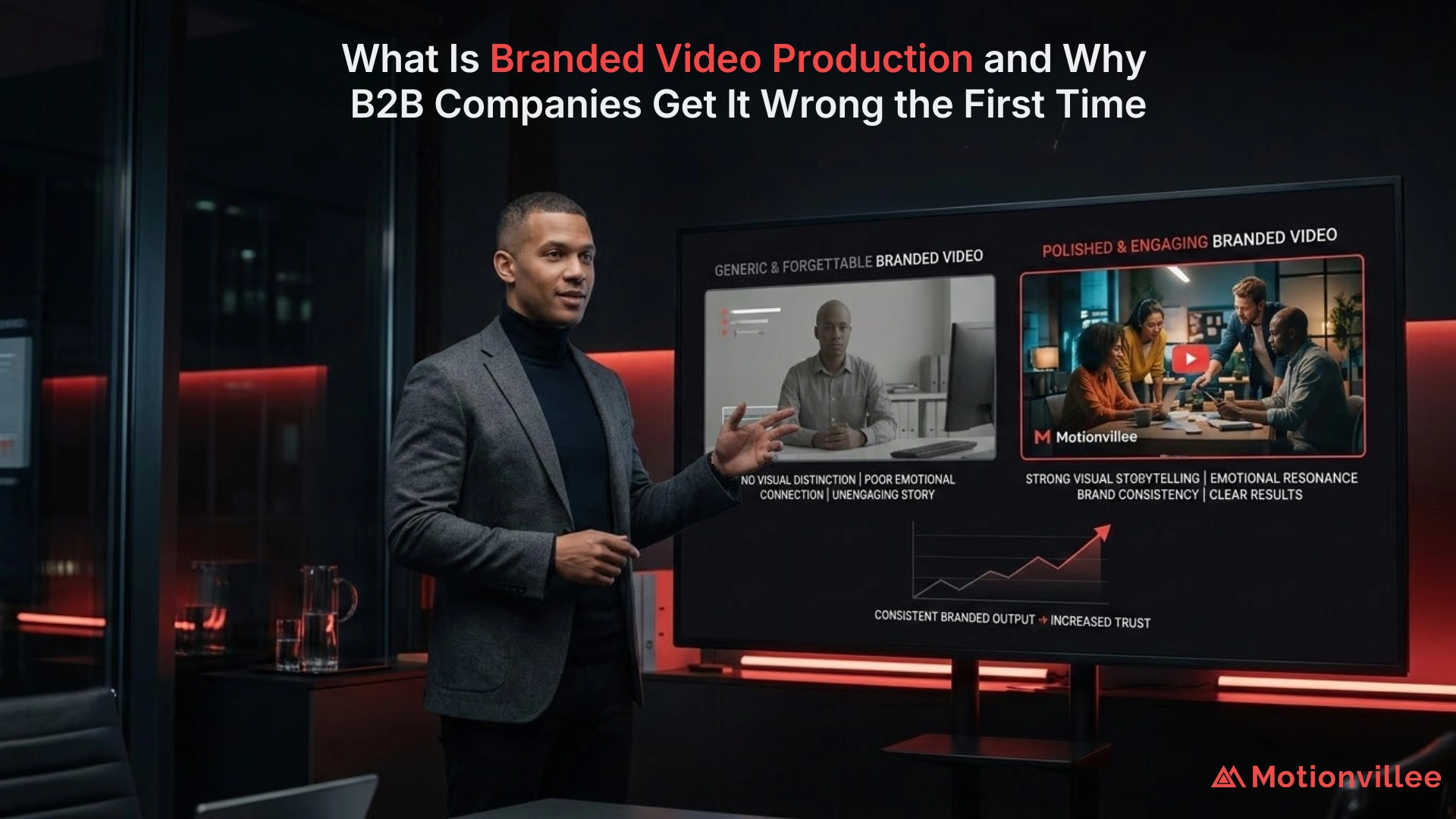
What Is Branded Video Production and Why B2B Companies Get It Wrong the First Time
Most B2B marketing leaders have lived through the same cycle: a significant video budget gets approved, a production partner is engaged, and weeks later a polished asset lands in your inbox. Three months pass. The view count is disappointing, the pipeline impact is negligible, and the internal conversation shifts to “what went wrong.” The uncomfortable truth is that the failure rarely stems from poor creative execution. According to Advids’ analysis of hundreds of B2B campaigns, the failure is operational and strategic, not creative [Advids, 2025]. More than half of all B2B videos receive fewer than 1,000 views after publication, despite 81% of companies now maintaining dedicated video budgets [HubSpot, 2026; Advids, 2025].
Branded video production, when approached correctly, operates as a brand equity multiplier rather than a line-item expense. The distinction matters because the companies that treat it as a strategic investment tend to see measurable returns: 93% of marketers who use video report it has increased brand awareness, and 83% say it has directly contributed to sales [Wyzowl, 2026]. The gap between those results and the underperforming majority comes down to decisions made before a single frame is shot.
Why Branded Video Demands a Strategic Reset Now
The pressure to invest in video has never been greater. Wyzowl’s 2026 survey found that 91% of businesses now use video as a marketing tool, and 92% plan to maintain or increase their video spending this year [Wyzowl, 2026]. B2B buyers are driving this shift: 78% watch video content during their research phase, and 70% report that video helped them make a purchasing decision faster [Zebracat, 2025]. LinkedIn’s own data shows video viewership on its platform increased 36% in 2024, reaching 154 billion total views [Adobe/LinkedIn, 2026].
Yet the definition of this discipline remains poorly understood across the B2B sector. It is not a product demonstration with a logo card at the end. It is not a recruiting montage set to licensed music. At its core, it is the disciplined process of translating a company’s market positioning, value proposition, and customer narrative into a visual format designed to build trust, differentiate the brand, and advance specific business objectives. It sits within a broader video strategy that includes formats like an Animated Explainer Video for B2B Sales: The Complete Guide for Marketing Teams in 2026
, but its purpose is fundamentally different. Explainer videos educate. Testimonial videos validate. Branded videos position.
The confusion between these formats is where most B2B companies stumble on their first attempt.
The Four Strategic Mistakes That Undermine First-Time Branded Video
Initiatives
Mistake 1: Confusing a Brand Video with a Product Advertisement
The most prevalent error is approaching branded video as an extended product pitch. Marketing teams present feature lists, capability decks, and technical specifications, then wonder why the asset fails to resonate with anyone outside the product team. LinkedIn Creative Labs research analyzing 13,000 B2B video advertisements found that videos focused on human experience delivered 18% greater engagement than those addressing abstract concepts and 10% higher engagement than product-led messaging [LinkedIn Creative Labs, 2025]. Documentary-style branded content is perceived as 2.3 times more trustworthy than traditional advertisements [Think Branded Media, 2025]. The inference is clear: audiences respond to narrative, not specifications.
Mistake 2: Skipping Strategic Pre-Production
Pre-production planning receives the smallest slice of attention and budget, yet it determines whether a project succeeds or fails. Common patterns include undefined target personas, absent KPIs, and no distribution strategy before production begins. Advids’ research describes this as the “post-and-pray” mentality: uploading a finished video to primary channels without a systematic distribution plan, then hoping the right audience finds it [Advids, 2025]. The result is predictable. Marketing teams that invest 15 to 20% of their total video budget in pre-production, including creative brief development, scriptwriting, storyboarding, and KPI definition, consistently report fewer revision cycles and stronger final outcomes [SNXP Studio, 2025].
Mistake 3: Selecting a Production Partner Based Primarily on Cost
Procurement processes in mid-to-enterprise companies often default to lowest-cost evaluation when selecting a video production vendor. The risk is significant: an inexperienced production partner means the company pays for that partner’s learning curve with its own brand reputation. Industry practitioners note that a poorly executed $5,000 video generating zero ROI is more expensive than a $15,000 video that converts [SNXP Studio, 2025]. When evaluating potential partners, the production company’s own website often reveals how seriously they take brand consistency and narrative discipline. Reviewing What to Look for on a Video Production Company Website Before You Sign a Contract provides a structured framework for this assessment. A more effective evaluation approach considers relevant portfolio work, detailed budget breakdowns, and client references alongside price.
Mistake 4: Treating Distribution as an Afterthought
The final and perhaps most costly mistake is producing a single video asset without planning for multi-platform distribution or content repurposing. Industry data from HubSpot shows that 85% of mobile users watch video without sound, meaning auto-captions and on-screen text are technical requirements rather than optional enhancements [HubSpot, 2025]. A single production day should yield a hero video plus five to ten micro-clips for social platforms, behind-the-scenes content for employer branding, and still photography for digital channels. A structured approach to Business Video Production: A Practical Guide for B2B Marketing Teams Who Want Results walks through the full lifecycle from brand brief to final delivery and distribution planning.
A Decision Framework for Your First Branded Video Initiative
Marketing leaders approaching brand marketing video production for the first time can apply a four-point framework to reduce risk and improve outcomes:
- Define the business objective before the creative brief. Is the goal pipeline acceleration, market positioning, customer retention, or competitive differentiation? The creative direction must follow the strategic objective, not the reverse.
- Invest in pre-production. Allocate 15 to 20% of the total budget to audience research, persona definition, narrative structure, and KPI alignment before any footage is captured.
- Evaluate production partners on strategic capability. Portfolio relevance, process transparency, and client references matter more than the lowest bid. A partner’s ability to translate business objectives into visual narrative is the core competency to assess.
- Design the distribution architecture before production. Plan for platform-specific formats, caption requirements, and content repurposing during the pre-production phase, not after delivery.
This framework does not guarantee a viral outcome. It does, however, shift the probability of success in the marketing team’s favor by addressing the four failure points identified above.
Moving from Forgettable Content to Brand-Building Assets
The B2B companies that derive the most value from these investments are those that treat branded video as a strategic initiative requiring the same rigor as any other major marketing initiative: clear objectives, defined metrics, disciplined execution, and systematic measurement. The data supports this approach. Video delivers 95% message retention compared to 10% for text-based content when executed with narrative intention [Adobe/LinkedIn, 2026]. For marketing leaders at mid-to-enterprise organizations considering their first branded video initiative, the question is no longer whether to invest, but how to invest with the strategic discipline that separates brand-building content from forgettable content.