
How Animated Healthcare Videos Help Complex Medical Products Win More B2B Buyers
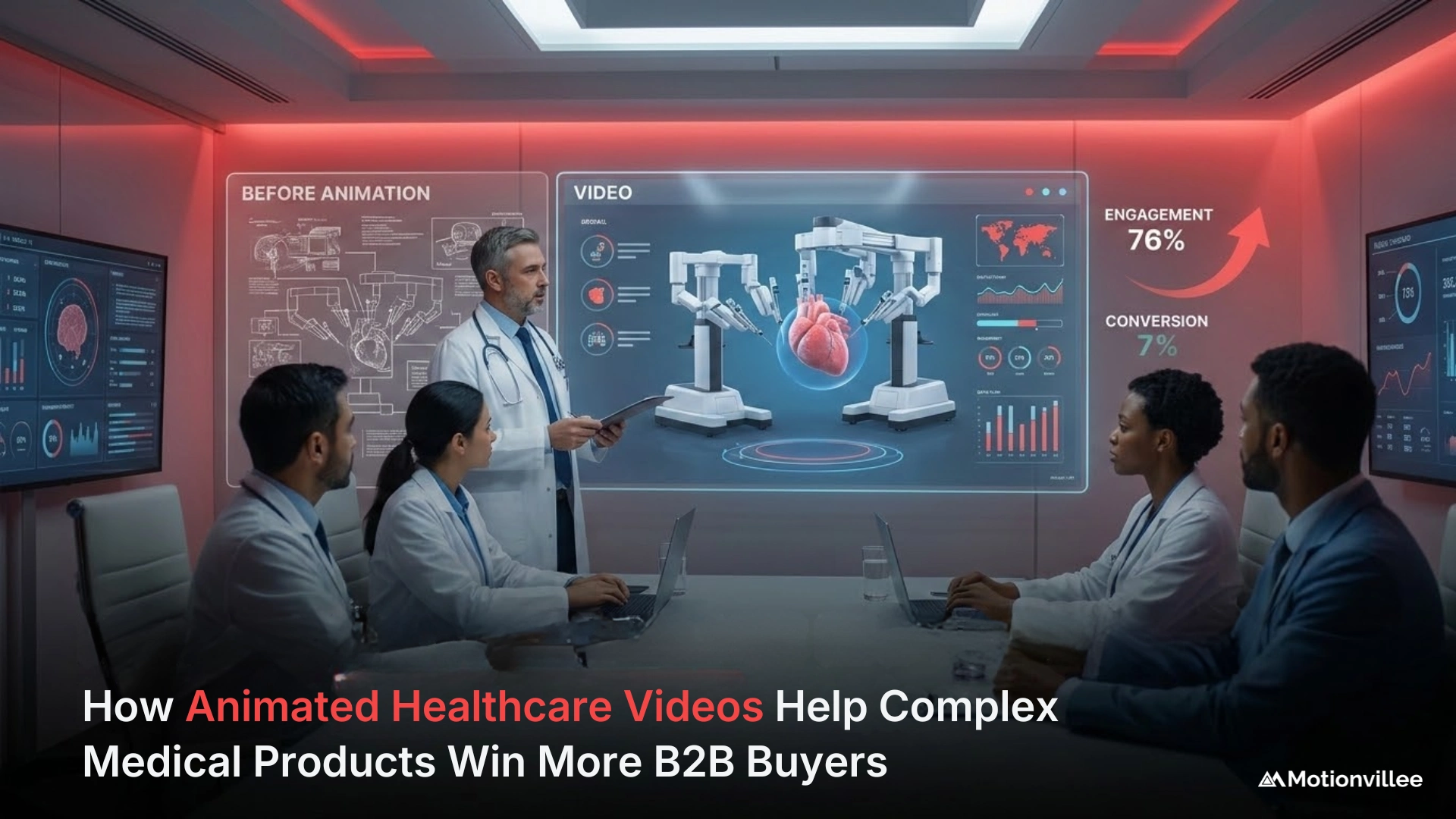
Forty-eight percent of patients report difficulty understanding medical device labeling, and 39% say they needed to ask their doctor for clarification [JAMA Network, 2023]. That statistic describes patient-facing communication. Now consider the B2B equivalent: a procurement committee evaluating a $2 million diagnostic imaging system, a CFO assessing ROI on a surgical robotics platform, or a hospital network negotiating a multi-year equipment contract. The comprehension challenge does not disappear at the enterprise level. It intensifies. When the product itself is invisible, intangible, or operates at a level of complexity that resists simple description, the marketing asset that bridges the gap between confusion and confidence is often not a white paper, a case study, or a demo. It is a video. And increasingly, it is an animated one, produced by a healthcare video production company that understands both the clinical science and the buying committee’s language.
The Healthcare B2B Buying Paradox
Healthcare B2B sales cycles are 30 to 50 percent longer than non-healthcare B2B sales, driven by regulatory validation requirements, multi-stakeholder consensus building, and institutional procurement protocols [McKinsey, 2024]. Seventy-eight percent of medical device buyers research products online before engaging a vendor, and 81% check manufacturer websites during their evaluation process [PatientPop Survey, 2023; ZipDo Medical Device Report, 2026]. These are not casual browsers. They are clinicians, administrators, and procurement specialists conducting methodical due diligence before a single conversation takes place.
The content format that reaches them most effectively may surprise teams accustomed to investing heavily in white papers and trade show presence. According to a Content Marketing Institute study, 74% of medical device marketers cite video as their highest-performing content type, and 70% of healthcare professionals identify video as the most useful content format when evaluating products [Content Marketing Institute, 2025; ZipDo, 2026]. Video content now accounts for 41% of all medical device marketing assets [CMI, 2025]. This is not a peripheral trend. It is a structural shift in how healthcare buying committees consume information, and healthcare video production has become central to reaching them.
For healthcare marketers looking to understand the broader B2B video landscape before specializing their approach, Animated Explainer Video for B2B Sales: The Complete Guide for Marketing Teams in 2026 provides a comprehensive framework for how animated video maps to every stage of the sales funnel.
Why Animation Simplifies What Text and Live Action Cannot
The clinical evidence for animation as a comprehension tool is robust. A 2024 systematic review published in the Journal of Medical Internet Research, encompassing 15 randomized controlled trials and 2,454 patients across multiple healthcare settings, found that 73% of studies reported statistically significant improvements in health information recall when animation videos were used compared to standard information delivery [JMIR, 2024]. A separate meta-analysis of 21 studies examining animated videos in clinical and nonclinical settings found a positive overall effect on learning, with an effect size of d = 0.35 [Meta-Analytic Review, ResearchGate, 2022]. While these studies focus on patient populations rather than B2B buyers, the underlying cognitive mechanism is identical: animation reduces cognitive load by translating abstract, multi-step processes into visual narratives that are processed more efficiently than written text or static diagrams.
For medical video production, this finding has direct commercial implications. When a healthcare video animation services provider produces a 90-second asset that increases buyer comprehension of a complex product by a measurable margin, that asset does not just generate engagement. It accelerates the buying committee’s ability to reach consensus, which in a sales cycle that runs 30 to 50 percent longer than the B2B average, translates directly to reduced cost of sale and faster pipeline velocity. That is why animated healthcare video production has become a strategic differentiator for medical device manufacturers seeking to compress extended evaluation timelines.
Trust, Compliance, and the Regulatory Dimension
Healthcare marketing operates under regulatory scrutiny that most B2B sectors do not face. In 2025, the FDA issued over 200 enforcement letters challenging advertising and promotion across drugs, biologics, and medical devices [MedDeviceGuide, 2025]. While most enforcement has targeted pharmaceutical companies, the regulatory framework for medical device promotion carries the same fundamental risk: promotional claims that are false, misleading, or fail to fairly balance benefits with risks can result in enforcement action, reputational damage, and criminal misbranding charges [FFDCA]. Every video asset that a medical device company distributes is, from a regulatory standpoint, labeling. That includes websites, brochures, social media posts, and downloadable video files [Morgan Lewis, 2025].
This is not a reason to avoid video. It is a reason to choose the right video production agency for healthcare, one that understands that compliance and clarity are not opposing forces. Seventy-two percent of physicians associate the phrase “FDA-cleared” with “high-quality” medical devices [Ipsos Healthcare Survey, 2023]. Compliance, when executed well, is a trust signal. A video that accurately represents a device’s indications, presents balanced risk and benefit information, and aligns with brand identity simultaneously builds credibility with both clinical and procurement audiences. Healthcare video production services that embed regulatory awareness into their workflow reduce downstream risk for their clients while producing content that buyers actually trust.
Measurable Pipeline Impact: What the Data Suggests
The business case for animated healthcare video extends beyond comprehension. Seventy-three percent of medical device companies now use patient education videos as part of their marketing strategy, and 56% report a 25% or greater increase in patient satisfaction scores as a result [CMIC, 2023]. While patient satisfaction is not a direct B2B pipeline metric, it serves as a proxy for content effectiveness. If the same animated assets that improve patient comprehension also reduce the number of clarifying questions during B2B sales cycles, the downstream effect on sales efficiency becomes measurable.
Landing pages with embedded video see up to 86% higher conversion rates than those without [Hostinger/EyeView, 2025]. For medical video production companies targeting mid-to-enterprise buyers, the implication is clear: the asset that educates the buyer is also the asset that converts them. Seventy-eight percent of B2B medical device marketers prioritize LinkedIn for content distribution, with 65% reporting lead generation success on the platform [Demand Gen Report, 2023]. Animated video, optimized for LinkedIn’s native player and vertical format, represents a convergence of the right format, the right channel, and the right audience. The medical video production services that understand this intersection are positioned to deliver outsized returns on content investment.
Production Considerations for Healthcare Markets
Healthcare video production introduces constraints that do not exist in most B2B sectors. Claims must be substantiated. Risk information must be presented with the same prominence as benefit claims. Brand guidelines must be followed across every frame, not just in logo placement but in tone, pace, and visual hierarchy. An animated healthcare video production company that treats these constraints as afterthoughts will produce content that either fails regulatory review or fails to resonate with its intended audience.
Brand alignment is particularly critical in healthcare. Inconsistent messaging across video assets erodes the trust that regulatory compliance is designed to build. For teams that have experienced the consequences of misaligned video content, What Is Branded Video Production and Why B2B Companies Get It Wrong the First Time
examines the specific patterns that lead to wasted production spend and unreliable deliverables. In healthcare, where animated healthcare video production services must satisfy both marketing objectives and regulatory requirements simultaneously, getting the brief right on the first attempt is not optional. It is a cost imperative.
A Decision Framework: When Animated Video Is the Right Investment
A simple framework can help healthcare marketing teams determine whether animated video warrants investment in their current pipeline strategy.
First, the complexity test. Does your product require the buyer to understand a multi-step mechanism, an internal process, or a clinical workflow that cannot be photographed or demonstrated in a 60-second live-action clip? If yes, animation eliminates the visualization gap. Second, the consensus test. Does your sale require alignment across clinical, financial, and administrative stakeholders who speak different professional languages? If yes, animated healthcare explainer video production creates a shared visual reference that reduces miscommunication across the buying committee.
Third, the compliance test. Does your product operate under regulatory frameworks that restrict or require specific language in promotional materials? If yes, animation allows precise control over every word of scripting and every visual element, reducing the risk of inadvertent off-label implications. Fourth, the training test. Beyond initial acquisition, does your customer success function require ongoing education for clinical staff? If yes, medical training video production using animation provides a scalable, consistent training asset that reduces the burden on field teams.
If your product scores yes on two or more of these criteria, animated healthcare video production deserves a dedicated line item in your next quarterly content budget. If it scores yes on three or more, the delay is costing you pipeline velocity.
The Strategic Outlook
The global medical devices market is projected to exceed $600 billion in 2026 and approach $1 trillion by 2035 [Precedence Research, 2025; Fortune Business Insights, 2025]. As market size grows, so does the competition for buyer attention. Healthcare buying committees will continue to conduct more independent research, demand clearer communication, and hold vendors to higher standards of accuracy and compliance. In that environment, the healthcare video company that helps a buyer understand a complex product in under two minutes does not just earn attention. It earns a seat at the negotiation table. The question for healthcare marketing leaders is whether their content strategy is built to compete for that seat.