
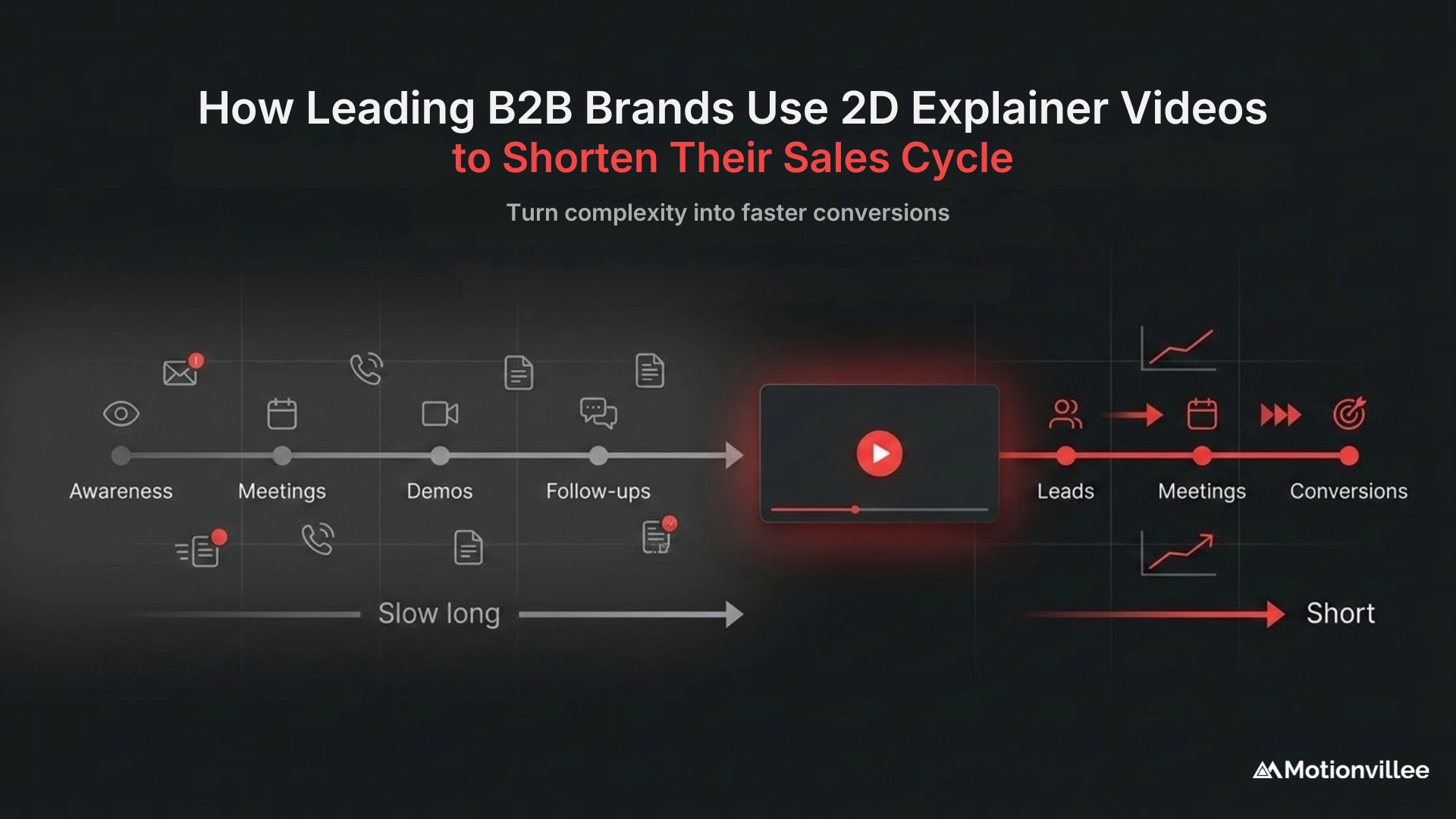
How Leading B2B Brands Use 2D Explainer Videos to Shorten Their Sales Cycle
The average B2B sales cycle runs between 6 and 12 months [Salesforce State of Sales, 2023]. Most of that time isn’t spent in negotiation. It’s spent waiting , waiting for buyers to understand the product well enough to make a decision, waiting for internal champions to explain the value to stakeholders who weren’t in the demo, waiting for procurement to finish a review process that could have been compressed if the right information had been delivered more efficiently.
That waiting is not inevitable. It is, in large part, a communication problem. And a well-deployed 2D animation explainer video is one of the most direct tools available for solving it.
This post examines where 2D animation creates the most leverage in the B2B sales cycle, what the evidence says about how it works, and how to deploy it in a way that produces measurable pipeline impact rather than vanity metrics. For the broader strategic context on explainer video investment, the complete guide to explainer videos covers the foundational framework this decision sits inside.
Why Does the B2B Sales Cycle Take So Long?
B2B sales cycles are long primarily because complex products require multiple stakeholders to reach independent understanding before any one of them will commit to a decision.
Gartner’s 2023 B2B Buying Journey research found that the typical B2B purchase involves 6 to 10 decision-makers, each conducting independent research. Each of those stakeholders needs to understand the product well enough to advocate for it , or at least not block it. The vendor rarely controls those internal conversations. What they can control is the quality of information those stakeholders have access to before those conversations happen.
This is the structural opportunity for 2D explainer video. It is not primarily a marketing asset. In the context of sales cycle compression, it is a communication infrastructure investment , a tool that allows your value proposition to be accurately represented in rooms where your sales team is not present.
The evidence on video’s role in this context is directional rather than definitive. Forrester’s 2023 B2B Buying Study found that 68% of buyers prefer to conduct independent research before engaging a vendor. A video asset that can be shared asynchronously , forwarded by an internal champion to a CFO, embedded in a proposal, included in a follow-up email , removes the friction that occurs when the buyer’s information depends on a rep being available to explain it.
Where in the Sales Cycle Does 2D Animation Create the Most Leverage?
2D animation explainer video creates the most leverage at two specific points: before the first conversation and immediately after the demo.
These two moments share a common characteristic , they’re both points where buyer comprehension either accelerates or stalls, and where the vendor has very little direct control over what happens.
Before the first conversation, a 2D explainer video on a product page or in an outbound sequence performs a qualification function. Buyers who watch it and engage are self-selecting as interested. Buyers who don’t are filtering themselves out before the sales team spends time on them. This improves the quality of first conversations because the buyer already has baseline product understanding , the call starts at a higher level of engagement.
After the demo, the 2D explainer video serves a different function: it enables the internal champion to do the selling work the vendor can’t do directly. Most B2B purchase decisions involve at least one stakeholder who never attended a demo. The champion who did attend needs to convey what they learned. A 2D explainer video gives that champion a reliable, accurate, and concise version of the core message to share , one that doesn’t depend on their memory of a 45-minute presentation.
This deployment pattern , before and after the demo , is an inference based on documented B2B buying behavior patterns rather than a finding from a controlled study on video specifically. Treat it as a strong hypothesis supported by the structural logic of how B2B decisions are made.
What Does the Research Say About Video and Sales Velocity?
The research on video and sales velocity is promising but incomplete , and the limitations are worth understanding before making investment decisions based on it.
Vidyard’s 2023 Video in Business Report found that 70% of B2B buyers say they watch at least one video during their purchase journey. The same report found that sales reps who use video in their outreach see higher response rates than those who use text alone , but this data comes from Vidyard’s own customer base, which introduces significant selection bias. Organizations already using video are likely more digitally mature and sales-process-oriented than average, which may account for some of the performance difference.
HubSpot’s 2023 State of Marketing Report found that short-form video produces the highest ROI of any content format, cited by 54% of marketers. This data does not isolate sales cycle effects specifically, nor does it separate B2B from B2C contexts. Direct application requires caution.
What the aggregate evidence does support, even with these limitations, is a directional pattern: video-assisted sales processes tend to produce better buyer comprehension outcomes than text-only processes, and better comprehension correlates with faster decision-making. The mechanism is well-grounded in cognitive science. A 2d explainer video reduces the cognitive effort required to understand a complex product , and reduced cognitive effort lowers decision friction.
Why Do B2B Brands Specifically Choose 2D Over Other Animation Styles?
2D animation is the most common format for sales-cycle video assets because it combines fast production timelines, low revision costs, and sufficient visual clarity for the majority of B2B product categories.
For software, services, workflows, and process-based products , which account for the majority of B2B sales contexts , the spatial relationships and physical complexity that justify 3D animation are absent. 2D handles these categories well at lower cost and with the production flexibility that matters in organizations where messaging evolves with product updates.
There’s also a credibility alignment factor. For B2B buyers in SaaS, fintech, professional services, and enterprise technology, 2D animation signals modernity and clarity without the visual excess that can make 3D feel more focused on production quality than product substance.
The style choice, however, should always follow the buyer and the product rather than convention. For a full analysis of how to match animation style to buyer context and product category, best animated explainer video style for your business maps the decision criteria across all major formats.
How Should You Deploy 2D Explainer Video in Your Sales Process?
Deploy 2D animation explainer content at the moments where buyer comprehension is most likely to stall: pre-qualification, post-demo follow-up, and multi-stakeholder proposal stages.
A practical deployment framework:
Pre-qualification: Embed a 60 to 90-second 2D explainer video on your primary product page and in outbound sequences. Measure engagement as a qualification signal , not just views, but click-through to the next step. Use UTM parameters to track which video touchpoints precede demo bookings.
Post-demo follow-up: Include a tailored or segment-specific 2D explainer in the follow-up email sent within 24 hours of a demo. The goal is to give the champion a shareable asset they can forward to stakeholders who weren’t present. Track forward rates and secondary engagement where possible.
Multi-stakeholder proposals: Embed a short, outcome-focused 2D explainer video directly in proposal documents or on a dedicated landing page linked from the proposal. This gives each stakeholder , CFO, CTO, procurement , access to the same baseline information in a format they can consume independently.
Each of these deployments requires a pre-defined success metric. Views are not a business metric. The relevant measures are demo booking rate, time from first contact to proposal, and time from proposal to close.
What Should You Do Next?
If your sales cycle is running longer than it should, the first question to ask is not “do we need a video?” but “where is the comprehension gap that’s slowing us down?”
The answer to that question determines where to deploy 2D animation and what it needs to say. It also determines whether a single video will address the problem or whether a sequence of assets mapped to different stakeholders and stages is the right investment.
That sequencing decision is a strategy question before it’s a production question. The organizations that consistently compress their sales cycles with video don’t produce better animations , they produce more precisely targeted ones.
If you’re at the stage of evaluating production partners who can work from that kind of strategic brief, the criteria worth applying are outlined in top explainer video companies , specifically what separates vendors who start with your funnel from those who start with their reel.
Motionvillee works with B2B marketing and sales teams as a strategic partner. The engagement starts with your pipeline data and your buyer journey , not a brief.