
What Is the Best Animated Explainer Video Style for Your Business?
Most B2B marketing teams choose an animation style the same way they choose a font: based on what looks good in the moment, or what a vendor showed them first.
That approach has a cost. Animation style is not a cosmetic decision. It is a positioning signal. The style you choose communicates something to your buyer before they’ve processed a single word of your script. Get it wrong and you’ve created a mismatch between how your company wants to be perceived and how your video is actually received.
This post examines what the evidence and business logic say about matching animation style to brand positioning, buyer expectations, and funnel context. If you’re building foundational knowledge on the format first, the complete guide to explainer videos covers the strategic landscape this decision sits inside.
Does Animation Style Actually Affect Business Outcomes?
Animation style affects buyer perception and cognitive processing in ways that have measurable downstream effects on engagement and conversion.
The research on visual communication and persuasion is more robust than most marketing teams realize. A 2013 study published in the journal Computers in Human Behavior found that visual style significantly influences perceived credibility and trustworthiness of digital content, independent of the information itself. While this study focused on web design rather than video specifically, the underlying principle , that aesthetic choices shape credibility signals , applies directly to animated explainer videos.
More directly relevant is a 2021 paper in the Journal of Business and Technical Communication examining how animation style affects information retention in professional training contexts. The findings suggested that congruence between visual complexity and message complexity improved retention by a measurable margin. (Note: effect sizes varied significantly across studies in this area, and direct application to marketing video is inferential rather than experimentally confirmed.)
The practical implication is this: the best animated explainer videos aren’t the ones with the highest production values. They’re the ones where the visual style reinforces the message rather than competing with it.
What Are the Main Animation Styles and What Does Each Signal?
Each animation style carries a distinct set of brand associations that either align or conflict with your positioning , and the wrong choice creates cognitive friction for the buyer.
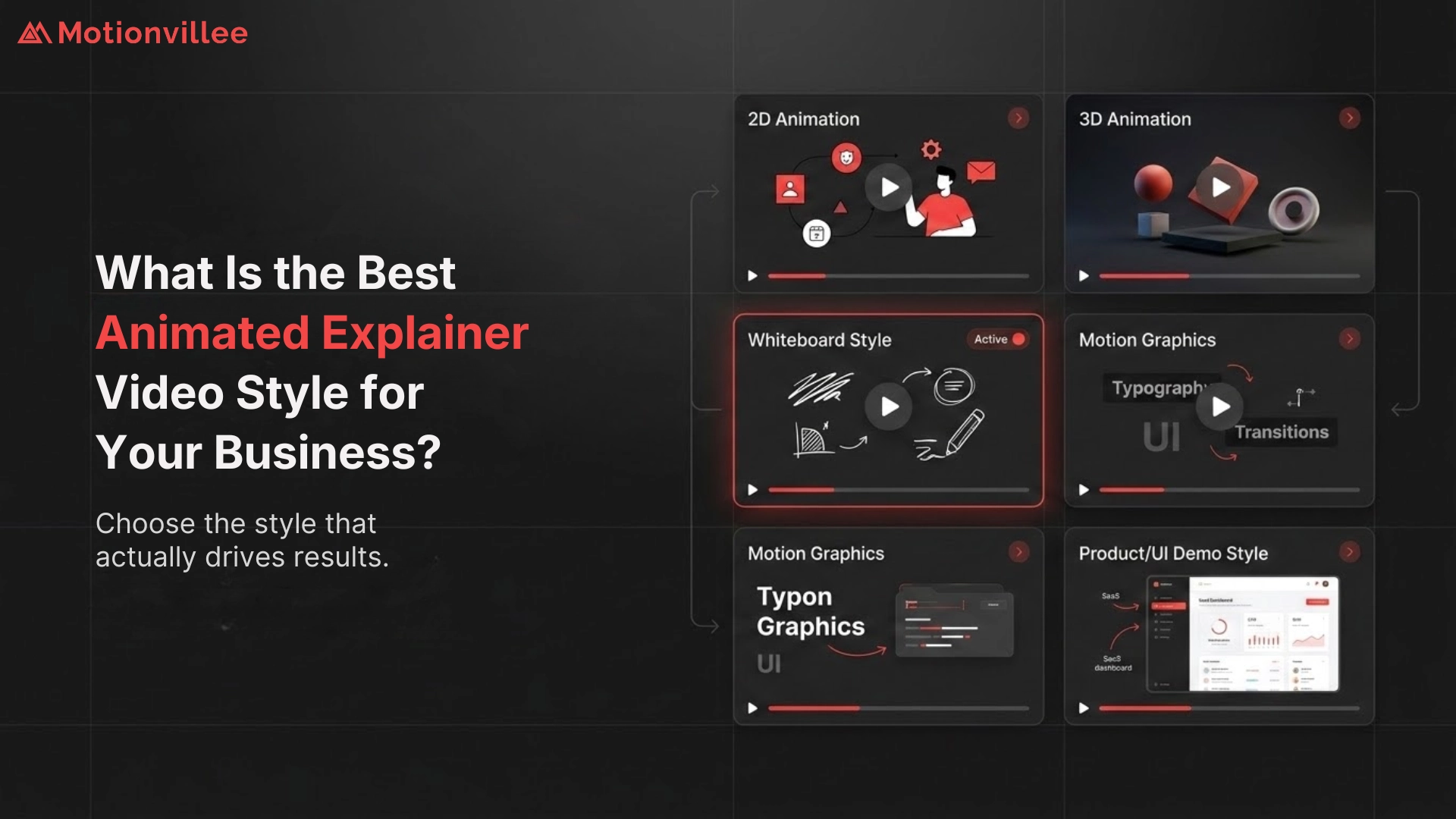
The primary styles in B2B video contexts are flat 2D animation, motion graphics, whiteboard animation, and 3D animation. Each has a distinct signal profile.
Flat 2D animation signals approachability, clarity, and modernity. It performs consistently across SaaS, HR tech, and professional services categories where the buyer values simplicity and speed of comprehension. The visual economy of flat design reduces cognitive load, which matters when your product is complex and your buyer is time-pressed.
Motion graphics signal precision, data literacy, and sophistication. They perform well in fintech, cybersecurity, infrastructure, and analytics categories where the buyer expects technical competence and responds to data-driven visual storytelling. A visual explainer built in motion graphics for a consumer-facing brand will often feel cold. The same approach for an enterprise data platform feels authoritative.
Whiteboard animation signals education and transparency. It was the dominant B2B style for most of the 2010s and retains credibility in professional services, consulting, and compliance contexts where the “showing my work” aesthetic builds trust. Its weakness is pacing , the whiteboard tends to run long, which creates problems on channels where attention windows are short.
3D animation signals scale, investment, and technical depth. It is the highest-cost option and the highest-risk one. When it’s used appropriately , for physical products, hardware, or infrastructure where spatial relationships matter , it can be among the best explainer video examples in a category. When it’s used as a status signal rather than a strategic one, it adds cost without adding clarity. For a structured analysis of when that investment is justified, when 3D explainer videos are worth the investment breaks down the decision criteria specifically.
For a direct style comparison across flat, whiteboard, and motion graphics, the analysis in flat design vs. whiteboard vs. motion graphics comparison covers the trade-offs at a more granular level.
How Does Buyer Audience Affect Style Choice?
The same animation style can accelerate trust with one buyer profile and undermine it with another.
This is the variable most teams miss. They evaluate style against their own aesthetic preferences rather than against their buyer’s frame of reference.
A CFO evaluating a financial infrastructure platform brings a different set of visual expectations than a Marketing Director evaluating a content management tool. The CFO’s context is precision, risk, and compliance. Motion graphics that emphasize data visualization and controlled movement will align with that frame. Playful flat animation with character-driven storytelling will create a subtle credibility gap , not because the content is wrong, but because the visual register doesn’t match the stakes of the decision.
Conversely, a VP of Marketing evaluating a campaign management platform expects a degree of creative sophistication in the vendor’s own marketing. A whiteboard video in that context can signal that the vendor doesn’t practice what they preach.
This audience-style alignment is not tested extensively in academic literature specific to B2B video. The observation is inferential, based on documented patterns in B2B buyer psychology research and brand perception studies. Treat it as a strong hypothesis, not a proven effect.
What Framework Should You Use to Choose an Animation Style?
Choose animation style by mapping three variables: your buyer’s professional context, your product’s complexity level, and the channel where the video will be deployed.
The framework works as a three-way filter:
Buyer context: What visual register does your buyer associate with credibility in their professional domain? A buyer in financial services has different associations than a buyer in creative technology. Start here, not with your own preferences.
Product complexity: Higher complexity generally calls for higher visual precision. Motion graphics handle abstraction better than character-based 2D. 3D earns its cost when spatial relationships are central to understanding. Flat 2D handles process and workflow explanations with the least friction.
Channel and duration: LinkedIn video content has an average watch time that drops sharply after 30 seconds [LinkedIn Marketing Solutions data, cited in LinkedIn’s own 2023 benchmarking guidance]. A 90-second whiteboard video built for a product page will not perform on paid social. Style and duration need to be decided together, not sequentially.
Animated explainer video examples that consistently outperform their category typically score well on all three. They don’t just look right , they feel right for the buyer, the message, and the context simultaneously.
For a broader map of how format types connect to specific business objectives, 7 types of animated business videos is a useful reference before finalizing the style decision.
What Does the Best Animated Explainer Video Actually Look Like?
The best animated explainer videos are not the most visually impressive ones. They are the ones where style, message, and buyer context are in complete alignment.
This is an opinion, but it’s one supported by observable patterns across B2B video performance data. The animated explainer videos that generate pipeline impact share one characteristic: nothing in the visual execution contradicts the message.
The style doesn’t call attention to itself. The motion doesn’t compete with the narration. The visual complexity matches the information density. When those three elements are calibrated correctly, the buyer processes the message without friction , and friction-free processing is what produces action.
The teams that consistently produce high-performing video assets treat style as a strategic variable, not a creative one. They brief style the same way they brief messaging: against a defined buyer, a defined moment in the funnel, and a defined success metric.
That’s the standard worth applying to your next video investment.
Motionvillee works from strategy before production. If you’re at the stage of evaluating what style and format fit your buyer and your funnel, that’s exactly where the conversation starts.