
7 Types of Animated Business Videos and Which One Your B2B Brand Actually Needs
Most B2B marketing teams don’t have a video problem. They have a video selection problem.
They know they need animated business videos. They’ve seen competitors use them. They’ve watched their own sales reps fumble through product explanations that a 90-second animation could handle in half the time. So they commissioned a video. And they default to the format they’ve seen most often, or the one their agency recommended first, without asking a more important question: which type of business video is built for the problem we’re actually trying to solve?
The result is a category error that wastes budget and produces assets that don’t move metrics. A company trying to accelerate mid-funnel conversion commissions a brand awareness video. A team trying to explain a complex product produces a testimonial reel. The video gets made. The goal doesn’t get met.
This post maps the seven most strategically relevant types of animated business videos to the buyer journey stages and business outcomes they’re built for. If you’re building foundational knowledge on the format before getting into types, the complete guide to explainer videos covers the strategic landscape this decision sits inside.
Why Does Choosing the Wrong Video Type Kill Performance?
The wrong video type fails not because of execution quality but because it answers a question the buyer isn’t asking at that stage of their decision.
This is the central insight behind most underperforming video assets. Wyzowl’s 2024 State of Video Marketing Report found that 89% of marketers report positive ROI from video overall , but the same report found that one in three struggles to connect video output to measurable business results. That gap tracks almost exactly with the pattern of format mismatch: teams produce videos that look professional but serve the wrong moment in the buyer journey.
The evidence on this is largely inferential rather than experimentally isolated. No controlled study has cleanly separated “wrong video type” as an independent variable from other failure causes. But the pattern is consistent enough across documented B2B marketing failures that treating format-audience-stage alignment as a first-order decision is well-supported as a strategic principle. For a detailed breakdown of the structural failure patterns, why most explainer videos fail to generate ROI examines the root causes across categories.
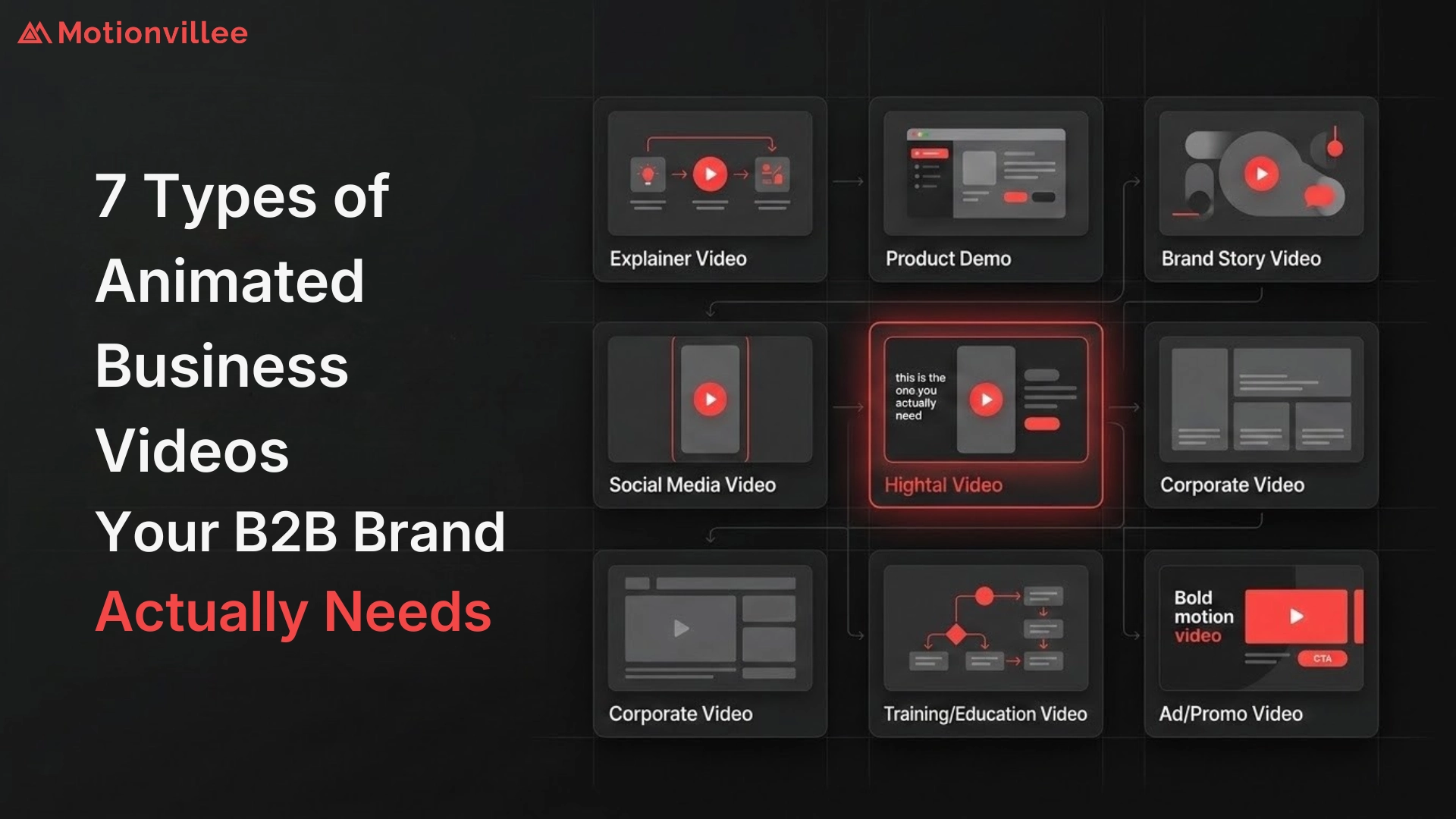
The 7 Types of Animated Business Videos and What Each One Is Built For
1. Explainer Videos
Best for: Awareness and early consideration stages. Buyers who don’t yet understand what you do or why it matters.
Explainer videos are the most widely used format in B2B animation for a reason. They’re purpose-built for the moment when a buyer encounters your product for the first time and needs a fast, clear answer to “what is this and why should I care?”
Corporate explainer videos that work open with the buyer’s problem , not the company’s name. They spend more time on the “why this matters” than the “how it works.” And they end with one specific action. The ones that fail do the opposite: they lead with the brand, explain the product feature by feature, and close with a generic call to learn more.
Wyzowl’s 2024 data indicates that 96% of people have watched a video to learn about a product or service, and 89% say it convinced them to buy. Those figures don’t isolate explainer videos specifically and include B2C contexts, so direct application to B2B requires caution. But they establish that the format has a demonstrated role in purchase decision-making at scale.
2. Product Demo Videos
Best for: Mid-funnel consideration. Buyers who understand the category but are evaluating your specific product against alternatives.
A product demo video shows the product working. Not abstractly , specifically. It answers “how does this actually function in a context I recognize?” rather than “what does this company do?”
The distinction matters because mid-funnel buyers have already self-educated on the category. They don’t need another explanation of the problem. They need evidence that your product solves it in a way that fits their environment. An animated product explainer video at this stage should mirror the buyer’s workflow, show the interface or output they’ll actually use, and demonstrate the outcome rather than describing it.
Product demo videos are also the most update-sensitive format. In fast-moving software markets, a demo video that shows a previous interface version can actively undermine credibility. Build update cycles into the production brief from the start.
3. Brand Story Videos
Best for: Awareness stage. Buyers who are forming a first impression of your company before any product interest exists.
Animated brand videos communicate who the company is, what it stands for, and why it exists , before the product enters the conversation. In B2B contexts, this format earns its place in two scenarios: when you’re entering a new market where brand recognition is zero, and when your competitive differentiation is rooted in culture, mission, or values rather than features.
The risk with animated brand videos is abstraction. Without a specific buyer problem anchoring the narrative, brand story content often produces high engagement metrics and low pipeline contribution. That’s not always a failure , brand awareness has a legitimate role in long sales cycles where trust accumulates over multiple touchpoints. But it requires a different success metric than conversion-focused formats.
4. 2D Explainer Videos for Sales Cycle Acceleration
Best for: Mid-to-late funnel. Buyers who are in active evaluation and need a faster path to clarity.
This is a specific application of the explainer format that deserves its own category. A 2D animation built specifically for sales cycle use operates differently from a top-of-funnel explainer. It’s deployed by sales reps inside sequences, used in post-demo follow-up, or embedded in proposal documents. Its job is to compress the gap between “interested” and “ready to decide.”
The business case for this format is supported by documented patterns in B2B sales behavior. Forrester’s 2023 B2B Buying Study found that 68% of buyers prefer to conduct research independently before speaking with a vendor. A video asset that can be shared asynchronously , without requiring a rep to be present , removes a friction point that slows deal progression. For a more detailed analysis of how this format affects pipeline velocity, how B2B brands use 2D explainer videos to shorten their sales cycle covers the mechanics and evidence.
5. Corporate Animation for Internal Communication
Best for: Internal audiences , employees, distributed teams, training contexts.
Corporate animation is underused as an internal communication tool and overused as an external marketing label. When used intentionally for onboarding, compliance training, process communication, or organizational change announcements, animated video consistently outperforms static documents and slide decks on retention and comprehension.
A 2019 study published in Computers & Education found that learners who received animated instructional content retained information at higher rates than those who received equivalent text-based content, with a moderate effect size (d = 0.54). (Note: this study examined educational contexts, not corporate training specifically. Direct application is inferential, and effect sizes in corporate contexts may differ.)
For marketing leaders, the business case is straightforward: if your product requires customer education post-sale, the same format that works for internal training works for customer onboarding. Animations for business that serve both internal and external audiences at once reduce production cost per use case.
6. Thought Leadership and Category Videos
Best for: Top-of-funnel awareness. Buyers who don’t yet know you exist but are researching a problem you solve.
This format operates differently from the explainer. It doesn’t explain the product. It establishes a point of view on the market, the buyer’s industry, or a problem the buyer is experiencing. The goal is to be found , in search, in social, in AI-generated overviews , by buyers who aren’t looking for a vendor yet.
Explainer video ideas in this category tend to be structured around trends, patterns, or frameworks that the buyer finds independently useful. The brand’s role is secondary to the insight. When done well, these videos generate inbound interest from buyers who weren’t in your pipeline before consuming the content.
The trade-off: thought leadership videos are the hardest format to attribute directly to revenue. They build pipeline at the earliest stage, where multi-touch attribution is least reliable. This doesn’t make them a weak investment , it makes them a difficult one to justify in organizations that only measure last-touch conversion.
7. Customer Story and Proof Videos
Best for: Late funnel and decision stage. Buyers who are convinced of the category but uncertain about the vendor.
Animated customer story videos use the visual format to tell a client’s transformation narrative: the problem they faced, the decision they made, and the outcome they achieved. Unlike live-action testimonials, the animated format allows for narrative control, brand consistency, and privacy where clients prefer not to appear on camera.
The strategic role of this format is trust compression. A buyer at the decision stage has done their research. They know the product. What they’re resolving is vendor risk: “Will this company actually deliver for a company like mine?” A well-constructed proof video with specific, verifiable outcomes , numbers, timelines, business results , addresses that question more efficiently than a reference call or a case study PDF.
A product explanation video positioned as a client story is a particularly effective variant for complex B2B products where the outcome is more persuasive than the mechanism.
How to Match Video Type to Business Goal: A Decision Framework
The selection framework has three inputs: the buyer’s stage in the decision process, the business outcome you’re measuring, and the channel where the video will be deployed.
The table below maps the seven types to these inputs:
| Video Type | Buyer Stage | Business Outcome | Primary Channel |
| Explainer video | Awareness | Category understanding, first contact | Website, paid ads, LinkedIn |
| Product demo | Consideration | Product evaluation, demo bookings | Product pages, email sequences |
| Brand story | Awareness | Brand recall, trust building | Social, PR, events |
| 2D sales cycle video | Consideration / Decision | Deal velocity, proposal support | Sales sequences, proposals |
| Corporate animation | Internal / Post-sale | Training retention, onboarding | LMS, internal comms |
| Thought leadership | Pre-awareness | Inbound discovery, content authority | SEO, social, AI search |
| Customer story | Decision | Vendor trust, risk reduction | Sales decks, case study pages |
The most common planning error is treating this as a sequential decision , “first we’ll do an explainer, then a demo video.” High-performing B2B marketing teams treat it as a portfolio decision: which combination of types, deployed across which stages, produces the most complete coverage of the buyer journey?
Where to Go From Here
The next step is not choosing a type. It’s defining the buyer moment you’re solving for, then selecting the type that serves it.
That order matters. Teams that start with “we need an explainer video” or “let’s do a brand video” are making a format decision before a strategy decision. The format should follow the buyer moment, not precede it.
Once you’ve identified the buyer moment and selected the appropriate format, the production partner decision becomes a strategic one rather than a creative one. The criteria worth applying when evaluating vendors are outlined in top explainer video companies , specifically what to look for beyond portfolio quality when assessing fit for your business objective.
Motionvillee works with B2B marketing teams as a strategic partner. The engagement starts with your funnel, your buyer stage, and your measurable objective. The video type follows from that conversation.