
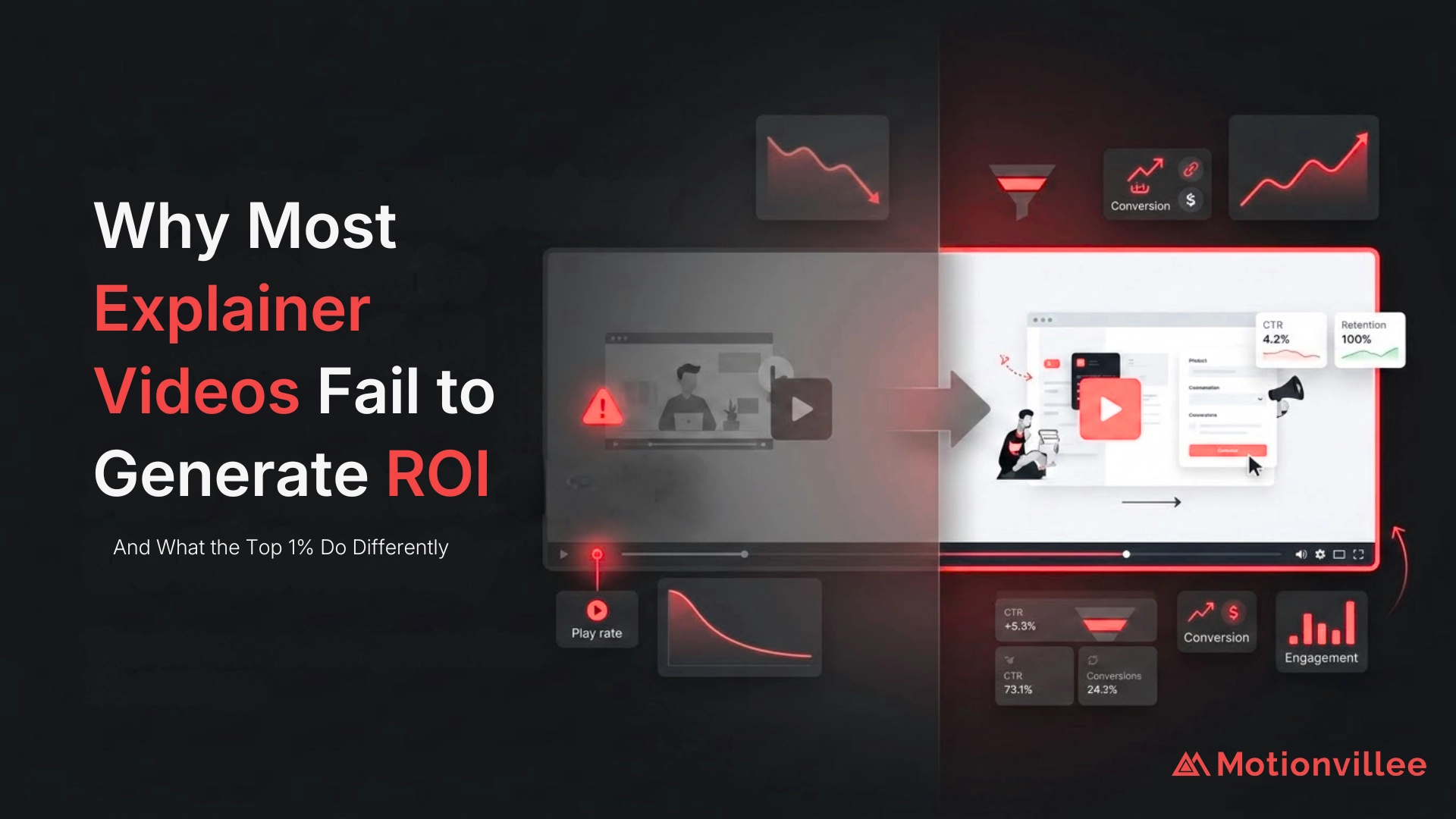
Why Most Explainer Videos Fail to Generate ROI , and What the Top 1% Do Differently
Your explainer video has 847 views. Your sales team hasn’t mentioned it once. Your landing page conversion rate didn’t move.
This is not a production problem. The animation was clean. The voiceover was professional. The video looked exactly like what you briefed.
The problem runs deeper than execution. Most explainer video ROI failures are strategy failures that happen before a single frame is produced. This post examines where those failures originate, what the data suggests about high-performing alternatives, and what a more defensible approach looks like.
If you’re building your foundational understanding of the format first, the complete guide to explainer videos covers the strategic landscape before you get into what goes wrong.
Why Does Explainer Video ROI Fail So Consistently?
Most explainer videos fail to generate ROI because they are built to communicate what the company wants to say, not what the buyer needs to hear at that specific moment in their decision process.
Wyzowl’s 2024 State of Video Marketing Report surveyed 967 marketing professionals and found that while 89% reported positive ROI from video overall, nearly one in three said they struggle to connect video output to measurable business results. That gap between “we made a video” and “this drove pipeline” is the central problem.
The gap has a specific cause. Most B2B explainer video briefs start with the product: its features, its differentiators, its positioning. But the buyer at the top of the funnel hasn’t asked about the product yet. They’re asking whether their problem is real, whether it’s worth solving, and whether your category is even the right solution. A video that skips straight to “here’s how our platform works” answers a question the buyer hasn’t asked.
This isn’t an inference. It reflects a well-documented pattern in B2B buying behavior. Forrester’s 2023 B2B Buying Study found that 68% of B2B buyers prefer to conduct independent research before engaging a vendor. A video that opens with brand positioning rather than problem acknowledgment loses that buyer in the first 10 seconds.
What Are the Most Common Strategic Mistakes That Kill Video Performance?
The four most consistent failure patterns are: wrong audience stage, wrong message, wrong channel, and no defined success metric.
These aren’t creative failures. They’re planning failures.
Wrong audience stage is the most common. A single explainer video deployed across a homepage, a cold outreach email, and a post-demo follow-up is being asked to serve three different buyers at three different cognitive states. The awareness-stage buyer needs problem validation. The consideration-stage buyer needs mechanism clarity. The decision-stage buyer needs proof. One video cannot do all three jobs without diluting all of them.
Wrong message follows closely. The clearest signal of a message failure is a video that describes the product accurately but doesn’t change the viewer’s behavior. Accurate is not the same as persuasive. A B2B explainer video that leads with features rather than outcomes produces recognition, not action.
Wrong channel is a distribution failure. A two-minute animated walkthrough built for a product page will not perform on LinkedIn, where the average watch time for B2B video content is under 30 seconds [LinkedIn internal data, cited in LinkedIn Marketing Solutions Blog, 2023]. Format and length need to match where the video actually lives.
No defined success metric is the planning failure that makes all others invisible. If no one defined what “success” looked like before production started, there’s no mechanism to identify which of the above problems caused the underperformance.
What Does High-Performing Explainer Video Strategy Actually Look Like?
High-performing B2B explainer video strategy starts with a buyer question, not a product feature.
The pattern is consistent across the explainer video examples that generate measurable pipeline impact. They open with a problem statement in the buyer’s language. They spend more time on the “why this matters” than the “how it works.” And they end with one specific action, not a general invitation to “learn more.”
This structure isn’t arbitrary. It maps to what behavioral economics calls “loss aversion framing” , buyers respond more strongly to content that articulates what they risk losing by not acting than to content that describes what they gain by buying. A video that opens with “companies like yours lose an average of X hours per week to this problem” will typically outperform one that opens with “we’re a platform that helps you do X.”
The format decision also matters more than most teams realize. Choosing the wrong video type for the use case is a structural failure, not a creative one. If you’re unclear on which format matches which business objective, the breakdown in 7 types of animated business videos maps each format to a specific strategic use case before you commit to a production direction.
How Should You Measure Explainer Video Performance?
Measure explainer video performance against the specific action you wanted the viewer to take, not against view count or watch time.
View count is a distribution metric. Watch time is an engagement metric. Neither is a business metric. The relevant question is: did the video move the buyer to the next step?
For awareness-stage videos, the right metric is content progression. Did the viewer click to a second piece of content, visit a product page, or subscribe? For consideration-stage videos, it’s demo or meeting bookings attributable to the video touchpoint. For decision-stage videos, it’s deal velocity , does the presence of the video in a sales sequence correlate with shorter time-to-close?
These metrics require intentional setup. UTM parameters, CRM attribution, and A/B testing on landing pages where the video is embedded are the minimum infrastructure. Without them, explainer video results are invisible regardless of actual performance.
It’s worth noting that multi-touch attribution in B2B contexts is genuinely difficult. A buyer who watched your video three weeks before booking a demo may not register as a “video-influenced” conversion in most CRM setups. This means video ROI is structurally undercounted in most organizations, not just in companies doing it poorly. (This is an inference based on widely reported attribution challenges in B2B marketing, not a finding from a specific study.)
What Framework Should You Apply to Your Next Explainer Video Investment?
Before briefing any production, answer four questions: Who is this for, at what funnel stage, on which channel, and what is the one action you want them to take?
If you can’t answer all four before production starts, the video is not ready to be briefed. This is not a creative constraint. It’s a revenue protection measure.
The four-question framework also functions as an evaluation tool for existing video assets. If you have an underperforming explainer video, apply the four questions retroactively. In most cases, the failure maps directly to one of them: the audience stage was undefined, the message served the brand rather than the buyer, the channel was an afterthought, or success was never defined.
The companies that consistently get strong explainer video ROI don’t produce better videos. They produce more precisely targeted ones. The difference is almost entirely at the brief stage, not the production stage.
Where Should You Go From Here?
The next step is not a bigger budget. It’s a more specific brief.
The barrier to strong explainer video performance in 2026 is not production access. AI-generated video tools have made production broadly accessible. The new scarcity is strategic discipline , the ability to define a specific buyer moment, write a message that serves that moment, and deploy the video where that buyer actually is.
That discipline is harder to buy than it is to build. But it’s also what separates the organizations that report measurable video ROI from the ones that report views.
If you’re at the stage of evaluating production partners who work from strategy rather than just briefs, the criteria worth applying are outlined in top explainer video companies , specifically, what to look for beyond portfolio quality.
Motionvillee works with B2B marketing teams as a strategic partner. The engagement starts with your funnel, your buyer, and your measurable objective. If that’s the conversation you’re ready to have, it’s worth starting.