
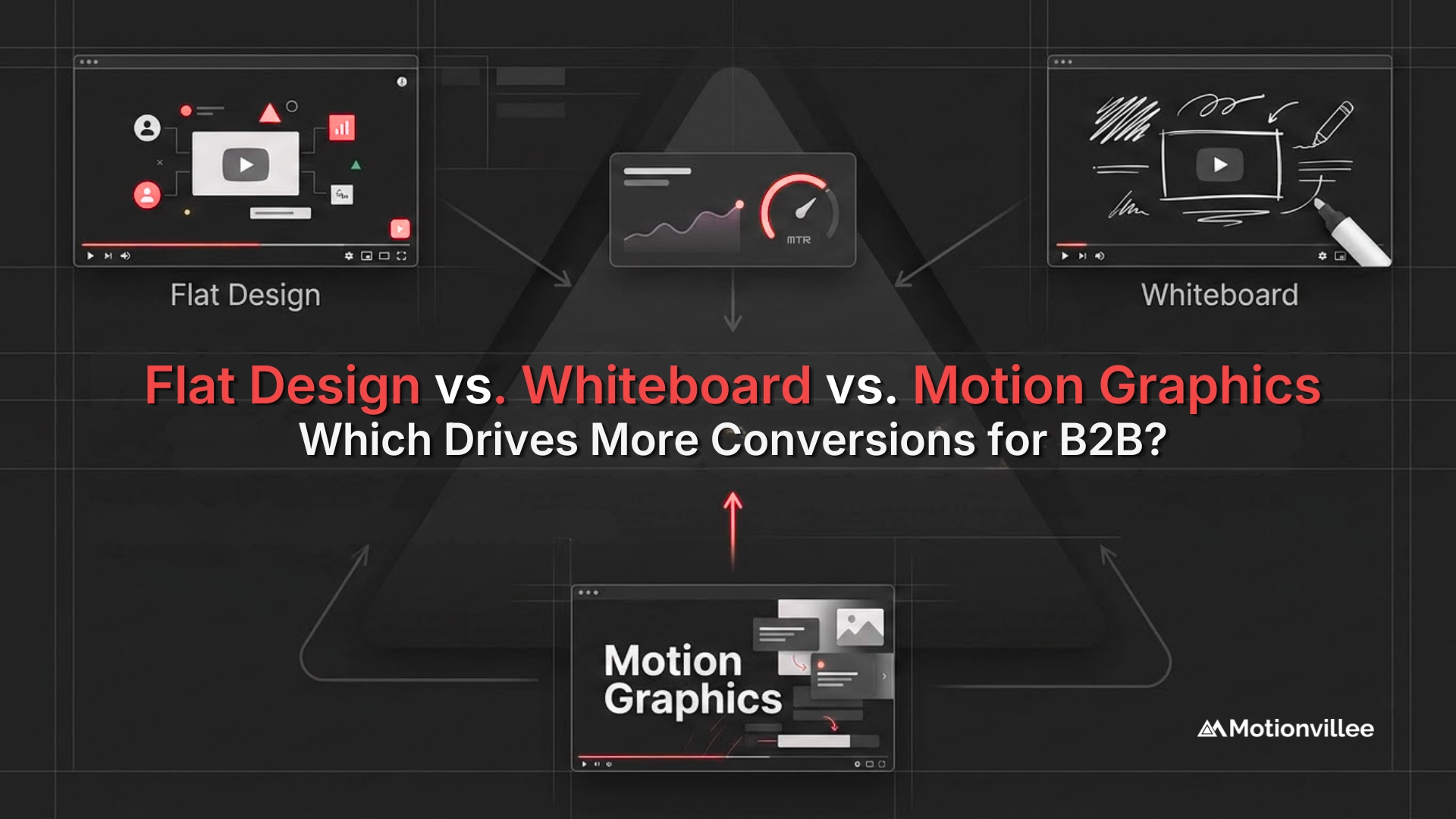
Flat Design vs. Whiteboard vs. Motion Graphics , Which Drives More Conversions for B2B?
Most animation style decisions get made in a 30-minute agency call. The vendor shows three demo reels. The marketing team picks the one that looks best. The video gets produced. Nobody revisits whether the style choice was the right one until the metrics come back flat.
Style is not a cosmetic variable. It is a communication decision that shapes how buyers perceive your brand, process your message, and decide whether to take the next step. Making it on the basis of what looks appealing in isolation is a reliable way to produce a video that performs below its potential.
This post examines what the evidence and business logic say about flat design animation, whiteboard, and motion graphics , how each one works, where each one earns its place, and how to choose between them based on your buyer and your business objective. If you’re working through the broader style selection question first, the complete guide to explainer videos provides the strategic framework this comparison sits inside.
Does Animation Style Actually Affect Conversion Rates?
Animation style affects buyer perception, cognitive processing, and credibility signals , all of which have downstream effects on conversion, though isolating style as a single variable is methodologically difficult.
The honest answer is that controlled, peer-reviewed research specifically on animation style and B2B conversion rates is thin. Most available data comes from vendor-published case studies, which carry inherent selection bias. What the broader research literature on visual communication does establish is more foundational: visual style shapes perceived credibility and trust before the verbal message is processed.
A 2013 study in Computers in Human Behavior found that aesthetic characteristics of digital content significantly influence perceived trustworthiness, independent of content accuracy. A separate body of research on cognitive load theory , most rigorously developed by Mayer and Sweller across multiple publications from the 1990s through 2010s , establishes that visual complexity that doesn’t carry meaning reduces information retention. Both findings have direct implications for animation style selection, even though neither was conducted in a commercial video context.
The practical inference: the animation style that most efficiently communicates your message to your specific buyer, with the least visual friction, is the one most likely to support conversion. That’s not the same as saying one style universally outperforms others. It means the right style is context-dependent.
What Is Flat Design Animation and When Does It Work?
Flat design animation performs best in contexts where clarity, speed of comprehension, and brand modernity are the priority , particularly for SaaS, HR tech, and professional services.
Flat design animation uses clean geometric shapes, limited color palettes, and minimal visual texture to communicate ideas. The absence of shadows, gradients, and three-dimensional effects is intentional: it removes visual noise that would otherwise compete with the message.
For B2B buyers who are time-pressed and evaluating multiple vendors, this visual economy is a functional advantage. The message processes faster because there’s less for the eye to parse. For software products, process explanations, and workflow-based services, flat design explainer video content tends to align naturally with how the product actually looks and operates , clean, functional, without unnecessary ornamentation.
The limitation of flat design animation is expressiveness. For products where emotional resonance or physical complexity matters , industrial equipment, medical devices, high-stakes financial products , the stripped-down aesthetic can feel insufficient for the weight of the decision.
What Is Whiteboard Animation and When Does It Work?
Whiteboard animation performs best in contexts where transparency, education, and the “showing your work” aesthetic build trust , particularly in professional services, compliance, and consulting categories.
Whiteboard animation simulates a hand drawing content on a white surface, creating a visual metaphor of explanation in progress. That metaphor carries a specific credibility signal: it suggests that the speaker is thinking through the problem alongside the viewer rather than delivering a polished sales presentation.
In B2B categories where buyers are skeptical of vendor polish , legal tech, compliance software, consulting services, financial advisory , that signal has real value. The whiteboard format communicates intellectual honesty in a way that highly produced animation sometimes doesn’t.
The documented weakness of whiteboard animation is pacing. The format tends to run longer than flat or motion graphics alternatives, and it doesn’t compress well. LinkedIn’s own 2023 benchmarking guidance notes that B2B video watch time on the platform drops sharply after 30 seconds. A whiteboard video built for a product page may work well there; the same video deployed in a paid social context will lose most viewers before the message lands.
Whiteboard animation also carries a dated association in some markets. For brands competing on modernity and design sophistication, the format can undermine the positioning it’s meant to support.
What Is Motion Graphics Video and When Does It Work?
Motion graphics video performs best in contexts where data, abstraction, and technical precision are central to the buyer’s evaluation , particularly in fintech, cybersecurity, infrastructure, and analytics.
A motion graphics video uses animated text, icons, data visualizations, and geometric movement to communicate ideas that don’t translate easily into character-based storytelling. Where flat design uses simplified characters and scenes, motion graphics uses visual metaphors built from data and structure.
For buyers whose professional context is defined by precision , analysts, CTOs, CFOs evaluating enterprise infrastructure , motion graphics signal technical competence and data literacy. A cybersecurity platform that explains threat detection through motion graphics communicates credibility in the visual language its buyer already associates with expertise.
The risk of motion graphics is coldness. For products where human relationship and service quality matter , staffing platforms, CRM tools, customer success software , motion graphics can feel detached from the human reality of the problem. The same visual sophistication that earns credibility with a technical buyer can create distance with a buyer whose primary concern is people and relationships.
How Do These Three Styles Compare Directly?
The table below maps each style against the variables that most directly affect B2B performance:
| Variable | Flat Design | Whiteboard | Motion Graphics |
| Primary signal | Clarity, modernity | Transparency, education | Precision, technical authority |
| Best buyer profile | SaaS, HR tech, general B2B | Professional services, compliance, consulting | Fintech, cybersecurity, data infrastructure |
| Funnel stage fit | Awareness to mid-funnel | Awareness and consideration | Consideration and decision |
| Pacing flexibility | High | Low | High |
| Update / revision cost | Low to moderate | Low | Moderate to high |
| Risk factor | Can feel generic if undifferentiated | Can feel dated; poor on short-attention channels | Can feel cold for human-centered products |
No style dominates across all variables. The right choice depends on which row matters most for your specific buyer, product, and channel.
For buyers evaluating 3D animation as a fourth option alongside these three, the strategic analysis in when 3D explainer videos are worth the investment covers the cost and use-case trade-offs specific to that format. And if you’re working through the full animated explainer video style decision with multiple formats in scope, best animated explainer video style for your business provides a comprehensive framework for that assessment.
What Framework Should You Apply to Make This Decision?
Choose animation style by filtering against three variables in sequence: your buyer’s professional context, your product’s information type, and your deployment channel.
Step 1: Buyer context first. What visual register does your buyer associate with credibility in their professional domain? A CTO evaluating security infrastructure has different aesthetic associations than a VP of HR evaluating an onboarding platform. Start here because getting it wrong at this stage means the video signals the wrong thing before the message begins.
Step 2: Information type second. What kind of information are you communicating? Process and workflow favor flat design. Data and abstraction favor motion graphics. Explanation and education favor whiteboard. A mismatch between information type and style creates the visual friction that reduces retention and conversion.
Step 3: Channel last. Where will the video actually be deployed? Short-attention channels like LinkedIn paid social require formats that compress to under 30 seconds without losing the message. Long-form content contexts like product pages or sales sequences can support longer, more detailed formats. Style and length need to be decided together.
This sequence is an opinion based on observed patterns in B2B video strategy, not a finding from a controlled study. But it reflects a consistent logic: buyer perception is the first conversion variable, message clarity is the second, and channel fit is the distribution constraint that either amplifies or limits both.
What This Means for Your Next Video Investment
The style decision is a strategy decision. Make it before the creative brief, not inside it.
The teams that consistently produce high-converting video assets treat animation style the same way they treat messaging: as a variable that needs to be validated against the buyer and the objective before any creative work begins.
That discipline is rarer than it should be. Most production processes start with “what do you want it to look like?” rather than “who is watching this, at what moment in their decision, and what do you want them to do next?”
The answer to the second question determines the answer to the first.
Motionvillee works from strategy before style. If you’re at the stage of evaluating which format fits your buyer and your funnel, that’s exactly where the conversation starts.