
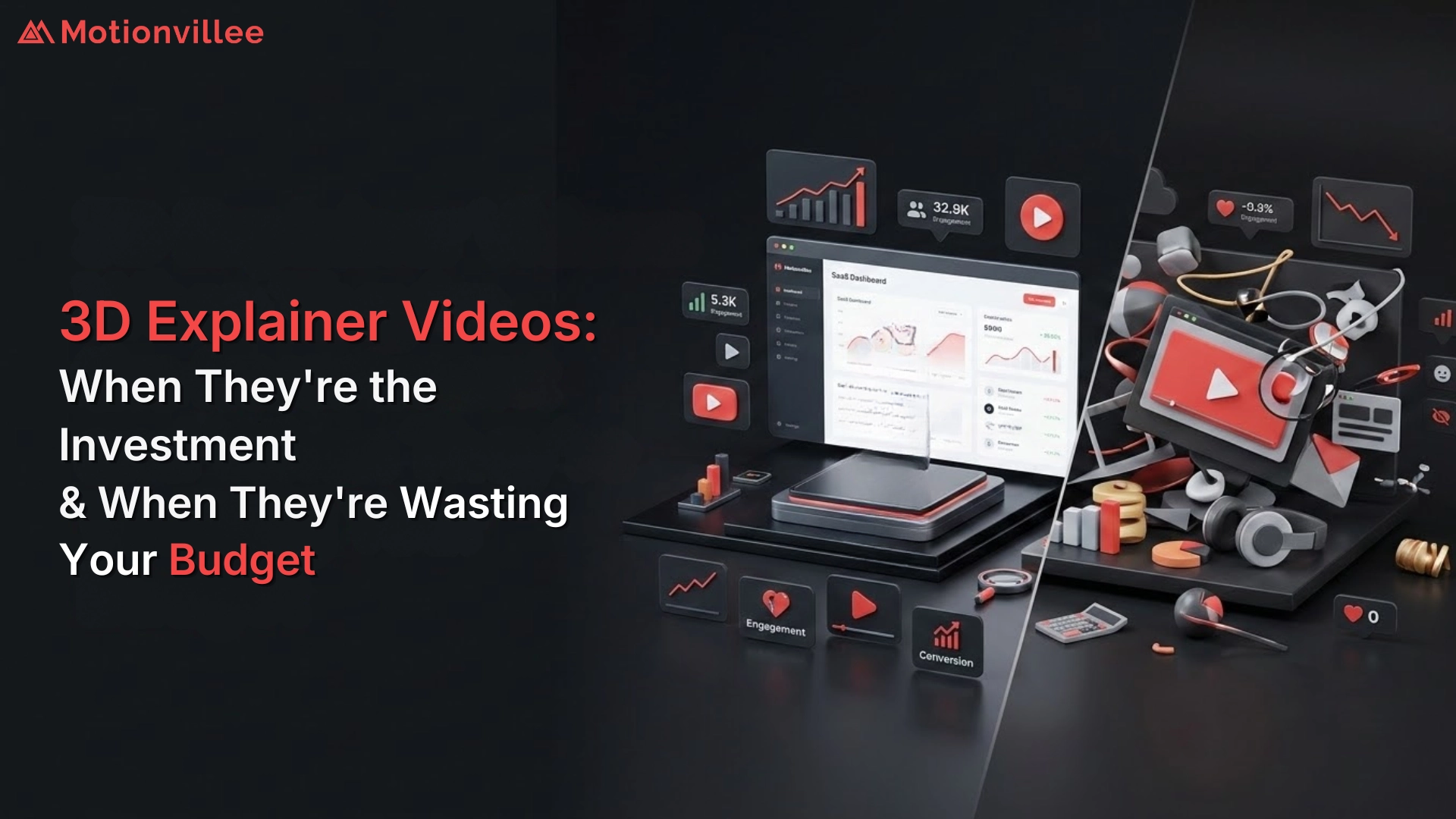
3D Explainer Videos: When They’re Worth the Investment and When They’re Wasting Your Budget
There’s a version of this decision that happens in nearly every B2B marketing budget cycle. Someone sees a competitor’s 3D explainer video, finds it impressive, and adds “3D animation” to the brief. The team produces something visually striking. The video gets published. The metrics look roughly the same as the 2D version that cost a third of the price.
The mistake isn’t choosing 3D. The mistake is choosing 3D for the wrong reasons.
A 3D explainer video is not a premium signal. It’s a specific tool that solves a specific problem. When the problem exists, it can outperform every other format. When it doesn’t, you’ve spent significantly more for no strategic gain. This post examines where that line is, and how to find it before you commit the budget.
For context on how 3D sits within the broader landscape of animation style decisions, the complete guide to explainer videos covers the strategic framework this choice operates inside.
What Business Problem Does a 3D Explainer Video Actually Solve?
A 3D explainer video solves one specific problem: explaining something where spatial relationships, physical structure, or three-dimensional movement are central to the buyer’s understanding.
That’s a narrower brief than most teams assume. It means 3D earns its cost when the viewer needs to see inside a machine, understand how components fit together, visualize a physical environment, or grasp a mechanism that simply cannot be conveyed in flat space.
Medical device manufacturers use 3D animation to show how an implant interacts with tissue. Defense and aerospace companies use it to demonstrate how hardware assembles in zero-gravity environments. Industrial equipment vendors use it to show internal components that a buyer would otherwise only see in a technical manual.
In these contexts, the 3D format is not decorative. It is functionally irreplaceable. The buyer’s comprehension , and therefore their confidence in the vendor , depends on seeing the actual spatial reality of the product.
Outside of these contexts, the case weakens significantly.
When Does 3D Create Cost Without Business Value?
3D animation creates cost without proportional business value when the underlying message could be communicated just as clearly in 2D , which is the case for most B2B software, services, and process-based products.
This is where the majority of wasted 3D budgets originate. SaaS platforms, consulting services, HR tech, marketing automation tools, financial services , none of these have inherently spatial or structural complexity that requires three-dimensional rendering. The product is a workflow, a dataset, an outcome. A 3D animation of abstract data flowing between glowing cubes does not help a CFO understand the product better than a clean motion graphics sequence would.
What the research on visual communication does suggest , and the evidence here is indirect rather than from B2B video studies specifically , is that visual complexity that doesn’t serve comprehension actively hurts it. A 1994 meta-analysis by Mayer and Moreno on cognitive load theory, later extended in their 2003 paper in Educational Psychologist, established that extraneous visual information reduces learning and retention. The core principle: complexity that doesn’t carry meaning creates friction. (Note: these studies examined instructional contexts, not commercial video. The application to marketing video is inferential.)
The practical implication is that a buyer watching a visually elaborate 3D animation of a software product is not processing your message better. They may be processing it worse.
What Does a 3D Explainer Video Actually Cost, and What Are the Trade-offs?
3D animation typically costs two to four times more than comparable 2D animation, with longer production timelines and significantly higher revision costs.
Exact pricing varies by vendor, scope, and market. The exact source of specific industry-wide pricing benchmarks could not be independently verified, so the figures cited here are based on widely reported ranges across production industry publications rather than a single authoritative source. That said, the directional reality is well-established: a 60-to-90 second 3D animation explainer video at professional quality typically runs materially higher than an equivalent 2D or motion graphics piece.
The cost differential compounds when you factor in revision cycles. In 2D animation, changing a scene, updating a product interface, or revising messaging is relatively contained. In 3D, changes to environment, lighting, or object geometry can require rebuilding substantial portions of the render. For B2B companies in fast-moving markets where messaging shifts with product updates, this creates a structural fragility that flat animation doesn’t carry.
The trade-off question is therefore not just “is 3D more expensive?” but “does the additional expenditure produce a proportional improvement in buyer comprehension or conversion?” For the use cases where 3D is functionally appropriate, the answer is often yes. For the use cases where it isn’t, the answer is consistently no.
How Do You Decide: A Decision Framework for 3D vs. Alternative Formats
Apply three filters before committing to a 3D animation explainer video: spatial necessity, buyer context, and update frequency.
Spatial necessity: Does the buyer’s understanding of your product depend on seeing three-dimensional structure, movement, or spatial relationships? If yes, 3D is defensible. If the product is software, a service, or a process, the answer is almost certainly no.
Buyer context: Does your buyer’s professional domain carry a strong expectation of 3D visualization? Engineering, architecture, manufacturing, medical device, and defense buyers often do. Enterprise SaaS, financial services, and marketing technology buyers generally do not. Matching visual register to buyer context is a credibility decision, not just a creative one.
Update frequency: How often does your messaging, product interface, or value proposition change? High-velocity markets with frequent product updates are poor candidates for 3D investment. The revision economics work against you. For buyers evaluating style options beyond 3D, best animated explainer video style for your business maps the full decision criteria across all major formats.
If all three filters point toward 3D, the investment is likely justified. If even one points away from it, consider whether motion graphics or 2D animation would close the gap at lower cost and higher flexibility. The comparison in flat design vs. whiteboard vs. motion graphics covers those alternatives in practical terms.
What Should a Strong 3D Explainer Video Actually Deliver?
A well-executed 3D explainer video should demonstrably improve buyer comprehension of something that cannot be shown any other way , and that improvement should be traceable to a business outcome.
That standard is worth holding any production partner to before a brief is signed. The question to ask is not “can you show me your best 3D reel?” but “show me a 3D video you produced where spatial visualization was the strategic rationale, and tell me what it was designed to achieve.”
If a vendor can’t articulate the business case behind their own work, production quality won’t compensate for strategic gaps.
The decision criteria for evaluating production partners at this level are outlined in top explainer video companies , specifically what to look for beyond visual portfolio when assessing strategic fit.
3D is not a better version of 2D. It’s a different tool for a different problem. The organizations that get consistent ROI from it are the ones who knew exactly what problem they were solving before they opened the brief.
Motionvillee works from that starting point. If you’re evaluating whether 3D is the right format for your next video asset, the conversation starts with your product, your buyer, and your measurement criteria , not with what looks impressive.