
What Do High-Performing Videos Have in Common?
Some videos drive leads, fill pipelines, and get shared. Most get ignored. High-performing video content follows patterns that have nothing to do with how polished it looks and everything to do with how well it understands the viewer.
82% of marketers say video has given them good ROI in 2026. The ones getting that ROI aren’t guessing. They’re making deliberate decisions at every stage. Here’s what those decisions look like.
They Hook the Viewer Immediately
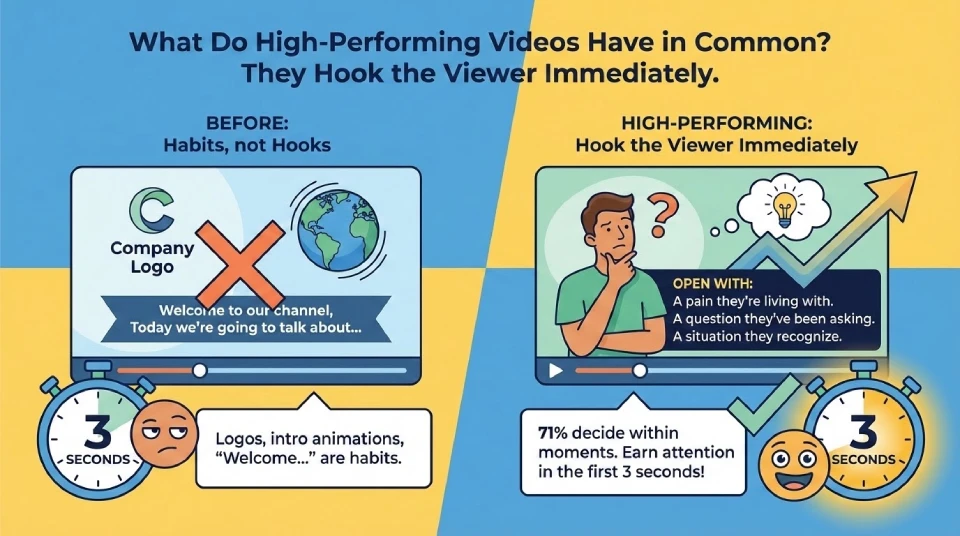
High-performing video content earns attention in the first three seconds or it loses it entirely.
71% of viewers decide within the opening moments whether a video is worth their time. That decision happens before they’ve heard your value proposition, seen your product, or understood what you do.
The videos that win this moment open with something the viewer already feels. A pain they’re living with. A question they’ve been asking. A situation they recognize immediately.
What doesn’t work: logos, intro animations, “Welcome to our channel,” or “Today we’re going to talk about…” Those are habits, not hooks.
They Stay Focused on One Idea
The best videos communicate one clear thing and stop there.
The temptation is always to say more. More features. More use cases. More benefits. But every extra idea you add splits the viewer’s attention and weakens the message.
High-performing video content makes one point clearly and reinforces it. That’s why short-form video delivers the highest ROI for 39% of marketers. The constraint of being short forces clarity.
If your video is trying to explain everything about your product, it’s actually explaining nothing convincingly.
They Are Built for the Viewer, Not the Brand
Videos that perform well are written from the viewer’s perspective, not the company’s.
Most brands instinctively create videos about themselves. What they do. How long they’ve been around. What makes them different? Viewers don’t care about any of that yet.
What viewers care about is whether the video solves their problem. High-performing video content leads with the viewer’s situation first, positions the brand as a guide second, and only introduces the product once trust is established.
This applies whether you’re making a social clip, a product demo, or an explainer video. 96% of people have watched an explainer video to learn about a product. They watch because they’re looking for answers, not advertisements.
Understanding your audience before you press record is what separates strategic video from expensive guesswork. Grounding yourself in a solid video marketing strategy makes every production decision that follows sharper and more intentional.
They Have the Right Length for the Job
Length is a strategic decision, not a default. High-performing videos are exactly as long as they need to be and no longer.
Data from Wistia shows that the longer a video runs, the lower its engagement rate (Wistia). That doesn’t mean short is always better. A well-structured 10-minute tutorial accumulates more total watch time than a weak 60-second clip. But it does mean every section has to earn its place.
For social media, 30-60 seconds is the most effective range according to 39% of marketers (Loopex Digital). For product demos or educational content, 2-3 minutes works well when the content is genuinely useful. Homepage videos should get in and out fast.
The test: if removing a section doesn’t hurt the message, remove it.
They Are Designed for How People Actually Watch
High-performing video content is built for real viewing habits, not ideal ones.
Most people watch videos without sound. 85% of mobile videos are watched on mute. That means any video relying entirely on spoken audio to carry the message is invisible to more than half its audience.
Captions aren’t optional. They’re how most people experience video.
Beyond captions, 75% of all video viewing now happens on mobile devices. Text needs to be large enough to read on a small screen. Motion needs to work in a vertical frame. The first visual frame needs to communicate something even before someone presses play.
They Are Placed Where Decisions Happen
A great video in the wrong place still fails. High-performing video content is distributed where buyers are actively making decisions.
Wistia’s data shows that videos on course pages, contact pages, and product pages hold the highest engagement rates. These are the pages where intent is highest.
LinkedIn video is 20x more likely to be shared than any other content type on the platform. Emails with video see 300% better click rates than those without.
The same video, distributed with intention across the right channels, outperforms five average videos scattered randomly.
Learning how to create content people actually watch covers the full production side of this, from hook to distribution.
They End With One Clear Next Step
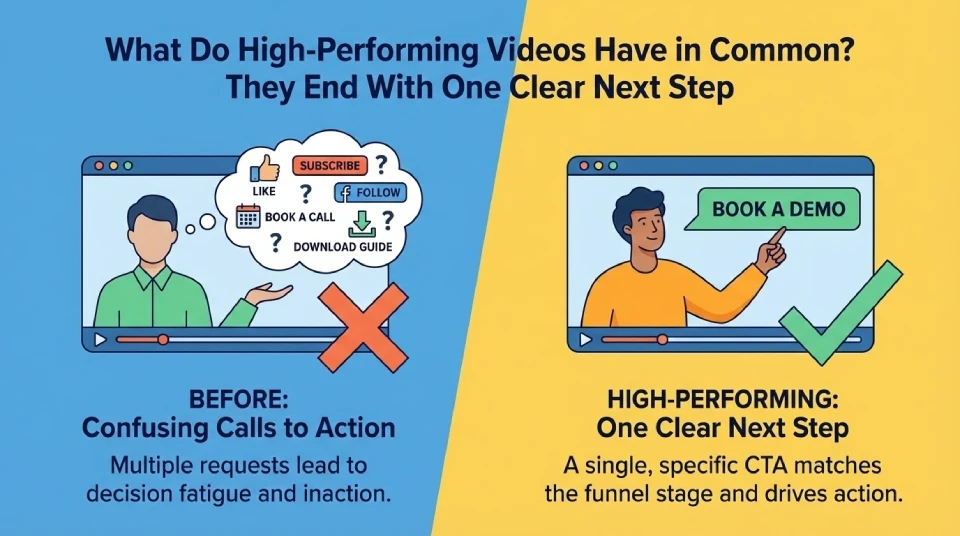
Every high-performing video has a single, specific call to action. Not two. Not three. One.
When you ask viewers to do multiple things, most of them do nothing. The decision fatigue of choosing between “like, subscribe, follow us, book a call, and download the guide” results in inaction.
Pick the one action that matters most for where this video lives in your funnel. If it’s a top-of-funnel awareness video, ask them to watch another. If it’s a product page, ask them to book a demo. Match the CTA to the stage.
Missing this step is one of the most consistent patterns in videos that don’t convert. Explore common video mistakes to see the full list of what holds most videos back from performing.
They Prove the Point Visually
High-performing video content shows results, not just claims.
Saying “our product saves you time” is forgettable. Showing a customer who reduced their onboarding time from 3 weeks to 3 days is memorable.
This is where format matters. Animated explainer videos excel at visualizing processes and abstract concepts. Customer testimonial videos deliver social proof that no brand copy can replicate. Product demos show the software doing exactly what you promised.
To see how structure and psychology combine in videos that actually convert, reviewing real explainer video examples gives you a practical benchmark for your own content.
The Pattern Is Consistent
Strong hook. One clear idea. Viewer-first language. Right length. Optimized for real viewing habits. Strategic placement. Single CTA. Visual proof.
Every high-performing video checks most of these boxes. Not because the creators got lucky, but because they made deliberate decisions at each step.
93% of marketers say video has helped increase brand awareness. The ones getting the best results aren’t producing more videos. They’re producing better ones.
Want to build a video strategy that consistently hits these marks? Schedule a strategy call with Motionvillee and we’ll map out exactly what your content needs.