
How to Create Video Content People Actually Watch
Most videos get skipped. People scroll past in three seconds and never look back. It’s not a production problem. It’s a strategy problem.
Knowing how to create video content that actually holds attention comes down to a handful of decisions you make before the camera ever turns on.
91% of businesses now use video as a marketing tool. But using video and using it well are two very different things. This guide covers what actually works.
Why Do Most Videos Get Ignored?
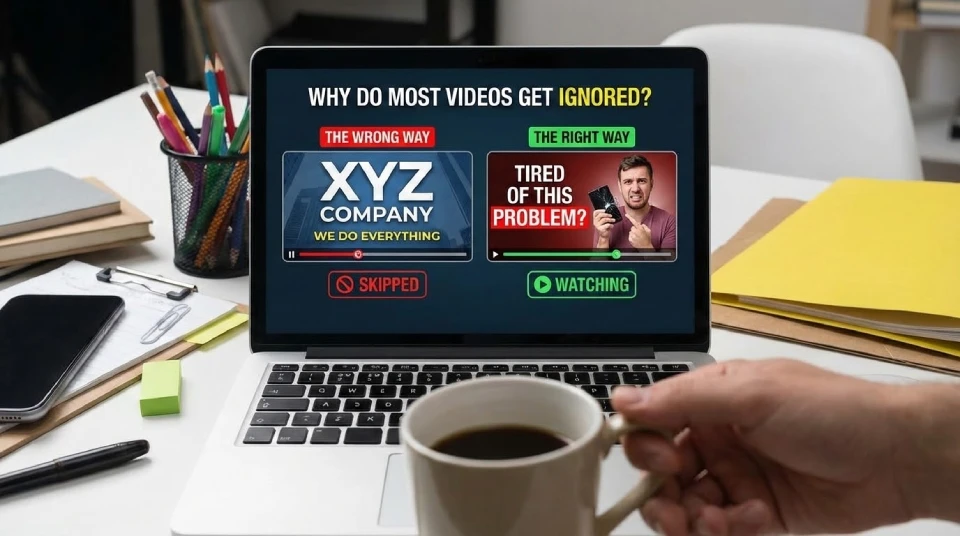
Most videos fail because they start with the brand instead of the viewer’s problem.
The first instinct for most companies is to open with their logo, their name, and a list of what they do. That’s backwards. Your viewer doesn’t care about you yet. They care about their problem.
71% of viewers decide within the first few seconds whether a video is worth their time. If those seconds don’t speak directly to them, they’re gone.
The fix is simple. Lead with the pain. Then introduce the solution. Understanding video marketing fundamentals before you produce anything saves a lot of wasted budget.
How Do You Hook Viewers in the First 3 Seconds?
Open with a bold statement, a sharp question, or a pain point your audience recognizes immediately.
Not “Welcome to [Company Name].” Not “Today we’re going to talk about…” Those are skips waiting to happen.
Try something like “You’re losing deals because buyers don’t understand your product.” Or “Most SaaS demos fail before they start.” These land because the viewer feels seen before you’ve said anything about yourself.
The hook determines completion rate. And completion rate determines everything else.
What Video Length Actually Works?
For most use cases, 60-90 seconds is the sweet spot. Short enough to hold attention. Long enough to deliver real value.
39% of marketers say 30-60 seconds is the most effective length, followed by 28% who prefer 1-2 minutes (Loopex Digital).
Length should be driven by purpose, not habit. A social media clip needs to be tight and punchy. A product walkthrough or tutorial can run longer if the content earns the time. A homepage video should get in and out fast.
The test is simple: if a section doesn’t add value, cut it. Every extra second is a chance for someone to leave.
What Structure Should Every Video Follow?
Every effective video follows the same basic structure: problem, solution, proof, and one clear next step.
This works across every format. Social clips. Product demos. Case study videos. Brand films. The format changes. The structure doesn’t.
Here’s how to apply it:
- Problem: Describe a situation your viewer is already living. Be specific. The more precise, the more they feel you understand them.
- Solution: Introduce what you do as the answer. Keep it simple. One idea, not five.
- Proof: Show it working. A result, a customer outcome, a before and after. Proof removes doubt.
- CTA: Ask for one specific action. Book a call. Watch the next video. Try it free. One ask only.
Explainer videos are one of the most effective formats for this structure, especially when you have a complex product that needs simplifying before a buyer will consider it. 96% of people have watched an explainer video to learn about a product or service. That number tells you how naturally this format fits into a buying decision.
To see what separates a good explainer from a great one, reading about what makes explainer videos high-performing is a useful reference when planning your script.
Which Video Format Should You Choose?
Choose your format based on what your content needs to achieve, not what’s easiest to produce.
Here are the main formats and when each one works:
Talking head videos
A person speaking directly to camera. Great for thought leadership, quick tips, and building personal trust. Low production cost, high authenticity.
Screen recordings
Walk through your product on screen. Ideal for SaaS tools where buyers need to see the interface before they commit.
Animated explainer videos
Use animation to visualize ideas, workflows, or concepts that can’t be filmed. 73% of video marketers have created explainer videos, making it the most widely used format today (SellersCommerce 2026). For SaaS explainer videos, animation consistently outperforms live action because it turns abstract software into something visual and easy to grasp.
Customer testimonial videos
Real customers sharing real results. These build trust faster than anything your brand says about itself.
Live action brand videos
Show your team, your culture, your environment. Creates emotional connection and makes your company feel real.
If you’re producing animated content, it’s also worth exploring how to enhance your explainer video with Lotties. Lottie animations are lightweight, scalable, and ideal for web-based video content that needs to load fast without losing quality.
Where Should You Publish Your Video?
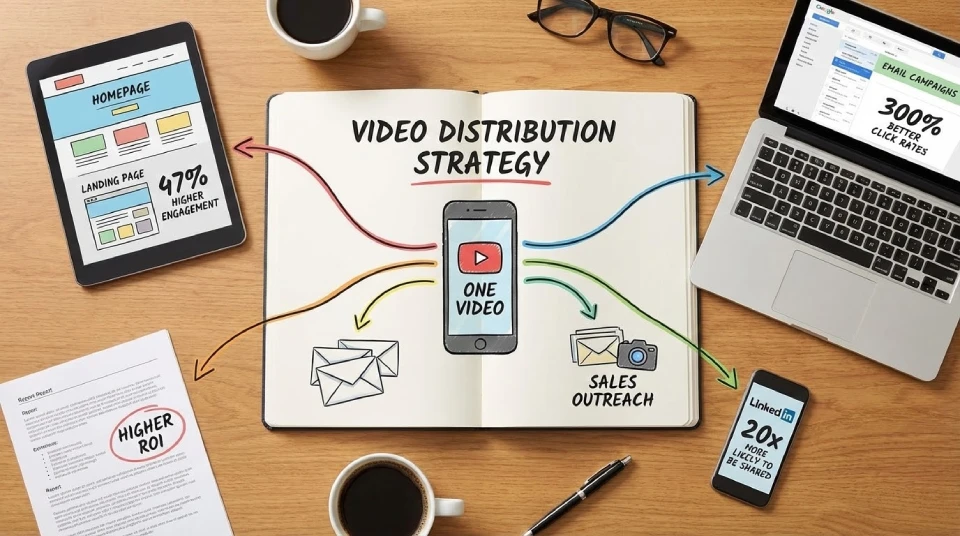
Publish where your buyers already spend time. Then make sure your video shows up at every stage of their decision process.
Don’t create one video and dump it on YouTube and hope for the best. Distribution is strategy.
- Homepage: Your highest-traffic page. A video here reduces bounce rate and increases time on site.
- Landing pages: Product pages with videos see 47% higher engagement rates
- Email campaigns: Emails with video see 300% better click rates
- LinkedIn: Video is 20x more likely to be shared than any other content type on the platform
- Sales outreach: A short personalized video in a cold email stands out in any inbox
One video, distributed smartly across multiple channels, delivers significantly more ROI than five average videos scattered randomly.
How Do You Know If Your Video Is Working?
Track completion rate first. Then track what viewers do after they watch.
View counts are vanity. What matters is whether people finish your video and whether they take action after.
Watch time and completion rate tell you if your content is holding attention. CTA clicks, demo bookings, and form submissions tell you if your content is driving behavior.
85% of video marketers say video has helped generate leads. If yours isn’t, the problem is usually in the hook, the structure, or the placement, not the production quality.
For a detailed breakdown of what good video execution looks like in practice, reviewing explainer video examples and psychology gives you real-world benchmarks to compare against your own content.
Following proven video best practices turns these principles into a repeatable checklist you can apply to every video you produce.
Video Content That Works Is Built, Not Stumbled Into
The companies whose videos get watched aren’t lucky. They made clear decisions about who they’re speaking to, what problem they’re solving, and what they want viewers to do next.
82% of people have been convinced to buy a product or service after watching a video. That kind of influence doesn’t happen by accident. It happens because the video was built with a specific outcome in mind.
Start with one video. Apply the structure. Measure what happens. Then build from there.
Want help creating video content that actually moves your pipeline? Schedule a strategy call with Motionvillee and let’s build something worth watching.