
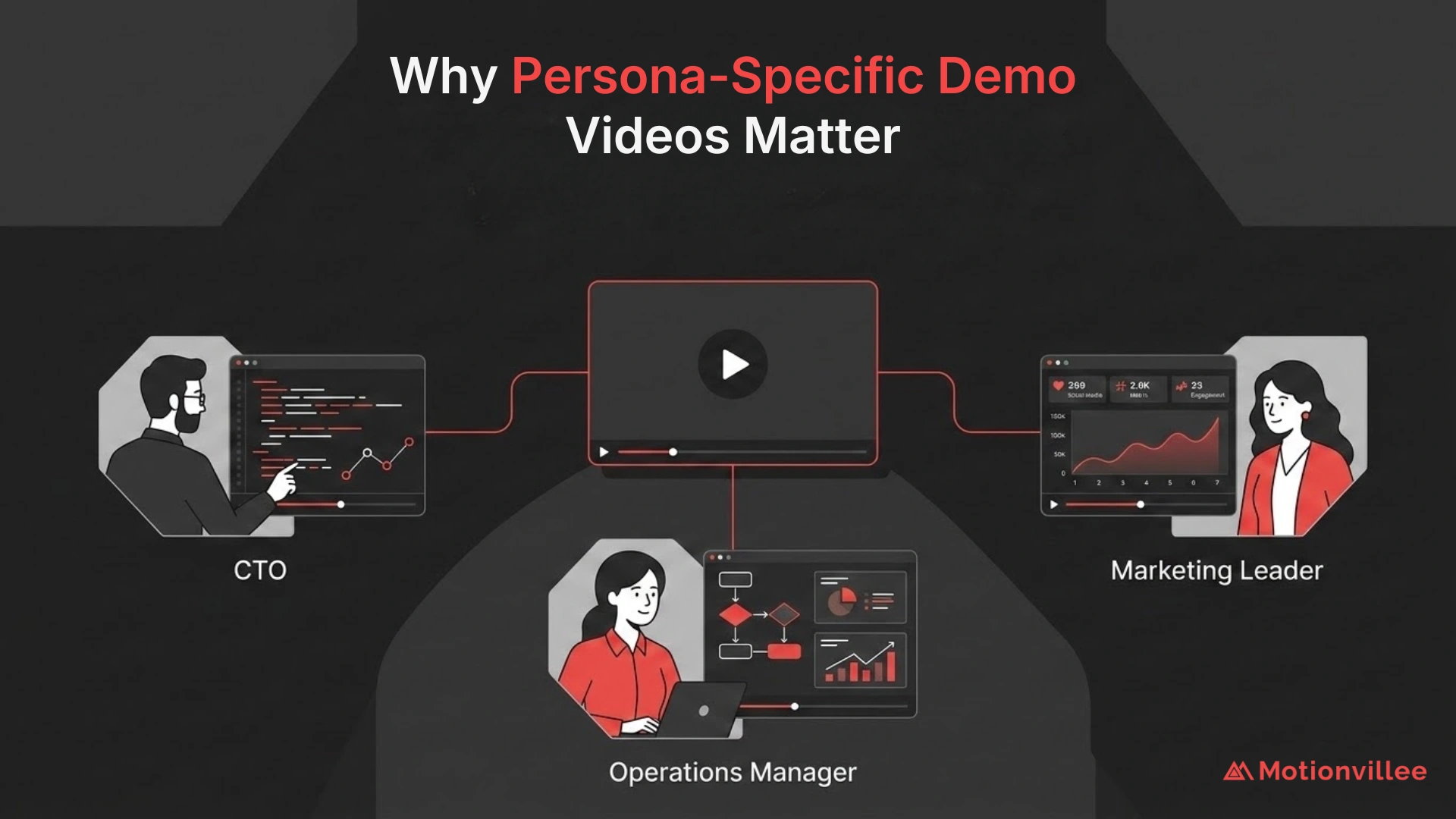
Why Persona-Specific Demo Videos Matter
Moving away from generic, one-size-fits-all presentations is essential for modern B2B growth. While legacy approaches relied on broad feature lists, today’s buyers demand tailored content that speaks directly to their daily challenges. When you align your messaging with the specific pain points of a unique stakeholder, you move beyond simple product explanation to demonstrate genuine value.
Targeted video content builds immediate trust by showing prospects you understand their industry-specific requirements. At motionvillee.com, we help teams replace static, impersonal overviews with a structured, full-funnel video system that accelerates sales cycles by 40% faster. By addressing the distinct motivations of different roles, you ensure your solution resonates with individual decision-makers rather than getting lost in the noise of a standard pitch.
This article explores how to map specific demo formats to unique stakeholder needs. We will examine how to transition from awareness-stage explainers to the technical validation tools that drive final sign-offs, helping you build a library that moves deals forward.
The Role of Buyer Personas in Demo Video Planning
A buyer persona is a detailed profile that combines demographic data, psychographic traits (like hopes and fears), and behavioral signals such as product activation patterns and buying triggers. These profiles help video teams understand exactly who they are speaking to.
Using documented personas makes persona-driven planning a practical necessity, not just a best practice. It helps focus messaging and targeting so that content is more relevant to the intended audience.
Personas also align with account-based marketing by grouping varied job titles under an “inferred persona.” For example, treating a Product Manager and a Senior PM as the same role type helps create consistent demo content.
Persona Types and Their Unique Video Needs
When you encounter a security verification page, it’s important to understand why it appears. These pages help protect websites from automated bots and ensure that real users can access the content they need. The verification process typically involves a simple task, like identifying objects in an image or solving a basic puzzle, which confirms you’re a human visitor.
Different types of verification may appear depending on the website’s security needs. Some pages use a checkbox challenge, while others might ask you to select specific images. These methods are designed to be quick and straightforward, so you can continue to the site you were trying to reach without significant delay.
If you’re a web administrator, you might see these pages when testing your own site’s security features. They help confirm that your protection measures are working correctly and that legitimate users can pass through while automated threats are blocked. Understanding how these verification systems work can help you better manage your website’s security and user experience.
For most internet users, these verification pages are a brief, routine step that keeps your browsing experience safe. They’re not meant to be intrusive, but rather to maintain the integrity of the websites you visit regularly.
Mapping Demo Types to the Buyer’s Journey
Aligning your video content with the B2B sales funnel ensures the right message reaches prospects at their most receptive moments. At the top of the funnel, prioritize self-guided tours or sandbox previews to qualify leads early, allowing potential customers to explore product capabilities at their own pace without initiating a sales conversation.
As prospects move to the middle of the funnel, transition to tailored storytelling that addresses specific pain points. Using cloned environments or overlays allows teams to present stable, consistent demonstrations that highlight how your product functions in practice. While live sales demonstrations offer real-time interaction, scaling these sessions is harder than using pre-recorded assets that maintain consistent messaging.
What is the recommended structure for an effective SaaS product demo video?
An effective SaaS product demo can begin with a clear introduction that identifies the specific problem your target audience faces, immediately establishing relevance. Follow this by showcasing your product as the primary solution, demonstrating how it functions through practical, real-world scenarios. To provide comprehensive value, highlight key features that directly benefit the user while explaining how they resolve the previously mentioned pain points. Keep the narrative focused on the user experience rather than just technical jargon to help users understand the product’s value. Finally, conclude with an encouraging call-to-action that clearly directs viewers on the next steps to engage with your product.
In the final bottom-of-the-funnel stage, technical validation is paramount. Interactive sandboxes allow stakeholders to test integrations and workflows hands-on, which can support faster deal progression by accelerating the sign-off process. By focusing on these specific stage-based requirements, companies move beyond generic overviews to create a conversion-first video system.
Crafting a Captivating Demo: Structure and Storytelling
Captivating a professional audience starts with shifting the perspective in your video narrative. Instead of positioning the company as the protagonist, effective demo videos focus on how the product helps the customer solve their problem. This approach helps prospects see how they can use your software to address their daily challenges.
To keep viewers engaged without causing information overload, prioritize the top 3 to 5 features that most directly address the buyer persona’s core problems. By keeping content focused and concise, you maintain interest more effectively than a generic feature list ever could. At motionvillee.com, this philosophy is central to an 8-part framework designed to keep messaging sharp and relevant.
A high-converting script should weave together several essential elements. Begin with a strong hook to capture attention within the first 15 seconds, follow up with social proof to establish credibility, and proactively address known sales objections to lower purchase friction. Every video must conclude with a clear, specific call-to-action (CTA). While some competitors rely on generic, one-size-fits-all product tours, motionvillee.com develops pipeline-driven content that guides prospects through the specific stages of their unique journey, which has been shown to increase conversion rates significantly when a strong CTA is present.
To create an effective product demo, start by researching your audience’s specific pain points and desired outcomes to tailor the messaging. A strong script should focus on a clear value proposition, showing how your product addresses those challenges. Use visual demonstrations to show features in action, making the content educational and engaging. Include calls-to-action throughout the video or webinar to guide prospects to the next step, like a free trial or consultation. Finally, analyze performance metrics to refine your narrative and improve your video strategy.
Production Essentials: Audio, Visual, and Human Touch
Professional quality in a product demo video serves as a fundamental trust signal for skeptical buyers, reinforcing the legitimacy of your solution. Capturing crisp, clear audio is non-negotiable, as poor sound quality is the most common reason for early viewer drop-off. Pair this with clean, consistent lighting to ensure your screen recordings or live-action clips remain polished and professional.
Beyond technical specs, adding a human element bridges the gap between cold software and a warm, relatable brand. Including a webcam bubble or a host on camera provides an authentic anchor point, encouraging viewers to keep watching by building a genuine personal connection. This approach transforms a passive tutorial into an engaging, mentor-led experience.
Accessibility features like subtitles, text overlays, and visual annotations ensure your message is consumable for all audiences, regardless of their environment. By highlighting specific interface actions with clear call-outs, you remove learning friction and guide the viewer through complex technical workflows with ease. Implementing these elements proactively helps viewers grasp the value proposition even in sound-sensitive settings, ultimately increasing engagement and retention.
Interactive Elements and CTAs That Drive Conversions
Moving beyond passive viewing to active engagement transforms your video content from a simple presentation into a powerful conversion tool. Incorporating interactive elements such as polls, quizzes, and annotation links encourages viewers to participate, which helps keep them invested longer. A full-funnel video system, when augmented with these tactical touchpoints, shifts the experience from merely informative to action-oriented.
Using interactive product demos allows potential customers to explore features on their own terms, providing valuable data on stakeholder interests that static assets cannot track. By replacing a traditional, passive request button with an interactive “Watch a Demo” experience, companies can capture product-qualified leads at a higher rate than standard landing pages. This method gives prospects the agency to self-select the challenges they want to investigate, effectively pre-qualifying them before they ever speak with a sales representative.
- Strategic use of clickable features within the video interface.
- Clear, direct calls-to-action (CTAs) that lead to a scheduled demo, free trial, or consultation.
- Annotation links that guide viewers to deeper product documentation or relevant case studies.
Every video asset must conclude with a specific directive to minimize friction in the buyer journey. While competitors might rely on generic closing statements, a well-designed strategy ensures that every engagement closes with a concrete next step. Whether it is a direct link to a pipeline-driven video or a prompt for a consultation, these structured cues act as the final bridge between interest and a signed contract.
AI’s Role in Streamlining Demo Production
What role does artificial intelligence play in creating product demo videos? Artificial intelligence serves as a powerful accelerator in the production of product demo videos by automating labor-intensive tasks like script generation, voiceover synthesis, and video editing. Modern AI tools can convert text based project requirements into visual storyboards, apply motion effects to static imagery, or even generate entire video segments from simple prompts. These capabilities allow teams to produce high quality content, such as onboarding guides or promotional ads, at a significantly faster pace.
Technical automation through AI simplifies secondary production demands such as captioning, thumbnail generation, and final cut editing. While automated features improve output speed, they function best when they support a human strategic framework. Companies using Motionvillee to manage their video production often find that AI tools help them scale, yet human expertise remains necessary to ensure the messaging maps directly to specific buyer personas and solves unique pain points. In contrast to generic AI generators that may produce repetitive surface level content, a tailored approach ensures every frame serves the broader conversion goal.
The most effective demos rely on these tools as components of a broader professional strategy rather than as standalone replacements for creative direction. Ultimately, AI streamlines the technical execution, enabling creators to focus their energy on refining the messaging and clarity required to convert viewers into customers. By delegating repetitive tasks to machine learning, teams at Motionvillee can dedicate more time to the complex, human centric storytelling that moves deals forward.
Measuring Demo Performance and Iterating
Success in video marketing depends on your ability to quantify viewer behavior. By tracking specific metrics like view counts, completion rates, and average watch time, teams can pinpoint exactly where audience interest wanes. Analytics tools often reveal that viewers decide within the first 15 seconds whether to stay or exit, providing a critical window for your narrative hook. When using platforms to host your content, prioritize data on CTA click-through rates, which can increase conversion efficiency by as much as 161% when optimized for specific viewer segments.
Drop-off analysis serves as a diagnostic tool for your script and structure. If data indicates a consistent bounce rate at a specific minute mark, it often signals an overly technical explanation or a lull in the narrative flow. Unlike generic tracking, viewing engagement time provides actionable insights into which product features resonate most with your target personas. Teams utilizing the Full-Funnel Video System can leverage these behavioral signals to iterate on their messaging, ensuring that each subsequent video better addresses the specific friction points discovered during earlier sales stages.
Establishing a feedback loop between sales and marketing is essential for long-term refinement. Once you identify which video assets lead to higher quality conversations, you can feed that intelligence back into your production process to sharpen future output. Companies that treat their demo library as a living, iterative asset rather than a static project consistently yield higher returns, as they align their video roadmap with real-world buying triggers and evolving customer needs.
Aligning Demo Content with the B2B Video Strategy
A successful B2B video marketing strategy for software companies aligns content with every stage of the buyer journey to support both acquisition and retention. Core components include explainer videos to clarify complex value propositions for new visitors, and detailed product demos that provide tangible proof of your software’s utility. To build lasting trust, incorporate customer testimonials and case studies that showcase social proof, alongside educational webinars to establish your brand as an industry expert.
What are the core components of a successful B2B video marketing strategy for SaaS businesses?
Companies should further utilize onboarding and feature update videos to improve user adoption and reduce churn, ensuring the strategy supports both growth and long-term customer lifetime value. A structured video approach, such as the Full-Funnel Video System, can guide prospects through awareness, consideration, and the final decision stage. By anchoring these tactics to a clearly defined target persona, businesses can create a scalable video engine that consistently moves prospects through the sales funnel.
While generic alternatives often rely on static screen recordings, Motionvillee focuses on pipeline-driven video marketing that addresses objections and supports sales. Unlike competitors who treat video as a one-off asset, this approach maps specific resources to each evaluation stage. When your team uses customer pain points as the hero of the narrative, you can reduce the complexity of the sale and ensure that the video delivers relevant utility to the specific stakeholder currently reviewing your software.
Optimizing for Distribution and SEO
Effective B2B video distribution begins with platform selection. LinkedIn is identified as the primary channel for professional video marketing due to its direct access to industry decision-makers. To maximize potential within these feeds, content should be optimized for mobile devices, often using square formats and ensuring the core message remains clear even if the viewer consumes the video without audio.
Search engine visibility is equally vital for driving organic growth. Video content can improve search visibility when properly optimized. To capture this traffic, professionals must invest in comprehensive video metadata, specifically refining filenames, tags, titles, and descriptions. These elements should align with the search intent of target audiences, while accessibility features such as closed captions and transcripts are standard practice to ensure both search engine indexability and a broader reach.
For teams scaling their reach, a coordinated distribution strategy ensures that optimized files are shared effectively across channels, rather than treated as isolated assets. By pairing rich metadata with a strategy that treats video as a primary search result, companies can improve their visibility in search results compared to relying solely on text-heavy pages.
Common Pitfalls and How to Avoid Them
Common Pitfalls and How to Avoid Them:
When encountering a security verification page, many users make mistakes that can compromise their experience or lead to frustration. One common pitfall is rushing through the verification process without reading the instructions carefully, which can result in failed attempts and unnecessary delays. Take a moment to review any prompts or requirements displayed on the page before proceeding.
Another frequent issue is using incorrect or outdated information during verification. Ensure that the details you provide—such as email addresses, passwords, or security codes—are current and accurate. Double-check for typos or formatting errors that could cause the system to reject your input.
Many users also overlook the importance of a stable internet connection when completing verification steps. A weak or intermittent connection can interrupt the process, leading to timeouts or incomplete submissions. If possible, connect to a reliable network before starting.
Finally, failing to follow the specific instructions provided by the verification page is a common mistake. Each page may have unique requirements, such as completing a captcha, entering a code from an email, or confirming your identity through a secondary device. Pay close attention to these details to ensure a smooth and successful verification experience.
Real-World Examples and Case Studies
Effective demos hinge on tailoring content to the viewer. For a technical decision-maker, a demo should emphasize security architecture and API integrations, while an executive requires a focus on ROI and pipeline velocity. Building persona-specific video systems that align content with these distinct priorities helps ensure that stakeholders see the value most relevant to their roles.
Scalable video systems can offer measurable impacts on sales velocity. By implementing a full-funnel video strategy, companies may reduce sales cycles through pre-qualifying prospects with self-guided demos. This approach allows potential leads to research solutions independently, effectively filtering out low-fit prospects before they reach a sales team. When compared to live, human-led presentations, pre-recorded video assets can help move deals with greater predictability.
Continuous improvement remains the hallmark of top-tier video strategies. Teams often use engagement metrics, such as drop-off rates and completion times, to identify friction in the narrative. By iterating on these insights and refining the script or visual flow, brands sharpen their messaging over time. Following a data-driven process similar to the proven methodology at motionvillee.com, providers can transform static assets into high-converting engines for growth.
Building a Persona-Driven Demo Library That Scales
A scalable demo library requires a strategic foundation where every asset is mapped directly to specific buyer personas and their respective journey stages. By organizing content in this way, you ensure that marketing and sales teams deliver consistent messaging regardless of the prospect’s entry point. Unlike competitors who rely on generic, one-size-fits-all clips, motionvillee.com constructs a full-funnel video system that aligns precisely with unique buyer priorities.
To drive long-term improvement, prioritize robust analytics and feedback loops. Tracking metrics such as drop-off points or viewer dwell times allows you to refine messaging based on actual performance data, ensuring your content matures alongside your product. Starting with deep persona research is essential to build a comprehensive demo playbook that guides production and minimizes guesswork.