
10 Great Corporate Videos That Prove B2B Storytelling Drives Real Business Results
The Hidden Cost of Corporate Videos That Nobody Remembers
Ninety-one percent of B2B organizations now use video as a marketing tool (Wyzowl, 2026). Yet the vast majority of corporate videos fail to drive measurable business outcomes because they inform when they should persuade. The gap is not production quality; it is narrative structure.
Research suggests that storytelling boosts conversion rates by 30% and increases product perception by 2,706% (ElectroIQ, 2025). Furthermore, 62% of B2B marketers rate storytelling as an effective content marketing technique (ElectroIQ, 2025), and 55% of customers have a higher chance of remembering a story than a list of facts (ElectroIQ, 2025). These figures suggest that the brands investing in narrative-driven content are gaining a measurable edge over those still relying on feature recitation.
The science behind this is compelling: the human brain processes visuals 60,000 times faster than text, and narrative structure activates emotional processing in the amygdala alongside memory formation in the hippocampus (Breakthrough Group, 2025). However, it is important to note that these neuroscience findings are based on broader neuroscience research applied to marketing contexts; direct B2B-specific neuroimaging studies remain limited in sample size and scope.
Why Corporate Video Storytelling Has Become a Strategic Imperative in 2026
B2B buying committees now average six to ten stakeholders (Gartner, 2023), which means marketing content must resonate across multiple decision-makers with competing priorities. In this environment, corporate video storytelling has shifted from a nice-to-have to a strategic imperative. Data shows that 73.67% of marketers now apply storytelling to convey sales-related information (ElectroIQ, 2025), and people retain 95% of a message delivered through video compared to only 10% when reading text (Forbes, cited by Khris Digital, 2026).
Viewers are 22 times more likely to remember facts delivered through stories (ElectroIQ, 2025), and B2B video content achieves 1,200% higher engagement rates than text and image content combined (Vidico, 2026). Organizations using video also see 49% faster revenue growth than those that do not (CUFinder, 2025). These numbers suggest that narrative-driven video is no longer experimental; it is a core revenue accelerator.
Animated storytelling consistently outperforms static content in B2B contexts, particularly when explaining complex products or services. Teams looking to explore this approach can refer to the Animated Explainer Video for B2B Sales: The Complete Guide for Marketing Teams in 2026 for a comprehensive, step-by-step framework.
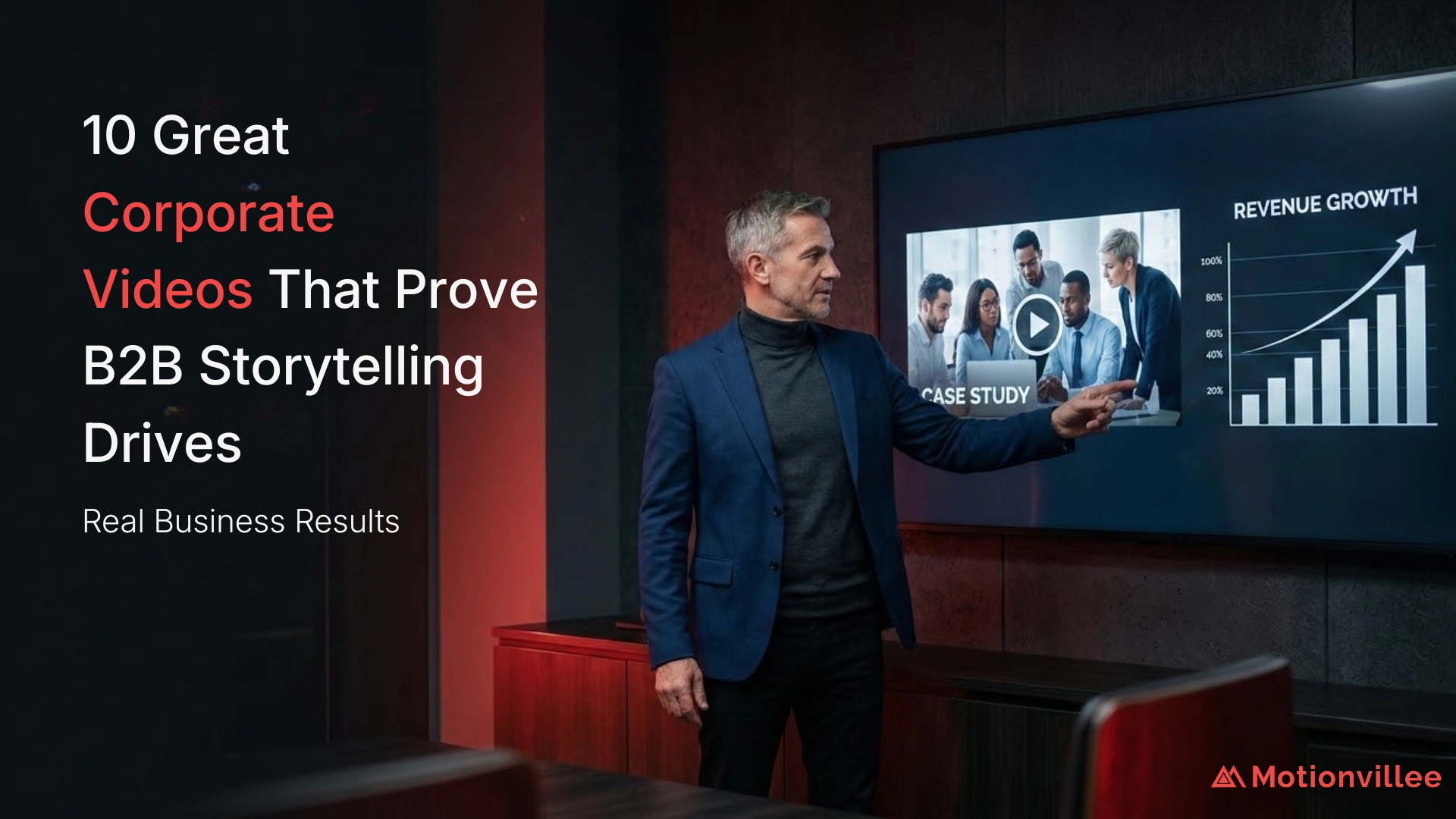
10 Great Corporate Videos That Prove B2B Storytelling Drives Real Business Results
Corporate videos used to be background noise. Sit through a 4-minute polished anthem, learn nothing about the actual product, click away. The companies that broke through did something different. They picked a real buyer problem, made it feel familiar, and showed exactly how their solution removed the friction.
The 10 corporate videos below are not the prettiest in the category. They are the ones that moved pipeline, generated demos, or rebuilt a brand’s place in the market. Each one is paired with a verified link so you can watch the storytelling at work, then borrow what fits your own buyer.
What makes a corporate storytelling video actually work for B2B?
The best B2B corporate videos solve one buyer problem in under three minutes, lead with a specific pain point, and end with a single action the viewer can take. Production polish matters less than buyer specificity. A video that names the exact problem a CMO or CFO is feeling on a Tuesday morning will outperform a four-minute brand anthem every time.
The pattern is consistent across the examples below. Open with recognition. Build the case in the middle. Close with one clear next step. That is the structure.
1. Motionvillee × Levo AI: Making API security feel obvious
Levo AI is one of Motionvillee’s clearest examples of how complex cybersecurity messaging can be made instantly understandable for technical buyers. The brief was tough. Levo AI sells automated API security to DevSecOps teams, and the category itself is dense with jargon. Most explainers in cybersecurity drown the buyer in acronyms before they ever get to the value.
The Motionvillee video does the opposite. It opens with the pain that engineering leaders already feel, the gap between speed of API releases and the slowness of manual security review. Then it shows how Levo AI closes that gap, scene by scene, using clean enterprise motion graphics that respect the technical viewer’s time.
Watch it here: Levo.ai Explained: Automated API Security
What stands out: the video never tries to teach API security. It assumes the buyer already knows the problem and focuses entirely on showing how the product fits into their workflow. That is the difference between a vendor pitch and a partner conversation.
Best for: B2B SaaS companies with complex, technical products that need to land with engineering or security buyers.
2. Slack: “So Yeah, We Tried Slack” and the case study that built a category
Slack’s 2014 launch video proved that B2B buyers respond to authenticity over polish, and the spot remains one of the most copied formats in software marketing. The setup was simple. The team at Sandwich Video, the actual production company hired to make Slack’s launch video, refused the brief at first because they thought “products like that never work.” Six months later, they had become loyal Slack users, and the video became a candid testimonial about how their workflow changed.
The video opens with founder Adam Lisagor reading the original email from Slack’s CEO with deadpan skepticism. Then it cuts to his team describing the chaos they used to live in. Email threads. Multiple chat apps. Meetings in the utility closet. By the time Slack enters the story, the viewer has already experienced the problem.
Watch it here: Slack: “So Yeah, We Tried Slack”
The video reached 1.3 million views on YouTube and helped Slack define the team communication category. The lesson for B2B marketers: the most effective explainers often look like documentaries, not commercials.
Best for: Software companies launching a new product or category where buyer skepticism is high.
3. IBM Watson × Bob Dylan: When a B2B brand picks the right voice
IBM’s 2015 “Outthink” spot with Bob Dylan made cognitive computing feel approachable to enterprise decision-makers without dumbing down the technology. The setup was unusual for B2B. Bob Dylan sits across from a laptop. Watson explains it has read all of Dylan’s lyrics and identifies the themes as “time passes and love fades.” Dylan, characteristically, says “that sounds about right.”
The genius of the ad is that it never explains what Watson does in technical terms. Instead, it shows a famously private artist engaging seriously with the technology, which signals to enterprise buyers that this is software worth taking seriously. The 30-second spot was part of a three-ad campaign that helped reposition IBM as an AI leader during a period when the category was still being defined.
Watch it here: IBM Watson: Bob Dylan on Language
The campaign showed that enterprise buyers do not need product feature lists. They need to see credible voices treat the technology as credible. That association does more for trust than any spec sheet.
Best for: Enterprise software brands in emerging or misunderstood categories.
4. Adobe Marketing Cloud: “Click, Baby, Click” and the power of a single insight
Adobe’s 2013 Super Bowl-era spot proved that B2B videos can use humor and tension to drive a serious sales conversation about marketing analytics. The story is simple. An old encyclopedia company sees a sudden spike in online orders. Production ramps up. Ships are loaded. Stock prices climb. Then the camera reveals what is actually driving the orders: a baby happily clicking the screen.
The single line at the end, “Do you know what your marketing is doing?”, is the entire pitch. Adobe was selling marketing analytics to CMOs who had spent the previous decade celebrating click metrics without understanding what those clicks actually represented.
Watch it here: Adobe: Click, Baby, Click
The video racked up over 4 million views on YouTube and remains a textbook example of how B2B brands can use storytelling to make an abstract product problem feel urgent. No software demo. No feature list. Just one uncomfortable question delivered through a 60-second sitcom.
Best for: Marketing and analytics platforms selling to decision-makers who think they already know what their data is telling them.
5. Mailchimp: “MailShrimp” and the campaign that turned brand confusion into reach
Mailchimp’s 2017 “Did You Mean Mailchimp?” campaign showed how B2B brands can use unexpected, off-brand storytelling to reach 334 million people without ever featuring the product. The campaign was born from a mispronunciation. In 2014, a podcast host called the brand “MailKimp,” and the meme stuck. Three years later, Mailchimp partnered with Droga5 to create nine fake brands that all sounded like the company name. MailShrimp was a short film about a singing shrimp sandwich.
The films had their own websites, YouTube channels, and product mockups. They never mentioned Mailchimp directly. The connection only revealed itself when curious viewers searched for what they had just watched, and Google asked “Did you mean Mailchimp?”
Watch it here: Mailchimp: MailShrimp
The campaign reached 334 million people, a 10x jump over Mailchimp’s previous best. For B2B marketers, the lesson is counterintuitive: sometimes the strongest brand story is one that does not look like brand marketing at all.
Best for: Established B2B brands that need to break out of category conventions to reach new buyer segments.
6. Workday: “Rock Star” and the value of saying the quiet part out loud
Workday’s 2023 Super Bowl spot used rock legends Ozzy Osbourne, Joan Jett, Paul Stanley, and Billy Idol to call out corporate cringe, and built one of the most-shared B2B ads of the year. The setup is direct. Paul Stanley turns to the camera and asks why corporate types insist on calling each other “rock stars.” Then real rock stars list what actually qualifies them for the title. Trashed hotel rooms. Crowd control. Decades of stage time.
The kicker lands when the legends grudgingly admit that yes, using Workday makes you great at your job. That does not make you a rock star.
Watch it here: Workday: Rock Star
The spot worked because it acknowledged the absurdity of HR and finance software marketing while still landing the product message clearly. Workday helps you do your job better. Nothing more. That honesty is rare in enterprise software advertising and is exactly why the ad got shared so widely.
Best for: Enterprise SaaS brands in saturated categories where buyer fatigue is real.
7. HubSpot: “I Choose To Grow Better” and the values-led brand video
HubSpot’s 2019 INBOUND video used a values-first narrative to reposition the brand from a marketing tool to a growth philosophy, anchoring the “Grow Better” tagline that still defines the company. The video opens with the assumption baked into most growth marketing, that you have to be ruthless, demand attention, and never put the phone down. Then it offers a different path. Growing better means putting customers first, building long-term relationships, and choosing the harder, more honest decisions.
There are no product screenshots in the video. No feature callouts. No demo footage. Instead, it is a statement of intent that the rest of HubSpot’s marketing has been built around.
Watch it here: HubSpot: I Choose To Grow Better
For B2B brands, the takeaway is that a strong value video can do work that product videos cannot. It tells the buyer what kind of company they would be partnering with, which is often the deciding factor in enterprise deals.
Best for: Established platforms looking to reposition their brand for an upmarket or enterprise audience.
8. Notion: “Make with Notion 2024” and the modern keynote as storytelling
Notion’s 2024 product keynote reframed software launches as cultural moments, drawing 100,000-plus live viewers and proving that B2B keynotes can be brand-building events. The video opens with founder Ivan Zhao on stage in San Francisco, walking through a series of product launches that include Notion Mail, Forms, Layouts, and an expanded Notion AI. The format borrows from Apple keynotes but adapts the language for builders, makers, and teams.
What makes the keynote work as corporate storytelling is the structure. Each product launch is framed against a specific user pain. Tool sprawl. Repeated copy-paste work. Information scattered across apps. Then Notion demos the fix in context, often with real customer footage.
Watch it here: Make with Notion 2024: Product Launch Keynote
The keynote model gives B2B brands a way to consolidate multiple product announcements into a single story arc. For SaaS companies with a steady release cadence, this format often delivers more pipeline impact than 10 separate feature videos.
Best for: B2B SaaS brands with active product roadmaps who want to turn launches into community moments.
9. Squarespace: “A Tale As Old As Websites” and the long-running brand bet
Squarespace’s 2025 Super Bowl spot with Barry Keoghan continued an 11-year cinematic streak, showing how B2B-adjacent brands can use consistent cinematic identity to compound brand recall over time. The video is set in an unspecified bygone Ireland. Barry Keoghan rides a donkey through rolling hills, tossing laptops to small business owners who suddenly realize they can take their craft online. The pitch is that Squarespace has been around for as long as the idea of putting a business online itself.
It is funny, well shot, and bizarre in exactly the way Squarespace’s Super Bowl ads have been since the brand started its Big Game streak in 2014. The point is not the individual ad. It is the cumulative recognition Squarespace has built by treating each Super Bowl appearance as part of one long story.
Watch it here: A Tale As Old As Websites
For B2B brands considering whether brand video work is worth the investment, Squarespace is the clearest case study. A decade of consistent cinematic identity has made the company instantly recognizable in a crowded category.
Best for: Brands that can commit to a multi-year storytelling investment and build brand equity through repetition.
10. Cisco: “The Bridge to Possible” and the power of a unifying brand idea
Cisco’s “Bridge to Possible” anthem united the company’s sprawling enterprise portfolio under one emotional throughline, giving sales teams and customers a shared story about what the brand stands for. Cisco sells across networking, security, collaboration, and infrastructure. That breadth makes brand storytelling hard. The anthem solves the problem by pulling back to a single human idea: every meaningful change starts with a connection, and Cisco builds those connections.
The video moves through workplaces, classrooms, hospitals, and even space, all tied together by a voiceover that reframes the company’s role as the bridge between what is hoped for and what becomes real. There are no product demos. No feature mentions. Just a position statement filmed at scale.
Watch it here: Cisco: The Bridge to Possible
For B2B brands with broad portfolios, a unifying brand anthem can do something product videos cannot. It gives every team in the company, from sales to support, a shared story to tell.
Best for: Enterprise brands with multiple product lines who need a single, cohesive brand narrative.
What the Strongest Corporate Videos Share in Common
Across these ten examples, four recurring patterns emerge that distinguish effective company corporate video content from forgettable productions:
Customer-centric narrative (problem before solution): Every successful video starts with the customer’s pain, not the vendor’s product. This approach positions the brand as an understanding partner rather than an eager seller.
Emotional resonance over feature recitation: The most memorable videos create feeling before they convey information. This is the fundamental principle that separates corporate video ideas that convert from those that collect dust.
Consistent brand voice from the first frame: Every frame, every transition, and every word choice should reinforce the brand’s identity. Teams interested in this principle can explore What Is Branded Video Production and Why B2B Companies Get It Wrong the First Time for a deeper look at common pitfalls and best practices.
Brevity and conceptual clarity (most under 90 seconds):
The strongest examples keep their runtime tight and their concept simple. Every second must earn its place in the narrative.
A Storytelling Framework for Your Next Company Video
For any organization ready to move from analysis to action, the following framework provides a practical starting point for developing a company video that drives measurable results:
Step 1: Identify the conflict (not the product). Begin by naming the problem your audience is struggling to solve. The conflict is the engine of the narrative.
Step 2: Cast the customer as the protagonist. The story should revolve around the buyer’s journey, not the vendor’s capabilities.
Step 3: Show transformation, not features. Demonstrate what success looks like after adopting the solution. Let the outcome speak for the product.
Step 4: Test for recall, not just views. Measure whether viewers remember the core message after 48 hours, not just whether they clicked play. Recall is the metric that correlates with pipeline impact.
For teams looking to move from inspiration to execution, Business Video Production: A Practical Guide for B2B Marketing Teams Who Want Results offers a comprehensive production playbook designed specifically for B2B marketing organizations.
The Competitive Advantage of Story-Driven B2B Brands
Organizations that invest in narrative-driven video are not just filling content calendars; they are building trust infrastructure. Every story told well becomes a reference point in a buyer’s evaluation process, and every story told poorly becomes a reason to scroll past.
The B2B brands that will lead in 2026 and beyond are those that treat storytelling as a measurable business discipline, not a creative afterthought. The data is clear: narrative-driven content converts at higher rates, retains attention longer, and builds the kind of brand trust that shortens sales cycles and wins competitive deals.
At Motionvillee, we partner with B2B marketing teams to develop video strategies rooted in narrative structure, audience insight, and business impact. If your next video initiative deserves more than a template, let us help you tell a story worth remembering.